Sunday, April 06, 2025
Lillebjørn Nilsen (1950-2024)
For the last week or so I've been revisiting Lillebjørn Nilsen and Andy Irvine's Live in Telemark CD, which I bought soon after it first came out in 2021 (original post here). I was enjoying it enough (again) to look up Lillebjørn Nilsen and see what he was up to these days, and now I find that not only is he dead, but that he died more than a year ago and that the news somehow escaped my notice. (So much for instant news and social media!)
Nilsen was a beloved and important figure in his native Norway, but he wasn't widely known outside of Scandinavia, so I can't really be surprised that virtually no English-language sources seem to have carried the news of his death. One exception is the NewsinEnglish.no website, which has a full obituary. Nilsen did have American connections, though; he apparently spent some time in Chicago, and memorialized it in this song, which (according to the Live in Telemark liner notes) is about a chance meeting in a pub with a fellow expatriate, a Norwegian au pair.
Nilsen was a fine singer, songwriter, and multi-instrumentalist. The Telemark concert with Andy Irvine was recorded in August 1994, and although Andy mentions having been very nervous, the performance captures their joy and comradeship as musicians whose backgrounds were different but whose temperaments and talents were congenial and complementary. Nilsen apparently stopped recording new material around that time, though he remained somewhat active. His health had reportedly declined in the years before his death. Live in Telemark can be ordered, in digital and CD versions, from Bandcamp. There is a brief documentary tribute to Nilsen (in Norwegian) here.
Saturday, March 22, 2025
Guy Fleming, Revisited
There is now a website (link here) dedicated to the life and work of Guy Fleming, the artist and book designer responsible for, among other things, the dust jacket art for the first American edition of One Hundred Years of Solitude. I was delighted to recognize some book art I hadn't realized was Fleming's, including this handsome trio of Willa Cather covers for Vintage Books.
In addition to his book jacket designs, the website features a bio of Fleming and reproductions of his paintings and other artworks.
Related post: "Guy Fleming Jackets."
Labels:
Art,
Dust jackets,
Guy Fleming
Monday, February 24, 2025
Stonewalking
I'm sure an oceanographer or geologist who had thought about the matter could come up with an explanation for why most of the stones on one stretch of beach would be rough and irregular while a few hundred yards away, just around a little rocky spit, there would be a collection of smooth and sometimes strikingly symmetrical cobbles, but I'm happy just to take it for granted. Some of these stones look like they could have been shaped by human hands; others look like bird's eggs (and you can see why some shore birds have evolved to lay eggs that look like stones).
After a stretch of cold weather and an accumulation of snow, yesterday the weather was fine and we went for a walk when the tide was out. A wide expanse of sandy flat came up from the water's edge, with a band of stranded seaweed at its upper margin, and then the ridge of stones where only the highest tides reach. I picked up a couple of the smaller and more perfect ones to bring home as paperweights or curios, but they were best appreciated in situ.
I spotted one well-worn brick that had undergone the same process as the natural cobbles and had long since lost any trace of the markings of its maker. And although most of the shapes were abstract, the stone below, which melded two different types of rock, reminded me of a ram's head in profile.
Eventually these stones will erode away or will be buried deep in the sand, never to be seen again, mixed in with twisted scraps of broken lobster pots, gull feathers, and the empty carapaces of crabs. But for now they seem to offer a quiet witness to something, though what it is isn't clear or lies beyond our ability to understand.
Labels:
Stones
Saturday, February 22, 2025
Ogreweed Day
Today marks the one hundredth anniversary of the birth of the artist and author Edward Gorey. As it happens, I can pinpoint my first encounter with Gorey's work quite exactly. It was June 1974, I was graduating from high school, and two friends and I went to a local stationery and book store in search of a collective teacher present for a woman who was not only a favorite teacher but also the mother of three friends of ours. (As it happens, I would later work in the same store, but that was several years in the future and another story.) We spotted an oversize book with an inscrutable title — Amphigorey — and upon opening it found a collection of amusing, vaguely Victorian drawings, mostly in black and white, accompanying a series of tales and rhymes, sometimes droll, sometimes sinister, but generally both. The book included an assortment of relatively clean limericks (some in French), an abecedarium cataloguing various horrible deaths suffered by small children, a poem narrating the abduction and ritual sacrifice of one Millicent Frastley at the hands of giant insects, a wordless, enigmatic story set in the west wing of an enormous mansion, and on and on. I at least had never encountered anything like it, nor had I heard of its creator. We bought the book and presented it, and as far as I know it was a success.
I didn't know at the time that Edward Gorey was a well-known figure in the book trade, that his slim individual volumes were avidly collected, and that he had illustrated children's books and created paperback book cover art for Anchor Books in its heyday. In time I would learn all that and come to keep an eye out for his distinctive style whenever I was browsing at a book sale or in a library. I saw him in the flesh at least twice, once browsing in the old Gotham Book Mart, with which he was closely associated, and once striding impassively up lower Fifth Avenue in his familiar fur coat, being cajoled by a young woman who was apparently assigned to capture him for a photo shoot. His theatre designs, his opening sequence for the old PBS Mystery! series, and his illustrations for Eliot's Old Possum's Book of Practical Cats would eventually bring him at least a modest bit of renown, but I don't think he cared much for any of that. He died in 2000 and his house on Cape Cod is now a museum dedicated to his work.
There isn't much, outside of Mexico perhaps, that can compare with Gorey for innocent delight in the macabre. There's no sadism in his work, but neither is there any tolerance for sentimentality or piousness. (Nor does he smirk.) If the Beastly Baby meets a beastly end (he explodes), that's only as it should be, and even the ghastly fate of inoffensive Millicent Frastley is more satisfying than disturbing. I don't think anyone who can appreciate Edward Gorey can ever be capable of real harm.
Every winter, when the nights get long, I break out a jigsaw puzzle of his book cover art. The silly title of this piece, by the way, is my feeble tribute to Gorey's fondness for anagrams of his name. I have, for instance, a little flip-book autographed by "Dogear Wryde."
I didn't know at the time that Edward Gorey was a well-known figure in the book trade, that his slim individual volumes were avidly collected, and that he had illustrated children's books and created paperback book cover art for Anchor Books in its heyday. In time I would learn all that and come to keep an eye out for his distinctive style whenever I was browsing at a book sale or in a library. I saw him in the flesh at least twice, once browsing in the old Gotham Book Mart, with which he was closely associated, and once striding impassively up lower Fifth Avenue in his familiar fur coat, being cajoled by a young woman who was apparently assigned to capture him for a photo shoot. His theatre designs, his opening sequence for the old PBS Mystery! series, and his illustrations for Eliot's Old Possum's Book of Practical Cats would eventually bring him at least a modest bit of renown, but I don't think he cared much for any of that. He died in 2000 and his house on Cape Cod is now a museum dedicated to his work.
There isn't much, outside of Mexico perhaps, that can compare with Gorey for innocent delight in the macabre. There's no sadism in his work, but neither is there any tolerance for sentimentality or piousness. (Nor does he smirk.) If the Beastly Baby meets a beastly end (he explodes), that's only as it should be, and even the ghastly fate of inoffensive Millicent Frastley is more satisfying than disturbing. I don't think anyone who can appreciate Edward Gorey can ever be capable of real harm.
Every winter, when the nights get long, I break out a jigsaw puzzle of his book cover art. The silly title of this piece, by the way, is my feeble tribute to Gorey's fondness for anagrams of his name. I have, for instance, a little flip-book autographed by "Dogear Wryde."
Labels:
Edward Gorey
Monday, January 27, 2025
Resurrecting Birds
The subject of my last post led me to anthropolgist Elizabeth Atwood Lawrence's 1997 book Hunting the Wren: Transformation of Bird to Symbol. In that book, which sadly is out of print, Lawrence does an outstanding job of tracing as much of the history of the wren hunt as can be reconstructed, and of exploring the dense symbolic networks surrounding it. She examines various latter-day interpretations of the practice in relation to totemism, the dying-and-resurrecting god motif, Christian iconography, and so on.
One of the most interesting aspects of the wren hunt is the suggestion that the "king of all birds" must be not only killed and paraded about but actually cooked and sacramentally eaten. (Some of the songs associated with the hunt make humorous declarations about the vast amount of food provided by the body of the tiny bird.) Although Lawrence doesn't discuss the Grimm Brothers' tale of "The Juniper Tree," which I briefly alluded to in my last post, this passage about the ritual cooking of the wren in a pot or pan immediately brought it to mind:
Another interesting case of the resurrection of a bird by eating it turns up in Peter Blegvad's song "Chicken," which describes how a man and a woman go for a walk carrying a chicken "in a gunnysack." After the man ("Frank") mysteriously disappears, the woman eats the chicken, gathers up the bones (accidentally overlooking one "finger bone"), and throws them down a well.
In a live performance of the song ( St. Ann’s Church, Brooklyn Heights, NY, March 14, 1992) Blegvad introduced it by reading from Sigmund Freud's discussion of the case of "Little Arpad," a young boy who was bitten on the penis by a chicken and thereafter developed an obsession with the bird. Blegvad did not, however, mention that (according to Peter Gay) Arpad reportedly also said "One should put my mother into a pot and cook her, then there would be a preserved mother and I could eat her."
One of the most interesting aspects of the wren hunt is the suggestion that the "king of all birds" must be not only killed and paraded about but actually cooked and sacramentally eaten. (Some of the songs associated with the hunt make humorous declarations about the vast amount of food provided by the body of the tiny bird.) Although Lawrence doesn't discuss the Grimm Brothers' tale of "The Juniper Tree," which I briefly alluded to in my last post, this passage about the ritual cooking of the wren in a pot or pan immediately brought it to mind:
[...] the wren is destroyed and dismembered but will be miraculously reborn. Through immersion in the cauldron the bird is resurrected, and with it those who partake of the ceremonial feast will be themselves renewed and reborn.For those unfamiliar with "The Juniper Tree," it concerns a little boy who is murdered by his stepmother, dismembered, and cooked into a stew that is fed to his unknowing father. The boy's half-sister, who has witnessed the dismemberment, gathers up the bones and sets them beneath the titular tree, out of which a brilliantly-plumed bird magically resurrects. The bird then sings a beautiful song, which it will only repeat if given a gift. After collecting a gold chain, a pair of red shoes, and a millstone, it bestows these gifts in turn on the father, the half-sister, and the stepmother (who is crushed by the stone). Interestingly, a gold chain turns up in one verse of one version of the wren song:
God bless the mistress of this house,Here it's the mistress, not the father, who receives the chain, but that wouldn't suit the narrative of "The Juniper Tree," since the mistress will receive a fatal punishment instead of a reward.
A golden chain around her neck,
And if she's sick or if she's sore
The Lord have mercy on her soul
Another interesting case of the resurrection of a bird by eating it turns up in Peter Blegvad's song "Chicken," which describes how a man and a woman go for a walk carrying a chicken "in a gunnysack." After the man ("Frank") mysteriously disappears, the woman eats the chicken, gathers up the bones (accidentally overlooking one "finger bone"), and throws them down a well.
She calls "Come back, Frank, and find your wife."
When the sack hits the water it comes to life
The woman takes the handle and she turns the crank
Up comes the bucket and there sits Frank
He says "There's only one thing I don't understand."
He says "Where's the little finger of my left hand?"
In a live performance of the song ( St. Ann’s Church, Brooklyn Heights, NY, March 14, 1992) Blegvad introduced it by reading from Sigmund Freud's discussion of the case of "Little Arpad," a young boy who was bitten on the penis by a chicken and thereafter developed an obsession with the bird. Blegvad did not, however, mention that (according to Peter Gay) Arpad reportedly also said "One should put my mother into a pot and cook her, then there would be a preserved mother and I could eat her."
Labels:
Folklore,
Peter Blegvad,
Wren
Sunday, January 19, 2025
The King of All Birds
Ideally I should have posted this on St. Stephen's Day (December 26th according to the Western Christian calendar), but the elements didn't come together until this week.
Back in December my wife and I went to our local music venue for a performance by two Irish-born musicians, John Doyle and Mick McAuley. The concert was billed as "An Irish Christmas" and was accompanied by a CD entitled This Christmas Time. At one point early on in the evening one of the two men (I think it was John Doyle) joked that birds were going to be mentioned in every song that night, and while this didn't turn out to be literally the case there were in fact two notable songs about wrens, specifically, about the Eurasian wren (Troglodytes troglodytes), which we don't have here.
The first song, "Gleann na n-Éan," was a Doyle original, although the story it tells dates back at least to Plutarch (who attributed it to Aesop). The birds gather to choose a king, the crown to be awarded to the bird that can fly highest. The boastful eagle outlasts all the other contestants, but just as he proclaims his triumph the wren, who had ridden to the top concealed on his back, proclaims that he in fact is the highest.
The status of the wren (or in some cases the similarly sized goldcrest, which sports a gold "crown") as king of the birds persisted through the Middle Ages, and a peculiar custom developed of ritually killing a wren every year on St. Stephen's Day, parading it through town on a pole, and begging for money to pay for its interment. The second wren song performed that evening was thus a version of the ditty that was traditionally sung as the procession moved from door to door. (The practice of ritually killing a king at the end of each year did not go unnoticed by Frazer in The Golden Bough). The custom still persists in parts of Ireland, although thankfully no actual birds are now harmed.
Those two songs were still in my head when I came to the crossword puzzle in the New York Times for January 18th, where I found this clue:
48 Across: Avian symbol of good fortune in Celtic cultureIt didn't take me long to fill in the four letters of the bird's name. And then I remembered another curious appearance of the Eurasian wren, in Elizabeth Hand's story "Pavane for a Prince of the Air" (from Saffron and Brimstone) which is set in Maine. Hand's tale follows the terminal illness and eventual death of a man named Cal, an old friend of the narrator. After Cal dies and is cremated, his grief-stricken wife and the narrator sift through his uncrushed ashes, picking out fragments of bones and the remains of trinkets that had been placed in the coffin. When they're done they go outside and shake out the sheet bearing the fine particles that are left behind. (The story makes explicit reference to "The Juniper Tree," where the bones of a murdered child are gathered up and placed beneath a tree, only to return to life in the form of a brilliant bird.) While the widow travels the world, scattering portions of Cal's ashes and seeking his next incarnation, it is to the narrator that the title "prince" or king seems to reappear, in the form of a bird not found in Maine at all.
Still, the bird is here. I researched it online, and in some books of folklore I have, and learned that the European wren is the bird that was the subject of the annual wren hunt, an ancient pre-Christian ritual of death and resurrection, still practiced in obscure parts of Ireland and the Isle of Man. It is a creature known for its cheer and its valor, its bravery suiting a bird of far greater size; and also for its song, which is piercingly sweet and flutelike, carrying for miles on a clear day.As the narrator continues to write at her desk, the bird watches her work. The story concludes:
It sings, day after day after day, and sometimes into the night as well. I never cease to marvel at the sound.
Labels:
Elizabeth Hand,
Folklore,
Ireland,
John Doyle,
Mick McAuley,
Music,
Wren
Wednesday, January 08, 2025
Logbook: Porcupines
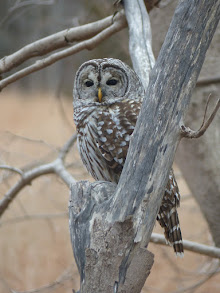
Moving to Maine has meant, among many other things, crossing into the range of the North American porcupine. We didn't see much of them for the first year, except in the form of roadkill, but this winter they've been very evident. I spotted the adult above high up in a pine tree in a little wood, and at first mistook it for an owl (which we also have here). With some difficulty I managed to get underneath it and take some photos; the animal undoubtedly knew I was there but showed no reaction.
The juvenile below showed up on the side of a mostly unused dirt road one day and lingered in the same spot for the three or four succeeding days. Porcupines may be slow to sense the presence of another creature, even one walking a dog on a leash, but eventually this one would move off. There may be sillier sights on earth than a juvenile porcupine waddling across a dirt road, but there can't be many.
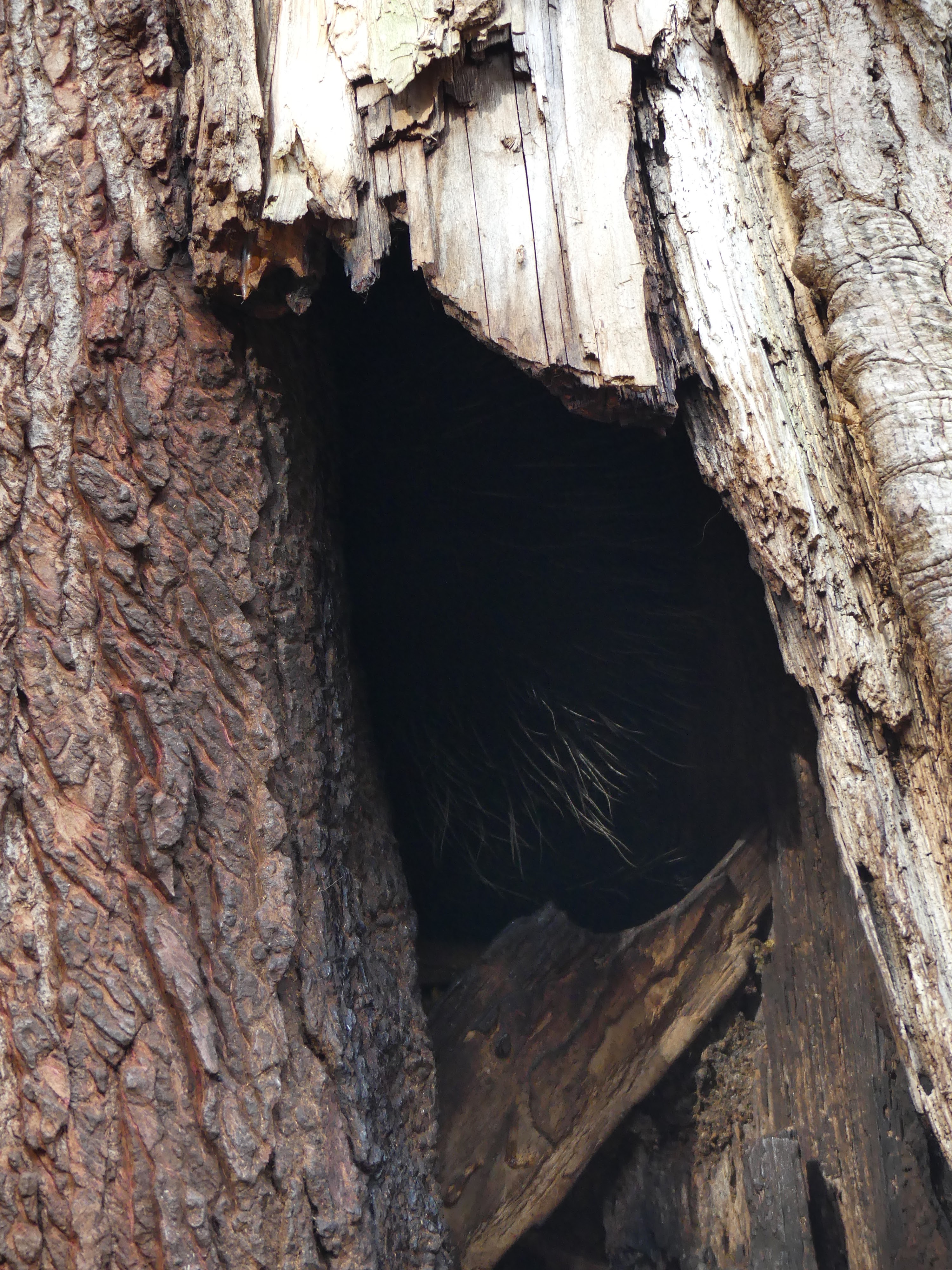
In another location, probably far enough away to represent a different territory, I've been keeping an eye on an active den in a dead tree, which judging from the depth of the pile of porcupine droppings around it has probably been in use for some time. Porcupines will den up together, so it's hard to say how many occupants this one may have, but by getting a bit closer I can see that there's definitely at least one.
The juvenile below showed up on the side of a mostly unused dirt road one day and lingered in the same spot for the three or four succeeding days. Porcupines may be slow to sense the presence of another creature, even one walking a dog on a leash, but eventually this one would move off. There may be sillier sights on earth than a juvenile porcupine waddling across a dirt road, but there can't be many.
In another location, probably far enough away to represent a different territory, I've been keeping an eye on an active den in a dead tree, which judging from the depth of the pile of porcupine droppings around it has probably been in use for some time. Porcupines will den up together, so it's hard to say how many occupants this one may have, but by getting a bit closer I can see that there's definitely at least one.
Thursday, January 02, 2025
The Monster (Charles Dickens)
On a dreary afternoon, Harriet Carker pauses from her needlework to gaze at the scene outside her window.
She often looked with compassion, at such a time, upon the stragglers who came wandering into London, by the great highway hard by, and who, footsore and weary, and gazing fearfully at the huge town before them, as if foreboding that their misery there would be but as a drop of water in the sea, or as a grain of sea-sand on the shore, went shrinking on, cowering before the angry weather, and looking as if the very elements rejected them. Day after day, such travellers crept past, but always, as she thought, in one direction—always towards the town. Swallowed up in one phase or other of its immensity, towards which they seemed impelled by a desperate fascination, they never returned. Food for the hospitals, the churchyards, the prisons, the river, fever, madness, vice, and death—they passed on to the monster, roaring in the distance, and were lost.
Dombey and Son
Labels:
Charles Dickens,
City
Wednesday, January 01, 2025
Resolutions for a New Year
(Since a certain public figure is distasteful to me, I refuse to refer to him by name. We all know who "he" is.)
Do something he wouldn't do.
Be something he isn't, and know something he'll never know.
Read something he'll never read. (That one is easily accomplished.)
Listen to music he'll never have the joy of. (Bonus points for live music.)
Care about something.
Care for someone.
Live in the real world.
Slow down. Unplug.
Go somewhere on foot. Look around.
Cook something from scratch.
Do something for the hell of it.
Live in spite of.
Tell the truth. Don't believe bullshit. Know the difference.
Know thyself.
Forget nothing.
Take the long view.
Don't expect things.
Do something he wouldn't do.
Be something he isn't, and know something he'll never know.
Read something he'll never read. (That one is easily accomplished.)
Listen to music he'll never have the joy of. (Bonus points for live music.)
Care about something.
Care for someone.
Live in the real world.
Slow down. Unplug.
Go somewhere on foot. Look around.
Cook something from scratch.
Do something for the hell of it.
Live in spite of.
Tell the truth. Don't believe bullshit. Know the difference.
Know thyself.
Forget nothing.
Take the long view.
Don't expect things.
Saturday, December 21, 2024
"Class Card"
Michael Leddy of Orange Crate Art has asked about the words "class card" in the Arthur Crudup recording embedded in my last post. (Some people may hear "draft card," but I don't think that's what he sings.) The entire line in which those words are found has caused problems. One version of the lyrics has the following:
Well, I got my quiet canary, my class card, tooAnother has:
My baby's wonderin', lord, now what am I to do?
Well, I got my white canary, my class card, tooIt's clear to me, however, that Crudup isn't singing about a canary, quiet or white or otherwise; the word is "questionnary," that is, "questionnaire," and that's reinforced by the fact that Crudup has another blues ("Give Me A .32-20," sometimes called "Questionnaire Blues") that opens with the following lines:
My baby's wondering Lord now what am I to do?
I've got my questionnaire, and they needs me in the warHere again Crudup distinctly adds an extra syllable to "questionnaire."
I've got my questionnaire, and they needs me in the war
Now if I feel murder, don't have to break the county law
The "questionnaire" Crudup refers to is presumably the document authorized in 1948 by President Harry Truman in Executive Order 9988. This "Classification Questionnaire" (SSS Form No. 100) was sent to potential draftees in order to determine their eligibility for concription. (There may have been earlier versions.) And Crudup's "class card" was probably the "Notice of Classification," which was one of the two "draft cards" issued by the Selective Service System, the other being a "Registration Certificate."
Sources:
Executive Order 9988—Prescribing Portions of the Selective Service Regulations
Selective Service System: Draft Cards
Labels:
Blues
Friday, December 20, 2024
The Wisdom of the Burrowers
Anthony J. Martin, from the author's website:
Arthur Crudup:
Burrows are a refuge from predators, a safe home for raising young, or a tool to ambush prey. Burrows also protect animals against all types of natural disasters: fires, droughts, storms, meteorites, global warmings―and coolings. On a grander scale, the first animal burrows transformed the chemistry of the planet itself many millions of years earlier, altering whole ecosystems. Many animal lineages alive now―including our own―only survived a cataclysmic meteorite strike 65 million years ago because they went underground.The Evolution Underground: Burrows, Bunkers, and the Marvelous Subterranean World Beneath Our Feet
Arthur Crudup:
Labels:
Blues,
Evolution,
Natural history
Thursday, December 05, 2024
Flight (Eduardo Halfon)
Libros del Asteroide in Barcelona has released the seventh in a series of slim, elegant volumes by the writer Eduardo Halfon. Like the others, Tarántula explores in quasi-fictional form the complicated matter of being a Guatemalan-born secular Jew and descendent of Holocaust survivors.
Born in Guatemala in 1971, Halfon left the country as an adolescent when his family fled political turmoil there and resettled in Florida, where he temporarily adopted English as his preferred language. (He now writes in Spanish, but is apparently fully bilingual or more likely multilingual.) When he was thirteen, the narrator of Tarántula, who is also named Eduardo Halfon, was sent back to Guatemala, along with a younger brother, in order to attend a camp that taught survival skills, or, more pointedly, survival skills for Jews. The experience soon took a dark turn, and Halfon took to his heels, hiding in the countryside until he came across a sympathetic campesina. The book relates how, years later, he encountered a female fellow-camper and, eventually, had a confrontational meeting with the former director of the camp, a man with apparent ties to shadowy security organizations.
Eduardo Halfon has described how an interviewer once asked him, provocatively, which two books that he had not read had influenced him the most. In response, equally provocatively, he cited the Torah and the Popol Vuh, the latter being the foundational mythological scripture of Guatemalan indigenous culture.
Tarántula is so far only available in Spanish (and several European languages), but an English-language edition is planned. The text of the above excerpt is available in English at the website of Tablet magazine.
Born in Guatemala in 1971, Halfon left the country as an adolescent when his family fled political turmoil there and resettled in Florida, where he temporarily adopted English as his preferred language. (He now writes in Spanish, but is apparently fully bilingual or more likely multilingual.) When he was thirteen, the narrator of Tarántula, who is also named Eduardo Halfon, was sent back to Guatemala, along with a younger brother, in order to attend a camp that taught survival skills, or, more pointedly, survival skills for Jews. The experience soon took a dark turn, and Halfon took to his heels, hiding in the countryside until he came across a sympathetic campesina. The book relates how, years later, he encountered a female fellow-camper and, eventually, had a confrontational meeting with the former director of the camp, a man with apparent ties to shadowy security organizations.
Eduardo Halfon has described how an interviewer once asked him, provocatively, which two books that he had not read had influenced him the most. In response, equally provocatively, he cited the Torah and the Popol Vuh, the latter being the foundational mythological scripture of Guatemalan indigenous culture.
When I mentioned to a friend this bizarre question-and-answer exchange with the Spanish journalist, she asked me why I didn’t just read both books now? Why did I still doggedly insist on not reading them? And I told her, with as much gravitas as I could muster, that if I did read them now I’d undoubtedly explode.Halfon's declaration may or may not be strictly accurate; for one thing, he has provided a blurb for an illustrated edition of the Popul Vuh created by Ilan Stavans (a fellow Latin American writer of Jewish ancestry). Nevertheless, the powerful centripetal and centrifugal forces of influence and flight run through all of his work.
The truth, however, is that I don’t feel I need to. I already carry both of them with me, written somewhere inside me. The book of the Jews and the book of the Guatemalans, if I’m allowed that oversimplification, and if I can call books those two monumental works that represent and define my two worlds—the two great columns upon which my house is built. But a house that for some reason, ever since childhood, I needed to destroy or at least abandon. I can’t explain why I always felt that way, as if something was forcing me to run off and disappear.
I’ve spent an entire lifetime running away from home.
Tarántula is so far only available in Spanish (and several European languages), but an English-language edition is planned. The text of the above excerpt is available in English at the website of Tablet magazine.
Labels:
Eduardo Halfon,
Guatemala,
Jewish
Sunday, November 24, 2024
Haystacks (Martin Johnson Heade)
According to the art historian Theodore E. Stebbins, the American painter Martin Johnson Heade (1819-1904) devoted more than 120 canvases to portrayals of the salt marshes of the northeastern coast of the United States. He also painted still-lifes, tropical flowers, hummingbirds, and a few portraits, but no subject received his obsessive devotion as did these coastal scenes. There is something hypnotic about them, individually and, especially, when viewed as a series of variations on a theme. The paintings are not large — Stebbins says few are more than 15 x 30 inches.
It's the stacks of salt hay that really set the pictures apart, the way their otherwordly forms — half mushroom, half alien landing-craft — form a middle element between the vastnesses of sky and marsh and the tiny human figures who seem much too insignificant to have built them. The weather, the time of day, and the details of the topography vary from canvas to canvas, but there is a haunting stillness to them all.
Saturday, November 09, 2024
Crows (Sarah Orne Jewett)
From A Marsh Island:
Update: Is it in fact "a gremlin"? I haven't been able to find out whether Heade actually used that word in referring to this painting; most sources indicate that it wasn't coined until after he died.
It was a famous day for crows: from one field after another a flight of them took heavily to their wings, and, as if unwillingly, mounted to the higher air. They cawed loudly, and appeared to have business of a public nature on hand. Some were migrating, and others were contemptuously rebuking these wanderers, and making their arrangements to winter in their familiar woods: it was all a great chatter and clatter and commotion. The affairs of human beings were but trivial in comparison. Helpless creatures, who crept to and fro on the face of the earth, and were drawn about by captive animals of lesser intellect, were not worth noticing, and the great black birds sailed magnificently down the sky, with the fresh breeze cool in their beaks and the sunlight shining on their sombre wings. Whatever might be said of their morals, they were masters of the air, and could fly, while men could not.I liked the cover art on this University of Pennsylvania edition of Jewett's novel, but I didn't immediately get it, in part because some elements on my copy are obscured by librarian's tape. It's a cropped version of a painting by Martin Johnson Heade (1819-1904) entitled Gremlin in the Studio I, and the round object in the left, just below the painting-in-a-painting, is in fact a gremlin. Harder still to notice is that water is flowing out of the marsh depicted in the upper canvas and onto the studio floor.
Update: Is it in fact "a gremlin"? I haven't been able to find out whether Heade actually used that word in referring to this painting; most sources indicate that it wasn't coined until after he died.
Saturday, October 26, 2024
Harris for President
Since I have no billion-dollar media empire to protect, and since hardly anyone listens to me anyway, I have no hesitation in endorsing Kamala Harris and Tim Walz for president and vice-president in the 2024 election. That many millions of my fellow citizens see things differently speaks volumes about the current state of American political culture (bad) and about the open wounds of American history (unhealed, and probably unhealable), but doesn't alter my opinion. A lie is a lie, no matter how often repeated and spread about, and, bluntly put, everything that comes out of the mouth of the Republican candidates is a lie. I find little point in arguing with those who still refuse, or are unable, to understand the danger. There is no grey area; to quote Peter Case, this is "the fork in the road where we all have to choose."
We have a long, sad history in the United States of failing to do the right thing; somehow we have muddled through, more or less. A similar failure now may be more difficult to overcome. We can only hope that historians of the future — if the honest study of history survives — will not find in our actions rich cause for condemnation.
Labels:
Politics
Saturday, October 19, 2024
Notes for a Commonplace Book (31)
Gillian Welch:
About a month ago, my eye was drawn to a book that has sat mostly unread on my shelf for some time, ‘The Book of Disquiet’ by Fernando Pessoa. I picked it up and randomly read a passage of such beautiful poignancy, such exquisite human precision, that the wonderment of creative expression flooded me. I told no one about it, but kept it to myself, and the impulse to write, the need to grapple with this moment has returned to me and grown from that little seed.
(From a 2020 interview with Hanif Abdurraqib)
Friday, October 18, 2024
Woodland (Gillian Welch & David Rawlings)
For whatever reason I've been listening to Gillian Welch a lot the last few weeks, and as it turns out she has a new record that has just been released. Woodland is officially credited to Welch and her longtime partner David Rawlings, probably because he takes lead vocals on a few tracks, but in any case their work has always been a collaboration.
I took a spin today to run some errands on a beautiful fall New England afternoon and put the new CD in the drive, this being probably the last car we'll ever own that has that capability. It's a pretty impressive record. Gillian's vocals are as good as ever and David's maybe better, the songs are interesting, and the instrumental textures are just gorgeous. Below is a sample track:
Woodland is available from Gillian and David's own Acony Records, as well as, of course, the usual sources.
I took a spin today to run some errands on a beautiful fall New England afternoon and put the new CD in the drive, this being probably the last car we'll ever own that has that capability. It's a pretty impressive record. Gillian's vocals are as good as ever and David's maybe better, the songs are interesting, and the instrumental textures are just gorgeous. Below is a sample track:
Woodland is available from Gillian and David's own Acony Records, as well as, of course, the usual sources.
Labels:
Gillian Welch
Tuesday, October 08, 2024
Lore Segal (1928-2024)
The writer Lore Segal has died; the New York Times has an obituary. Two of Segal's novels have been on and off my to-read list for years, though I confess that I've never quite gotten around to them; I'm putting Other People's Houses and Her First American back at the top of the queue. What I have read, and re-read often, are her brilliant translations from the Brothers Grimm collected in The Juniper Tree and Other Tales from Grimm with the delicious illustrations by Maurice Sendak. Segal was without peer in being able to capture both the lyrical beauty of the tales and their sinister horror, as in the refrain from the title tale, which I believe I first heard on the radio in the 1970s.
My mother she butchered me,
My father he ate me,
My sister, little Ann Marie,
She gathered up the bones of me
And tied them in a silken cloth
To lay under the juniper.
Tweet twee, what a pretty bird am I!
Thursday, September 26, 2024
Findings (1)
Description of Item: Cash register receipt, La Fabrique de Bagel de Montréal
Origin and Date of Item (if known): Montreal, Canada, August 8, 2024, 9:58 AM
Where and When Found: Portsmouth, New Hampshire, September 2024
Circumstances of Finding: Tucked into a library book (Edward P. Jones: The Known World)
Condition of Item: Slightly wrinkled; no evidence of folding or food stains
Analysis: Given that the item is unfolded and of no evident value, it was probably placed in the book at the time of issuance and used as a bookmark. Since the book belongs to a US library it (the book) has therefore crossed the US-Canada border twice. We interpret "sdw dejeuner" as meaning "breakfast sandwich." Two drinks, a sandwich, and a bagel were purchased, so there were probably two patrons traveling together, perhaps a Portsmouth couple on vacation. Only one of the "carrés assortis" was purchased.
Origin and Date of Item (if known): Montreal, Canada, August 8, 2024, 9:58 AM
Where and When Found: Portsmouth, New Hampshire, September 2024
Circumstances of Finding: Tucked into a library book (Edward P. Jones: The Known World)
Condition of Item: Slightly wrinkled; no evidence of folding or food stains
Analysis: Given that the item is unfolded and of no evident value, it was probably placed in the book at the time of issuance and used as a bookmark. Since the book belongs to a US library it (the book) has therefore crossed the US-Canada border twice. We interpret "sdw dejeuner" as meaning "breakfast sandwich." Two drinks, a sandwich, and a bagel were purchased, so there were probably two patrons traveling together, perhaps a Portsmouth couple on vacation. Only one of the "carrés assortis" was purchased.
Labels:
Findings
Notes & Queries (Zelia Nuttall)
"Paean" isn't exactly an everyday word, but it's amusing to find it being confused with an even more obscure word, one that is new to me. Merilee Grindle:
That minor error aside, Grindle's book is a fine piece of work, illuminating the colorful life and notable accomplishments of a pivotal figure in the transition between archaeology and anthropology as pursuits for wealthy amateurs and archaeology and anthropology as the domain of university-trained scholars.
Like the Chicago World's Fair, the [San Francisco] exposition of 1915 was a paeon to the technological, industrial, creative, and colonial achievements of the United States.According to Merriam-Webster, a "paeon" is "a metrical foot of four syllables with one long and three short syllables (as in classical prosody) or with one stressed and three unstressed syllables (as in English prosody)." It is sometimes confused with the far more common "paean," which is "a joyous song or hymn of praise, tribute, thanksgiving, or triumph."
In the Shadow of Quetzalcoatl: Zelia Nuttall and the Search for Mexico's Ancient Civilizations
That minor error aside, Grindle's book is a fine piece of work, illuminating the colorful life and notable accomplishments of a pivotal figure in the transition between archaeology and anthropology as pursuits for wealthy amateurs and archaeology and anthropology as the domain of university-trained scholars.
Labels:
Archaeology,
Notes
Subscribe to:
Comments (Atom)