Eventually it diverged from the trail but stopped for a moment, perhaps to register my presence before resuming its travels.
Showing posts with label Porcupine. Show all posts
Friday, September 12, 2025
Logbook: Porcupines (2)
When I was out walking yesterday morning in one of my regular haunts, keeping an eye out for the deer and rabbits I often see if I arrive first before someone else has spooked them, I heard a rustling just off the trail and spotted a large porcupine with a beautiful dark coat. I was having camera trouble, and while I was fumbling with the zoom lens, trying to get it to co-operate, I figured the creature would note my presence and get itself out of sight. But porcupines have their own agendas, and also aren't very perceptive — they don't really need to be — and soon this one ambled out of the brush directly in front of me and went for a stroll down the middle of the trail for several hundred feet while I followed a few yards back. It only quickened its pace when it came under some hickory trees where some squirrels were chewing up husks and raining the remnants onto anyone or anything passing by.
Eventually it diverged from the trail but stopped for a moment, perhaps to register my presence before resuming its travels.
Wednesday, January 08, 2025
Logbook: Porcupines
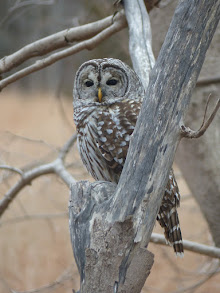
Moving to Maine has meant, among many other things, crossing into the range of the North American porcupine. We didn't see much of them for the first year, except in the form of roadkill, but this winter they've been very evident. I spotted the adult above high up in a pine tree in a little wood, and at first mistook it for an owl (which we also have here). With some difficulty I managed to get underneath it and take some photos; the animal undoubtedly knew I was there but showed no reaction.
The juvenile below showed up on the side of a mostly unused dirt road one day and lingered in the same spot for the three or four succeeding days. Porcupines may be slow to sense the presence of another creature, even one walking a dog on a leash, but eventually this one would move off. There may be sillier sights on earth than a juvenile porcupine waddling across a dirt road, but there can't be many.
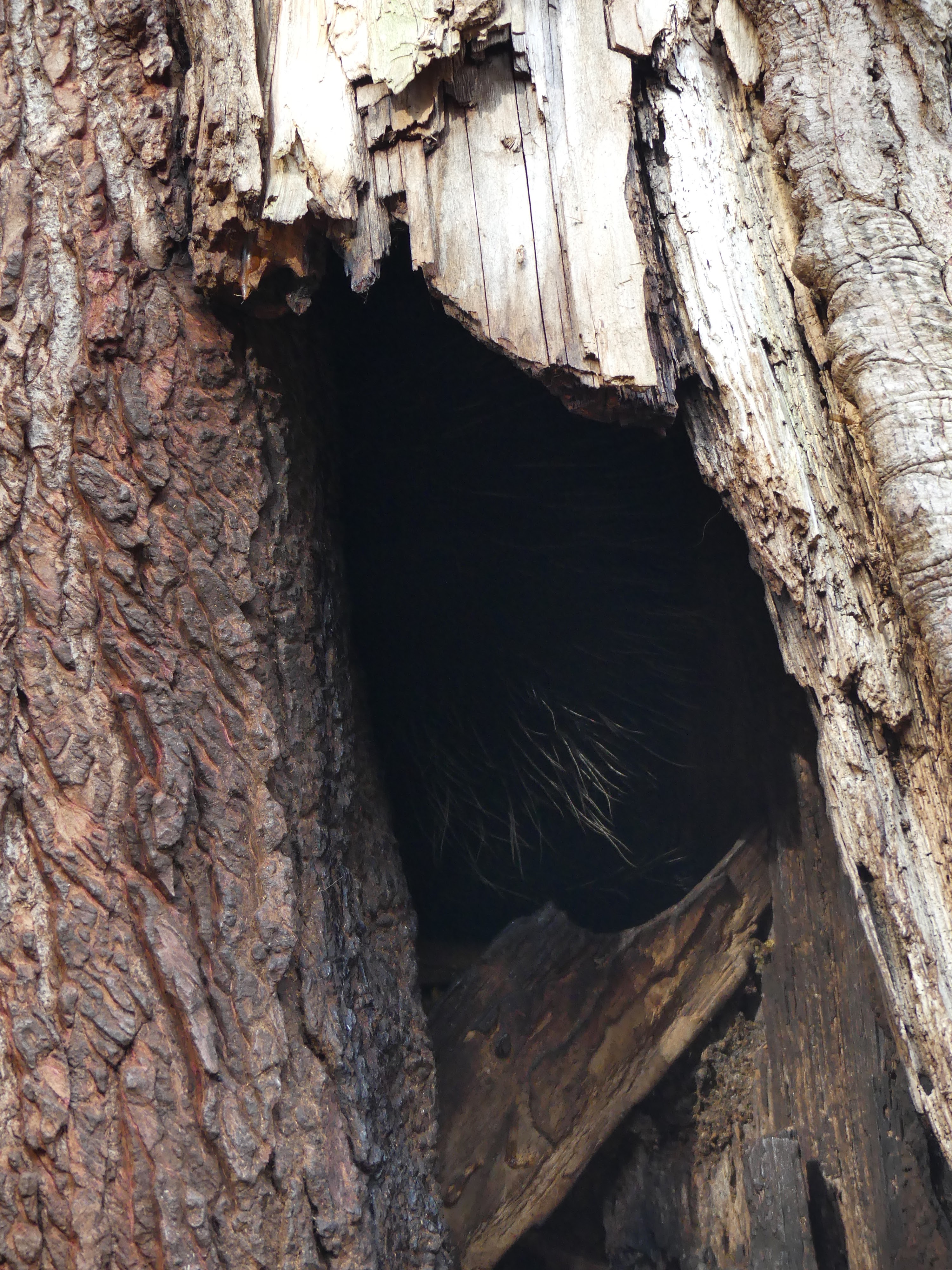
In another location, probably far enough away to represent a different territory, I've been keeping an eye on an active den in a dead tree, which judging from the depth of the pile of porcupine droppings around it has probably been in use for some time. Porcupines will den up together, so it's hard to say how many occupants this one may have, but by getting a bit closer I can see that there's definitely at least one.
The juvenile below showed up on the side of a mostly unused dirt road one day and lingered in the same spot for the three or four succeeding days. Porcupines may be slow to sense the presence of another creature, even one walking a dog on a leash, but eventually this one would move off. There may be sillier sights on earth than a juvenile porcupine waddling across a dirt road, but there can't be many.
In another location, probably far enough away to represent a different territory, I've been keeping an eye on an active den in a dead tree, which judging from the depth of the pile of porcupine droppings around it has probably been in use for some time. Porcupines will den up together, so it's hard to say how many occupants this one may have, but by getting a bit closer I can see that there's definitely at least one.
Tuesday, August 27, 2024
Pioneers
The development where we live now is a relatively new one, and there are patches of recently disturbed "vacant" ground dotted around its periphery. In particular, there's a knoll out our back window that was scraped and reshaped by earth-moving machinery just last year. In one growing season it has gone from bare earth to a thriving and complex meadow ecosystem. A cover crop may have been broadcast for erosion control, but most of what has sprouted up appears to have arisen from seeds that lay dormant in the ground for months or years, awaiting an opportunity to germinate.
My unscientific survey finds, just beyond our walls, Queen Anne's lace, yarrow, great mullein, hare's-foot clover and several other clovers, crown vetch, purple vetch, and bird's-foot trefoil, various grasses, fireweed (Erechtites hieraciifolius), asters and goldenrods (probably several species of both), boneset (which a worried neighbor mistook for poison hemlock), thistles, and evening-primrose. Down an adjoining embankment, where there has been growth for a longer period, there are cattails and phragmites, blackberry brambles, pokeweed, whorled and purple loosestrife, and agalinis. That's not counting the ones I haven't noticed or can't identify. A healthy percentage of these plants are so-called "aliens" that weren't part of the precolumbian landscape of North America but have long since become naturalized.
An even less scientific survey turns up a host of insects, notably various dragonflies, bees, wasps, beetles, and a scattering of butterflies (but few swallowtails and monarchs, perhaps because the milkweeds haven't yet appeared). There are orb-weavers and other spiders, and unfortunately ticks as well. We've had regular visits from wild turkeys and deer and occasional sightings of coyotes, groundhogs, and skunks. One evening we spotted a porcupine browsing unhurriedly and almost invisibly among the clumps of herbage. Earlier in the summer there were woodcocks buzzing and courting at dusk, and goldfinches, bluebirds, hummingirds, and mourning doves have been abundant. We hear owls often, and no doubt they hunt for voles and other small mammals as soon as the sun goes down.There is certainly far more that we don't see than what we do.
A dirt road leading out of the back of the development has been widened and graded in the last few weeks, and further construction is expected. No doubt the resident and transient flora and fauna will be in flux for some time. But it's astonishing how quickly and vigorously life can seize hold, given half a chance.
My unscientific survey finds, just beyond our walls, Queen Anne's lace, yarrow, great mullein, hare's-foot clover and several other clovers, crown vetch, purple vetch, and bird's-foot trefoil, various grasses, fireweed (Erechtites hieraciifolius), asters and goldenrods (probably several species of both), boneset (which a worried neighbor mistook for poison hemlock), thistles, and evening-primrose. Down an adjoining embankment, where there has been growth for a longer period, there are cattails and phragmites, blackberry brambles, pokeweed, whorled and purple loosestrife, and agalinis. That's not counting the ones I haven't noticed or can't identify. A healthy percentage of these plants are so-called "aliens" that weren't part of the precolumbian landscape of North America but have long since become naturalized.
An even less scientific survey turns up a host of insects, notably various dragonflies, bees, wasps, beetles, and a scattering of butterflies (but few swallowtails and monarchs, perhaps because the milkweeds haven't yet appeared). There are orb-weavers and other spiders, and unfortunately ticks as well. We've had regular visits from wild turkeys and deer and occasional sightings of coyotes, groundhogs, and skunks. One evening we spotted a porcupine browsing unhurriedly and almost invisibly among the clumps of herbage. Earlier in the summer there were woodcocks buzzing and courting at dusk, and goldfinches, bluebirds, hummingirds, and mourning doves have been abundant. We hear owls often, and no doubt they hunt for voles and other small mammals as soon as the sun goes down.There is certainly far more that we don't see than what we do.
A dirt road leading out of the back of the development has been widened and graded in the last few weeks, and further construction is expected. No doubt the resident and transient flora and fauna will be in flux for some time. But it's astonishing how quickly and vigorously life can seize hold, given half a chance.
****
Many of the plant species mentioned above, as well as their faunal associates, are profiled by John Eastman in The Book of Field and Roadside: Open-Country Weeds, Trees and Wildflowers of Eastern North America (2003). Like its companions The Book of Forest and Thicket and The Book of Swamp and Bog it is illustrated with line drawings by Amelia Hansen, and was published by Stackpole Books; all three volumes now seem to be out of print.
Monday, February 19, 2024
Prickly issues
The poet Donald Hall was born and raised in suburban Connecticut, but he spent many of his summers at his maternal grandparents' farm in New Hampshire in the 1930s and '40s, an experience he recollected in a memoir entitled String Too Short to Be Saved. Though he was capturing a disappearing way of life, and remembering it fondly, he largely avoided the lure of nostalgia. There are golden afternoons spent haying and tending chickens in the book, but there is also alcoholism, mental illness, and suicide among the neighbors. He would later own up to embellishing a bit; in a reprint he confessed that the abandoned railroad on Ragged Mountain that he described didn't actually exist. It was another passage in the book, though, that initially perplexed me. Hall describes a day on the farm in the company of his grandfather:
As any naturalist can tell you, there are no wild hedgehogs in New England or anywhere in the Americas, nor do they readily climb trees (pace Maurice Sendak), nor are they considered agricultural pests (though they were once popularly thought to suckle milk from cows). There are, of course, porcupines, but no one who had grown up in New England (and was later educated in part in the UK, where there are hedgehogs), would be likely to confuse the two. So what gives?
As it turns out, Hall was simply following vernacular tradition. Although "porcupine" (unlike "opossum" and "skunk") is a European word dating to the Middle Ages, few English colonists to New England would have ever seen an Old World porcupine, as the closest ones live in Italy, and faced with a spiny creature they simply borrowed the familiar name "hedgehog." The usage was common enough to have been written into law; as late as the early twentieth century the state of New Hampshire was paying bounties for killing "hedgehogs." The bounty was repealed in 1979, by which time the word had been corrected to "porcupines."
Another word for hedgehog is "urchin," from Latin ericius (see Spanish erizo, French hérisson). Today that word refers to a street waif, but its original meaning is preserved in the name for the spiny echinoderms known as "sea urchins."
Image: "Hans My Hedgehog," from The Juniper Tree.
We walked slowly uphill to the barn, which looked like a rocky ledge of Ragged in the gray light. When we were nearly to the milk shed, he suddenly pointed upward at the branches of the great maple next to the old outhouse. "Look!" he said. "There's a hedgehog!" I followed the angle of his finger and saw what resembled a bird's nest at a fork in the branches, indistinct in the late light. "Let's see how you are with a shotgun these days," he said.The animal is dispatched, not by Hall, who misses four times, but by his grandfather. In a later chapter, when the grandfather is dead, Hall returns to the farm, spots three more "hedgehogs" in the trees, and brings them down.
As any naturalist can tell you, there are no wild hedgehogs in New England or anywhere in the Americas, nor do they readily climb trees (pace Maurice Sendak), nor are they considered agricultural pests (though they were once popularly thought to suckle milk from cows). There are, of course, porcupines, but no one who had grown up in New England (and was later educated in part in the UK, where there are hedgehogs), would be likely to confuse the two. So what gives?
As it turns out, Hall was simply following vernacular tradition. Although "porcupine" (unlike "opossum" and "skunk") is a European word dating to the Middle Ages, few English colonists to New England would have ever seen an Old World porcupine, as the closest ones live in Italy, and faced with a spiny creature they simply borrowed the familiar name "hedgehog." The usage was common enough to have been written into law; as late as the early twentieth century the state of New Hampshire was paying bounties for killing "hedgehogs." The bounty was repealed in 1979, by which time the word had been corrected to "porcupines."
Another word for hedgehog is "urchin," from Latin ericius (see Spanish erizo, French hérisson). Today that word refers to a street waif, but its original meaning is preserved in the name for the spiny echinoderms known as "sea urchins."
Image: "Hans My Hedgehog," from The Juniper Tree.
Subscribe to:
Comments (Atom)