Showing posts with label Archaeology. Show all posts
Showing posts with label Archaeology. Show all posts
Tuesday, July 21, 2026
Digging in Orkney
The producers of Time Team have released a 75-minute video covering the excavations at Orkney's Ness of Brodgar, which were conducted over a twenty-year period ending in summer 2024. Rather than the typical Time Team episode, in which a team of archaeologists swoop in and excavate a site in real time over a limited period, this is more of a straight documentary, and a very good one at that. The only recognizable Time Team regulars here are Tony Robinson, who contributes some voice-over, and the geophysicist John Gater, who has longstanding connections to the site. The other archaeologists seen on camera, including the site's director, Nick Card, are veterans of the dig at the Ness.
Orkney prehistory is fascinating. The Ness complex, dating to roughly 3000BC, is one of the most important Neolithic sites in Britain. Despite Orkney's isolation, it was no cultural backwater. In addition to the Ness, the islands are home to important stone circles, the chambered tomb at Maes Howe, and the settlement of Skara Brae. Whoever the ancient Orcadians were, they had sufficient time and energy to devote to craftsmanship and public architecture; the impressive fine stonework at the Ness is featured in the documentary.
When the excavation concluded, the site was reinterred to protect it, but during the final stages of that work a geophysical survey revealed an intriguing circular feature outside the limits of the original excavation, and the investigation of that feature (rumored to be a large Neolithic hearth) will be the subject of a future Time Team episode. The analysis and publication of the finds at the Ness is expected to go on for many years.


Thursday, September 26, 2024
Notes & Queries (Zelia Nuttall)

Like the Chicago World's Fair, the [San Francisco] exposition of 1915 was a paeon to the technological, industrial, creative, and colonial achievements of the United States.According to Merriam-Webster, a "paeon" is "a metrical foot of four syllables with one long and three short syllables (as in classical prosody) or with one stressed and three unstressed syllables (as in English prosody)." It is sometimes confused with the far more common "paean," which is "a joyous song or hymn of praise, tribute, thanksgiving, or triumph."
In the Shadow of Quetzalcoatl: Zelia Nuttall and the Search for Mexico's Ancient Civilizations
That minor error aside, Grindle's book is a fine piece of work, illuminating the colorful life and notable accomplishments of a pivotal figure in the transition between archaeology and anthropology as pursuits for wealthy amateurs and archaeology and anthropology as the domain of university-trained scholars.
Tuesday, February 22, 2022
A Buried Book

A book was found within deposit 3001, located immediately south of the southern ditch section, and approximately 0.23 m below the present ground. The book was a buckram bound copy of Demonology and Witchcraft by Walter Scott, published in 1831 (Plate 4.5). The inside front cover was daubed with red ink and crudely inscribed with the words 'Demon de Uffing'. Some decay was evident to the cover and the edges of the pages although it was generally in very good condition. Its state of preservation may well have been due to the surrounding matrix of chalk and soil, which maintained a dry environment. The excavator was confident that the ground around the location of the book's burial had not been recently disturbed, and therefore a pre-excavation joke by persons unknown was ruled out. In theory the book could have been deposited during the 19th-century excavations, but it is more likely that its burial is related to one of the more recent revivals in the mystical aspects of the White Horse and its surroundings.Related posts:
D. Miles et al., Uffington White Horse and Its Landscape: Investigations at White Horse Hill, Uffington, 1989-95, and Tower Hill, Ashbury, 1993-4
Up in the Downs
The Lay of the Hunted Pig
Saturday, February 19, 2022
The Lost Altar
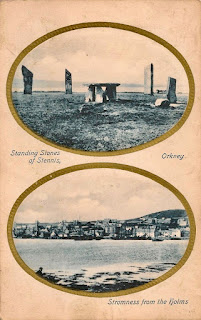
The central "altar" or "dolmen" shown in the view of the neolithic Standing Stones of Stennis (or Stenness) was a "reconstruction" from 1907, possibly inspired by Sir Walter Scott's interpretation of the site. It was dismantled under murky circumstances in 1972 and only the uprights were put back in place. A century earlier a landowner had vandalized the site extensively, resulting in the loss of much of the surrounding circle of stones.
Despite its barren northern location, Orkney has some of the most extraordinary neolithic monuments in Britain. I haven't been there (my wife and daughter have), but perhaps someday I will make a visit.
Sunday, March 14, 2021
Notebook: Stephens at Palenque

There was no necessity for assigning to the ruined city an immense extent, or an antiquity coeval with that of the Egyptians or of any other ancient and known people. What we had before our eyes was grand, curious, and remarkable enough. Here were the remains of a cultivated, polished, and peculiar people, who had passed through all the stages incident to the rise and fall of nations; reached their golden age, and perished, entirely unknown. The links which connected them with the human family were severed and lost, and these were the only memorials of their footsteps upon earth. We lived in the ruined palace of their kings; we went up to their desolate temples and fallen altars; and wherever we moved we saw the evidences of their taste, their skill in arts, their wealth and power. In the midst of desolation and ruin we looked back to the past, cleared away the gloomy forest, and fancied every building perfect, with its terraces and pyramids, its sculptured and painted ornaments, grand, lofty, and imposing, and overlooking an immense inhabited plain; we called back into life the strange people who gazed at us in sadness from the walls; pictured them, in fanciful costumes and adorned with plumes of feathers, ascending the terraces of the palace and the steps leading to the temples; and often we imagined a scene of unique and gorgeous beauty and magnificence, realizing the creations of Oriental poets, the very spot which fancy would have selected for the "Happy Valley" of Rasselas. In the romance of the world's history nothing ever impressed me more forcibly than the spectacle of this once great and lovely city, overturned, desolate, and lost; discovered by accident overgrown with trees for miles around, and without even a name to distinguish it. Apart from everything else, it was a mourning witness to the world's mutations.Unlike many early observers who attributed the ruins to a civilization originating in the Old World, Stephens ultimately concluded, correctly, that the builders were the ancestors of the same Maya people who still inhabited the region. I visited several of the sites, including Palenque, in 1980, by which time conditions for travelers, distinctly rough in 1840, were vastly improved. The fine Dover editions of the four volumes of Stephens's travels are still in print.
Tuesday, January 09, 2018
Roundabout

Colin Sackett's Uniformagazine is a pamphlet-sized quarterly, published in the UK, that ranges eclectically over various themes, but especially the intersections of landscape, human activity, and memory. Most of its contributors are unknown to me. In issue No. 3, published in Spring–Summer 2015, Ian Waites revisits the publicly funded council estate where he grew up, finding a zone that has been deregulated and privatized to the point that it is no longer the center of anything that might be called a community:
I went back to the estate to photograph my playground only to find that it had all gone. The slide, the swings and the roundabout had all been removed, leaving behind a set of modern yet suddenly ancient earthworks: concentric circles of grass, concrete and disintegrating synthetic playsurfacing. Once there were roundabouts, and children who were given the chance to play in a changed society that valued social democracy, progress and community. But now all we are left with are archaeological traces of a future that was never quite allowed to come off, and which only I seem to notice. These earthworks act like conduits in space and time, carrying me back to my childhood, and to this estate as it was in its hey-day.Ian Waites, "Once there were roundabouts," Uniformagazine No. 3.
Uniformbooks has published Waites's related book, Middlefield: A postwar council estate in time.
Friday, March 26, 2010
Up in the Downs


Artwork by Richard Doyle from The Scouring of the White Horse by Thomas Hughes. These illustrations are not in the copy I have, which is the American edition published by Ticknor & Fields in 1859. The elaborate titling, which I'm guessing is supposed to evoke the twisted branches of a hedgerow, reads The Scouring of the White Horse / A Country Legend.
The scene depicted, of stout Saxon warriors exuberantly memorializing King Alfred's victory over the Danes in 871 AD, is anachronistic, as it is no longer believed that the stylized hill figure known as the Uffington White Horse has anything to do with Alfred or with Anglo-Saxon England at all. It was carved into the chalk of the Berkshire Downs, in essentially the design in which it appears to this day, in the late Bronze Age (c. 800-1000 BC), and would have disappeared long ago had it not been periodically "scoured" of encroaching turf. That more than a hundred generations of Celts, Romans, Anglo-Saxons, and Normans not only refrained from obliterating the carving but actually went to the trouble of renewing it from time to time is, when you think about it, fairly astonishing. Perhaps it served as a convenient excuse for merrymaking -- it certainly did so in Tom Hughes's day. Whether the horse -- if that's indeed what it is -- was originally intended as a religious symbol or as some kind of territorial or tribal marker no one now knows.
The White Horse is located above the village of Uffington in what used to be part of Berkshire but is now Oxfordshire. From Oxford, where we were staying, it can be reached by taking a bus to the market town of Wantage, which has an excellent small museum devoted to the history of the region, and then a second bus that stops at the isolated crossroads below White Horse Hill. We scaled the hill the hard way, across its face through pastureland that was muddy in spots, not realizing that there was a paved road to the top of the ridge. Even on a fair March day -- there were paragliders soaring above us, and the views were splendid from the summit -- the site was uncrowded. A small flock of sheep just a few meters from the carving ignored our approach and only broke away when we strode right through their midst.
 We sat down to catch our breath near the head of the figure, and while we were there passed our copy of an illustrated guidebook to a fellow climber so that he could prove to his skeptical son that he was indeed standing next to a giant horse, as the full outline of the carving, which measures more than 100 meters from nose to tail, is best seen from a distance or from above. Above and behind the horse, on the crest of the hill, are the earthworks of an Iron Age fort known as Uffington Castle. The Ridgeway, an ancient trail that runs through the Downs and on to Avebury, passes over the hill, and if you follow it west for a mile or so you will come to Wayland's Smithy, a fine Neolithic chambered long barrow sheltered in a beech grove.
There's no gift shop or visitor's center on White Horse Hill, and I for one hope there never is, as the bleak, peaceful solitude of the place allows one to better contemplate the views of the surrounding countryside as well as the vast expanses of time that are in evidence. There was a lone vendor selling ice cream from a van; we passed on the ice cream but took him up on what he solemnly promised was the best hot chocolate in the world. And it wasn't bad at that.
Tom Hughes's novel The Scouring of the White Horse is still enjoyable reading, although more reliable for its glimpses of Berkshire folklife than for its archaeology. Kate Bergamar's Discovering Hill Figures, in the Shire Classics series, is an excellent portable guide to the Horse and similar figures, most of which are far more recent in origin. The latest archaeological evidence is surveyed in Uffington White Horse in its Landscape, by C. Gosden et al.
Photo by Maddie.
Sunday, December 13, 2009
Old stuff
NYU's Institute for the Study of the Ancient World is currently featuring a new exhibit entitled "The Lost World of Old Europe: The Danube Valley, 5000 - 3500 BC." The objects on display, most or all of which were excavated in Bulgaria and Romania, belong to Neolithic cultures that are still relatively little known here, in part because of their extreme antiquity (they predate the invention of writing), and also no doubt because of the limited interchange of scholarship between East and West before 1989. Manhattan's Upper East Side may be as far removed from the world of the makers of these artifacts as it would be possible to travel, but nevertheless, here they are, until April 25, 2010. Admission is free, and this may be your one chance to see them. If you can't make it there is a companion catalog, which I haven't yet seen.
The term "Old Europe" was coined by the late archaeologist Marija Gimbutas, who believed that large parts of Neolithic Europe were characterized by common traditions of matriarchy and the worship of a "Mother Goddess," traditions that were supplanted or subsumed when new, patriarchal, cultures from further east penetrated the Balkans. Gimbutas's work has come under heavy criticism in recent years, and David Anthony, one of the co-authors of the exhibition catalog, is among the critics, but the "Old Europe" description itself has evidently stuck. The current exhibit seeks a nuanced view, pointing out that the archaeological evidence for matriarchy is now considered to be more ambiguous that it was a generation or so ago.
None of which should interfere with the enjoyment of what is on display, including, for instance, this remarkable pair of fired clay figurines from Hamangia in Romania.

The male figure on the left has been dubbed, inevitably, "the Thinker," although the exhibit notes that his posture may in fact indicate mourning. Whatever the truth is, there is nothing "primitive" about the artistry of these pieces, created at least 6,600 years ago.
Here's a clay vessel, 4200-4050 BC:

My daughter and I both concluded that this was a doll's house:

We weren't "serious," of course, but it raises an interesting question: when does a religious figurine become a "toy," or vice versa. Is a crèche, whatever else it is, not a toy set, and if not, why? Are figurines no longer "toys" when adults "play" with them? Is there really an absolute gap between the "serious" religious or magical practices of adults and the imaginative play of children? I suspect the distinction would have had no meaning when these pieces were created.


The above are not museum groupings of similar objects but actual assemblages as found in place; the lower one has been called, somewhat speculatively, "the Council of the Goddess."
From an essay by Douglass W. Bailey, included in the exhibition catalog but also available online (PDF):
Contemporary psychological studies have shown that something very odd happens to the human mind when one handles or plays with miniature objects. Most simply put, when we focus our attention on miniature objects, we enter another world, one in which our perception of time is altered and in which our abilities of concentration are affected. In a well-known set of experiments, the psychologist Alton Delong showed that when human subjects were asked to imagine themselves in a world where everything was on a much smaller scale than everyday reality, or when they engaged in activities in smaller than normal environments, they thought that time had passed more quickly than in fact it had and they performed better in tasks requiring mental agility. Importantly, the subjects of these studies were not conscious of their altered experience of time or concentration.This one was interesting:

Called a pintadera (there were several other examples in the exhibit), it is, in effect, an early printmaking tool, used to stamp patterns on skin, cloth, or even bread.
The above images are from a slide show on the website of The New York Times; there is an accompanying article by John Noble Wilford. The Institute, which is located at 15 East 84th Street, provoked controversy when it was founded in 2006, because its principal benefactors, Leon Levy and Shelby White, had in the past been accused of purchasing looted antiquities for their own private collections. As far as I know the objects in the current exhibit have been legitimately loaned by museums in the countries where they were first located and their presence in the exhibit hasn't been challenged.
Subscribe to:
Posts (Atom)