Today, entirely by accident, I learned of the existence of this bundle of eight chapbooks published in 2017 by the Center for Humanities at CUNY as part of a project called Lost & Found: The CUNY Poetics Document Initiative. My interest in this particular number (Series VII) centers on two of the chapbooks, which bear the collective title of
“Querido Pablito"/"Julissimo Querido," Selected Correspondence, 1958-1971 (Parts I & II). These volumes contain translations of the letters between Julio Cortázar and his first US translator (and literary agent), Paul Blackburn. I'm familiar with portions of the correspondence from the five-volume Spanish-language edition of Cortázar's Cartas, but I despaired of ever seeing them published here. (Some time ago I translated and posted brief excerpts here and here.)
The CUNY chapbooks are a little tricky to find at the moment, in part because CUNY's offices have been shuttered by the pandemic. If it helps, the ISBN for this series is 9780997679625.
World Without Borders has an excerpt from the CUNY volumes as well as an interview with the editors, Ammiel Alcalay, Jacqui Cornetta, Alison Macomber, and Alexander Soria.
In addition to the two chapbooks described above, the next installment in the CUNY series (Series VIII) contains a chapbook dedicated to a translation of a portion of Cortázar's posthumously-published study of Keats, Imagen de John Keats.
More information to come.
Showing posts with label Paul Blackburn. Show all posts
Saturday, January 02, 2021
Saturday, March 22, 2014
Dance Respite, Dance Catalan, and if You Can, Dance Hopeful
Translated, with permission, from Tororo's French original at A Nice Slice of Tororo Shiru.
The year 2014 has been decreed the año Cortázar by the relevant authorities.
For the duration of the año Cortázar, the cronopios have deposited receptacles intended to receive contributions towards the financing of the festivities on windowsills, on loose planks at construction sites, on shelves in telephone booths (where these still exist), and in various other locations reasonably well-sheltered from rain (preferably, but not always, because after all one can't think of everything).
These receptacles consist of china tea cups, faux-bronze key trays inherited from grandparents, colored advertising mugs given away by various catering companies, plastic toothbrush-cups, ashtrays recently discarded by the bistros that once utilized them, and aluminum pie-tins; you will easily recognize them, in spite of their variety, because the cronopios, with admirable foresight, have deemed that it would be a shame if these objects served absolutely no purpose until they had been completely filled with money — something which, they are aware, will require the passage of a certain amount of time — and have thus garnished the bottoms of the receptacles with bird seed.
Locate the ones in your neighborhood, and wait before depositing your offering until the birds have eaten all the seed, because it would be a shame if your bills, softened by long circulation, were to be diverted from their fiduciary purpose in order to line the nest of swallows, or that your shiny coins should end up decorating the abodes of magpies.
During the same period, the famas have announced through official channels that in honor of Julio Cortázar they will dance respite on even-numbered days from 4:30 to 5:00 in the afternoon, and that they will dance catalan on odd-numbered days from 5:00 to 5:30.
Green and humid, a cronopio poses on a slab...
... on which someone has carved "Julio Cortázar," somewhere in the cemetery of Montparnasse.
Once there, not really knowing what to do, he smiles with a slightly embarrassed air.
✵
Translator's note: I have borrowed the names of the dances (which are tregua, catala, and espera in the original Spanish) from Paul Blackburn's translation of Cronopios and Famas. Blackburn had apparently worked up a hypothesis, based on the similarity between catala and catalán, to explain the three-fold division of cronopios, famas, and esperanzas along ethnic lines. Below is Cortázar's response, from a letter dated March 27, 1959 that was written in a mix of Spanish (which I've translated) and English. The passages in brackets are missing words restored by the editors of Cortázar's letters:
Let me explain: to dance tregua and dance catala can't be [translated as] "to dance truce and dance catalan," because I never thought that tregua and [catala] had that meaning. For me it's simply a phrase with a certain magic of [rhyme], a sort of "runic rhyme" in Poe's sense. To begin with, catala doesn't [mean] Catalan. Of course now that I've read your division between [Spanish], Catalan, and Madrid businessmen, I wonder if you're not right. Who is right, [the Agent] or the Author? No use to scan the contract. No explanatory clause provided. But, Paul, if Cortázar's Famas dance catalan, is that fundamentally wrong? The Author SAYS, no. Famas may dance catalan and dance truce. Let them dance. I think your philological enquiry is delightful and quite true in the poetic sense of Truth, which is the ONLY sense of Truth. (I am speaking like Shelley, I'm afraid.)In the end, Blackburn's published translation replaced "truce" with the much funnier "respite," but arguably the terms should be left untranslated so that the cronopios, famas, and esperanzas may freely dance tregua, catala, and espera as the spirit moves them. — CK
Saturday, February 08, 2014
The Prehistory of Cronopios, Famas & Esperanzas (Epistolary Phase)

Julio Cortázar's Historias de cronopios y de famas, a volume of short, unclassifiable whimsical fables and texts, was published by Francisco Porrua's Ediciones Minotauro in Buenos Aires in 1962, and appeared (as Cronopios and Famas) in Paul Blackburn's English translation for Pantheon Books in 1969, that is, well after the US editions of The Winners, Hopscotch, and End of the Game and Other Stories (also known as Blow-up and Other Stories). Curiously, though, it appears that the cronopios reached an English-speaking audience before they were widely available in Spanish. Here's the story in brief as I've been able to piece it together thus far.
Blackburn, a poet and translator from several languages, first exchanged correspondence with Cortázar in the spring of 1958 through the auspices of Edith Aron (who, incidentally, is said to have been the inspiration for the character of la Maga in Hopscotch). Aron, a native German speaker, had translated some of the pieces that would eventually become Historias de cronopios y de famas into German for a magazine, and Blackburn may have seen them there. (It's also possible that he had come across the selection of seven pieces that were published in Havana by the review Ciclón in 1956.) In March 1958, at Aron's instigation, Cortázar sent Blackburn some of the cronopio material, possibly in the form of a homemade mimeographed "edition" similar or identical to one he had sent to the Cuban poet José Lezama Lima in January 1957. In April 1958, responding to a letter he had received in return, he wrote again, complimenting Blackburn on his Spanish, expressing an interest in reading the latter's own poetry, and providing a brief curriculum vitae that listed the books he had written to that point, including the story collections Bestiario and Final del juego as well as the (as yet unpublished) novels El examen and Los premios.
Blackburn seems to have set to work quickly on translating the material Cortázar had provided, and two excerpts appeared, in his translation, in the 1958 edition of New World Writing. By June 1959, he had translated large portions of the book and sent it to the author. A letter from Cortázar on June 29th describes the translation as "formidable" and mentions that he had read it twice and noted with pleasure that it reminded him in spots of Damon Runyon ("whom I always admired a great deal"). Several pages of suggested corrections follow, not all of which would be reflected in the final version.
By now, Blackburn was acting as Cortázar's literary agent in the US, and was seeking an American publisher for the cronopio material, without notable success. In December 1959, Cortázar refers to a public reading by Blackburn of the stories in New York City:
Paul, it's stupendous that you've read the cronopios in N.Y. and that people have enjoyed them so much. You don't know how happy this makes me. Did you make a tape recording? How I would have liked to hear your voice reading your translations, it would be fabulous. Many thanks for scattering my cronopios in the cafés of 9th Avenue. They must have eaten all the hamburgers, I imagine, and then left without paying. Deplorable conduct of the cronopios in New York.A tape recording of this performance (or a later one) must have existed, because in a letter sent in March 1960 Cortázar reports having received it and having greatly enjoyed listening to it. He also delightedly acknowledges receipt of a tube of garish Stripes toothpaste — a bit of an inside joke, as one of the cronopio texts involved misbehavior with toothpaste. Later in that same letter he indicates that an Argentine publisher had agreed to accept a volume including those pieces as well as several other groups of texts that would eventually be included in the published book. In April 1961, Cortázar told Francisco Porrua, the publisher, that the texts had met with great success in their New York reading:
Last year a radio station in New York broadcast all of the cronopios in a magnificent version by Paul Blackburn. There was a torrent of mail, which the translator showed me...By 1961, Editorial Minotauro was beginning work on the Argentine edition and Cortázar reports that Maurice Girodias' Olympia Press, located in Paris, had agreed to publish some of the cronopio texts in English in an issue of a new review, Olympia. They would, in fact, appear in issue No. 2 of that short-lived publication, but as of a June 1962 letter to Sara Blackburn — both Paul's wife and Cortázar's editor at Pantheon — Cortázar complained of not having been paid.
Cronopios and Famas would, as it happened, have to wait its turn in the US; the novels and longer stories were no doubt considered more easily marketable. The version that Pantheon eventually released includes a translation of at least one text ("Instructions on How to Dissect a Ground Owl") that Porrua persuaded Cortázar not to include in the Spanish-language version. It also incorporates most, but not all, of the changes Cortázar had suggested to Blackburn. The most puzzling of the corrections not made is found in "Improprieties in the Public Service," where Cortázar's objection to the incomprehensible "the confusion daddy" as a translation of "una confusión padre" (roughly, "one hell of a confusion") was never addressed. Nevertheless, Blackburn's translation of this elusive material holds up well, and Cortázar was right to be happy with it.
But what was the tape Blackburn sent Cortázar in 1960? The Pacifica Radio Archives holds a tape recording (not yet digitalized, sadly) of a 44-minute performance of Cortázar's "Stories of Cronopios and Famas" read by Blackburn and fellow poet Robert Kelly on WBAI in New York on July 19, 1962, which may or may not represent a re-broadcast of an earlier reading. The UC San Diego library, which holds Blackburn's papers, has a tape of what may be the same performance. It's possible that the original 1959 or 1960 tape still exists somewhere among Cortázar's papers.
(Translations from Cortázar's letters, taken from Cartas I (2000), are mine.)
Sunday, January 12, 2014
"He was my brother"
The letter below was sent to the American writer Toby Olson on October 1, 1971. A few weeks earlier the poet Paul Blackburn, Julio Cortázar's translator, agent, and friend, had died in Cortland, New York. The letter was written in English, with a few minor errors; it was addressed from Paris.
Dear Toby,
I found your letter last night when coming back from Vienna. You see, I knew that Paul was dead, I had the feeling all the time since I got Joan and Sara's letters. The only thing I learned from you was the date, September 13. He was my brother, Toby, he was a wonderful friend, he was the first and most wonderful of cronopios, who he loved, who he made live in English. Toby, he sent me a letter, his last, in July 3, in full summer, he sent it to my small rancho in Vaucluse where he and Joan spent two or three weeks in 69, and where he finished his translation of the cronopios book. I was unhappy then and he came and he made me laugh and forget a lot of unpleasant things. He gave me hell with a tape of the Beatles which he played for hours and hours until I cried for mercy. We were so happy, we drank so much pastis, we read poetry, his and Latin American poetry, and he promised to come back in two years. Ah, Toby, is so tough and my English is so bad, forgive me, I just wanted to tell how I loved my brother, how I feel now. I'd like to be there with you and Jerry and Schwerner, in a way I'll be there, please count me there, Toby. I send you a photograph of Paul's last letter. He wrote a poem about the way he had to drive to get to my rancho. If you want to read that poem I'll be there to listen to it, with all his friends. I can't write no more, forgive me.
Julio
Tuesday, October 05, 2010
Cortázar: 62: A Model Kit

This dust jacket is so similar in style and lettering to the one used for Hopscotch that you'd think it would have to be by George Salter as well, but Salter was long dead and this dazzling design was in fact by Kenneth Miyamoto. If you didn't look closely you might miss the suggestion of a cityscape with mountains in the distance. The superimposed geometrical forms below the title are actually appropriate, since the novel is set in several real European cities but also takes place in overlapping dimensions ("the City" and "the zone") that are organized more by systems of affinities than by geography. This is Cortázar's strangest novel, and it took me a couple of tries to penetrate its mysteries. The first thirty pages or so are slow going the first time out, but once you get past that it's a book like no other, aptly described by Carlos Fuentes as "an ironic, sentimental journey through a city plan drawn up by the Marx Brothers with an assist from Bela Lugosi." The reference to Lugosi isn't gratuitous; there's vampirism in the book, among many other things. The title alludes to Chapter Sixty-Two of Hopscotch, in which a prospectus for a novel -- or rather an approach to the writing of a novel -- is set forth. Almost everyone in the book is in love with someone, usually someone who's interested in another person entirely, who in turn... It all ends, sweetly and sadly, with dead leaves (actually a character named Feuille Morte, who has a pet snail) and insects circling a streetlight. The American edition, from 1972, is jointly dedicated by Cortázar and translator Gregory Rabassa to "Cronopio Paul Blackburn," who had died the year before, and bears these lines from Jorge Manrique's "Coplas por la muerte de su padre":
y aunque la vida murio, nos dexo harto consuelo su memoria
Cortázar: Cronopios and Famas

Paul Blackburn and Cortázar were exchanging correspondence about the translation of this book of whimsical stories and fables as early as 1959, three years before the book appeared in Spanish.
Paul, your translation is formidable. I've read it twice, making note in passing of the observations that I have to make to you, and they're minor details. You've managed the spirit of the thing, that way of writing that I used with the cronopios and that comes out beautifully in English (at times it makes me think a little of Damon Runyon, whom I've always admired a great deal). I congratulate you, and I give you a big hug (with one arm only, because the other one is still all messed up).A subsequent letter refers to a reading Blackburn gave in New York City that included several of the pieces, apparently with great success.
You don't know how happy this makes me. Did you make a tape recording? How I would have liked to hear your voice reading your translations, it would be fabulous. Many thanks for scattering my cronopios in the cafés of 9th Avenue. They must have eaten all the hamburgers, I imagine, and then left without paying. Deplorable conduct of the cronopios in New York.Blackburn did eventually send Cortázar a tape, whether from that reading or another. As it turned out, the cronopios, famas, and esperanzas had to wait their turn until 1969, after Pantheon's publication of two novels and one book of short stories. Dave Holzman did the artwork for this jacket. My copy is a paperback reprint. A Journey Round My Skull has the hardcover version.
Monday, October 04, 2010
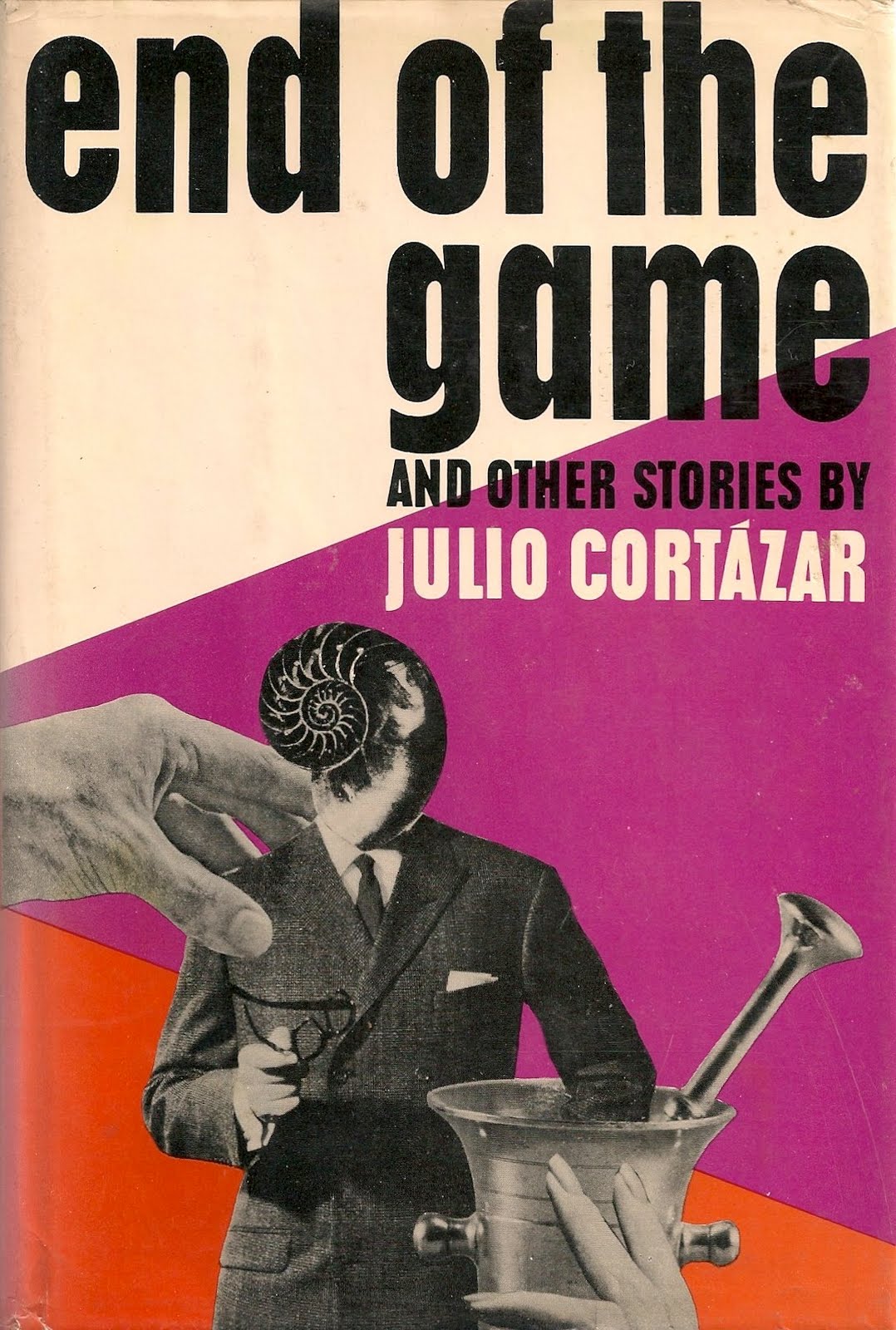
Cortázar: End of the Game
The idea of translating selections from Cortázar's work must have been in Paul Blackburn's mind at least from April 1958, when the Argentinian wrote him a friendly letter, in the course of which he outlined the books he had published to date and mentioned that he had just completed a long story, "El perseguidor" ("The Pursuer") based on Charlie Parker. Blackburn seems to have turned his hand first to Cronopios and Famas, although that book wouldn't appear in its entirety until 1969. By 1962, Cortázar was writing to Sara Blackburn (Paul's wife, and Cortázar's US editor) about a translation of "Las armas secretas" (apparently just the title story, not the entire volume) by Hardie St. Martin:It seems formidable to me. It's very faithful, very precise, and it has all of the atmosphere of the original. I marked two or three little things that can be corrected without great effort... I would be delighted if someone would be moved to translate "The Pursuer" and the other stories in the book, but above all "The Pursuer."I'm not sure what became of St. Martin's translation, but in 1967, after Pantheon had already published The Winners and Hopscotch, End of the Game appeared, containing Blackburn's translations of most of the contents of Bestiario, Las Armas Secretas, and Final del Juego, including the Parker story, "Axolotl," "The Idol of the Cyclades," and twelve other pieces. By then Antonioni's film Blow-Up, which is loosely based on Cortázar's "Las babas del diablo," was about to appear, and so the story was retitled "Blow-Up," a felicitous change as the original title translates to something like "the devil's spittle." When the Collier Books edition appeared a year later the title of the entire volume was changed and a still from the movie became the cover art.
In the late '70s or early '80s a Harper paperback edition restored the original title, but the subsequent Vintage edition that remains in print is once again Blow-Up.
The original surrealist-derived cover art from the hardcover edition is credited to one Hoot von Zitzewitz, whose identity appears to be a bit mysterious. In a letter to Paul Blackburn and his wife Sara (who was his editor at Pantheon), Cortázar wrote: Dear Sarita, many thanks for the copy of End of the Game, which is very nice. I have the impression that we have chosen the sequence of stories well, and that some critics will say some interesting things about them.The same letter also alludes with regret to Sara's decision to leave Pantheon. By 1969 she and Paul Blackburn had divorced and Paul had married for a third time. (Translations are mine, from the three-volume Alfaguara edition of Cortázar's Cartas.)
Cortázar: Hopscotch

In the final paragraph of a letter to Paul Blackburn written from Vienna in September 1961, Cortázar shared a bit of news with his agent and friend. "Last week I finished La Rayuela (Hopscotch, you know). It is, I humbly believe, a very beautiful thing." Blackburn must have expressed puzzlement, because two weeks later the author explained: "La Rayuela is a novel, Mr. Agent. Of about 650 pages." And so it was. It was published in Buenos Aires in June 1963, although the American edition would not appear for another three years. During that time Pantheon's chosen translator, Gregory Rabassa, then a novice at the craft, worked closely with the author, struggling to devise creative solutions to the sometimes nightmarish obstacles the book posed. Years later, Rabassa recalled:
Hopscotch was for me what the hydrographic cliché calls a watershed moment as my life took the direction it was to follow from then on. I hadn't read the book but I skimmed some pages and did two sample chapters, the first and one further along, I can't remember which. Editor Sara Blackburn and Julio both liked my version and I was off and away.When not busy translating One Hundred Years of Solitude, Paradiso, Conversation in the Cathedral, and dozens of other books, Rabassa went on translate five more of Cortázar's, the last being A Certain Lucas in 1984. His memoir, If This Be Treason: Translation and Its Dyscontents, was published by New Directions in 2005.
Cortázar, who was himself an experienced multilingual translator, was delighted with everything about the American edition -- except for this colorful jacket by George Salter, which he claimed to have removed and thrown in the wastebasket as soon as his author's copy arrived.
Sunday, October 03, 2010
Cortázar: The Winners
The first of Cortázar's books to appear in English, The Winners (Los premios) was published by Pantheon in 1965 in a translation by Elaine Kerrigan. The jacket is by Muriel Nasser.I really like the JACKET, Sara. Say so to Muriel Nasser, who I hope is not related to that other Nasser. Or is it the same Nasser who works for you under a feminine pseudonym? You never can tell.

I put the jacket on another book, and it looked wonderful. I like it very much, you know. I've never seen such a large photo of me. How young I was when it was taken! In this last three years I've aged a lot; now I can't read for more than two hours in one sitting, and at times I have rheumatism. But the heart is still young, as the bishop said to the actress.Excerpts from a letter to Sara and Paul Blackburn, December 17, 1964, from Cartas 2: 1964-1968, published in 2000 by Alfaguara. Sara Blackburn was Cortázar's editor at Pantheon; her husband, the poet Paul Blackburn, translated several of his works as well as being his American agent and good friend. The translation of the excerpts is my own, but the portions in italics are in English in the original.
Monday, April 04, 2005
Notes on the jazz lyrics in Cortázar's Rayuela (Hopscotch)
Update 2014: the discussion below is now very much out-of-date, but I'll leave it up in case it's of use to anyone.
Julio Cortázar was a great jazz fan. In one section of his novel Rayuela there is a long set-piece, broken up over several chapters, in which the members of the “Club del Serpiente” pass an evening listening to records, most or all of which are American jazz and blues records from the '20s and '30s. In the original Spanish-language text several of the songs are quoted, in English. When the English-language version of the novel, created by Gregory Rabassa, was published, most of these lyrics were changed substantially and, in most cases, without any self-evident reason. This was presumably done with the author's blessing, since he worked closely (if at a substantial geographical remove) with Rabassa on the preparation of the translation. But why? [Update 2013: see footnote1]
My first assumption was that Cortázar had mangled the lyrics when he wrote the book, either because he was working from memory or because he had difficulty making out the correct lyrics. Though Cortázar was a professional translator and knew English very well, he occasionally shows signs, when he quotes from the language, of being a little uncertain with vernacular expressions (his compositor or publisher may have been more uncertain still), and in a few instances (the lyrics aside) Rabassa clearly cleaned up English phrases that were not idiomatically likely (“This is a plastic's age” being one example). Since Rabassa was a jazz aficionado himself, he may have known or discovered that Cortázar had the lyrics wrong and corrected them, with the author's knowledge. (“It don't mean a thing if it ain't that swing” being one example of an obvious misremembering or printer's error.)
But some spot-checking of lyrics on the web suggests that frequently Cortázar's original versions are more accurate than the corrected ones. (Many of these tunes, by the way, can be heard at the online Red Hot Jazz Archive.) The only guess I can make — and it's a hesitant one, at best — is that the lyrics were intentionally altered in the Pantheon edition to avoid copyright clearance issues. Some examples follow.
Rayuela Chapter 13:
... Don't play me cheap.
Satchmo cantaba Don't play me cheap
Because I look so meek
Hopscotch Chapter 13:
... Don't play me cheap.
Satchmo was singing:
So what's the use
If you're gonna cut off my juice
Rayuela Chapter 15:
Champion Jack Dupree ...
Say goodbye, goodbye to whiskey
Lordy, so long to gin,
Say goodbye, goodbye to whiskey
Lordy, so long to gin,
I just want my reefers
I just want to feel high again —
Hopscotch Chapter 15:
Champion Jack Dupree ...
So long, whiskey, so long ver-mouth
Goodbye, goodbye, gin.
So long, whiskey, so long ver-mouth
Goodbye, goodbye, gin.
Jus' want some good grass
'Cause I wanna turn on again —
Rayuela Chapter 15:
Big Bill [Broonzy] ...
They said if you white, you all right
If you brown, stick aroun',
But as you black
Mm, mm, brother, get back, get back, get back.
Hopscotch Chapter 15:
Big Bill [Broonzy] ...
If you're an ofay, well, you're okay,
An' if you're tan, you're all right, man,
But if you're brown or black, mmn,
Step down, git back, git back.
Rayuela Chapter 16:
It don't mean a thing if it ain't that swing
[obvious error]
Hopscotch Chapter 16:
It don't mean a thing if it ain't got that swing
Rayuela Chapter 16:
You so beautiful but you gotta die some day,
All I want's a little lovin' before you pass away.
Hopscotch Chapter 16:
Skin like darkness, baby, you gonna die some day,
I jus' want some lovin' be-fore you go your way.
[This is an interesting case because after quoting the three lines in a block, Cortázar works them into the text of the following paragraph. So does Rabassa, but curiously he uses the original lyrics, not the substituted ones.]
Rayuela Chapter 17:
[unidentified]
I could sit right here and think a thousand miles away,
Since I had the blues this bad, I can't remember the day —
Hopscotch Chapter 17:
[unidentified]
I can set right here and think
three thousand miles away,
set right here and think
three thousand miles away,
can't remember the night
had the blues this bad any-way …
Rayuela Chapter 106:
The Yas Yas Girl [= Merline Johnson]:
Well it's blues in my house, from the roof to the ground,
And it's blues everywhere since muy [sic] good man left town.
Blues in my mail-box cause I cain't get no mail,
Says blues in my bread-box 'cause my bread got stale.
Blues in my meal-barrel and there's blues upon my shelf
And there's blues in my bed, 'cause I'm sleepin' by myself.
Hopscotch Chapter 106:
[no attribution]
Cold feet on the kitchen floor, cold feet on the ground,
cold feet everywhere since my man left town.
Cold feet in the butcher shop, cold feet in the store
since nobody comes around to grind my meat no more.
Cold feet on the motor and cold feet on the stones,
and cold feet in my bed, 'cause I'm sleeping all alone.
Rayuela Chapter 106:
Johnny Temple [“Between Midnight And Dawn”]:
Between midnight and dawn, baby we may ever have to part,
But there's one thing about it, baby, please remember I've always been your heart.
Hopscotch Chapter 106:
[no attribution]
Between now and tomorrow, babe, morning, we'll have to part
midnight to morning, babe, tomorrow we'll have to part
Please remember just one thing about it, I've always been in your heart.
Update (5/18/2005): More evidence that copyright issues may be the explanation: in Chapter 87 of Rayuela there is a nine-line quote from Ellington's “Baby when you ain't there,”
I get the blues down North
The blues down South
Blues anywhere,
I get the blues down East,
Blues down West,
Blues anywhere.
I get the blues very well
O my baby when you ain't there
ain't there ain't there —
In Rabassa's translation the lines are simply omitted, perhaps because the length of the quote put it beyond the limits of fair use without permission.
Incidentally, at least two compilations of most of the quoted tunes have been issued. One, issued by the Institute of Pataphysical Studies of Melbourne, Australia is El Jazz para leer Rayuela / The Jazz to read Hopscotch. The track listing is as follows:
Chapter 10
1) "I'm coming, Virginia" (Cook - Heywood) 3.10 m
Frankie Trumbauer & His Orchestra
New York 13/5/1927
2) "Jazz me blues" (Delaney) 3.02 m
Bix Biederbecke & His Gang
New York 5/10/1927
Chapter 11
1) "Four O'clock drag" (Gabler) 2.49 m
Lester Young with The Kansas City Six
New York 28/3/1944
2) "Save it pretty mama" 3.26 m
Lionel Hampton
Chapter 12
1) "Wrap your troubles in dreams" 2.43 m
Coleman Hawkins
New York 1/5/1944
2) "Grooving high" 2.42 m
Dizzy Gillispie
3) "Empty bed blues" 3.25 m
Bessie Smith
New York 20/3/1928
Chapter 13
1) "Don't play me cheap" (Dial - Randolph) 2.54 m
Louis Armstrong
Chicago 26/4/1933
Chapter 14
1) "After the rain" 4.07 m
John Coltrane
New York 29/4/1963
2) "Village blues" (Marsala) 2.48 m
Sidney Bechet
3) "See see rider" 2.55 m
Lonnie Johnson
Copenhagen 16/10/1963
Chapter 15
1) "Jelly beans blues" 3.20 m
Ma Rainey
New York 16/10/1924
2) "Blue interlude" 3.25 m
Benny Carter
10/10/1933
3) "When I'm drunk" 8.30 m
Champion Jack Dupree
En vivo 1971
4) "Black brown and white" 3.06 m
Big Bill Broonzy
Paris 20/9/1951
Chapter 16
1) "Hot and bothered" 3.16 m
Duke Ellington & His Orchestra
New York 1/10/1928
2) "I ain't got nobody" 5.40 m
Earl Hines
New York 7/3/1964
Chapter 17
1) "Mamie's blues" (Desdume) 2.46 m
Jelly Roll Morton
New York 16/12/1939
2) "Stack O'Lee blues" (Lopez) 2.20 m
Waring's Pennsylvanians
18/4/1928
I was able to obtain the above from Leedor.com in Argentina. Some of the tracks are actually later performances that did not exist when Rayuela was written. The CD also includes a reading by Cortázar of Chapter 7 of the novel.
A second compilation, which may be obtainable in Europe, is called Jazzuela (Recopilación de Pilar Peyrats K Industria Kultural, Barcelona, 1979). These are the tracks:
I'm Coming Virginia
Jazz Me Blues
Four O'Clock Drag
Save It Pretty Mamma
Body and Soul
Baby Doll
Empty Bed Blues
Don't You Play Me Cheap
Yellow Dog Blues
Mahogany Hall Stomp
See See Rider
Blue Interlude
Junker's Blues
Get Back
Hot and Bothered
It Don't Mean A Thing
I Ain't Got Nobody
Mamie's Blues
Stack O'Lee Blues
Jelly Beans Blues
Neither compilation appears to have tried to include the songs quoted in Chapter 106.
There is, by the way, a different kind of “correction” in the English version of the same author's short story “El Perseguidor” (“The Pursuer”). In the original the jazz musician Johnny Carter (modelled on Charlie Parker) is, somewhat ridiculously, a marijuana fiend; in Paul Blackburn's translation he is, like Parker and more plausibly, a heroin addict.2 Again, it is likely that this was with Cortázar's blessing, since Blackburn was a good friend (and for a time the author's North American agent).
1. A 1965 letter from Cortázar to editor Sara Blackburn essentially answers the question. Cortázar agreed to rephrase the lyrics to avoid copyright hassles, since the laws regarding the use of even short snippets of lyrics were stricter in the US than in Argentina and France. The letter, which is dated November 20, 1965 and is entirely in English, can be found in Volume 3 of the 2012 expanded edition of Cortázar's Cartas. Sara Blackburn was, at the time, married to Paul Blackburn, Cortázar's agent, friend, and occasional translator.↩
2. Apparently this was due to an innocent mistake on Cortázar's part. Martín Caparros reports that Cortázar told him that at the time he wrote the story he knew nothing of the effects of the two drugs; when Blackburn pointed out the implausibility Cortázar elected to leave the original alone, although in the translation the choice of drug was changed. Caparros: "It is strange to imagine now a time when a Latin American in Paris, thirsty for modernity and for various underworlds, had not the faintest idea what marijuana was." ↩
Further reading:
Rabassa, Gregory If This Be Treason: Translation & Its Discontents New Directions, 2005; (discusses his work translating Cortázar and other writers).
Cortázar, Julio Cartas (5 volumes), Alfaguara, 2012; (includes some of Cortázar's letters to Rabassa during the time the latter was working on the translation of Rayuela).
Subscribe to:
Comments (Atom)