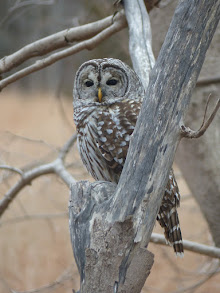
"Another wonderful thing," says Ralph of Coggeshall, "happened in Suffolk, at St. Mary's of the Wolf-pits. A boy and his sister were found by the inhabitants of that place near the mouth of a pit which is there, who had the form of all their limbs like to those of other men, but they differed in the colour of their skin from all the people of our habitable world; for the whole surface of their skin was tinged of a green colour. No one could understand their speech. When they were brought as curiosities to the house of a certain knight, Sir Richard de Calne, at Wikes, they wept bitterly. Bread and other victuals were set before them, but they would touch none of them, though they were tormented by great hunger, as the girl afterwards acknowledged. At length, when some beans just cut, with their stalks, were brought into the house, they made signs, with great avidity, that they should be given to them. When they were brought, they opened the stalks instead of the pods, thinking the beans were in the hollow of them; but not finding them there, they began to weep anew. When those who were present saw this, they opened the pods, and showed them the naked beans. They fed on these with great delight, and for a long time tasted no other food. The boy, however, was always languid and depressed, and he died within a short time. The girl enjoyed continual good health; and becoming accustomed to various kinds of food, lost completely that green colour, and gradually recovered the sanguine habit of her entire body. She was afterwards regenerated by the laver of holy baptism, and lived for many years in the service of that knight (as I have frequently heard from him and his family), and was rather loose and wanton in her conduct. Being frequently asked about the people of her country, she asserted that the inhabitants, and all they had in that country, were of a green colour; and that they saw no sun, but enjoyed a degree of light like what is after sunset. Being asked how she came into this country with the aforesaid boy, she replied, that as they were following their flocks, they came to a certain cavern, on entering which they heard a delightful sound of bells; ravished by whose sweetness, they went for a long time wandering on through the cavern, until they came to its mouth. When they came out of it, they were struck senseless by the excessive light of the sun, and the unusual temperature of the air; and they thus lay for a long time. Being terrified by the noise of those who came on them, they wished to fly, but they could not find the entrance of the cavern before they were caught."The incident described, which reportedly took place in the 12th century, has prompted various explanations, all of which seem superfluous. The town where they were found is today known as Woolpit, a corruption, but what connection if any the story may have with wolves is unclear. A laver, according to Merriam-Webster, is "a large basin used for ceremonial ablutions in the ancient Jewish Tabernacle and Temple worship."
The Fairy Mythology (1828)
Showing posts with label Enigmas. Show all posts
Showing posts with label Enigmas. Show all posts
Wednesday, April 22, 2026
Notebook: The Green Children
Thomas Keightley:


Monday, January 29, 2024
The Drifter

The Mary Celeste incident is one of the great nautical enigmas. An American merchant sailing ship is found in the Atlantic Ocean, a bit west of Portugal, with no ship's boat, a full cargo, a logbook a few weeks out of date, and no obvious evidence of fire, shipwreck, mutiny, or piracy. No trace of the crew or the passengers (which included the captain's wife and young daughter) is ever found. The ship is boarded by sailors from the Canadian brigantine Dei Gratia and brought to port in Gibraltar. After lengthy legal proceedings it is eventually reclaimed by its owners and put back into service. (Later proprietors sank it as part of an insurance scam, but that's another whole story.)
Various explanations and impostures have been put forth over the years, some of them fairly bizarre. An early one was offered, anonymously and fictionally, by a young Arthur Conan Doyle, who mistakenly called the ship the Marie Celeste (as many have done since) and imagined a tale of conspiracy involving a psychopathic ex-slave with a grudge against the white race and the missing ear of an African stone idol. Perhaps the most amusing solution was put forward by one J. L. Hornibrook:
There is a man stationed at the wheel. He is alone on deck, all the others having gone below to their mid-day meal. Suddenly a huge octopus rises from the deep, and rearing one of its terrible arms aloft encircles the helmsman. His yells bring every soul on board rushing on deck. One by one they are caught by the waving, wriggling arms and swept overboard. Then, freighted with its living load, the monster slowly sinks into the deep again, leaving no traces of its attack.I thought about the incident during a trip to a library, when, while looking for something else, I spotted the title Mystery Ship stamped in gold on a green binding and opened it on a hunch. The book, written by a historian named George S. Bryan and published by Lippincott in 1942, was indeed about the Mary Celeste. I brought it home on a lark and found that it was actually quite good, though it's apparently long out-of-print and mostly forgotten except by nautical historians. Bryan looked carefully at the original documentary evidence (much of which he reproduces), went over the various explanatory theories point by point, reprinted a good portion of the Conan Doyle, and dispelled much of the nonsense that had accreted over the years. (The ship's cat was not dozing contentedly when the Mary Celeste was found, there were no live chickens on board, nor were there half-eaten meals still warm in the mess.) His own tentative conclusion was that the ship was deliberately abandoned because the captain had reason to believe that it was in grave danger, either from shipwreck or from an imminent explosion of its cargo (which consisted almost entirely of barrels of alcohol). The line that may have tethered the single ship's boat failed to hold, and the passengers and crew drifted into oblivion.
I was aware of the story of the Mary Celeste from a fairly early age, though I never knew it in detail. This painting no doubt shaped how I imagined it. I've had a weakness for eerie nautical stories ever since.
Monday, December 04, 2023
Produce department
We're lying in bed and there's a rap on the window glass. I get up and open the window. A middle-aged couple are standing on the sidewalk and the man asks me if I have any ramps. I say yes and go to the front door to meet them. On the way there I pick up a handful of limp scallions, which I offer with an apology, saying that ramps are out of season and that's all I have. He and his wife aren't wearing masks (neither am I) but he tells me they've both had COVID. He gives me a dollar and they leave. On the way down the hall I pass the open door of another room, where a male relative is standing next to a tall wooden cabinet. The cabinet is festooned with hundreds of radishes of different sizes and colors (but mostly red), lovingly and symmetrically arranged. Where some people have knickknacks, he has radishes. And now, back to bed.
Sunday, January 22, 2023
Roadside assistance
One summer evening about twenty years ago I left work at rush hour and joined a line of backed-up traffic using the on-ramp to merge onto the parkway I took to get home. Several minutes went by before I made it to the head of the line. The compact car immediately in front of me, driven by a woman who looked to be in her thirties, had no choice but to come to a complete stop and wait for an opening, to the considerable frustration of the drivers behind us, some of whom had started leaning on their horns. I could see the woman leaning anxiously out her open side window, intently watching the cars to her left until, finally, a car moved into the center lane and let her out. The gap was small, however, and so she immediately floored it to get up to speed with the flow of the oncoming cars. What she didn't see, and had no reason to expect, was that two bicyclists, who weren't supposed to be on the parkway at all, had crept up on her right and pulled into the highway lane just in front of her.
As soon as she realized what had happened she slammed on her brakes, but the bicycles were moving too slowly and her momentum was already too great. Boxed in to her left, with only a fraction of a second to react, she had nowhere to go but over the curb to her right. Her car lurched onto the grass border, flattened a small bush, and came to rest at the base of an overpass some ten yards from the pavement.
I had kept my foot on the brake pedal while I watched all this happen, but when the lane opened up I crept out, then carefully pulled off the road onto the grass. So did the car immediately behind me, which was a tan Ford station wagon that looked like it had seen better days. The bicyclists, in the meantime, had heard tires squeal and stopped along the curb to look back. I turned off the engine, walked over to the woman's car, and asked her if she was okay. She said she was but she seemed dazed, distraught. I stepped back a bit, uncertain, half-expecting a cop to come along and sort it all out. After a moment, when nothing seemed to be happening, a heavy-set Black man in his fifties got out of the station wagon and walked, with a barely perceptible limp that suggested a painful hip, over to the woman's car. Even before I noticed the instrument case in the back of the station wagon, I had no trouble recognizing the bass player and composer Clifford Margen. I had seen pictures of him in jazz periodicals and even in a spread in Life magazine. I had a few of his records, one of which some record company marketing whiz had unimaginatively entitled Margenalia. I also knew that he had a reputation for what one writer, with no particular axe to grind, had called "truculence and unpredictability."
The woman tensed visibly as the man approached, but as soon as he spoke to her she relaxed, again said that she was okay, and leaned back against the headrest. He walked around the car once to make sure there was no damage, but by the time he got back to the driver's window he could see that she was sobbing. I couldn't make out his words, but whatever they were they seemed to help and soon she was more composed. He had her take some deep breaths and eventually she managed an embarrassed smile. When it was clear that she was all right he glared briefly at the bicyclists, who were quietly slipping off, and also at me, then got in his car, started the ignition, flipped on his four-way flashers, and crept back to the curb. He waited until the woman had started her car, then put his arm out the window to hold back traffic and let her pull out ahead of him. When they were gone I got into my car and drove off as well.
There was an office party at work the next day, and while chatting with my colleagues I told several of them about the incident. They were about evenly divided between those who shook their heads over the woman's bad driving and those who deplored the presence of bicyclists on a road where they had no business to be. Just one of them recognized the name of Clifford Margen, and he wasn't sure what instrument he played: tenor sax, maybe? Only on the way home that night did I remember what I had, in truth, known perfectly well all along, namely that Clifford Margen had been dead for twenty years, the victim of a landslide on a deserted mountain road somewhere northwest of Mexico City. Even so, I had no doubt about my identification, just as I have no doubt, even now, that there's a tan Ford station wagon somewhere out there driven by a heavy-set Black man who's heading for his next gig and rescuing travelers along the way.
Tuesday, September 13, 2022
Stateless person

Who was B. Traven? He usually claimed that, like Gerard Gales, he was an American whose documents had gotten lost. Sometimes he blamed the destruction of his birth record on the fires caused by the 1906 San Francisco earthquake. He may have even believed it, and it may even have been true, although few scholars now give the idea much credence. That he was the same person as one Ret Marut, a German actor and radical writer whose paper trail went cold in the 1920s, is no longer seriously questioned, but then who was Ret Marut? We may never know with absolute certainty.
The Death Ship was originally published in German as Das Totenschiff. The earliest English-language edition, issued in 1934 by Chatto & Windus, was translated by Eric Sutton. It was followed almost immediately by an American edition brought out by Alfred A. Knopf, of which my Collier Books edition above is a reprint. No translator is indicated inside the book. Traven, who reportedly didn't like the Sutton version, chose to translate the novel himself for Knopf, expanding it as he did so. His command of English was faulty, however. The German scholar Karl S. Guthke explains what happened:
The manuscript of The Death Ship that arrived in New York in 1933 was couched in an English that would have raised the eyebrows of most readers. As Knopf editor Bernard Smith reported, the text was so Germanic in vocabulary and syntax that it could never have made it in to print. And for good reason: Traven himself had translated the novel (as he was to translate the other novels Knopf would bring out), at the same time giving free rein to his lifelong passion for rewriting, cutting, and inserting new material. Knopf asked Traven to agree to a revision by Smith. Traven asked for sample pages and was favorably impressed. After instructing Knopf that only grammatical, syntactic, and orthographic changes were to be made, he authorized Smith to rework the entire manuscript. "This entailed treating about 25% of the text," Smith recalled. "In any given paragraph there was sure to be at least one impossibly Germanic sentence, and sometimes an entire paragraph had to be reconstructed." Smith stressed that his contribution in no way involved what could be considered literary or creative work on the three novels he revised. He had merely turned Traven's translations into acceptable English. It was clear to Smith from the beginning that English was not the translator's mother tongue; the syntactic thread was German, and even in Smith's reworked version the German original rears its head from time to time.The treatment of American place-names in the Traven-Smith version is a bit off. Referring to Wisconsin familiarly as "Sconsin" might just slip by unnoticed, but Chicago is casually referred to as "Chic," Cincinnati as "Cincin," and, least likely of all, Los Angeles as "Los." Other than that and a few eccentric colloquialisms the novel doesn't particularly "read like a translation" at all. Weirdly, it winds up being a work of American literature.
B. Traven: The Life Behind the Legends
Traven, who would stubbornly maintain the fiction that his novels were originally written in English, allowed his German-language publisher, Büchergilde Gutenberg, to issue a new German "translation" in 1937 based on the Knopf version.
Sunday, August 28, 2022
Literary services
I've been assigned to escort a famous poet to a public reading in Princeton, New Jersey. We are to meet in Grand Central Station before transferring across town to catch a southbound train, but I've neglected to arrange an exact rendezvous with Famous Poet, whose number isn't in my phone. I wander about looking for him, but the terminal is an enormous bazaar covering acres and acres, and it's hopeless to try to locate one person in such an intricate and crowded space. Parts of the bulding have been torn down or have fallen into ruins; on the levelled ground earth-moving machines are preparing the foundation for new structures to come. I select a name from my list of contacts, a colleague who would be likely to have Famous Poet's number, but the person who answers is a stranger who knows nothing about it. I call my boss but he can't help; he is alarmed that we aren't already on the way.
Finally I spy Famous Poet near the ticket booth. He is distraught and tears of rage are streaming down his face. There's no question of continuing; the reading will have to be rescheduled.
Thursday, March 03, 2022
From the Archives: A Letter
The post below was posted in a different venue in 2006; I'm dusting it off in honor of Michael Leddy's post at Orange Crate Art.
I've never read Rose Macaulay's novel The Towers of Trebizond and I suspect that I'm never going to get around to it. But I still have the hardcover copy that I bought at a used book sale a number of years ago, and I'm not quite ready to give up on it. That's only partly because everything I've ever heard about the book is positive; when you come down to it, I suspect, the book is probably not really my thing at all. The real reason I'm hanging onto it is the following letter, which I found neatly folded inside the front cover when I bought it.
TELEPHONE: TEMPLETON 8-7440
CABLES - SECNARFS, NEW YORK
654 MADISON AVE
NEW YORK, 21, NEW YORK
April 6, 1959
Mr. James H. Sachs
Bedford, New York
Dear Jimmy:
It was so sweet of you to think of us and to introduce us to the Schaffners. As the result of The Tower of Trebizond we are going to get a wonderful trip to Europe.
We are sailing with them on the Giulio Cesare on the 9th and will see Ravello, Sicily and trans-Appenine Italy. Mr. Schaffner thinks that he can enjoy me more completely on board. I don't know just what it means but it sounds alarming. Thanks so much. If I survive maybe I will send you a postal card.
Sincerely yours,
Rose
Rose Macaulay
At first sight this seems like the kind of witty missive a cosmopolitan, well-educated older British woman like Macaulay might have written to a social acquaintance in the mid-20th century. The hint of naughtiness in the second paragraph, the learned reference to “trans-Appenine Italy,” the British “postal card,” instead of “postcard,” all seem fit to type. But there's a problem: the date. Rose Macaulay died on October 30, 1958, a full five months before the letter was supposedly written. Moreover, as far as I have been able to determine, she was not in New York at any time in the last months of her life, making a simple dating mistake of a year or so (but how likely would that have been anyway?) less than probable.
The closer I examine the letter, the less genuine it seems. The date is in American style, not British. The title of the book is wrong — it's Towers not “Tower,” and in fact what the correspondent originally typed was “Trevizone”; the correct spelling is overwritten in pencil. (It's true that the errors involve contiguous pairs of letters on the keyboard, so it's possible she — whoever she was — was simply a bad typist.) And why would the real Rose Macaulay write gratefully of the prospect of “a wonderful tour of Italy” as if she were not a seasoned, independent traveler herself?
If the letter is not really by Rose Macaulay, and it seems very doubtful that it is, then two possibilities come to mind. The first one, unlikely but consistent with the signature, is that it was written by another woman named Rose Macaulay, who somewhow, as the “result” of the odd coincidence of her name with that of the famous author, was invited to see some of her namesake's old stomping grounds.
The other possibility is that the writer of the letter was not named Rose Macaulay at all. She was simply a woman who, perhaps as the outcome of a conversation about The Towers of Trebizond, was invited to Europe by a wealthy couple she had just been introduced to. The signature, then, would have been just a little joke for the benefit of “Jimmy.”
In either case, I wonder if she survived the trip.
Update: The James H. Sachs to whom the letter was addressed appears to be the individual of that name who was one of the founders of Newsweek and later a publisher of Horizon magazine. He also donated a few acres of land to a preserve where I occasionally hike. If the identification is correct he died in 1971. The New York Times obituary is here.
Tuesday, February 22, 2022
A Buried Book

A book was found within deposit 3001, located immediately south of the southern ditch section, and approximately 0.23 m below the present ground. The book was a buckram bound copy of Demonology and Witchcraft by Walter Scott, published in 1831 (Plate 4.5). The inside front cover was daubed with red ink and crudely inscribed with the words 'Demon de Uffing'. Some decay was evident to the cover and the edges of the pages although it was generally in very good condition. Its state of preservation may well have been due to the surrounding matrix of chalk and soil, which maintained a dry environment. The excavator was confident that the ground around the location of the book's burial had not been recently disturbed, and therefore a pre-excavation joke by persons unknown was ruled out. In theory the book could have been deposited during the 19th-century excavations, but it is more likely that its burial is related to one of the more recent revivals in the mystical aspects of the White Horse and its surroundings.Related posts:
D. Miles et al., Uffington White Horse and Its Landscape: Investigations at White Horse Hill, Uffington, 1989-95, and Tower Hill, Ashbury, 1993-4
Up in the Downs
The Lay of the Hunted Pig
Friday, February 11, 2022
Bookseller's Nightmare
A prim middle-aged woman steps up to the counter and asks if we have any books by the novelist Catherine Cookson. I say I don't think so but I agree to check the shelf and the stockroom. No Catherine Cookson. She would like to order some. I reach for Books in Print, but the volumes we have on our reference shelf are decades old and the authors volume is missing anyway. I switch on the microfiche reader. The information that is displayed on the screen has nothing to do with books. Instead, there are a series of street-level views of a city, and I can't even find the intersection I'm looking for. In the meantime, someone has set down a plateful of very appetizing-looking chocolates next to the microfiche reader, but who knows when I'll have a chance to try one.
Thursday, February 10, 2022
Curiosity Cabinet
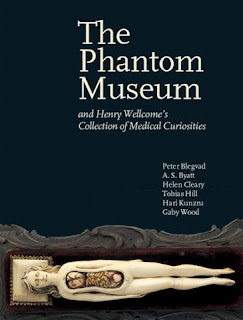
The Wellcome Collection is (or was) a vast assemblage of objects related to the history and anthropology of medicine. As one might expect, many of the objects are gruesome or bizarre. Henry Wellcome, who amassed the objects, died in 1936, and after his death much of the collection was apparently dispersed, though some of its holdings became accessible to the public in 2007. The editors explain the concept:
This book forms a companion volume to the catalogue of an exhibition on Henry Wellcome's collection held at the British Museum in the summer of 2003. The aim of the exhibition was to reunite a fraction of the collection back in one place. The exhibition catalog endeavours to present the facts of the collection, exploring its objects through documents and physical evidence. Here, in The Phantom Museum, the objects are investigated using a different method, that of the sympathetic imagination.Each of the six pieces in the volume is inspired by one or more of the Wellcome's objects. A. S. Byatt is the most familiar name among the writers. Peter Blegvad contributes an unclassifiable piece, but my favorite is a deft short story entitled "The Venus Time of Year," which follows two women, one modern and one in Roman Britain, who both have recourse to votive offerings in the form of a fertility figurine. Admirably, it doesn't try to do too much or look too far ahead in the women's lives. Of the author, the back flap notes, "Helen Cleary lived in Singapore, Wales and East Anglia before moving to London. She is working on her second novel and writes non-fiction for the BBC History website."
Oddly, I've found no evidence that either of the two Helen Cleary novels mentioned was ever published, nor any indication that she has published any additional fiction. She didn't disappear; she apparently has contributed to several documentaries and reference books.
In conjunction with the British Museum show, the Quay Brothers released an eccentric short documentary about the collection, which is also entitled The Phantom Museum.
Wednesday, December 08, 2021
Purgatorio
I'm walking in the woods at night in the company of Willie McTell. I see three deer standing a few yards away; somehow, in spite of his blindness, McTell is aware of their presence and able to describe them to me. What he doesn't realize is that a half-grown mountain lion has stepped out from among them and begun to approach us.
We climb a series of concrete steps that ascend to an unseen waterfall somewhere ahead. Far below, on the right, is a broad expanse of seething whitewater. The cat is hard on our heels now, drawn by the smell of the sausages I'm carrying wrapped up in deli paper. McTell knows he's there but doesn't seem overly alarmed, and refers to him, jokingly, as "Kitty." Behind us, silently, the mountain lion's parents have begun to follow.
As we climb, the cats press closer and closer to us, bumping us and sniffing at our hands. One opens its mouth tentatively, but for now doesn't bite down. In desperation I unwrap the sausages and drop one on the steps behind us; it rolls off and into the torrent below. The adult male instantly leaps the railing and lands safely on a rock. We leave it behind and continue to climb. I drop the sausages one by one until we're alone. I know that McTell will be disappointed later about losing the sausages, but he'll understand when I explain.
Monday, December 06, 2021
Monday afternoon
I stepped into a little café that was simply a small room with a counter in the rear and a table on either side of the door. The woman behind the counter gestured for me to sit and brought me a menu, which listed just two or three choices. I ordered tea and a pear torte, which turned out to be a delicious warm mélange of fruit and cream swathed in puff pastry, and which was accompanied, for some reason, by a ficelle in a wax bag. When the bill came I was a bit surprised to see that the total came to $60, but even as I reached for my wallet a man strode out of the kitchen, picked up the bill, looked at it, frowned, then began a heated argument with the woman that I couldn't follow, as it was conducted in a language I couldn't identify. I broke off a piece of the ficelle, which was also quite tasty, and waited for the outcome.
Thursday, October 21, 2021
Visitors
A posh tour bus pulls up outside our house and discharges a group of North Koreans and American supporters, who barge in through our front door carrying books and brightly-colored papier-mâché animals as gifts. Some of the North Koreans carry automatic weapons; there are also some children. I round everybody up and make them leave, then call the police. The police already know about it; they say the tour bus is going all around the country like that and not to worry. When I look at some paperwork tucked into the books I realize that they were bought from a former employer.
Monday, August 26, 2019
Ode

The larger the scale, the more predictable the world is. The planets and stars move on determined courses, the earth revolves, day becomes night, the seasons change, all obeying established patterns. The closer you focus, the murkier it becomes. Will it rain tomorrow? Will it be a harsh winter? Will the breeze blow down the last leaf this morning, or the next?

And then there are phenomena — things appearing to view. We can predict comets — some of them, at least — but not every flash of a meteor shower. We can't be sure of the consequences of all of our own actions, though with some the baneful results are easy enough to foresee. And why does a bird appear one evening, and not the next? They obey their own unknowable laws, and cross through our vision only by accident.

And yet that's too facile. We ourselves are on unpredictable courses, and our fellow beings are inextricably mixed up in ours, for better or worse. The bird at top is no wild thing but someone's racing pigeon, and bears a band of human possession. I saw it two days in a row at the same location on the summit of a nearby dam. It showed no fear of me, and perhaps was lost, or maybe it was just resting before heading home. On the third day it was gone.
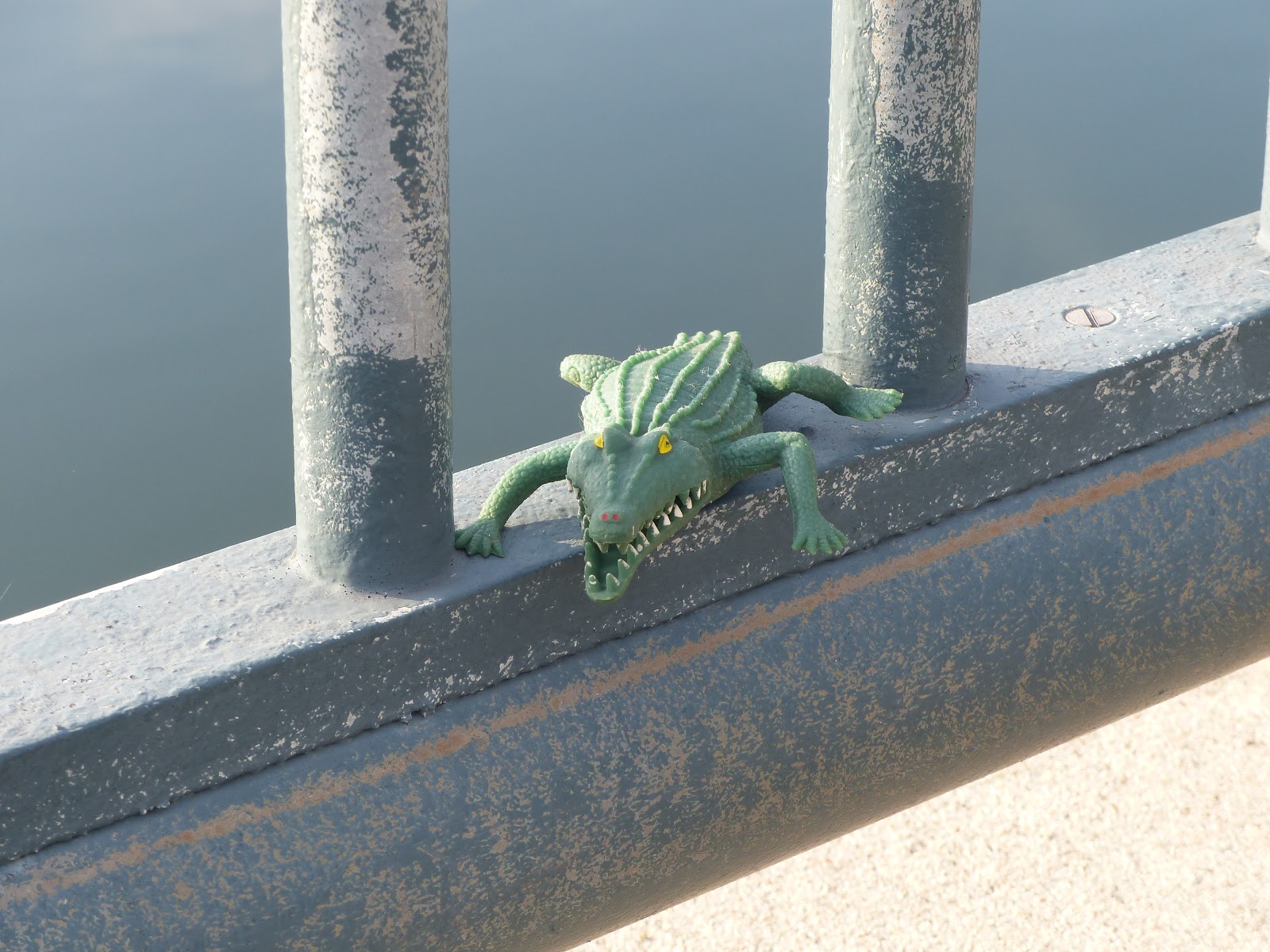
As for the last creature, I found it on its back, not far from the dove, and set it aright, for someone else to ponder.
Thursday, August 01, 2019
The Folks Back Home

It's very difficult, at least for me, to make out the long inscription on this Real Photo postcard, but the language is apparently German, and it may be from Switzerland. It shows three women, two men, a boy holding a gun, and a dog, posing in a group in front of a vine-covered cottage. There's a flourishing garden in the foreground, possibly including poppies, and a whole social history in the hats the figures wear, no two of which are alike.

The very few bits I can make out in the inscription on the reverse of the card include the names Meinhof and Dietrich and a reference to an address of (I think) Kapellenstr[asse] 31, which might be in Bern or Basel. The most intriguing is a reference to America, including the name of the state of Kansas in parentheses. Perhaps some of the family members were now living in the New World.

Just a few scratch-marks in ink now, but they were presumably perfectly legible to the recipients, whoever they may have been.
Postscript: When I came up with a title for this post perhaps I had in mind these lyrics by Peter Blegvad:
I sent a card to the folks back home
a picture of a burning aerodrome
it came back stamped: address unknown
I was alone
in the meantime
Monday, May 13, 2019
"Mala Cosa" (Cabeza de Vaca)
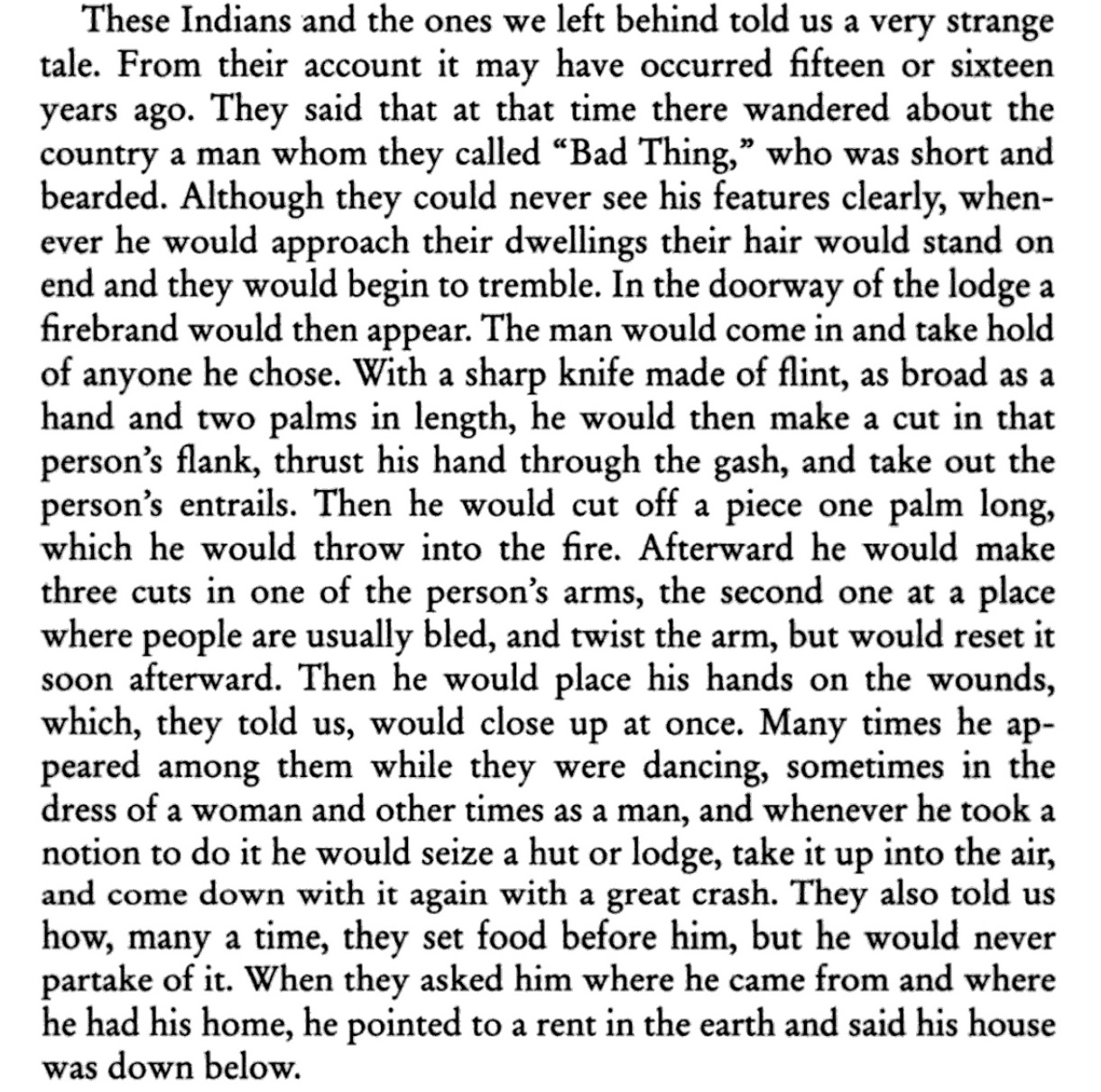
The Spanish explorer Álvar Núñez Cabeza de Vaca recounts an incident that was related to him by Native Americans he encountered during his long sojourn across the southern US and northern Mexico:
Narrative of the Narváez Expedition, edited by Harold Augenbraum.
Cabeza de Vaca was one of a handful of survivors of a 16th-century expedition to Florida that went catastrophically wrong. The accuracy of his account of his travels on many points has been questioned, but few things in it are as difficult to believe as the one thing that is unquestionably true, which is that he and three other men did survive eight years wandering among various Native American peoples before finally meeting up with a group of his countrymen near Culiacán in Sinaloa. Along the way he found himself cast in the role of faith healer, and claimed to have performed countless miracles on ailing (and very grateful) Indians.
The passage above has been much pondered. It appears to record some kind of shamanic performance reminiscent in some ways of modern "psychic surgery" cons and fortune-telling bujo scams. How the Indians understood what they told Cabeza de Vaca, and how it differed from what he recorded, is impossible to say. It's the oddest passage in the book.
Monday, April 30, 2018
Tower
In the office on the 73rd floor, high above the city, the president of the company passes me a handful of letters to mail and a note with the deli order for lunch. "Quickly!," he shouts, and I rush to the elevator, which swiftly descends the great steel and glass tower until its doors open at the ground floor. A rush of wind hits me as I exit through revolving doors, and the letters are blown from my hand and scattered. Pedestrians hurrying in and out of the building trample the letters and leave their footprints on them. I gather them up and enter the deli, but there's a crowd ahead of me struggling to be served and in the confusion I drop the letters again. Now they're torn, soiled with beef blood and grease. I run outside looking for a mailbox, for a place to wash my hands, but all in vain...
Sunday, April 08, 2018
On Friendship (Elena Poniatowska)

Elena Poniatowska's Leonora is a biographical novel that closely follows the eventful life of her longtime friend, the artist and writer Leonora Carrington, who, like Poniatowska, was European-born but Mexican by choice or accident. (Carrington died in 2011, aged 94, and Poniatowska, one of Mexico's most distinguished writers, is now in her mid-80s.) In the early 1940s, following the fall of France and a traumatic stay in a mental institution in Spain, Carrington migrated to New York City alongside a host of artistic luminaries, including her former lover Max Ernst, who by that time was romantically involved with the wealthy arts patron Peggy Guggenheim. Poniatowska's chapters covering this period are peppered with the familiar names of her fellow emigrés Marcel Duchamp, André Breton, Luis Buñuel, and Marc Chagall, but the appearance of one name in particular caught my eye. Carrington and Ernst remain close, and often spend the day together exploring Manhattan. Poniatowska writes:
They wandered the shores of the Hudson, along which steamed long freighters that Bell Chevigny saw pass by from her window on Riverside Drive.Chevigny is not otherwise identified, and in fact never mentioned again, but I recognized her name, because many years ago I took a college course taught by one Bell Chevigny, a literary scholar and the author of a biography of Margaret Fuller. She would have been a young girl in the 1940s, and as far as I know had no direct connection to Carrington and the surrealist exiles in New York. So what is she doing in the pages of Leonora? One of her other areas of interest is modern Latin American literature (as it happens, I translated a few pages for a book on the subject that she co-edited) and she and Poniatowska have apparently known each other for years. Perhaps Poniatowska remembered Chevigny telling her how the ships would pass by her family's window when she was a child, and slipped her name into the text by way of a friendly wink.
Monday, September 18, 2017
The owls

I was walking on a quiet back street in the next town north. Some twenty feet up in the branches of a great oak that rose up next to the sidewalk I caught sight a family of owls — two parents, and a fledgling — then saw three more owlets sheltered in a hollow at the base of the tree, peering out at me as I approached. That the owls were visible in broad daylight was not as remarkable to me as was the fact that they were sharing their quarters with a comparably-sized family of cats, who played and curled up with the little owlets, tails and wings fluttering and shaking together as I watched, as if nothing could have been more natural.
I hadn't brought my camera with me. I ran home — a distance of some five miles — and when I returned again I took a wrong turn down a parallel street. A Frenchman approached, seeing my camera and indicating his own which he carried around his neck, and asked me a highly technical question regarding photography. As I am essentially an ignoramus in that regard I apologized and said that I couldn't help him, but as compensation I offered to lead him to the tree, where he was sure to find a promising subject for his lens. We walked the few blocks that remained, but when we arrived we learned that the health department had ordered the people who owned the cats to send them away, as their presence was deemed a threat to the vulnerable owls. There was nothing left for the Frenchman and I to do except shake hands and exchange our farewells.
Image by Toshi Yoshida.
Sunday, June 11, 2017

Subscribe to:
Posts (Atom)