Showing posts with label Notebook. Show all posts
Showing posts with label Notebook. Show all posts
Wednesday, October 07, 2026
Written before sunrise
I wake up early by habit and by nature, using no alarm. In part this is because I turn in early as well, but in truth I've just never had much aptitude for sleep, tossing and turning and waking up multiple times, and the quiet early morning hours are my most productive time of day. I also have a prejudice against using artificial light in the morning, which means, by this time of year, that I'm generally waking up during the period of what is called astronomical twilight and that I get out of bed during the phase known as nautical twilight, with an hour or so still to go before the sun actually rises. If I put up the window shades a bit there's enough moonlight and ambient light to find my clothes in, and I press the on button on my phone to give me enough light to make my way downstairs without falling over the dog, who is mostly black, or the cat (in the night all cats are black). The refrigerator light, when I reach in for cream, is a bit blinding at this hour, and when I open the laptop I realize that I have no idea how the keyboard lights up, but it does. By 6:30 AM I can see the changing colors of the trees outside, and grazing deer if there are any (there aren't).
The temperature has dipped into the thirties overnight, although a frost isn't expected for at least a couple of weeks, even here in southern Maine. I also have a prejudice against turning the heat on in the morning, for as long as I can stand it, so in the coming months the temptation to stay in bed in the dark will be greater. But now the sun is about to rise and it's time to stop.


Sunday, May 10, 2026
Notebook: Chloe Dalton

If I had an addiction, it was to the adrenaline rush of responding to events and crises, and to travel, which I often had to do at a few hours' notice. I avoided fixed plans that would remove the flexibility to take a bag and go, and what I missed of holidays and family occasions I believed I gained in novel, unrepeatable experiences and exposure to parts of the world I might otherwise never have seen: glimpses of Bamako, Baghdad, Kabul, Algiers, Damascus, Ulaanbaatar, Tallinn, Sarajevo and Siem Reap.The precipitating factor in her book is the COVID pandemic, which grounds her, exiles her from her urban rounds, and confines her to a converted barn somewhere in the countryside that she has been slowly restoring. She finds a leveret — a baby hare — that has apparently been abandoned or orphaned, and decides to take it in, although no one seems to have much information about how to foster a leveret or even about whether it can be done at all. Though she feeds it with a pipette, she refuses to regard it as a pet and never names it. Surprisingly, the animal survives and soon makes itself at home. Eventually allowed to come and go at will, it wanders the nearby garden and fields, bears several litters of young (we — and Dalton — only then learn that it's a female), but still likes to come in and lie by the fireside. Apparently hares are notably clean and instinctively house-trained, and the greatest damage it does is to chew through some computer cables.
I see lots of rabbits in my perambulations, but my only experience of hares — except, perhaps, in a zoo — was during a bus ride one spring through the Berkshire Downs, where I witnessed from a distance the sparring and dancing of their mating season that gave rise to the expression "mad as a March hare." Anyone writing about hares is quick to point out that they aren't rabbits, and are very distinct in form and behavior. Oddly, the staff at the Library of Congress doesn't seem to have gotten the message. Here is the CIP (Cataloging in Publication) subject data from the copyright page of the Vintage Books edition:
Subjects: LCSH: European rabbit—Great Britain—Popular works. | European rabbit—Great Britain—Anecdotes. | European rabbit—Behavior—Great Britain—Anecdotes. | European rabbit—Infancy—Great Britain—Anecdotes. | Human-animal relationships—Popular works. | Dalton, Chloe.I've been somewhat skeptical about attempts to cross the human-wildlife divide (see earlier post), but Dalton's book effectively makes the case that the divide isn't necessarily absolute, if one respects the fundamental nature of the animal in question. She doesn't domesticate the hare (it can't be done), and only partially "tames" it, but it accepts and values her presence and, perhaps of equal importance, re-centers her perspective on the relationship between human beings and the other inhabitants of the planet.
Wednesday, May 06, 2026
Notebook: The Use of Learning
Henry Fielding:
Booth, as the reader may be pleased to remember, was a pretty good master of the classics; for his father, though he designed his son for the army, did not think it necessary to breed him up a blockhead. He did not, perhaps, imagine that a competent share of Latin and Greek would make his son either a pedant or a coward. He considered likewise, probably, that the life of a soldier is in general a life of idleness; and might think that the spare hours of an officer in country quarters would be as well employed with a book as in sauntering about the streets, loitering in a coffee-house, sotting in a tavern, or in laying schemes to debauch and ruin a set of harmless ignorant country girls.
Amelia
Wednesday, April 22, 2026
Notebook: The Green Children
Thomas Keightley:
"Another wonderful thing," says Ralph of Coggeshall, "happened in Suffolk, at St. Mary's of the Wolf-pits. A boy and his sister were found by the inhabitants of that place near the mouth of a pit which is there, who had the form of all their limbs like to those of other men, but they differed in the colour of their skin from all the people of our habitable world; for the whole surface of their skin was tinged of a green colour. No one could understand their speech. When they were brought as curiosities to the house of a certain knight, Sir Richard de Calne, at Wikes, they wept bitterly. Bread and other victuals were set before them, but they would touch none of them, though they were tormented by great hunger, as the girl afterwards acknowledged. At length, when some beans just cut, with their stalks, were brought into the house, they made signs, with great avidity, that they should be given to them. When they were brought, they opened the stalks instead of the pods, thinking the beans were in the hollow of them; but not finding them there, they began to weep anew. When those who were present saw this, they opened the pods, and showed them the naked beans. They fed on these with great delight, and for a long time tasted no other food. The boy, however, was always languid and depressed, and he died within a short time. The girl enjoyed continual good health; and becoming accustomed to various kinds of food, lost completely that green colour, and gradually recovered the sanguine habit of her entire body. She was afterwards regenerated by the laver of holy baptism, and lived for many years in the service of that knight (as I have frequently heard from him and his family), and was rather loose and wanton in her conduct. Being frequently asked about the people of her country, she asserted that the inhabitants, and all they had in that country, were of a green colour; and that they saw no sun, but enjoyed a degree of light like what is after sunset. Being asked how she came into this country with the aforesaid boy, she replied, that as they were following their flocks, they came to a certain cavern, on entering which they heard a delightful sound of bells; ravished by whose sweetness, they went for a long time wandering on through the cavern, until they came to its mouth. When they came out of it, they were struck senseless by the excessive light of the sun, and the unusual temperature of the air; and they thus lay for a long time. Being terrified by the noise of those who came on them, they wished to fly, but they could not find the entrance of the cavern before they were caught."The incident described, which reportedly took place in the 12th century, has prompted various explanations, all of which seem superfluous. The town where they were found is today known as Woolpit, a corruption, but what connection if any the story may have with wolves is unclear. A laver, according to Merriam-Webster, is "a large basin used for ceremonial ablutions in the ancient Jewish Tabernacle and Temple worship."
The Fairy Mythology (1828)
Sunday, October 19, 2025
Autumn

In the meantime, the political condition of the country is as bad as it's been in my lifetime, and there seems to be no prospect of improvement in the offing. The people holding the reins are not only corrupt and sociopathic but actually grotesque; that many of us are endorsing this or accommodating ourselves to it is the surest indication that the republic as a whole is politically and morally dead. We no longer seem able to discern right from wrong or true from false, but that's hardly surprising when our public and private lives are increasingly given over to fakery and superficiality. (End of screed.)
And suddenly the seasons have changed. In spite of some lovely mild October weather, I'm waking in the dark and in the cold now. Afternoons still linger a bit but that will change when we turn the clocks back. After a seemingly endless (and mostly rainless) summer it's hard to wrap my head around the idea that it will be half a year before I can start planting things outdoors again.
The corn and peaches are gone from the local farmstands and weekend markets, but there are pumpkins and winter squashes and beautiful apples in abundance. I've broken out the first Dickens for winter reading and the jigsaw puzzles await patiently in their cardboard boxes.
The wild turkeys above are from a group of twelve that overnighted in a local graveyard. Just down the road at our favorite local farm there's a small flock of their white domestic cousins enjoying their last weeks of life before Thanksgiving. The world turns, and the harvest goes on.
Wednesday, January 24, 2024
Notebook: James Boswell Imitates a Cow
John Brewer, describing a night at the Royal Drury Lane Theatre in 1769:
During the hour before the curtain rose the theatre was filled by what a bemused German visitor, von Archenholz, called ‘noise and bombardment’: the audience chatted, cheered and sang, threw fruit at one another, flirted and preened themselves. A few years earlier James Boswell, waiting with a Scottish friend for a Drury Lane performance to begin, ‘entertained the audience prodigiously by imitating the lowing of a cow.’ As he later proudly remarked, ‘I was so successful in this boyish frolic that the universal cry of the galleries was “Encore the cow! Encore the cow!”’
The Pleasures of the Imagination
Tuesday, October 31, 2023
Welcoming committee

The mid-fall Maine weather has been far warmer than advertised, with temps grazing 80, and for several days the side of our house swarmed with ladybird beetles and assasssin bugs. The latter weren't living up to their name, perhaps because they know that the beetles are somewhat toxic; the two species crawled around each other, pursuing their separate interests.
Then last night, around 8:30, an owl started hooting outside and kept it up for roughly a half-hour. The noise kept setting off our dog, and finally I took him out for a look. The bird, probably a great horned owl, was clearly visible in the top of a tree just across the street and was undisturbed by our presence. It flew off eventually but made a brief return just after dawn.
Sunday, August 06, 2023
August notebook
Here's a little object lesson in the compartmentalization of modern life. One afternoon we went out for a drive and as we headed to our car we looked back and saw our striped cat watching us from the window of our second-floor apartment, as she sometimes does. It took a moment before we realized that it wasn't our window at all, but the window of the adjacent apartment, whose occupants we haven't met, and that the striped cat wasn't our striped cat but an apparently identical one belonging to our neighbor or neighbors. Unlike the numerous dogs in the building, who see each other outside and hear each other barking from time to time, the two cats live parallel lives in cubicles a few feet apart, presumably in utter ignorance of each other's existence.
***
Mysteriously, we've been followed by dragonflies ever since we moved in. When we drive out of the parking lot we often see one hovering over our windshield, as if checking us out, and sometimes we find what we can only assume is a different dragonfly greeting us when we get out of our car at our destination. They're said to be an omen of good luck — and a symbol of Japan, whatever that might entail for us. Today a meadowhawk (many dragonflies have wonderful, vivid names) approached me while I was out walking, settled on my hand, and stayed there for some time. It chose my camera hand, but I managed to slip the other in my left pocket for my cell phone and take a picture.

Friday, March 25, 2022
Honest Things
Eleanor Clark, on the Oysterman's Cooperative building in Brittany, where "there is just about everything there you could ever need in oystering, from women's dark blue canvas pants and the beautiful fishermen's blouses up to the heaviest cable":
A lovely store, in which nothing has been advertised, nothing is packaged, no patronage is solicited, no brainwashing is done, no profit is to be made and therefore it is most unlikely that anything bought will break or otherwise go to pieces the first time it is used. Oh, the long-lost delight of this decency! For the general American public there is nothing left that begins to approach it but the small-town hardware store, where a nail is still a nail and had better be a good one, and there is apt to be a good deal of junk and vanity even there. Besides, in this place with its crude heavy counters and air of a warehouse, the aura of the single trade, of the beau métier with all its sea-depths and adventure, hangs around every item, for not a bolt or rope or pair of gloves there is meant for any other purpose, and it is remarkable what beauty it casts over everything. Beauty depends after all on what you come from, what you are being cleansed and relieved of, and in the pass we are in nowadays an American lady of the buying type might be tempted to come away from this place with a batch of pulleys, the way her grandmother acquired a little replica of the Venus de Milo.Clark was writing in the early 1960s, and no doubt many things are different now. Except for The Oysters of Locmariaquer and Rome and a Villa, her books seem to have gone out of print. She moved in Trotskyite circles for a time and apparently knew the man himself, if briefly, in his Mexican years; later she married Robert Penn Warren.
But no, that wouldn't do, would it? The beauty of all these honest things, aside from their fine conjunction of textures, is in their being together and being there, not somewhere else, in the above-mentioned association, in the simple appropriateness of it all. It is not to be bought; the poor lady will have to go back to the square, with its tasteless souvenirs.
Sunday, October 31, 2021
Notebook: Home Fires
Sir James George Frazer:
Not only among the Celts but throughout Europe, Hallowe’en, the night which marks the transition from autumn to winter, seems to have been of old the time of year when the souls of the departed were supposed to revisit their old homes in order to warm themselves by the fire and to comfort themselves with the good cheer provided for them in the kitchen or the parlour by their affectionate kinsfolk. It was, perhaps, a natural thought that the approach of winter should drive the poor shivering hungry ghosts from the bare fields and the leafless woodlands to the shelter of the cottage with its familiar fireside. Did not the lowing kine then troop back from the summer pastures in the forests and on the hills to be fed and cared for in the stalls, while the bleak winds whistled among the swaying boughs and the snow-drifts deepened in the hollows? and could the good-man and the good-wife deny to the spirits of their dead the welcome which they gave to the cows?
The Golden Bough
Sunday, March 14, 2021
Notebook: Stephens at Palenque

There was no necessity for assigning to the ruined city an immense extent, or an antiquity coeval with that of the Egyptians or of any other ancient and known people. What we had before our eyes was grand, curious, and remarkable enough. Here were the remains of a cultivated, polished, and peculiar people, who had passed through all the stages incident to the rise and fall of nations; reached their golden age, and perished, entirely unknown. The links which connected them with the human family were severed and lost, and these were the only memorials of their footsteps upon earth. We lived in the ruined palace of their kings; we went up to their desolate temples and fallen altars; and wherever we moved we saw the evidences of their taste, their skill in arts, their wealth and power. In the midst of desolation and ruin we looked back to the past, cleared away the gloomy forest, and fancied every building perfect, with its terraces and pyramids, its sculptured and painted ornaments, grand, lofty, and imposing, and overlooking an immense inhabited plain; we called back into life the strange people who gazed at us in sadness from the walls; pictured them, in fanciful costumes and adorned with plumes of feathers, ascending the terraces of the palace and the steps leading to the temples; and often we imagined a scene of unique and gorgeous beauty and magnificence, realizing the creations of Oriental poets, the very spot which fancy would have selected for the "Happy Valley" of Rasselas. In the romance of the world's history nothing ever impressed me more forcibly than the spectacle of this once great and lovely city, overturned, desolate, and lost; discovered by accident overgrown with trees for miles around, and without even a name to distinguish it. Apart from everything else, it was a mourning witness to the world's mutations.Unlike many early observers who attributed the ruins to a civilization originating in the Old World, Stephens ultimately concluded, correctly, that the builders were the ancestors of the same Maya people who still inhabited the region. I visited several of the sites, including Palenque, in 1980, by which time conditions for travelers, distinctly rough in 1840, were vastly improved. The fine Dover editions of the four volumes of Stephens's travels are still in print.
Tuesday, September 22, 2020
At the equinox
This ill-starred year grinds towards its end but still has ample time to accumulate additional misfortunes. My body remains on summer schedule, attuned to neither the clock nor the sun. I lie in the dark and wait for signs of daylight, then rise and perform the little rituals of waking up the house. I draw curtains open, put water on to boil, make breakfast. Outside I've already pulled up the tomatoes and summer squash, and the okra is bearing more slowly as the daylight dwindles and temperatures begin to drop. I wrap up the butternut squash fruits in pillow-cases at night to keep the deer from eating them before they're ready to cut off the vine. The resident hummingbirds still buzz around their feeder, but the swallowtail butterflies that feasted on our zinnias all summer have moved on.
Gardening plans, early morning walks, things not accomplished, will have to be deferred. There's a sense, in general, of being balanced on the cusp — but of what? Winter's grim days and long nights can't be avoided, and spring now seems very far away.
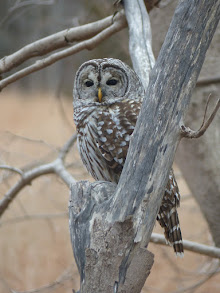
One late afternoon I came across a barred owl at the edge of a wood. I wasn't looking for it, nor it for me. It settled on a branch and looked me over, but not so intently that it couldn't be distracted by a hawk calling in the distance. Somehow it will probably make its way through the winter. I'll keep an eye out for it next year.
Subscribe to:
Posts (Atom)