Showing posts with label Tales. Show all posts
Showing posts with label Tales. Show all posts
Tuesday, February 04, 2020
The Limit
Years ago, a friend from grad school and I decided to spend most of one summer rambling around rural New England on foot. Sergei had been born in what was then still the Soviet Union and was studying engineering (he later pioneered a mechanism that greatly increased the efficiency of wind turbines). I was studying environmental science but had no clear career path in mind, nor would I for some time thereafter. We both figured that it wasn't going to be long before we got sucked up into some kind of corporate or academic drudgery that would keep us occupied for years, and that this might be our last chance for anything resembling freedom. Sergei wasn't even all that interested in the outdoors, but he had an adaptable character and was equally happy spending his days walking a rural road in the Northeast Kingdom as he was watching television in his dorm room or tinkering in the engineering lab.
We were both agreed that we wanted to avoid the well-traveled trails, even if that meant going out of our way or missing some of the scenic high points. We also took care not to venture too far from civilization, since our provisions were limited to whatever we could carry on our backs. We could go a day or two on trail mix and the like if we had to, but when ever possible we would load up on bread and cheese at some local store in the towns we passed along the way. Foraging wasn't something we had any inclination or background to engage in, although we did eat our share of berries we found along the roadside.
In order to minimize the weight we had to carry we didn't bring a tent, just our sleeping bags and some sheets of plastic that we thought might keep us dry but never did. Luckily it was a dry summer and most of the time we managed to find shelter of some kind when it rained. Here and there we were offered a bed for the night by people we met along the way, but we usually declined. Somehow we managed to wander from western Connecticut up through the Berkshires, across the Green Mountains and through New Hampshire into central Maine, before circling back through eastern Massachusetts and heading home, without getting eaten by bears, bitten by rattlesnakes, or murdered by psychopaths, and we were even still speaking to each other when it was all over.
I'm a lifelong insomniac, and although my symptoms abated a bit under the daily routine of trekking ten miles or more a day, I was never like Sergei, who could plod along from sunup to sundown without ever appearing tired but then for want of a better bed could sink into an apparent coma leaning against a tree when he finally came to a stop. Sometimes I fell asleep easily enough, but after an hour or so I would wake into a miserable combination of exhaustion, anxiety, and exhilaration in which I often lingered until the first grey beginnings of dawn. I would wake in the morning sore and depressed, though I bounced back soon enough once I stretched my legs and had a bite to eat.
One evening, not long after we crossed the upper Connecticut River into New Hampshire, we left the road and went off into the forest a half-mile or so to find a sheltered place for the night, not wanting to be too obvious about it since we were presumably trespassing. We found a little clearing where the undergrowth had been nibbled down by deer and spread our sleeping bags out under the stars, which on that moonless night were as brilliant and abundant as I had ever seen them. It was comfortably warm and the only sound, once we settled down, was the chattering of flying squirrels somewhere high above us. Sergei of course was out like a light at once, and I too fell asleep before long, but I woke a while later — how much later I couldn't tell, as my watch dial wasn't luminous — and at first I couldn't remember where I was. I could hear Sergei breathing lightly a few yards away and eventually I came to my senses, but with a feeling of despair that it was probably hours until dawn and that I was too agitated to return to sleep. I got up and walked around a bit, but didn't stray too far lest I stumble over something in the dark. Had I been a smoker now would have been the time to light up, but I didn't have even that recourse.
I took a sweater out of my knapsack and pulled it on against the beginnings of a chill. I sat on a fallen tree trunk and looked up at the stars and thought about everything and nothing: about the vastness of the universe and my own insignificance in it, about my family and some young women I knew from school, about the future, about a hundred things that seemed to matter at that late hour but probably wouldn't in the light of day. I don't know how much time passed by. I felt a bit drowsy but didn't have the energy to get into my sleeping bag again and wage the struggle for sleep.
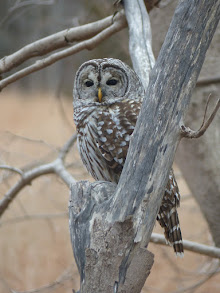
From somewhere in the dark, high above, I heard a single brief sound, just distinct enough for me to recognize the hoot of a barred owl, the sturdy night-bird of the many childhood evenings I had spent out of doors. They were common enough where I grew up and often active in the day; I had seen them dozens of times. I listened until I heard the telltale call in full: Who cooks for you? Who cooks for you? Softly, not so loud as to risk waking Sergei, I echoed the call: Who cooks for you? Who cooks for you? There was dead silence for a long time, then I thought I heard a fluttering not far off. I repeated the call and the owl responded, closer this time, maybe just ten yards away. I held my breath, then gave the call once more.
Immediately, without warning, the owl swooped down and began striking its wings fiercely against my face. I fell backwards off the trunk and as it followed me down I felt its feathertips and the pressure waves of each wingbeat. I covered my eyes with my arm, expecting at any second to feel talons tearing my face. I opened my mouth to yell to Sergei for help but my voice was paralyzed and nothing emerged. Eventually the owl's rage subsided and it flew off as invisibly as it had arrived. I felt my face and my hands for blood but there was nothing. I crawled into my sleeping bag, pulled it up around my head, and lay panting, finally weeping.
At dawn I crawled out of the sleeping bag and looked around; there wasn't a feather in sight or any other indication of the incident, and except for a bruise on my elbow where I had fallen back I could have dismissed it all as a dream — but I knew it was not. When Sergei began to stir I told him what had happened. He didn't understand at first — I had to repeat the whole story — but I think in the end he believed me.
When I try to think back on the incident in a reasoned manner the encounter still baffles me, but I think I understand now that I had somehow violated a sacred boundary. It wasn't my physical presence in the clearing that had crossed a line, or even my pretending to be an owl and calling out in the dark in a language I didn't understand. It was something else; I had transgressed, if only for a second, a margin where the domain of the human reached its terminus. The owl and I could exist in the same space, but in every other way our worlds were mutually impenetrable. I could no more understand the owl's behavior that night than it could understand the road maps we carried or the pop songs that were stuck in our heads.
Sergei and I made it safely home and finished up our studies the next spring. We still drop each other a line every now and then.
NB: The above is fiction, except for the insomnia.


Sunday, June 28, 2015
American Nightmares

A friend of mine recommended this volume of short stories, by an author whose name was unknown to me, and although I'm perhaps not the easiest person to suggest books to she hit the money on this one. Maybe she just knew that "lake" and "monster" are a combination I can't resist.
Actually, there's only one lake monster in the collection, and it's a doozy, but there's horror of some kind in all nine tales. I won't get into the question (a fairly tired one at this point) of whether Nathan Ballingrud is a "horror writer" who happens to set his stories among down-and-out, emotionally drained working-class Americans, mostly in the South, or whether he's essentially a "realist" who likes to draw on the horror playbook for material; let's just say that his approach, which is leavened by a good bit of subtle black humor, is his own, and a refreshing one at that. So here on the one hand you have convincing characters who are waitresses, building contractors, oil rig workers and the like, and on the other you have vampires, werewolves, and the undead. There's one story ("S.S."), dealing with a young New Orleans man dawn to a Neonazi group, that appears to have no fantastic element in it, although it may be as uncanny as any of the others. One tale ("The Crevasse"), the only one not set in the US, is a kind of homage to Lovecraft's At the Mountains of Madness.
Ballingrud is quite deft at juxtaposing these elements, and also in the way that he works into the stories an underlying substrate of guilt, much of it connected with family members who have let each other down in one way or another. There's a father whose neglect may have led to his son's kidnapping, another father who is struggling to revive his relationship with his family after a stint in prison, and a number of characters who are simply overwhelmed by their family responsibilities. In "The Good Husband," for example, a man wakes in the middle of the night and finds his wife's body in the bathtub, the result of the last of multiple suicide attempts, and decides to go back to bed without calling for help. (What happens next I won't reveal, but it's one of a number of stunning plot twists in this collection.)
North American Lake Monsters is available from Small Beer Press. Ballingrud has published one other book, a novella entitled The Visible Filth, which is published by This Is Horror in the UK.
Sunday, March 29, 2015
More Japanese Gothic

Satori Ediciones in Spain has published its second collection of translations into Spanish of the Japanese writer Izumi Kyōka (1873-1939), following in the wake of El santo del monte Koya, which I discussed here last year.
As with the previous volume, all of the stories (there are four) are fantastic in manner and draw on the long tradition of Japanese supernatural literature and lore. The title story is available in English (as "Of A Dragon in the Deep") but the edition is difficult to obtain and I haven't seen it; the longest of the tales, "El fantasma que esconde las cejas" (The Ghost Who Hid Her Eyebrows) has been translated by Charles Shirō Inouye and can be found in a volume entitled In Light of Shadows: More Gothic Tales by Izumi Kyōka, published by the University of Hawai'i Press. As far as I know the other two tales are not available in English.

Kyoka was a fascinating but sometimes difficult writer, who made of use of what Charles Inouye calls "an eccentric, highly convoluted narrative method that precluded his participation in the more mainstream attempt to accomplish an objective description of an exterior world and a psychologically depicted realm of an interior one." "His narratives," Inouye continues, "neither maintain a consistently stable and omniscient point of view nor do they present time as a steady flow of logically connected events that are contained in the past." Writing at a time when many of his contemporaries were embracing the conventions of the Western realistic and psychological novel, Kyoka held to his own way.
Two of the stories in Sobre el dragón del abismo describe the encounters of children with a unpredictable but not necessarily hostile supernatural world; the third, "La historia de los tres ciegos" (The Story of the three Blind People) is classic horror tale of the perils that lie in wait for those who trangress. The last narrative, "El fantasma que esconde las cejas," is a ghost story so many-layered (and impossible to summarize here) that Inouye includes a diagram in his edition to help visualize its intricately nested levels.
I've now read this final story twice in English and twice in Spanish, gaining insight into it with each reading, but I wouldn't pretend to have mastered it. Because of the richness of cultural allusions in Kyoka's tales, as well as the inherent difficulties of translating from Japanese into a European language, it's interesting to compare the two translations, Spanish and English. Since I know no Japanese, I naturally can't comment on their relative accuracy, but while they're generally complementary (and mutually clarifying) there are numerous passages that show fairly radical differences in interpretation. Below is just one sample passage; what follows is 1) Alejandro Morales Rama's Spanish-language text; 2) my rough English translation of the Spanish into English; and finally 3) Inouye's version:
1) Las montañas y el cielo estaban tan nítidos que parecía que los estuviese viendo a través de una capa de hielo. Los brillantes rayos del sol hacían que las agujas de los pinos y los árboles secos resplandecieran. Al mismo tiempo se veía volando una figura de un blanco cegador y en las profundides de la montána, donde el oso vive alejado de los hombres, la nieve se había tornado en una ventisca punzante como agujas.Inouye's "wintering trees" is a nice touch, but I don't much like "rear legs" (rather than "hind"). What's interesting, though, is the very different ways in which the reference to the bear or bears is understood. Whatever the truth of its accuracy, Rama's donde el oso vive alejado de los hombres (where the bear lives apart from men) is a beautiful lyrical touch, suggesting a fundamental if estranged kinship between the two species. Reading the two translations side-by-side provides an unstable but rewarding reading of an intricate masterwork of modern Japanese literature.
2) The mountains and the sky were so clear that it seemed as if one were seeing them through a covering of ice. The brilliant rays of the sun made the needles of the pines and the dry trees shine. At the same time, a figure of blinding white was seen flying, and in the depths of the mountain, where the bear lives apart from men, the snow had turned into a blizzard as sharp as needles.
3) The mountains and sky became clear as ice. While the sun sparkled brilliantly in the pines and other wintering trees, something white began to fall from the sky. In the deep mountains, where bears stood on their rear legs like human beings, the snow came down like needles.
Thursday, January 01, 2015
The Palace of the King of Night (Introduction)

In the spring and summer of 2007 I wrote a narrative entitled The Palace of the King of Night, described in its subtitle as "a novella, or folly." Later, when I phased out the website where I had originally posted it, I elected not to transfer it over to my current blog. Not being inclined to revise or or even re-read it at that particular moment, I suspected that the length and likely artistic shortcomings of the piece would render it a distraction from what I was interested in doing at my new address. For whatever it's worth, I have decided to make it available now, in installments, but spun off onto a separate blog [here].
The novella originated, as does much of the (relatively little) fiction that I write, in a dream or half-dream, and the opening scene and perhaps a little more derive directly from that source. Once the story got going, however, I more or less consciously steered it according to a preconceived plan, and it became a kind of ersatz Grail legend, set not in a forest, as is traditional, but in an arid landscape that perhaps was also a kind of underworld or land of the dead. The peculiar artwork of Charles-Frédéric Soehnée (see above) was a partial inspiration, at least for atmosphere, and their were faint traces of what I knew about ancient Egyptian mythology, which was (and remains) very little.
I am far happier composing shorter forms (a few paragraphs) and so the writing of the novella was both exhilarating and grueling. I'm afraid its deficiencies will be all too evident, but perhaps something of what impelled me to keep at it will come across. I dislike reading long texts on a screen, and ideally I would print this up as a chapbook, give the copies away to the twenty or so people who would be polite enough to pretend to read it, and leave it at that. Until I get around to doing so, here it is, warts and all.
Saturday, September 20, 2014
Unearthly Loves

I started reading modern Japanese literature in Spanish translation because there were a couple of books I wanted to read that didn't seem to be available in English, but at this point I'm just doing it for fun — or perhaps in part because the psychological effect of reading a book in a foreign language — any foreign language — gives me the illusion that I'm reading it "the original," which in the case of Japanese is something I'm utterly unable to do. Plus I just like these editions from Satori in Spain. Putting aside such eccentricities, three of the four stories in Izumi Kyōka's El santo del monte Koya are readily available in English in a volume entitled Japanese Gothic Tales, translated by Charles Shirō Inouye and published by University of Hawaii Press.
And they're great stories, intricately told, shocking at times, richly atmospheric; each of them rewards — in fact demands — a second reading. I'll pass over the two shorter ones, as good as they are, and say a few words about the title story, which in Inouye's translation is called "The Holy Man of Mount Koya," and the novella-length "Un día de primavera" ("One Day in Spring"). Both can be found in the Inouye translation mentioned above.
The former follows a classic Japanese storytelling pattern: a lone traveler — here, a Buddhist monk — hiking through the remote countryside encounters a figure — in this case, a woman — who turns out to be other than what she appears. Kyōka, who died in 1939, was adept at nesting stories within stories, and the events in the tale are actually narrated by the monk to a traveling companion he shares a room with much later. As the monk recalls, during the original journey he had fallen in with a traveling salesman whose vulgar behavior had offended him; the two come to a fork in the road and the salesman chooses a path which, the monk is subsequently informed, will lead him to great danger, perhaps even certain death. After some hesitation, the monk decides that his Buddhist principles require that he set out to persuade the salesman to turn back, since allowing his personal antipathy to sway his duty towards the man would be a great sin. The route he thus follows subjects him to gruesome, skin-creeping horrors — told in vivid detail by Kyōka — but eventually he makes it through, only to find himself the guest of a kind of Japanese Circe, with whom he almost decides to remain forever.
As exemplary a tale as "The Holy Man of Mount Koya" is, it can't quite match the measured, uncanny beauty of "One Day in Spring." Again we have nested narratives, although in this case it is the frame-tale that involves a traveler, a lone figure who arrives at a remote temple and hears from the resident monk a bizarre tale about an earlier pilgrim, who had taken up residence in a nearby cottage and become obsessed with a beautiful woman with whom he had — in this world, at least — only the most fleeting of encounters. Drawn to an isolated spot by the sound of music, the pilgrim had witnessed an oneiric pageant in which he and the woman — or their semblances — appeared as the principle players; a few days later he is found drowned at the edge of the sea. Having heard this strange tale, the second traveler has his own encounter with the woman, then witnesses an appalling and unexpected denouement.
There's at least one additional collection of Kyōka's tales in English, also translated by Charles Inouye and published by the University of Hawaii Press; it's entitled In Light of Shadows: More Gothic Tales. I've ordered a copy.
Sunday, June 22, 2014
Destroying Angels

Kyūsaku Yumeno was the pen name of a prolific Japanese writer who died in 1936 and whose work is apparently relatively little-known in the English-speaking world. Satori Ediciones in Spain has just published El infierno de las chicas (The Hell of Girls), a Spanish-language translation by Daniel Aguilar of the three dark, intricate stories that were originally collected in Japanese as Shōjo jigoku. As far as I can tell the stories have never appeared in English.
All three tales included here are narrated largely or exclusively in epistolary fashion, though in each case we read only one side of the correspondence. One story makes use of fictional news articles, and now and then letters from third parties are nested within the letters of the primary correspondent. The first story, "No tiene importancia," (It's of no importance) takes the form of a long missive written by one physician to another, describing the case of a young woman who has worked as a nurse, first for the recipient and then for the sender. We are told from the first page that the woman, who goes by the name of Yuriko Himegusa, has killed herself; the remainder of the story, which is approximately one hundred pages long, is in effect an extended flashback explaining this act. Himegusa was, to all appearances, a model employee: pleasant, conscientious, skillful, and beloved by her patients. She was also, it seems, a pathological liar, and the eventual unraveling of the skein of lies she has wound around herself proves her undoing. Or does it? Both Aguilar, the translator of this volume, and Nathen Clerici, the author of a recent doctoral dissertation (PDF here) on Yumeno, point out that the final outcome of the story is in fact highly ambiguous; no body is found, and the "suicide" (revealed, naturally, by means of a letter) may simply be one more deception.
From the point of view of the doctor narrating her history, Himegusa represents simply an unfortunate if rather bizarre case of female psychopathology. But Himegusa sees herself as a victim of misunderstanding and suspicion, and her suicide — real or faked — amounts to a salvo in the drawn-out battle between women and a male-dominated world. This aspect is heightened in the two remaining stories in the volume, in both of which the central female characters are at once victims and avengers of the crimes of men. The briefest, "Asesinatos por relevos," (roughly, Murders by relay) takes the form of a series of letters written by a young woman who works as a conductor or ticket-taker on a bus, in which she seeks to dissuade a friend from leaving her rural home and taking up the same career. Her contention that such a career only serves to subject a woman to the whims and abuse of men is chillingly documented in the course of the correspondence, as a new male driver who appears to be a serial killer of women takes the wheel on the bus route she is assigned to.1 In the end, the man gets his comeuppance, although what amounts to a happy ending, in both this and the last story in the volume, may seem appalling to contemporary Western readers.
The final story, "La mujer de Martes" (The woman from Mars), which, like the first, is novella-length, is the most intricate of the three. It begins with a newspaper article about the discovery of a charred body after a fire in one of the outbuildings of a girls' school, and proceeds breathlessly through a series of follow-up reports, which document an increasingly bizarre and inexplicable series of events, including disappearances, a hanging, and the desecration of a cross inside a nearby Catholic church. Only after these events have been catalogued is the explanation teased out, in the form of a long letter from one of the students at the school (the gangly misfit whose nickname gives the story its title) to its headmaster, a pious bachelor who has inexplicably gone insane since the fire. As in the previous story, there is a woman wronged and vengeance to be exacted in disturbing — and in this case extraordinarily elaborate — fashion.
Daniel Aguilar notes that those stories are written from a feminine, almost feminist viewpoint, and there is something to that, bearing in mind the limitations of the time and place (1930s Japan). What is certain is that men don't come off well at all; if not all entirely depraved, they are nevertheless very bad at running things. But there's something more here too, a sense that the world is essentially amoral and devoid of meaning. The men, blinded by lust and vanity, may not acknowledge that fact, but the women know it all too well. In the words of Utae Awakawa, the "woman from Mars":
Little by little I began to feel with greater and greater intensity that the emptiness that lay in the depths of my heart and the emptiness that could be found above the blue sky were exactly the same thing. And I began to think, as well, that the act of dying was something simple and of no importance.2This bleak sense of futility that emerges over and over throughout these stories may perhaps owe something to Buddhist thought, but in its incarnation into 20th-century urban Japan it takes on a character that is very much Yumeno's own brilliant creation.
1 The bus is staffed by two employees: the man at the wheel (conductor in Spanish), and the female cobradora or revisora who accepts tickets and provides assistance to the driver.↩
2 My translation from the Spanish version.↩
Saturday, July 13, 2013
Dark beginnings

It's a bit disconcerting, perhaps, to reflect that the oldest story in this collection is now more than sixty-five years old. Gabriel García Márquez is still with us, of course, though he seems to have outlived his muse, but these early stories, almost of which were written before more than a handful of readers had even heard of him, now seem to belong to a distant era. Even so, many of them still hold up quite well for all that.
The volume gathers "all the stories" Gabo had published as of 1975 (the latest story is in fact dated three years earlier), organized into the three earlier collections — Ojos de perro azul; Los funerales de la Mamá Grande; and La increíble y triste historia de la cándida Erendira y de su abuela desalmada — in which they first appeared. They can be roughly divided into three distinct but not necessarily mutually exclusive modes. Two are fairly easy to categorize: the neorealism of "La mujer que llegaba a las seis" and "En este pueblo no hay ladrones"; and well-wrought fantastic tales like "Un señor muy viejo con unas alas enormes," "El ahogado más hermoso del mundo," and "El último viaje de la buque fantasma." The third (but chronologically earliest) group is made up of what we might call existential horror tales, and here we find most of the contents of Ojos de perro azul.
There are deservedly popular gems among both the neorealist and fantastic tales, but it is the author's first — and by most measures least accomplished — pieces that interest me for the moment. And what a difficult and strange bunch of stories they are! Most are concerned with ghosts, or corpses, or disembodied spirits of some kind; in the least challenging (perhaps "Nabo, el negro que hizo esperar a los ángeles") the reader is eventually able to piece together something resembling a narrative thread, but at their most extreme (the frankly baffling "Amargura para tres sonámbulos") we're pretty much left scratching our heads. Note that this is not a criticism. Note also that the stories, though written over the course of a least a half-dozen years, weirdly illuminate each other; thus certain cryptic references in "Diálogo del espejo," which describes a man shaving before work and discovering that the face he sees in the mirror has begun to diverge from his own, acquires new possibilities when read alongside "La otra costilla de la muerte," in which one of a pair of twins has died and the survivor waits while a barber shaves the face of his brother's corpse in the next room. Motifs of consciousness beyond the grave, of transmigration, not always fully developed, weave in and out of these tales, though it isn't clear whether their affinities are the result of strategy, improvisation, or simply the reworking of material that wasn't fully mined the first time through.
One of the strangest, and most abstract, of the tales is the brief "La noche de los alcaravanes," in which three men who have been blinded by curlews* stumble about within a space that is neither explained nor truly described; the setting could be from one of Beckett's theatre pieces, except that Beckett would never have conceived of anything so garish. According to Gerald Martin's biography of García Márquez, the tale alludes to a folk belief about curlews blinding children, but no such origin can account for the oddness of the tale. Longer, but no less perplexing, is "Eva está dentro de su gato" ("Eve Is Inside Her Cat"), in which a woman who is tormented by her own beauty (which she compares, in a lush extended metaphor that runs to a full page, to a population of insects coursing through her veins) suddenly leaves her body, floats in a dimensionless world, finds herself drawn back by a craving for the taste of oranges, and then attempts (apparently unsuccessfully) to enter the body of a cat. There is no backstory, no explanation; instead there are mysterious allusions to a buried "niño" — a boy or child, but the word is placed in quotation marks in the original — and to "three unmovable enemies" (the sonámbulos of the other story?) and the reader has little to hold onto, though the story's final sentence provides a devastating, if not clarifying, conclusion.
To some extent, these perplexing stories can, perhaps, be characterized as apprentice work, though by a singularly gifted hand. García Márquez would go on to write more classically polished tales, as well as audience-pleasing novels like One Hundred Years of Solitude. But these earliest pieces, as clunky and difficult to interpret as they often are, also display the possibilities of a more radical approach to narrative.
*"Curlews" is the word used in Gregory Rabassa's translation of the story, though the Spanish alcaraván may correctly refer to a "stone-curlew" or bittern.
Friday, November 04, 2011
The woman by the stream
A number of years ago I was invited to deliver a lecture at a summer conference on ethnobotany at the University of Tokyo. It was not my first visit to the country; I had been stationed there for two years shortly after the war, and had developed cordial relationships with a number of Japanese colleagues. Although I never learned to recognize more than a handful of kanji, I became fairly conversant in the spoken language, thanks largely to the instruction of my informal mentor, the highly regarded scholar Professor S. Matuzaki, one of the most cultured men I have ever known and most certainly the kindest. It was at the behest of Professor Matuzaki, who had kept careful track of my scholarly achievements in the intervening years, that I had been invited, and in fact it was his extremely generous offer to serve as my host for the duration of the conference that had prompted my immediate acceptance.
I was met at the airport by the professor, now a widower in his seventies, and by his daughter, herself already both an accomplished agronomist and the mother of two small boys, and taken by taxi to the modest apartment of the daughter and her husband, which is where the professor, by then semi-retired, stayed during his frequent visits to Tokyo. Though the presence of an extra guest must have inconvenienced my hosts, they never gave the slightest sign that this was the case, and my week in their company remains one of my fondest memories.
The conference was, as these affairs nearly always are, a mixture of tedium, moments of intense intellectual exhilaration, and more or less constant social activity, and it is the last of these, more than anything else, which eventually wears one down. Fortunately, Professor Matuzaki's impeccable considerateness had extended to an offer to spend the week following the conclusion of the conference "recuperating" at his country house in Hyōgo Prefecture, not far from the Hatsuka River, an area of great historical and biological interest, which, though somewhat remote from Tokyo, was where the professor had spent most of his childhood. As a true scientist is never really off duty, this kind offer was made even sweeter by the prospect of being able to make some short excursions to investigate the cultivars and traditional agricultural practices of the region.
My host had become somewhat frail over the years since I had last seen him, and if he had ever learned to drive he had given it up with age, so after devoting an initial day to rest we were chauffered about for most of the week by a wiry local man, himself in his sixties, who did odd jobs and served as caretaker when the professor was away. In his light Toyota pickup truck we explored fertile river valleys and rugged foothills, taking in only those few temples and historic sites that Professor Matuzaki deemed absolutely indispensable for the visitor from abroad, but making ample use of the opportunity to meet with local farmers, examine wild relatives of local crop plants in their natural settings, and get an overview of the range of geology and soil types to be found in those parts.
On the fifth day, however, our driver had business of his own to attend to, and the professor suggested that I might enjoy taking a day hike on my own through the hills in the immediate vicinity of his home, which, because of their discontinuous terrain, had as yet been largely unscathed by development. He provided me with a hand-drawn map and a simple lunch prepared by his housekeeper, a woman who lived a few houses down the road, and pointed me off in the right direction. It was an overcast and fairly damp morning, and I brought along a light coat, but as I climbed away from the main road the exertion soon made this more of an encumbrance than anything else. I am a strong hiker, accustomed to vigorous outings, but I was glad that the professor had not sought to accompany me out of an excess of courtesy, as the trail was steep and in some places largely overgrown.
I reached the summit of the ridge marked on the map a little after noon, and from there walked along the heights for several miles. Though the sun never really broke through as the day wore on, the morning mist had cleared off and above the intervening canopy of forest I was able to see many hectares of neatly tended farmland in the distance. There were a few old cottages dotting the sides of the ridge, and at one point I caught sight of a section of sinuous highway not far off, but I met with no one. After a while I descended the far slope, and as I did so I must have misread the professor's map, for I soon found that, having thought it unnecessary for me to bring a compass and not having the sun to guide me, I was no longer sure in which direction I was heading. On an undulating piece of ground I came upon the remains of an old orchard. It's not in the character of the Japanese to neglect things that require attention nor to let good land go unused, but these trees had obviously gone untended for several years at least; the fruit, much of which lay rotting in thick clusters on the ground, was stunted and mealy, and the trunks were surrounded with a dense overgrowth of suckers and weeds. At the lower end of the slope the land turned sodden, and little runnels arose that made my footing tricky as I picked my way down to the orchard's lower edge.
I heard a trickle of water running ahead of me, and soon emerged on the rocky bank of a shallow stream a few yards wide. Though I probably could have waded through, the farther side appeared impenetrably marshy and choked with reeds, so I decided to turn and walk upstream along the near bank, where a path had been trodden out which, though muddy in spots, was easy enough to follow. Here and there patches of iris were in flower along the stream.
After hiking for an hour or more over increasingly difficult ground, I emerged into a little clearing on a ledge above the water, where smoke was drifting from the chimney of a single small stone hut or cottage roofed with thatch, of a style so primitive I was surprised to see it still in use outside of a museum village or the like. The door was open and when I stuck my head inside and uttered a tentative greeting in Japanese I'm afraid I startled the lone occupant, who quickly put down what she had been doing and rushed in some embarrassment to usher me in. She was one of the most peculiar looking women I had ever seen, though I can not honestly say that her appearance was unpleasant -- in fact, quite the opposite. Well under five feet tall, she wore a long, trailing kimono printed with a curious mottled red pattern the like of which I had never seen before. Her hair was tied up but largely hidden by an elaborately folded hat, of the same pattern as her kimono, which she wore low on her brow. Her eyes were small and dark and I quickly got the impression that she was either blind or at best could not see well. Her nose was delicate, but her mouth, which she seemed to barely open even when speaking, was unusually broad, though her lips were thin. I could not hazard a guess at her age, which might have been anywhere between twenty-five and fifty.
Once she had recovered from the surprise of my unexpected arrival, for which I of course apologized as best I could, she seemed positively delighted to see me. Her fingers were unusually slender but proved quite agile as she set about making her guest some tea and a hastily prepared meal, which I dared not refuse for fear of giving offense, though I still had the lunch the professor's housekeeper had provided me tucked away in my knapsack.
The cottage had a dirt floor and there was little furniture, only a pair of low three-legged stools, an ancient iron stove, and some small rustic wooden cabinets she used for storing food and sundries. It was evident that she customarily slept on mats on the floor, and I saw no sign that she had any substantial wardrobe other than what she was wearing. When she was done cooking she handed me a bowl with some sticky rice and a few bits of what I took to be smoked eel, which proved to be unexpectedly delicious, along with a cup of a rather bitter but flavorful and invigorating tea. She had accepted without evident curiosity my awkward attempt to explain who I was and why I had intruded on her privacy, and gave no sign of recognizing the name of the professor or the village near which he lived. She seemed, on the other hand, quite interested in the condition of the stream outside, and whether it had overrun its banks in the meadows across from the old orchard. I got the impression that, in spite of the language barrier, she was quite glad to have someone to chat with, and I suspected that it had been some weeks or months since she had been provided with a similar opportunity.
After we had finished our meal and she had poured us each another cup of tea, she seemed to grow more serious, lowering her voice to just above a whisper, and began to intone a long story of which I'm afraid I could not follow even half, though it appeared that she was relating some kind of onomastic folk legend about a young girl many centuries ago and about a stream which I gathered was the very one outside her door. Some parts of the story were evidently quite humorous, as she several times broke into laughter, but here and there the telling brought her nearly to tears with the heartbreak of it. Spellbound by her manner more than the matter of the tale, I did my best to react appropriately at the proper times. When the story was done she seemed pleased, fell silent, then looked down meditatively into her empty cup for a long while. I noticed that it had begun to rain.
The downpour lasted until well after nightfall, and by then there was no question of my setting out again that day. The woman seemed untroubled by this. She had a small oil lamp that provided a few moments of flickering light, but as this dwindled she arranged a mat for me on the floor not far away from her own. Like many country folk who have not yet been told that their ways are "backward," she seemed unconcerned that this arrangement might be regarded as indelicate. As the product of a less innocent world, I confess that for a few moments some ungentlemanly thoughts did cross my mind, but the combination of my upbringing and fatigue swiftly put them to rest.
I was awakened in the night, in total darkness, by the feverish impression of a pair of lips on my own. I reached up with my hands and felt the woman's kimono slip from her shoulders. Tiny fingers were deftly undoing the buttons of my shirt...
In the morning chill, as the first pale light began to filter under the door, I heard the woman rise and stoke the fire. For a while I heard her bustling with dishes and pots, then in my weariness I fell back to sleep. When at last I did get up there was no sign of her. She had left some rice and tea, still warm, beside the fire, but though I waited nearly until midday I never saw her again. Absurdly, I left my card propped up on one of the stools, though I knew she would be unable to read it.
I began to follow the trail downstream, confident that, even though I didn't know exactly where I was, I would be able to find my way back to the professor's house by retracing my steps of the previous day. I had only gone twenty yards or so, however, when I was brought up short. In front of me, on a low shelf of stone just above the water, lay a Japanese giant salamander. I had seen one of these extraordinary creatures, among the largest amphibians in the world, once before, in a Tokyo aquarium, but the specimen I beheld now, with its beautifully mottled, pinkish skin still wet from swimming, was much larger and at nearly five feet from nose to tail must have been fully grown. I cursed myself for not having thought to pack my camera.
The creature eyed me neutrally for a moment -- indeed its expressionless, almost featureless face was probably incapable of displaying emotion in any case -- and then slipped smoothly but unhurriedly into the water. It swam downstream past me a few yards while I watched, then, reversing its course and drawing close to the bank, lifted its head just above the water and seemed to incline it in my direction. I scarcely breathed until, after circling back and forth three or four times, it dove down into the muddy current and disappeared from sight forever.
Though they suffer, like many species, from the loss of their native habitat to the activities of man, these salamanders are carefully protected in Japan and their population appears for the time being to be fairly stable throughout much of their range, which is confined to the islands of Honshu, Shikoku, and Kyushu. (A closely related species in China, sadly, is critically endangered.) Possessing few natural enemies once they reach adulthood, individual specimens can live for decades -- perhaps nearly a century. They breed in August and September.
I made it back to Professor Matuzaki's house at around two o'clock in the afternoon; he had been concerned, but not greatly alarmed, by my failure to return the previous night. I am afraid that my inability to provide a full explanation of my activities during my absence caused one of the rare moments of awkwardness in my otherwise highly productive and enjoyable sojourn in his company.
Saturday, October 01, 2011
The survivor
(Found on the body of a partisan)*
My Dearest M—,
As you are no doubt aware, on the 12th day of this month the invading army, after an extended siege, was able to breach the inner ring of our defenses at several points on the eastern side of the city, leaving our forces in an untenable position. Amid the general evacuation that ensued, our unit was among several assigned to hinder the enemy's advance and thus gain time to permit our army to retreat in an orderly manner and to remove or destroy any remaining matériel. After several days of ferocious fighting, during which we were repeatedly forced to abandon our positions while sustaining severe losses (I am happy to say that we inflicted much of the same in kind on the invaders), several of us, now detached from the other members of our unit, fell back to a textile mill along the L— River, from the upper story of which we had a commanding view of one of the two main bridges leading to the western outskirts of the city through which our army was evacuating. Here we stationed our machine gun at a window and for the time being were able to prevent the advance guard of the enemy from securing the bridge and crossing the river. In the meantime other units, still fighting block to block in the center of the city, were able to prevent the enemy's main column from reaching the waterfront and putting our position within ready range of their artillery.
Of our friends that you would remember, only Trofim was still with us at this time. Some of the others may have escaped after we became dispersed, but I am sad to say that many of those whose memory you cherish no longer walk upon this earth. For two days and two nights we heard the incessant retort of shelling and gunfire coming from across the bridge, and we knew that our brothers were valiantly resisting the oncoming army and perishing in the streets of our beloved city. At last, when all had fallen silent except the roar of the enemy's advancing columns of tanks, a messenger arrived bearing orders to fight on only until our position became impossible, along with instructions on where to rendezvous with other units after our retreat. A few hours later, having used up the remainder of our ammunition and disabled the machine gun, we slipped out of the back of the building just after nightfall, hearing as we did so the percussion of the first rounds of artillery being lobbed across the river at our now empty outpost.
As the enemy chose not to attempt the crossing of the bridge until morning, we made our way unimpeded through the deserted outskirts of the city, where many buildings had been set afire by our retreating army and still smouldered in the dark, but where not a child or a dog remained, all having withdrawn in the army's wake. By dawn we had left the city at our backs and were walking through fields of ripening barley. No longer hearing the sounds of battle, the scene radiated a sense of great peace, though we knew that within days or even hours the enemy's motorized columns would be hastening along these roads in vain pursuit of our retreating army.
It was near midday when we reached our appointed destination, a large farmhouse set in a little grove of chestnut trees. Here we were reunited with several of our comrades, including H— whom you no doubt remember well, but here we also shared sad tales of those who had lately fallen, whose number is too painful for me to relate. A few of the survivors had been wounded, though none gravely, and the kitchen of the farmhouse had been pressed into service as a dispensary and surgery, as well as to provide us with tea and a welcome hot meal after so many days of short rations.
Three small military trucks had been assigned to evacuate ourselves and our remaining supplies, which if truth be told were no longer substantial. A fourth, larger truck, which had been commandeered from civilian use, stood by as well, but the back of this truck, which was open to the sky, was still occupied by a large and thoroughly placid elephant. This beast, which had evidently been removed from a circus or the zoological park during the retreat, seemed reluctant to descend and surrender its place, and four or five soldiers were gently trying to coax it down the ramp at the back of the truck. Though the animal could easily have turned on the men and crushed them against the side of the truck or trampled them underfoot, it seemed to be of a quite genial disposition, only unwilling to be persuaded. At last, lured by a handful of fruit, it trod with heavy step onto the dirt driveway and was left to amble off on its own as the final truck was loaded with guns and ammunition and the remaining soldiers climbed aboard. As we drove off it watched us with what seemed a rather bemused but patient expression, as if it were indulging us in the little game we were playing and expected our return in good time.
As I hope to return to you, in good time, if not in this world then in another.
Your own,
S—
*Unlike the various items of found correspondence that I have posted here from time to time, this one is entirely fictional.
Sunday, January 30, 2011
The Coup
Just ahead of dawn the young sentry in the lobby of the interior ministry, bored and sleepy after yet another overnight shift alone, heard tapping on the plate glass door as he made his rounds of the long empty corridors. Startled, he adjusted the strap of the rifle that was slung over his shoulder, straightened his cap, and made sure his shirt was tucked in all the way around. Visitors were rare on his watch; most likely it was an inspector, and it wouldn't pay to be looking unkempt. He strode quickly to the main entrance and peered out through the glass at the plaza that surrounded the ministry, lit up by the spotlights along the building's exterior.
When he reached the door and saw who was there he stood panicked and puzzled for a moment. It wasn't an inspector at all but three girls, identically dressed in the uniform of the national university that occupied a bluff a half-mile away along the river. As soon as they saw him they began calling to him urgently. One, the tallest of the three, held aloft a large manilla envelope that appeared to have some kind of official stamp on it; the flap was open and several sheets of paper were protruding a bit, though he couldn't tell what kind of documents they might be. The other two girls, after a brief pause when they first caught sight of the sentry, began banging on the glass again, pleading with him to unlock the door.
He stared at them, then shook his head. Obviously it was against regulations to open the door until the ministry officials began to arrive for their morning office hours and he was relieved by the day shift. He nervously felt for his radio, but decided it wouldn't be wise to disturb the chief of the security detail, no doubt still asleep in bed with his mistress, for a trivial matter he could handle himself. Hadn't he once received a dressing down for calling an alarm, in the middle of the night, because he had heard what turned out to be windblown acorns bouncing against the side of the ministry? He shook his head at the girls again, emphatically this time, and gave them a dismissive wave of the hand to make them go away.
But they didn't go away. Instead, the one holding the manilla envelope, who seemed to be their leader, drew out some papers and held them up. She seemed very indignant. Perhaps she was the daughter of some official, dispatched to deliver urgent correspondence to the ministry, though the more he thought it over the more unlikely that possibility seemed. He shook his head one more time, looking as severe as he could, hoping the girls would understand that the matter was now settled and that further entreaties would be a waste of time, but he didn't resume his rounds.
The girls turned away from him, conferring by themselves, then the tall one pulled out a cell phone and punched a number. She gestured at the door and shook her head while she spoke into the phone; she leafed through the papers, then slapped them against her thigh in evident exasperation. In the meanwhile the other two girls had returned their attention to the door. They banged on the glass and beckoned to him; he couldn't make out what they were saying but he distinctly heard the word “idiot.”
The sentry tried to pretend he was ignoring them, but as this clearly wasn't having the desired effect he thought it over, reached for his radio again, then changed his mind. Instead he strode firmly to the door and demanded their business in a firm voice. The girl on the cell phone broke off the call, and all three began chattering at him at once, more frantically than before. They held up a sheet of paper; it looked official, but he couldn't catch its import from where he stood. Finally he reached to his belt for the key and inserted it in the door.
The girls rushed in all at once. One of them immediately darted to the bottom of the stairs. He yelled after her, started to follow, until he noticed that somehow, from out of nowhere, another cluster of students had appeared and were shoving their way through the half-open door. This group included some male students, as well as a couple of burlier, older men. Before he could react one of them had seized the rifle that still lay slung on his shoulder. He resisted but they pulled it away and subdued him, then pushed him aside.
Another cell phone snapped open, and within seconds a crowd was forming, a hundred, maybe a hundred and fifty people, students mostly but not all, running individually or in twos and threes across the plaza between the oak trees, scattering or crushing the newly fallen acorns as they came. Swiftly, largely in silence, they made their way inside and swept up the stairs to the offices above.
Upstairs the corridors were mostly deserted, but the crowd barged into an office where a dozen startled men and women sat at desks, headphones on, cigarettes between their fingers. One of them drew a revolver and waved it around; the intruders swarmed past him and out of the room, hurrying down the hall towards the private elevator that led to the minister's office. The man with the pistol put it away and reached for the telephone. Then he noticed that his fellow-workers had all abandoned their posts and disappeared.
The door to the minster's office was locked. While the crowd debated how to proceed a guard rushed in and fired a pistol shot into the ceiling. At the sound the throng drew back, at first, but the force of new arrivals propelled them forward again, trapping the guard against the door for an uncomfortable moment, until word was passed back and the shoving stopped. A harried-looking functionary, bloodshot and tieless in a glum disheveled suit, foced his way through, unopposed. After a moment's parley he dismissed the guard and produced a key, then stood aside as the crowd burst into the inner sanctum of the ministry.
At the headquarters of the national broadcasting service, a little after dawn, the staff suddenly rose, seemingly as one, and stormed into the studio just as the morning newscast was beginning. The perplexed announcer froze, looked up at the crowd gathered around him, then took off his earpiece and yielded the microphone to one of his subordinates. The camera crew continued filming without a pause. A producer darted in from the control room, infuriated, yelling and threatening, but was soon subdued by an offer of immediate defenestration.
As the city woke up and the news began to spread the downtown districts filled with pedestrians, most of them hustling towards the presidential palace and the ministries that surrounded it. Traffic began to back up, as a tide of cars and trucks, all heading in the same direction, inundated the main avenues, tying up streets for hundreds of square blocks. By the time the army arrived the entire area was gridlocked. The lead tank tried to ram its way through, pushing three or four cars aside and riding over the top of another, but the situation was quickly understood to be hopeless, especially after the military vehicles became trapped, in their turn, by another wave of incoming traffic behind them. The soldiers abandoned their stalled vehicles and stood around in groups, shouting into radios and cell phones, until the crowds began to swell around them and they broke up, retreating on foot to their barracks or just heading home.
The president had slept in, as usual, and was shaving when he heard the commotion outside. He set his razor down, hastily grabbed a towel, and strode to the window in his sleeveless undershirt and shorts. The sight of the crowed stunned him; just then the phone rang. It was the minister of defense, calling from his home in the hills on the outskirts of the city. Had he heard the news? What were his orders? The president said he would call right back, then pulled on a pair of pants and rushed into the hallway, looking for his chief of staff. The offices around him were bustling like a hive; papers were being shredded, desks emptied out. His secretary breezed by him, securing her purse on her shoulder as she hurried off, giving him just a quick glance and a weak smile before she darted towards the elevator.
He went over to a window, hid himself behind a curtain, and peeked outside. The plaza was jammed with thousands of people; they seemed to be in the mood for celebration. He looked in vain for any sign of the police, or his personal bodyguard, but except for one police cruiser parked on the far edge of the crowd, its lights flashing, they were nowhere to be seen. He retreated into his private chambers, pulled down a briefcase and a plastic shopping bag, and began to gather his personal effects. When he left, walking in a daze down the hall towards the elevator as the transitional committee assembled in his office, no one even noticed him.
The above was first written in 2007. I am reposting it and dedicating it to all those in Egypt, Belarus, and elsewhere for whom it must, for now, remain only a fantasy.
Friday, December 03, 2010
The Boatmen of Venice (The Passion)

Jeanette Winterson:
Rumour has it that the inhabitants of this city walk on water. That, more bizarre still, their feet are webbed. Not all feet, but the feet of the boatmen whose trade is hereditary.
This is the legend.
When a boatman’s wife finds herself pregnant she waits until the moon is full and the night empty of idlers. Then she takes her husband’s boat and rows to a terrible island where the dead are buried. She leaves her boat with rosemary in the bows so that the limbless ones cannot return with her and hurries to the grave of the most recently dead in her family. She has brought her offerings: a flask of wine, a lock of hair from her husband and a silver coin. She must leave the offerings on the grave and beg for a clean heart if her child be a girl and boatman’s feet if her child be a boy. There is no time to lose. She must be home before dawn and the boat must be left for a day and a night covered in salt. In this way, the boatmen keep their secrets and their trade. No newcomer can compete. And no boatman will take off his boots, no matter how you bribe him. I have seen tourists throw diamonds to the fish, but I have never seen a boatman take off his boots.
Tuesday, November 30, 2010
The telegraphist (conclusion)
All was quiet the next morning. There were a few heavy clouds along the horizon that he thought might portend a storm, but the next time he looked in that direction, a few moments later, they had vanished without a trace and the air around him was as searing as ever. He didn't even bother to look in on the mule, of whose existence he had by now in any case forgotten. He had lost track of time and only occasionally remembered how he had come to be stranded in such an isolated, godforsaken place. The thought occurred to him that he might in fact be dead, but after trying to get his head around that notion for some time he decided that he couldn't form a conclusion one way or another and so put the matter out of his mind. He opened a fresh can of beans -- there weren't many left but he wasn't eating very much anymore -- mouthed a few spoonfuls, and set it aside. The telegraph bell rang now and then, but he paid no attention to it.
He passed two or three days in a state of intermittent delirium, shaking with fever and too weak to get up, until in a brief lucid moment he realized that he must soon drink something or die. Filling a bucket from the wooden barrel, he drank steadily for several minutes until he felt himself about to retch. He returned to his cot and almost immediately fell asleep.
When he awoke -- it could have been the next morning, or the day after, he wouldn't have been able to say -- he felt much better and his appetite had revived. He grabbed the same can of beans, brushing away the flies that had congregated around it, and sat up at his desk. As he was pushing the first spoonful through his cracked and blistering lips he heard the alarm ring. Seconds later the message came down:
Nesabap alaba barababaranap mana ba STOP Palaba banabarep arefep ber erabet geret nasefaterabat gret bara basarepHe carefully wrote the words down, then examined them at length. Their significance was as inscrutable as ever, and yet the longer he looked the more there seemed to be something in them -- some delicate gesture, some faint hint of tenderness -- that desperately longed to be conveyed. He read them backwards and forwards and out of order, anagrammatized them and spent at least an hour simply staring at the forms of the letters as if the shapes alone bore some critical message that had nothing to do with any language known to man, a message that arose from some other realm where nothing was arbitrary symbol, where every communication was a direct encounter with some truth so profound and absolute that it couldn't be expressed in anything as insignificant and arbitrary as language but only as itself. Before he even knew he was doing it, he began to tap out a response:
Qa balaqa STOP Barabasabaraq qaraq ablababap STOP Balap rabelaba perap salap balarepareb na nabapThe reply was almost instantaneous:
Gasap beragera aramerabap STOP Beragabaragap blagap gasa berarqaraba basaraba berap asanta nabep rebasapar raba berabasepHe sat back, contemplating the words. At that moment they seemed to him as soothing as the freshest spring rain, as deep as a desert well, as tender as a mother's love for the infant at her breast. Weeping with gratitude at their beauty, he stood up and spoke the message aloud, chanting it over and over as he circled the room, kissing the paper on which he had written it out. Trembling with joy, he leaned over the key and tapped out a response that he knew, with complete certainty, would be received and understood as his irreversible declaration of utter and undivided submission:
Garaqasap abamaba maserab berasseraber STOP Asarabageram merasapa aba basapa mergaraga berasaperaba STOP Meragerabarap birab qaru nagraba barasabarWith one motion he swept everything off the desk -- his books, his water jug, and his lamp, which shattered onto the floor -- and awaited the answer that he knew would soon be forthcoming.
*****
When the relief party arrived at the oasis they found the mule still barely clinging to life in its stall. Out of mercy they shot it. The body of the telegraph operator was slumped over his desk, surrounded by page after page of incomprehensible scribbling. At the orders of the officer in command of the party they buried him just beyond the edge of town; then they gathered all of his papers in a pile and set them ablaze. After that they cut the telegraph wires and stripped them off the poles; the copper, at least, could be used again. When they were done, right before they left, they dynamited the command post, just to be sure.
Wednesday, November 17, 2010
The telegraphist (II)
At the beginning of the seventh week all communication with Z---- was broken off again, this time for three days. It resumed promptly and without explanation on the fourth morning at 0600 hours, but two days later it ceased and did not resume. A slave to protocol, he submitted no daily reports, since none had been requested. To break the monotony he began to make his morning rounds in a counter-clockwise direction. He was struck by how different an aspect the oasis revealed when examined in this fashion, but after a few days the novelty wore off. He began to alternate, walking clockwise one day and counter-clockwise the next, and this seemed to be the most tolerable arrangement.
After the second full week of silence he caught himself softening his steps, listening for the engines of the relief party that by now was overdue. He heard none, nor were there any unexpected visitors, suspicious or otherwise. The worst of the heat of the dry season, suffocating and blinding, lay upon the desert, and he spent as much time as he could asleep with wet rags over his eyes. Scarcely animate, the lethargic mule stared at him from its stall with unblinking and (he half suspected) unseeing eyes, and barely summoned the energy to eat.
He was writhing on his cot in a semi-delirious state, somewhere between night and morning and between sleep and waking, when the alarm rang. He leapt up and rushed to the telegraph. It wasn't the operator at Z---- but the outward post, and the message, as ever, was incomprehensible:
Ba bara sabara rebapara azera ba STOP Sarabara berisa seribisarabisa serata bezera razara ra STOP Berisol sorisoriso bazara sarisarasarisab STOPHe transcribed this seeming gibberish into his logbook, returned an acknowledgement, then relayed the message to the operator at Z----. There was no response.
The following day, at around the same hazy hour of dawn, another message came down:
Saraba barisaserisab azarasaraza bazirazep STOP Azirasora sarizap borisoq qrabba oraseraborisep prebanamarasarasap STOP Azapep STOPAgain he acknowledged, transcribed and forwarded the message, and received no response from Z----. To his surprise, however, an hour later an identical message arrived. Perplexed, he carefully compared it with the previous one and acknowledged it, but almost immediately a third came, and then a fourth. He duly forwarded each transmission, but when the fifth and sixth arrived he held back. Clearly the operator in the hinterlands was not receiving his acknowledgments and was repeating himself in the mistaken belief that his messages were not getting through. There was no point in annoying the authorities at Z----, if they were indeed listening, with obvious repetitions. For several hours the wires carried message after identical message, dozens, scores, eventually hundreds. He transcribed each one, for a while, then simply gave up, walking away and returning every hour or so to see if the incoming transmission was the same as the others. It always was.
The messages trailed off in late evening, then sputtered to a halt. He was awakened once during the night, then again around 0500, and after that the pace began to pick up again until the incoming transmissions had become a virtually continuous stream of characters. He walked away from his desk and went outside. The wind had gathered and a sandstorm was obscuring the horizon, but the heat was as relentless as ever. The mule stood motionless and he wondered whether it had died standing up during the night and had simply neglected to fall. He threw it some hay regardless.
When he went back inside the telegraph was still chattering. He recorded a few lines, then threw his chair back in a huff and started to walk away, rage rising within him. On the verge of losing control completely, he was about to smash the instrument and put an end to his torment once and for all when he caught himself, finding that a greater fury was welling up inside him, and coldly and meticulously typed out a message to the operator on the other end:
Raberaparabep barabap parabarabagarap garap baregatarat top barop roparaoparop bererep qrabab STOP Garep arepabap gop STOPThese syllables, though they meant nothing to him, he transmitted without a single pause. To his surprise, the machine did not pick up where it had left off. Instead there was silence for a few moments, then a brief acknowledgment, and then it lay still.
No further transmissions arrived until late that evening. He was dozing in the cot, his spoon rattling in the empty can of beans beside him with every labored breath, when the alarm woke him and a message trickled out:
Garabarep farabara barana marabap amar raba raba barabaramop STOP Garabananana badarap badar badar badarap bada STOPHe wrote out the message, then tore it roughly out of the logbook and paced the room, reading it over and over. He had been instructed in the making and cracking of basic ciphers during his initial training, but this fit the pattern of nothing he had ever seen. He leafed through his logbook, carefully examining old entries. There seemed to be too few unique letters, too much obvious repeated filler, for the messages to contain any but the most rudimentary communication. No doubt there was a key, known to the operator on the other end and also at Z----, or maybe not even there, maybe the transcriptions were referred to another operator at some distant headquarters, perhaps even all the way to the home country, to some intelligence officer in the national palace, who perhaps decoded them for the eyes of M. le Président himself. One way or another it was clearly beyond his ken.
While he was considering this the alarm sounded again, and another string came through, this one identical to the last:
Garabarep farabara barana marabap amar raba raba barabaramop STOP Garabananana badarap badar badar badarap bada STOPAnd then it seemed to wait, patiently, expecting an answer. He put his hand on the key and tapped, hesitantly at first, then fluently:
Morarerabap aramara marabeparepamar berererapap STOP Beraqraba garab megaraba babap babap babap ma garabarap STOP Serabep arbaraba barapep a pep perapebabep merera baramabap STOPA brief acknowledgment followed, and then nothing for the rest of the night.
(To be continued.)
Monday, November 15, 2010
The telegraphist (I)
He was the last one left. Just before decamping the legionnaires loaded up the barrels of gunpowder that remained onto carts, piled on all the old carbines and anything else that was portable, and blew it all up at the edge of the desert. The shock wave whipped the overhead wires that hung slack between the weatherbeaten poles and blew out two windows of the command post, but the adobe walls held firm. The little generator in the next room, after skipping a single beat at the initial concussion, resumed its steady chugging, brushing off the aftershocks that echoed, ever more faintly, for the better part of an hour.
They left him a mule and some fodder, a rifle and cartridges, and enough fuel and food and water for two months, three if he was careful with it, and not very much rum at all. By the time his provisions ran out, if he was lucky, he would be relieved; in the meantime his presence would be essential to communication along the line, sporadic though it might be. In the absence of the lieutenant, who had never returned from a reconnoitering expedition the year before and was assumed to be among the casualties of war, the sergeant formally transferred his authority in a brief ceremony several times interrupted by boisterous outbursts on the part of his subordinates, all of whom were in varying states of drunkenness and immune to the sergeant's halfhearted rebukes. They wished him good luck, embraced him one by one in turn, and clambered into the back of the hulking, wheezing truck just as the driver, who perched alongside the sergeant was by no means the soberest of the lot, ground on the gears until he managed to cajole the reluctant vehicle into lurching forward, blowing up clouds of dust and sand as it lumbered haltingly to the edge of the oasis. He watched them drive off for a moment, waved his cap three times over his head, and returned to his desk.
During the first few weeks his duties kept to their normal routines. He slept in a cot in the office within earshot of the alarm. Each morning, at precisely 0600 hours, the office at Z---- would transmit an identical message inquiring for his report. He would respond that all was well and await instructions. A few moments later the machine would jigger into life again, with a one-line order to expect a further communication at 1800 hours. After breakfast and coffee he would make a brief circuit of the immediate environs of the command post in order to stretch the kinks out of his legs, he would feed and water the mule, and then go back to sleep until evening, when there would be a similarly terse exchange with the operator on the other end. He would warm up a few more spoonfuls of canned rice and beans, knock back a single precisely measured shot of spirits, and call it a night. On rare occasions and at unpredictable hours a brief message came down from further up the line, transmitted by an operator in some even more isolated and woebegone outpost. When that happened he tapped out an acknowledgment and promptly relayed the information; as these messages were usually encrypted and he had not been entrusted with the key this entailed the careful replication of a string of apparently meaningless syllables, a task for which, he decided, he was particularly suited.
Only twice did he see any sign of life other than the vacant and imperturbable mule. One morning, during his constitutional, he discovered the faint traces of hoof prints across his path. That the marks were visible at all, considering the incessant drifting of sand over every square inch of the oasis, proved that they had been made the previous night, perhaps just before dawn. He traced their origin back as far as the last palms, but no further, then reversed course and followed them to the point at which they trailed off into the desert. He determined that there had been three camels, that their riders had never dismounted, and that they had found nothing of interest to detain them or even to cause them to veer from their course. A week later, by chance, on one of the few relatively windless days, he spied a small caravan -- twenty riders or so, from the look of it -- very far off, but it never approached and he lost sight of it, even with his binoculars, after an hour. His report of each incident was duly noted and acknowledged, but nothing more was said of either one.
It was somewhere near the end of the fourth week, or perhaps the beginning of the fifth -- he had become increasingly indifferent to the calendar -- that his orders failed to arrive on schedule for the first time. He wasn't alarmed by this. Interruptions along the line, due to downed poles or balky generators, weren't particularly unusual or unexpected. The lack of communication posed no imminent danger, as the front lines -- to the extent that those could be defined in a guerrilla conflict in inhospitable and poorly charted terrain -- lay hundreds of miles off, and even the odd raiding party, should it by chance happen to break through, would have no reason to venture into a region that offered little in the way of opportunities for pillage. The telegraph remained dormant through the evening, but when at 0600 the next morning the alarm sounded and the operator at Z----, making no reference to his silence of the previous day, inquired for an update on local conditions, the telegraphist neither sought an explanation nor gave it a second thought.
Tuesday, August 31, 2010
The lake
For a while after I retired from teaching one of my former colleagues invited me back once a year to give a guest lecture at a summer seminar he ran. I had moved to the city by then, but as it was an afternoon class and I was an early riser I usually took back roads because they were quieter and because I liked the drive along the Housatonic. When my talk was over my host would invite me to dinner -- we were both widowers and I at least was past the age where I thought there was much likelihood of my marrying again -- and we would reminisce for a while over a stew and a glass of wine before I headed home.
It was on one of these evenings that I took a wrong turn in the dark somewhere on the way back to the city. The students had seemed a bit unresponsive earlier in the day and I was mulling over the question of whether they were the ones to blame – as any academic can tell you, some crops of incoming students are more promising than others -- or whether I had just been doing this for so long that other people were catching on to the fact that I was maybe getting a bit tired of it by now. My colleague had seemed a bit subdued as well; he hadn’t mentioned retirement but I suspected that the eventuality probably wasn’t far from his mind. There had been rain as I drove up but it had ended by late morning; the sun had steamed the moisture off the lawns but a few puddles still remained in the low places. I don’t know how I mistook my course, a moment’s inattention I suppose, as I knew the roads in that part of the Berkshires well and made a point of never drinking enough to affect my judgment. It was a darker night than usual, with no moonlight and little traffic, and maybe a sign had been knocked down or removed since the last time I drove that way. There aren’t many landmarks on the back roads, just miles of green woods broken by cornfields and the occasional mailbox, and so it was a while before I realized that I had gotten off my regular route. I was a little annoyed at myself but not alarmed; I had a full tank and I figured that eventually I’d come to a town or an intersection I recognized.
I was only doing about forty-five at this point. There were a lot of twists and turns and ups and downs in the road, and there was always the chance of a deer blundering out of the woods. After five miles or a bit more the gloom of the overhanging woods began to thin out on my left side, and I realized that I was driving along the edge of a body of water – not just a pond but a good-sized lake from the look of it. My headlights picked up the brown rippling of waves along the surface. I vaguely remembered there being a lake on the map in the area – it had a long Indian name I couldn’t come up with -- though it was off the main drag and I didn’t think I'd ever actually seen it before. I knew it was long but quite narrow from east to west, and that if I just skirted its shore I would come out into familiar territory in due time. I passed a tiny hamlet – really just a gas station and bait shop, set in a cluster of four or five clapboard houses, all with darkened windows -- and a mile beyond that the road split. There were no signs; the apparently less traveled thoroughfare – I was no Frost fan but the inevitable allusion popped into my head nonetheless – lay off to the right and up an incline, and I quickly dismissed it as a secondary road and bore to the left, keeping to the shore. It was only after driving another three or four miles, as the roadway seemed to narrow and the weeds on the shoulder grew more and more obviously untended, that I suspected I had been mistaken, and that the road I chosen led out to some uninhabited peninsula I didn’t remember from the map.
The barrier appeared suddenly, just around a bend. Luckily I had just slowed, having that moment determined to turn around and backtrack to the fork in the road, or I might have struck it. It was just a couple of wooden crosspieces, painted with black and yellow stripes and set on steel posts sunk in concrete disks; there was a single dangling battery-operated lantern, not that it cast much light. The road surface beyond seemed drivable enough, though creepers had begun to encroach on the edges and a few weeds poked through. I suspected there might be a bridge further on that had been dismantled or condemned as unsafe, never to be rebuilt for lack of funds or just because it was no longer deemed to be worth the trouble. It struck me there was something about the scene I didn’t like. It seemed to resuscitate memories from an impressionable period of my childhood, of watching war movies with roadblocks manned by grim helmeted soldiers who rode motorcycles with sidecars, things like that. I stopped the car and got out – the truth was that at this point I needed to empty my bladder – but left the engine running and the lights on, figuring that since I hadn’t seen another car for at least twenty minutes there was little danger of being rear-ended.
I stepped around the barrier and saw that there was a little path leading down to the shore of the lake, which I had lost sight of in the woods moments before but which now lay just twenty paces off. Above the lake there was a patch of lawn on an artificial embankment, though there was no sign of a house or any other building nearby, and I rested there for a moment. The air was warm and calm; on the far side of the lake there were some distant lights, but not many. A bullfrog bellowed not far away, then another, and I heard what sounded like falling water a little further down the shore. I picked my way in that direction, climbing over dead branches, mossy stones, and brambles, until I could get a better view. A few yards further out the lake's edge was bordered with a crescent of neatly dressed stone. Glowing faintly in the night, it topped a spillway through which the lake overflowed; to my great surprise I saw a lone human figure – it was a man, I could see, in spite of the darkness -- standing at the exact center of the crescent, his back turned toward me. He was about my height and I thought about my age, and wore a fedora and a brown coat that was much too heavy for the time of year, even at this hour. He was staring down into the stream that flowed out of the bottom of the chute some twenty feet or so below him. He hadn’t noticed my approach – or gave no sign of having done so – but just as I saw him begin to lean – too far for safety – over the edge of the spillway I shouted at him and he started and turned in my direction.
Though I couldn’t quite make out the man's features, what I did see filled me with terror. I won’t attempt to describe the lifeless, inhuman horror that peered out from under the brim of that dark felt hat, but I can see it in front of me now as clearly as I did at that moment, and will bear that awful memory to my grave. The figure took first a tentative step then several determined strides towards where I stood. I backed away, shaking with fear, and was about to turn and make a run for it when something called out of the dark waters of the lake.
When I say that it called I don’t mean to say that I heard it; there was no sound, at most there was only the opening of a hollow in the silence where a sound might have been, but the figure bearing down on me heard the summons, as if beckoned by a lover, and instantly froze in his tracks. He cocked his head towards the lake and listened; the call was repeated and he turned sharply and walked down to the water’s edge. To my astonishment, instead of stopping there he kept going, striding forward at the same pace, until the water rose up around him and he leaned into it and began to swim. For a moment or two, as he swam out towards the deepest part of the lake, I could make out the sound of his limbs breaking the surface; then there was utter stillness except for the burping of the frogs.
I don’t know why I didn’t immediately run back to my car, but somehow I knew the danger was past. I stood on the shore for a while, staring out into the blackness above the lake, until I thought I heard something moving at my feet. I knelt down; it was the man’s fedora, being gently nudged ashore by the lapping of the waves. I left it where it lay.
I turned my car around, eventually found the main road, and returned home without further incident. That winter my colleague passed away unexpectedly after a brief illness. His replacement was a younger man I had never met, and I was never invited back to campus to speak to his class.
Tuesday, August 03, 2010
The lost army
It's been raining since morning. The day broke gray and cold, and the overnight mist off the lake, instead of burning off quickly as the sun gained strength, slowly but steadily gathered into a forlorn, gusting, incessant storm. It must be raining high in the mountains too, for the little streams that irrigate the fields on the city's edges, normally placid and clear, are swollen and lead-colored and seem to be straining ahead in their long transit to the sea. You'd think the city itself would break up and melt away, but it won't, and the wooden bridges, built by experienced hands for storms worse than this, arch securely over the swell, bearing pedestrians who cross the solid timbers without delay but with no shiver of fear.
I've been watching the streets from this high window. The inn must be half deserted, tonight; now and then I hear bustling below but no one seems to have taken the other rooms on this floor, and it's late enough that in all likelihood no more travelers are to be expected, unless the odd straggler, perhaps delayed by washouts along the road from the hills, makes it in time to the city gates. There's a faint smell of barley and vinegar coming from the kitchen, but the rain has dampened all of my senses and most of the time I scarcely notice. The ghosts are coming out, and are beginning to flow, unnoticed, into the current of pedestrians, keeping to the edges of the crowd when they can, their heads bowed, though not against the rain like the others, no, it's the shame that keeps their heads cast down, their faces concealed. No one around them sees them but I see them, I know their names, each of their names. They'll wander the streets all night, searching for a destination they won't find, and with the first touch of morning they'll withdraw once more into the crawlspaces below buildings, into the runnels between paving-stones, into stagnant pools left behind by the flood, into the weathered beams of sad houses soaked by the steam of boiling laundry and the sweat of endless, unendurable toil. They'll never emerge to see the stars or the moon that casts its milky light on the lake, no, only when it rains like this and all hope is lost, only when despair walks abroad, will they feel their way, tentatively at first, out of their hiding-places and dare to walk the streets, seen only by their general, their commander in iniquity, in this high room, from this window through which light never shines.
Monday, July 19, 2010
Bad Guys

Jorge Luis Borges had already made a name for himself, at least in Argentine literary circles, as a poet and essayist years before he turned to the short fiction on which his broader international renown would largely come to be based. When he did so, like many an artist he began by borrowing from the masters, in his case with a volume of retellings and translations of tales gleaned from Mark Twain and the Thousand and One Nights as well as Herbert Asbury's Gangs of New York, the Encyclopedia Britannica (Eleventh Edition), and other, less familiar sources. Most of the stories and anecdotes in Historia universal de la infamia deal with some kind of treachery or violence, usually both, and together they make up a little guided tour of a few of the lower precincts of Hell, the ones reserved for those whose crimes can't be easily ascribed to mere misplaced love or folly.
The only declaredly original story, describing the fatal dénouement of a confrontation at knifepoint at a Buenos Aires dance hall, is "Hombre de la esquina rosada," the title of which is here translated, felicitously if not entirely accurately, as "Streetcorner Man." Most of the pieces were originally published, in many cases pseudonymously, in Argentine literary magazines and supplements in the 1930s; one of the headings used for their appearance was "Museo" ("Museum"), which seems particularly appropriate. The arts of collecting and of presentation are here given equal footing with the art of creation. Borges scrupulously provides the source for each piece, and if a few of those attributions turned out, on closer examination, to be fictions, who was to know?
In the preface to the 1954 edition, written with nearly two decades of hindsight, Borges was fairly dismissive about the volume's merits, but, in contrast to his attitude towards several early works that he actively sought to suppress, he evidently managed to come to terms with its shortcomings (which may well strike the reader as no shortcomings at all).
The very title of these pages flaunts their baroque character. To curb them would amount to destroying them; that is why I now prefer to invoke the pronouncement “What I have written I have written (John 19:22) and to reprint them, twenty years later, as they stand. They are the irresponsible game of a shy young man who dared not write stories and so amused himself by falsifying and distorting (without any esthetic justification whatsoever) the tales of others. From these ambiguous exercises, he went on to the laboured composition of a straightforward story – “Streetcorner Man” – which he signed with the name of one of his great grandfathers, Francisco Bustos, and which has enjoyed an unusual and somewhat mystifying success...As Borges had remarked in the preface to the first edition, the stories are not, and do not try to be, psychological.
The theologians of the Great Vehicle point out that the essence of the universe is emptiness. Insofar as they refer to that particle of the universe which is this book, they are entirely right. Scaffolds and pirates populate it, and the word “infamy” in the title is thunderous, but behind the sound and fury there is nothing. The book is no more than appearance, than a surface of images; for that reason, it may prove enjoyable. Its author was a somewhat unhappy man, but he amused himself writing it; may some echo of that pleasure reach the reader.
The di Chiricoesque cover painting of this edition, in which nefarious characters from various eras -- probably intended to represent specific antiheroes from the tales themselves -- lurk among the cracking pillars of a looming colonnade, is by Peter Goodfellow, who created several other Borges covers for Penguin UK in the 1970s. The translations above are by Norman Thomas di Giovanni, who had the advantage of working closely with Borges himself. Sadly, his translation is out of print, having been replaced by one commissioned -- largely, it appears, for pecuniary reasons -- by the author's widow.
Tuesday, June 01, 2010
The Approach to the City (7)
It was nearing dusk as he descended the steps into the city, and in the distance he could see the first scattered lights coming on across the river. A storm moved through and thundered briefly, leaving the paving-stones damp and the air thick as rising steam before moving off to the north. Except for a few stragglers everyone seemed to be having dinner, either at home or behind the windows of the restaurants along the plaza. He wasn't hungry, though, and he wanted to make it back to the street of red bricked houses before nightfall.
There was a light on in the front window this time, and when he rang the bell he heard the shuffling of shoe leather in addition to the alarms of the dog. A tall, withered man just over the cusp of old age answered the door, holding a newspaper in one hand, and ushered him in. He brushed the cocker spaniel aside and nodded at the advertisement. As he led his visitor up the winding stairway he explained that he was a widower with no children, and that the room was more than he needed now. The rent was low and he implied without quite saying so that he wanted someone to be there to watch out for him. He was gentle and soft-spoken and seemed unlikely to meddle; for its part the spaniel soon lost interest in the newcomer and retired.
The room was large and open and the walls bare. There were windows on two sides, one pair looking up the hill and the other over the rooftops to the water. They were open a few inches at the bottom and the breeze was lifting the bottom of the thin white curtains. The wooden floor had recently been swept clean, there was a bed and a dresser and a rocking chair, and a small bathroom with a freestanding tub lay off to one side; the man said there was another chair and a nightstand that he could bring up from the basement. A large porcelain lamp on the dresser, topped with a faded but clean and intact shade with a fringe along the edges, gave evidence of a woman's taste, he thought, and he wondered how long the wife had been gone.
They shook on it. He offered a month in advance but the man said not to worry. As he went to go back downstairs he turned and ask if he'd eaten, then invited him for a sandwich when he learned he hadn't. He left him to settle in, which didn't take long. He hung up his coat, unpacked a few things, washed his hands, and lay on the bed for a moment to test it out, which he hadn't thought of doing before. It seemed adequate so he got up and descended to join his landlord.
The dog was sleeping behind the front door and barely lifted its head as he stepped past. He could see now by its muzzle that it was old, as advanced in its term of years as the man. There was a platter of cold meat on the table and a jar of horseradish. He took two slices of bread from a paper package, fixed the sandwich, and finally, at his host's urging, helped himself to a bottle of beer from the refrigerator.
The old man was sitting in an arm chair turned away from the window, a pile of newspapers in a basket by his side. He had been doing a crossword puzzle but set it aside and turned his attention to the sandwich in his lap. His tenant sat across from him on the couch, setting his plate on the low wooden table in front of him, and the two men ate, mostly in silence but entirely at ease, as the darkness filled up the streets around them.
(The above is the last section, for now, of what may become an ongoing project.)
Subscribe to:
Posts (Atom)