Showing posts with label Winsor McCay. Show all posts
Saturday, January 07, 2017
Dante on the BRT
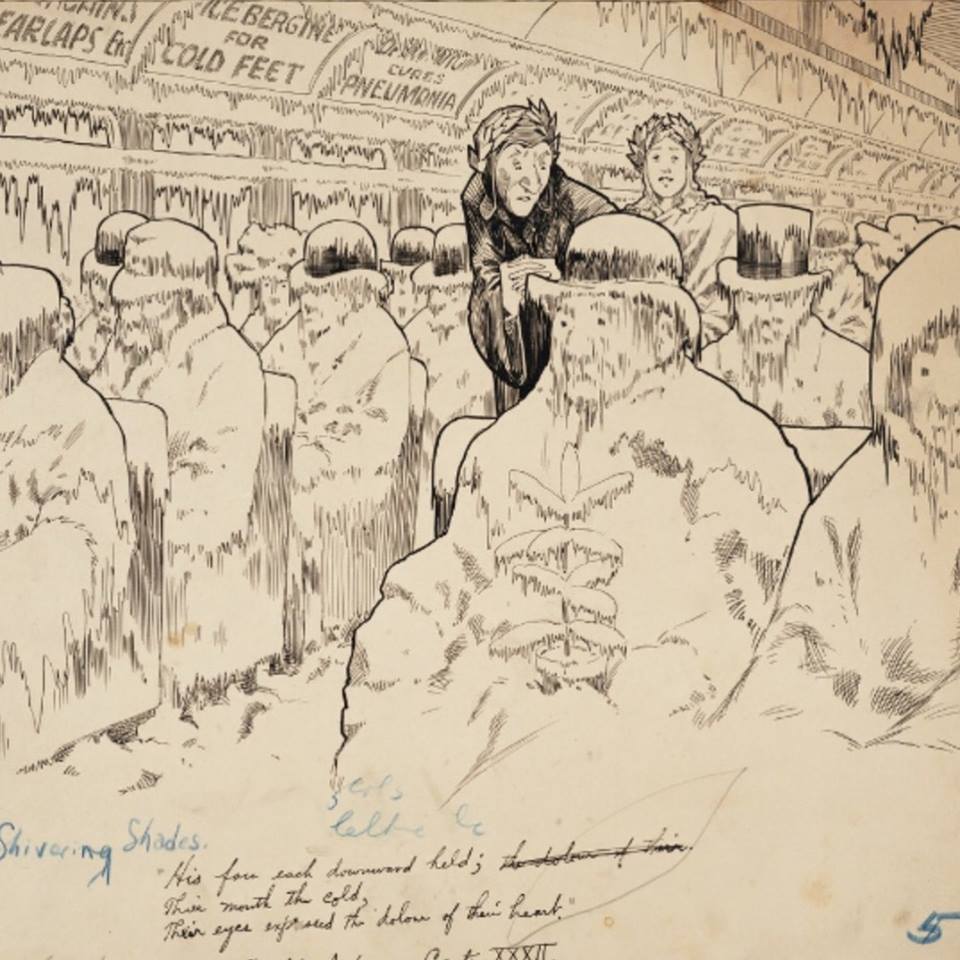
His face each downward held; their mouth the cold,
Their eyes express'd the dolour of their heart.
"B.R.T.'s Icy Inferno" (cropped version), an undated original drawing by cartoonist Winsor McCay, inscribed with lines from H. F. Cary's translation of Inferno XXXII. The Brooklyn Rapid Transit Company went belly-up in 1919, a year after the Malbone Street Wreck killed scores of passengers, and the Billy Ireland Cartoon Library & Museum believes that the drawing is from the first decade of the twentieth century.
Sunday, March 06, 2011
Flying slowly

By now, the status of the airship as an emblem of a kind of alternative, softer version of modern technological development is a well-established cliché, found throughout contemporary steampunk and fantasy from Philip Pullman's His Dark Materials to the TV show Fringe. Why do these lumbering craft provoke such nostalgia?

Over the course of the 20th century, the Futurist aesthetic embodied by the airplane -- sleek, fast, loud, and efficient -- would gradually lose its appeal, done in by the nightmares of Guernica, the Blitz, Dresden, and the Enola Gay. The airship wasn't entirely innocent of such possibilities -- zeppelin raids killed hundreds in Britain in the First World War, and Thomas Harris's novel Black Sunday imagined a blimp as what we would now call a weapon of mass destruction -- but for lethal efficiency it really couldn't compare. Nor, in the end, could it compete commercially. For a brief period the airship seemed to offer a kind of compromise between the genteel leisure of the hot-air balloon and the machine-age imperatives of speed and maneuverability fulfilled by the airplane, but the disaster of the Hindenburg doomed it to be forever confined to limited and special uses like hovering over football stadiums. A sad but probably inevitable end for the emblem of a less hurried kind of technological development that perhaps wasn't really ever going to be possible.

Artists, fortunately, are less constrained by such considerations, and there's something particularly pleasing and restorative about the sight of an airship poised above a landscape -- or an iceberg.

The above four images are all from the Eisbergfreistadt project by the artists Kahn + Selesnick. The first two are in the form of postcards; the latter pair are notgeld (emergency money).

The image above is by Donald Evans, an American artist who sadly died too young in a fire in the Netherlands in 1977. Evans's work consisted almost entirely of postage stamps, drawn actual size and appropriately perforated and often endorsed, of imaginary countries with names like Domino, Amis et Amants, Lichaam and Geests (Body and Soul), and Mangiare. (He also drew a fascinating set of zeppelin stamps for the country of Achterdijk, but unfortunately they are triangular in shape and too difficult for me to reproduce.) Willy Eisenhart's The World of Donald Evans, long out-of-print but not impossible to locate, is the indispensable collection.

Finally, above is one of a series of Little Nemo Sunday cartoon panels by Winsor McCay devoted to an airship tour of North America. This particular image is from January 15, 1911 and I rather like its conceit of Nemo and his companion Flip sweeping newly fallen snow off the deck. The whole series can be enjoyed online and at full size at The Comic Strip Library.
Sunday, May 03, 2009
Winsor McCay's Natural History
All of the Little Nemo pages below are from the collections of the Comic Strip Library. Click through the images for the original full-sized versions.


The last pair of images have occasioned rumors about McCay's possible interest in hallucinogenic plants and fungi.

Labels:
Comics,
Fungi,
Natural history,
Winsor McCay
Tuesday, April 28, 2009
Winsor McCay (II): Unreal City
McCay's work had its limitations. His dialogue is, for the most part, utterly lifeless, and displays none of the dazzling wordplay and pitch-perfect ear for the rich variety of American dialects displayed by his contemporary George Herriman, the brilliant creator of Krazy Kat. And there's no getting around the unfortunate racial stereotype represented by Nemo's sidekick Impie, who with his grass skirt, grunting gibberish, and apelike features actually predated Little Nemo, having first appeared, with his fellows, in McCay's early feature A Tale of the Jungle Imps. Some of the thematic material he worked into the strip -- the dragons, princesses, beasts, and savages -- was drawn from the stock situations and characters of adventure and fantasy stories, even if it's true that later creators (notably Walt Disney) would in their turn draw heavily on McCay for inspiration. Little Nemo debuted just a few years after the first Oz stories, and at its weakest it has some of the same preciousness without any of Baum's talent for spinning out a sustained and coherent narrative. But for imaginative daring, and above all for the originality and vitality of his artwork, McCay had few peers. At his best he leaves clichés and stereotypes behind and brings us into a world that is entirely his own.

The above strip is particularly interesting both for what it is and what it isn't. The surreal menace of buildings that sprout legs and chase the children is perhaps not completely unprecedented (one thinks of Baba Yaga and her house with chicken legs in Russian folklore), but it's unexpected and uncanny nonetheless, and the way McCay slowly draws us into an awareness of what is going on is masterful. But there's something noteworthy about the exterior scenes, which is that they don't show any indication of the cosmopolitan cityscape that, c. 1909, was sprouting up in Manhattan, Chicago, and other great metropolises. Street scenes like this still existed in every large city, of course, as they continue to do in sections of New York City (though the absence of parked cars tips us off that this is not 2009), but there's nothing in the lower eight panels that could not have been drawn, say, fifty years earlier.
But then there is this sequence; fleeing from a pair of red, bearded giants, Nemo and Impie, transformed into giants themselves, are, in a deft bit of visual sleight-of-hand, suddenly carried aloft. They race over farms and suburbs, finally coming to rest in the center of an ethereal city.

In the next panel, which again is brightly illuminated, a crowd gathers around the pair in the heart of what must have been a fairly realistic depiction of Manhattan in McCay's heyday, but as they scale the surrounding buildings and make their way to the harbor one tall structure after another sprouts up, until they are surrounded by a dense forest of skyscrapers that stretches right to the water's edge.


The interesting thing is that the Manhattan skyline that these images suggest -- and surely Manhattan, where McCay worked, was the inspiration -- did not yet exist (and arguably still doesn't). New skyscrapers were being constructed at a rapid clip in various parts of the city, but the New York waterfront still retained a mix of low buildings and high rises. Here, for instance, from the New York Public Library's collections, is a photo of the North River (Hudson) piers, from 36th St. to 48th St., taken just months after McCay's drawing appeared:

We see a few large buildings relatively close to the harbor, but most of them are set well inland, and the immediate waterfront skyline is like a mouth with missing teeth. And only a few years before an Edison photographer had shot this moving picture footage of lower Manhattan, from Fulton Street to the Battery, recording the condition of the other portion of the island that was undergoing rapid modernization:
McCay, a superb draftsman, was perfectly capable of drawing realistic cityscapes. Here's a fine sequence of views of Chicago as Nemo and his companions approach it by airship.

And here, in a bird's eye view, is how Manhattan probably did appear, more or less, in the first decade of the 20th century -- bearing in mind that neither McCay nor likely anyone else would as yet have had the opportunity to actually view at from that angle.

Now it could be argued, and is doubtless true at least in part, that McCay was simple looking ahead and extrapolating when he drew the scene of Nemo and Impie emerging from the columns of towers. But I think it's at least equally true that he had no intention of drawing a literal city, either an existing one or one projected for the decades to come. Instead, he captured the psychological and social effects that the 20th-century city created, the sense of vastness, of totality, it provoked. We are no longer in the Dickensian warrens of the 19th-century metropolis. Seemingly self-created, looming out of all human scale, this new city is neither horrifying nor sheltering, but it will be an inescapable organizing and centering presence in the lives of all who live in it. It will be in cities like this -- not in aristocratic palaces or Rockwellian small towns -- that the course of the years that lay ahead will be determined. The century that he heralds, though McCay does not know it yet, will be a century of cities, of urban high-rises, subways, and expressways, of mass movements and mass production, of Stalinism and Fascism and the bombing of cities from the air, of Beirut and Grozny, and, just beyond its final cusp, of the fall of the Twin Towers.
Labels:
Comics,
Winsor McCay
Monday, April 27, 2009
Winsor McCay (I)
Now that we may have entered the twilight of the newspaper, this may be as good a time as any to look over some souvenirs from what was, at least visually, its Golden Age.
In the course of his career, Winsor McCay (1867-1934) was a pioneer animator, a theatrical impressario, and an editorial cartoonist, among other things, but above all he was one of the supreme visionary geniuses of the newspaper comic, an art form that reached its creative peak a century ago and has -- in all frankness and despite the good work of a number of fine individual creators -- been slowly coasting downhill ever since. Imagine this in your Sunday supplement (click through for a full-sized version):

That's a sample from McCay's best-known strip (and of course the word "strip" doesn't do justice to this elaborate full-page layout), Little Nemo in Slumberland, which ran, on and off and under various names, from 1905 to the late 1920s. (All of the McCay images here are from the wonderful archive maintained at the Comic Strip Library.)
McCay, who was born in 1867 or thereabouts (the original birth records have been lost), had already been drawing cartoons professionally for several years, first in Cincinnatti and later for James Gordon Bennett's New York Herald, when he began Little Nemo. A year earlier he had begun what would become his other important newspaper project, Dreams of the Rarebit Fiend. The two strips would run concurrently for years, and McCay, no slouch, would continue to create other work on a regular basis as well.

Week after week the framing premise of Rarebit Fiend was unchanging: a man, or occasionally a woman, is captured in a horrifying or bizarre predicament, but in the last frame we learn that it's all been a dream, the consequence of the supposedly oneirogenic properties of the Welsh rarebit he or she has rashly consumed before retiring. The genius of the strip lay in McCay's ability to come up with an apparently inexhaustible supply of phantasmagorical variations, as both thematically and artistically he breaks new ground week after week. He plays with the dimensions of the frames, makes sophisticated self-referential jokes (one character is gradually obscured by ink blots from the artist's pen), and provokes an impressive array of unsettling horrors and fears. (The "buried alive" scenario above, of course, recapitulates Poe's nightmarish tale "The Premature Burial.")
One thing that Rarebit Fiend lacked, though, was momentum, for the strip had no narrative progression from week to week. Little Nemo, on the other hand, had a continuing story line, one which, though interrupted at the end of each week's installment, would resume where it had left off in each succeeding episode. McCay couldn't quite let go of the framing device: again we have a dreamer, this time always the same child, who awakens in bed -- or tumbling out of it -- in the last panel. But now there is a guiding narrative: at the strip's inception, on October 15, 1905, Nemo has been summoned by a messenger from King Morpheus of Slumberland, and everything that happens after that, all of his colorful, farflung adventures, will flow inexorably from that first action.
The episode below, however, is an exception, a one-off for the Thanksgiving holiday, which is why the outsized turkey is literally turning the tables, not to mention the whole house, on the human inhabitants. The lake the boy falls into is filled with cranberry sauce.

I'm not the one to provide an overall assessment or description of the riches (and weaknesses) of Little Nemo. Its best years were from 1905 to 1911, before McCay left Bennett's Herald and moved on to work for William Randolph Hearst; thereafter the strip, though still interesting, lost much of its visual daring as it became confined to a fixed grid of identically sized frames.
What I'd like to focus on, though, is just one aspect of Little Nemo at its peak, namely the way McCay imagined and depicted modern urban space. I'll address that in my next post.
Labels:
Comics,
Winsor McCay
Subscribe to:
Comments (Atom)