Showing posts with label Translation. Show all posts
Showing posts with label Translation. Show all posts
Monday, March 16, 2026
Reading Spanish: By Way of an Essay
I first studied Spanish in junior high school. There were, as I remember, four languages you could select: French, Spanish, German, and Latin, the last of which was chosen by only a few top students. Spanish was assumed to be the easiest, and I had some slight connection to the language because my father had been stationed in Panama during the Second World War, but I don't think I could do more than count from one to ten when I began. (I was green enough that when I first came to class I thought there was someone there with a last name that sounded like "Hustead," that is, usted.) I learned the lessons along with the other students — I still remember bits and pieces of those first-year dialogues — and I got good grades, but as soon as I had fulfilled the requirements for a diploma I gave it up, not anticipating that it would be of any use in my future — which at that point was basically what I thought about all of my subjects, other than perhaps biology. I remember memorizing the names and most famous works of a few Spanish authors, but I don't remember reading anything literary except for bits of Pío Baroja's Las inquietudes de Shanti Andía and an anecdote by Ciro Alegría called "Hueso y pellejo" (Skin and Bones).
When I got to college I took French for a while, since that corresponded more to the writers I was reading then, then I dropped out for a couple of years and went to live in Manhattan, reading and book-buying on my own. Though the Latin American literary "boom" was already old news at the time, the major writers were still around and American publishers had discovered that their work was marketable. I don't remember exactly what got me started on contemporary Latin American literature. It may have been a friend's copy of an anthology entitled Doors and Mirrors: Fiction and Poetry from Spanish America, or it may have been hearing good things about One Hundred Years of Solitude. I was already interested by late 1976, which is when I bought a copy of García Márquez's The Autumn of the Patriarch when it appeared in translation in the US. At some point I started, very haltingly, trying to work through some of the literature in the original. I think I began with a volume of stories that had an English version on the facing page, and in spite of my previous exposure it took me a while to develop a useful reading knowledge of Spanish. Eventually I went back to college and focused on the language and its contemporary literature, and wrote a bachelor's thesis on Cortázar that I would probably wince to read now.
I've used the language in various ways since then, but above all for the simple joy of reading it. My understanding of the grammar is solid, but there remain persistent gaps in my vocabulary depending on the author and the subject matter. If I want to read something badly enough I will read it without a crib, but I don't object to having a translation at hand for occasional reference (and out of curiosity — i.e., How would you translate that phrase?)
Unless the material is more didactic than literary, my usual practice involves reading books in Spanish twice. The first reading allows me to decode anything I can't immediately understand, to look up unfamiliar words, etc., as well as to rush to the end to find out how the story comes out. The second reading, begun as soon as I finish the first, is entirely different in character. Having deciphered the author's words and gotten a sense of the structure of the book, I can simply indulge in the pleasure of understanding the text and appreciating the author's style and inventiveness — all of the things, in effect, that can't be readily summarized or transferred to another form.
Which leads, of course, to the question of whether those things can be translated. To that, I'd have to say that the answer is yes and no. There are very good translators around; people like Gregory Rabassa and Edith Grossman have done wonders with twentieth-century Hispanic literature, and glancing back and forth between versions I'm impressed by how well most things do in fact carry over. There will always be some issues; in García Márquez's brilliant short novel Del amor y otros demonios, for example, the same word — rabia — means both "rabies" and "fury," and there is no easy way in English to convey that potentially significant point. (In the novel, an adolescent girl is bitten by a rabid dog, but the nature of her real affliction is very much for the reader to determine.)
But to me one of the advantages of reading a book in another language is that it forces me to work harder. I can't let my concentration wander and skip a few pages. I have to read, page by page, sentence by sentence, word by word, and engage in the miraculous process of moving meaning from mind to mind by way of text.


Monday, March 14, 2022
"This is my city"
Sergio Borschevsky, the translator of Borges, Cortázar, Neruda, García Márquez, and other writers into Ukrainian, is staying put in Kiev with his wife. From an interview with the Argentinian news website Infobae:
Why should we have to leave? This is my city. It doesn't belong to Putin or to his general staff or to the Russian Ministry of Defense... This is my city and my apartment. I live here. When I was a boy I saw all this destroyed by German Nazis. I saw it, because I was born in 1946 and I saw Kiev in ruins, I was born a year after the war. And now when I see these images of cities destroyed by the Russian Army, I remember my childhood. And I can tell you that I'm not thinking of leaving. I will die in this city. Now or later? I don't know, but in this city.The full interview (in Spanish) is available here.
Update: A version in English, though imperfect, can be read here.
Thursday, March 10, 2022
Briefly Noted
Some news items of potential interest to readers of this space.
The translator Edmund Keeley has died. Known for his versions of the work of modern Greek poets like Yannis Ritsos, George Seferis, and C. P. Cavafy, he taught for many years at Princeton University, where he directed the creative writing program. The New York Times has an obituary.
Musician and songwriter Peter Case is the subject of a new documentary by Fred Parnes entitled A Million Miles Away, which is premiering at the Santa Barbara International Film Festival this month. No word yet on wider distribution.
Hayao Miyazaki's 1983 graphic novel Shuna no tabi (Shuna's Journey) will finally have an authorized English translation when it is published this fall by First Second Books. The translator is Alex Dudok de Wit. A news report can be read here.
Saturday, November 27, 2021
A Few "Regrets"


Among his public activities, Heckscher was Consultant in the Arts for President Kennedy and a Commissioner of Parks who planted thousands of trees in New York City. In his living room in New York, he set type by hand and printed fine small books and ephemera, often with the help of his son Charles. More recently he has set up "The Printing Office at High Loft" at his summer home in Seal Harbor, Maine, where with young apprentices he prints and publishes modestly but with éclat.A little more digging turned up this photo of Heckscher and his sons at work from a 1962 profile in Life magazine.

The brief "Note" attached to this chapbook sets the scene:
Joachim du Bellay journeyed to Rome in 1553 in the service of his uncle, Cardinal du Bellay. The young Renaissance poet and scholar might have been expected to find many rewards during his three years at the center of the classical world. On the contrary, he was extremely unhappy — though it must be remarked that like many who are unhappy when they travel, he was hardly less so when he returned home. In Les Regrets, published in 1558, he poured out in sonnet form the varied pains of exile.Heckscher tells us that he was inspired to translate the selections while he himself was traveling, in his case in Morocco. Below is a sample; I've cropped the page for the sake of readability on the web. Heckscher's margins are more generous, and of course he would have taken pride in his page design.

Sleep, du Bellay, sleep sound and do not fret.
Dislikes and troubles vanish with the past.
The stuffy Roman dames, the Latin cast,
Are one with centuries that rise and set.
The endless littleness of your regret,
The heart in servitude, the soul harassed,
Are eased by kindly death, which gives at last
The peace men seek in life, but do not get.
Your verses still are read: along the Quai
When earliest Paris spring was on its way
And pear-trees flower'd in your beloved Anjou
I bought your book. I heard from far away,
Above the crimes and passions of our day,
Your sad, so human accents speaking through.
Saturday, January 02, 2021
Blackburn & Cortázar: The Correspondence

The CUNY chapbooks are a little tricky to find at the moment, in part because CUNY's offices have been shuttered by the pandemic. If it helps, the ISBN for this series is 9780997679625.
World Without Borders has an excerpt from the CUNY volumes as well as an interview with the editors, Ammiel Alcalay, Jacqui Cornetta, Alison Macomber, and Alexander Soria.
In addition to the two chapbooks described above, the next installment in the CUNY series (Series VIII) contains a chapbook dedicated to a translation of a portion of Cortázar's posthumously-published study of Keats, Imagen de John Keats.
More information to come.
Monday, September 03, 2018
V is for ...
A case of a ghastly linguistic muddle involving, in one sentence, no fewer than five languages:
Euclides da Cunha, who was a fanatical republican, a man totally convinced of the necessity of the republic in order to modernize Brazil and create social justice in the country ... was working at that time as a journalist in São Paulo and wrote vehement articles against the rebels in the northeast, calling this rebellion "our vendetta" because of the French reactionary movement in Britain against the French Revolution.The passage above is from Mario Vargas Llosa's A Writer's Reality, based on a series of lectures he delivered (in English) at Syracuse University in 1988. The context is a discussion of the Brazilian writer Euclides da Cunha, whose non-fiction work Os Sertões, regarded as one of the foundation stones of his country's literature, describes a millenarian (and, at least in part, monarchist) uprising in Northeast Brazil towards the end of the 19th century. (Vargas Llosa used the same revolt as the basis for his own novel, La guerra del fin del mundo.) But Euclides da Cunha, who wrote in Portuguese, never called the events in Canudos (where the revolt was centered), "our vendetta"; he called them nossa Vendée, that is, "our Vendée," in allusion to the French counterrevolutionary uprising of 1793. Not writing in his native Spanish, Vargas Llosa has mistakenly employed a false English cognate of Italian origin that in fact has no relation to the French word used in the Portuguese text; moreover, he has apparently confused Britain with Brittany, which is at least vaguely in the same part of France as the department of the Vendée.
The moral of the story, perhaps: never be your own translator.
NB: Os Sertões has been translated into English at least twice, once by Samuel Putnam as Rebellion in the Backlands, and in a recent Penguin Classics translation as Backlands: The Canudos Campaign. Vargas Llosa's novel, which has considerable merit of its own, has been translated as The War of the End of the World.
Tuesday, June 14, 2016
Gregory Rabassa (1922-2016)

The translator Gregory Rabassa has died, according to a notice from the Associated Press.
Rabassa was a professor for many years at Queens College, but it was his work as a peerless translator of modern Latin American literature that secured his place in the literary firmament. Beginning in 1966 with an English-language version of Cortázar's Hopscotch (itself a daunting feat, given that novel's linguistic fireworks), he produced dozens of translations, including more than a few that, taken individually, would have been sufficient to secure his reputation: José Lezama Lima's Paradiso, Mario Vargas Llosa's Conversation in the Cathedral, Gabriel García Márquez's One Hundred Years of Solitude, and on and on and on. That he not only managed to translate such challenging, verbally sophisticated works at all but did so with scrupulous care and endless creativity is simply astounding. We owe him a very great debt.
Update: The New York Times now has a full obituary.
(Photo of Gregory Rabassa from the jacket of Rabassa's memoir If This Be Treason: Translation and Its Dyscontents, published by New Directions.)
Sunday, March 29, 2015
More Japanese Gothic

Satori Ediciones in Spain has published its second collection of translations into Spanish of the Japanese writer Izumi Kyōka (1873-1939), following in the wake of El santo del monte Koya, which I discussed here last year.
As with the previous volume, all of the stories (there are four) are fantastic in manner and draw on the long tradition of Japanese supernatural literature and lore. The title story is available in English (as "Of A Dragon in the Deep") but the edition is difficult to obtain and I haven't seen it; the longest of the tales, "El fantasma que esconde las cejas" (The Ghost Who Hid Her Eyebrows) has been translated by Charles Shirō Inouye and can be found in a volume entitled In Light of Shadows: More Gothic Tales by Izumi Kyōka, published by the University of Hawai'i Press. As far as I know the other two tales are not available in English.

Kyoka was a fascinating but sometimes difficult writer, who made of use of what Charles Inouye calls "an eccentric, highly convoluted narrative method that precluded his participation in the more mainstream attempt to accomplish an objective description of an exterior world and a psychologically depicted realm of an interior one." "His narratives," Inouye continues, "neither maintain a consistently stable and omniscient point of view nor do they present time as a steady flow of logically connected events that are contained in the past." Writing at a time when many of his contemporaries were embracing the conventions of the Western realistic and psychological novel, Kyoka held to his own way.
Two of the stories in Sobre el dragón del abismo describe the encounters of children with a unpredictable but not necessarily hostile supernatural world; the third, "La historia de los tres ciegos" (The Story of the three Blind People) is classic horror tale of the perils that lie in wait for those who trangress. The last narrative, "El fantasma que esconde las cejas," is a ghost story so many-layered (and impossible to summarize here) that Inouye includes a diagram in his edition to help visualize its intricately nested levels.
I've now read this final story twice in English and twice in Spanish, gaining insight into it with each reading, but I wouldn't pretend to have mastered it. Because of the richness of cultural allusions in Kyoka's tales, as well as the inherent difficulties of translating from Japanese into a European language, it's interesting to compare the two translations, Spanish and English. Since I know no Japanese, I naturally can't comment on their relative accuracy, but while they're generally complementary (and mutually clarifying) there are numerous passages that show fairly radical differences in interpretation. Below is just one sample passage; what follows is 1) Alejandro Morales Rama's Spanish-language text; 2) my rough English translation of the Spanish into English; and finally 3) Inouye's version:
1) Las montañas y el cielo estaban tan nítidos que parecía que los estuviese viendo a través de una capa de hielo. Los brillantes rayos del sol hacían que las agujas de los pinos y los árboles secos resplandecieran. Al mismo tiempo se veía volando una figura de un blanco cegador y en las profundides de la montána, donde el oso vive alejado de los hombres, la nieve se había tornado en una ventisca punzante como agujas.Inouye's "wintering trees" is a nice touch, but I don't much like "rear legs" (rather than "hind"). What's interesting, though, is the very different ways in which the reference to the bear or bears is understood. Whatever the truth of its accuracy, Rama's donde el oso vive alejado de los hombres (where the bear lives apart from men) is a beautiful lyrical touch, suggesting a fundamental if estranged kinship between the two species. Reading the two translations side-by-side provides an unstable but rewarding reading of an intricate masterwork of modern Japanese literature.
2) The mountains and the sky were so clear that it seemed as if one were seeing them through a covering of ice. The brilliant rays of the sun made the needles of the pines and the dry trees shine. At the same time, a figure of blinding white was seen flying, and in the depths of the mountain, where the bear lives apart from men, the snow had turned into a blizzard as sharp as needles.
3) The mountains and sky became clear as ice. While the sun sparkled brilliantly in the pines and other wintering trees, something white began to fall from the sky. In the deep mountains, where bears stood on their rear legs like human beings, the snow came down like needles.
Saturday, March 22, 2014
Dance Respite, Dance Catalan, and if You Can, Dance Hopeful
Translated, with permission, from Tororo's French original at A Nice Slice of Tororo Shiru.
The year 2014 has been decreed the año Cortázar by the relevant authorities.
For the duration of the año Cortázar, the cronopios have deposited receptacles intended to receive contributions towards the financing of the festivities on windowsills, on loose planks at construction sites, on shelves in telephone booths (where these still exist), and in various other locations reasonably well-sheltered from rain (preferably, but not always, because after all one can't think of everything).
These receptacles consist of china tea cups, faux-bronze key trays inherited from grandparents, colored advertising mugs given away by various catering companies, plastic toothbrush-cups, ashtrays recently discarded by the bistros that once utilized them, and aluminum pie-tins; you will easily recognize them, in spite of their variety, because the cronopios, with admirable foresight, have deemed that it would be a shame if these objects served absolutely no purpose until they had been completely filled with money — something which, they are aware, will require the passage of a certain amount of time — and have thus garnished the bottoms of the receptacles with bird seed.
Locate the ones in your neighborhood, and wait before depositing your offering until the birds have eaten all the seed, because it would be a shame if your bills, softened by long circulation, were to be diverted from their fiduciary purpose in order to line the nest of swallows, or that your shiny coins should end up decorating the abodes of magpies.
During the same period, the famas have announced through official channels that in honor of Julio Cortázar they will dance respite on even-numbered days from 4:30 to 5:00 in the afternoon, and that they will dance catalan on odd-numbered days from 5:00 to 5:30.

Green and humid, a cronopio poses on a slab...

... on which someone has carved "Julio Cortázar," somewhere in the cemetery of Montparnasse.

Once there, not really knowing what to do, he smiles with a slightly embarrassed air.
✵
Translator's note: I have borrowed the names of the dances (which are tregua, catala, and espera in the original Spanish) from Paul Blackburn's translation of Cronopios and Famas. Blackburn had apparently worked up a hypothesis, based on the similarity between catala and catalán, to explain the three-fold division of cronopios, famas, and esperanzas along ethnic lines. Below is Cortázar's response, from a letter dated March 27, 1959 that was written in a mix of Spanish (which I've translated) and English. The passages in brackets are missing words restored by the editors of Cortázar's letters:
Let me explain: to dance tregua and dance catala can't be [translated as] "to dance truce and dance catalan," because I never thought that tregua and [catala] had that meaning. For me it's simply a phrase with a certain magic of [rhyme], a sort of "runic rhyme" in Poe's sense. To begin with, catala doesn't [mean] Catalan. Of course now that I've read your division between [Spanish], Catalan, and Madrid businessmen, I wonder if you're not right. Who is right, [the Agent] or the Author? No use to scan the contract. No explanatory clause provided. But, Paul, if Cortázar's Famas dance catalan, is that fundamentally wrong? The Author SAYS, no. Famas may dance catalan and dance truce. Let them dance. I think your philological enquiry is delightful and quite true in the poetic sense of Truth, which is the ONLY sense of Truth. (I am speaking like Shelley, I'm afraid.)In the end, Blackburn's published translation replaced "truce" with the much funnier "respite," but arguably the terms should be left untranslated so that the cronopios, famas, and esperanzas may freely dance tregua, catala, and espera as the spirit moves them. — CK
Saturday, February 08, 2014
The Prehistory of Cronopios, Famas & Esperanzas (Epistolary Phase)

Julio Cortázar's Historias de cronopios y de famas, a volume of short, unclassifiable whimsical fables and texts, was published by Francisco Porrua's Ediciones Minotauro in Buenos Aires in 1962, and appeared (as Cronopios and Famas) in Paul Blackburn's English translation for Pantheon Books in 1969, that is, well after the US editions of The Winners, Hopscotch, and End of the Game and Other Stories (also known as Blow-up and Other Stories). Curiously, though, it appears that the cronopios reached an English-speaking audience before they were widely available in Spanish. Here's the story in brief as I've been able to piece it together thus far.
Blackburn, a poet and translator from several languages, first exchanged correspondence with Cortázar in the spring of 1958 through the auspices of Edith Aron (who, incidentally, is said to have been the inspiration for the character of la Maga in Hopscotch). Aron, a native German speaker, had translated some of the pieces that would eventually become Historias de cronopios y de famas into German for a magazine, and Blackburn may have seen them there. (It's also possible that he had come across the selection of seven pieces that were published in Havana by the review Ciclón in 1956.) In March 1958, at Aron's instigation, Cortázar sent Blackburn some of the cronopio material, possibly in the form of a homemade mimeographed "edition" similar or identical to one he had sent to the Cuban poet José Lezama Lima in January 1957. In April 1958, responding to a letter he had received in return, he wrote again, complimenting Blackburn on his Spanish, expressing an interest in reading the latter's own poetry, and providing a brief curriculum vitae that listed the books he had written to that point, including the story collections Bestiario and Final del juego as well as the (as yet unpublished) novels El examen and Los premios.
Blackburn seems to have set to work quickly on translating the material Cortázar had provided, and two excerpts appeared, in his translation, in the 1958 edition of New World Writing. By June 1959, he had translated large portions of the book and sent it to the author. A letter from Cortázar on June 29th describes the translation as "formidable" and mentions that he had read it twice and noted with pleasure that it reminded him in spots of Damon Runyon ("whom I always admired a great deal"). Several pages of suggested corrections follow, not all of which would be reflected in the final version.
By now, Blackburn was acting as Cortázar's literary agent in the US, and was seeking an American publisher for the cronopio material, without notable success. In December 1959, Cortázar refers to a public reading by Blackburn of the stories in New York City:
Paul, it's stupendous that you've read the cronopios in N.Y. and that people have enjoyed them so much. You don't know how happy this makes me. Did you make a tape recording? How I would have liked to hear your voice reading your translations, it would be fabulous. Many thanks for scattering my cronopios in the cafés of 9th Avenue. They must have eaten all the hamburgers, I imagine, and then left without paying. Deplorable conduct of the cronopios in New York.A tape recording of this performance (or a later one) must have existed, because in a letter sent in March 1960 Cortázar reports having received it and having greatly enjoyed listening to it. He also delightedly acknowledges receipt of a tube of garish Stripes toothpaste — a bit of an inside joke, as one of the cronopio texts involved misbehavior with toothpaste. Later in that same letter he indicates that an Argentine publisher had agreed to accept a volume including those pieces as well as several other groups of texts that would eventually be included in the published book. In April 1961, Cortázar told Francisco Porrua, the publisher, that the texts had met with great success in their New York reading:
Last year a radio station in New York broadcast all of the cronopios in a magnificent version by Paul Blackburn. There was a torrent of mail, which the translator showed me...By 1961, Editorial Minotauro was beginning work on the Argentine edition and Cortázar reports that Maurice Girodias' Olympia Press, located in Paris, had agreed to publish some of the cronopio texts in English in an issue of a new review, Olympia. They would, in fact, appear in issue No. 2 of that short-lived publication, but as of a June 1962 letter to Sara Blackburn — both Paul's wife and Cortázar's editor at Pantheon — Cortázar complained of not having been paid.
Cronopios and Famas would, as it happened, have to wait its turn in the US; the novels and longer stories were no doubt considered more easily marketable. The version that Pantheon eventually released includes a translation of at least one text ("Instructions on How to Dissect a Ground Owl") that Porrua persuaded Cortázar not to include in the Spanish-language version. It also incorporates most, but not all, of the changes Cortázar had suggested to Blackburn. The most puzzling of the corrections not made is found in "Improprieties in the Public Service," where Cortázar's objection to the incomprehensible "the confusion daddy" as a translation of "una confusión padre" (roughly, "one hell of a confusion") was never addressed. Nevertheless, Blackburn's translation of this elusive material holds up well, and Cortázar was right to be happy with it.
But what was the tape Blackburn sent Cortázar in 1960? The
(Translations from Cortázar's letters, taken from Cartas I (2000), are mine.)
Saturday, August 24, 2013
Cortázar: Of piantados and idos

Julio Cortázar's essay, "Del gesto que consiste en ponerse el dedo índice en la sien y moverlo como quien atornilla y destornilla," the title of which translates as something like "On the Gesture that Consists of Placing One's Index Finger to One's Forehead and Moving It Like Someone Screwing and Unscrewing," appears in the second volume of his collection La vuelta al día en ochenta mundos. Being a bit culture- and language-specific, the piece hasn't (as far as I can tell) been translated into English, and isn't included in the North Point Press volume (translated by Thomas Christensen) entitled Around the Day in Eighty Worlds, which gathers other pieces from La vuelta al día as well as from another Cortázar miscellany, Último Round.
The essay is dedicated to a consideration — in fact, a celebration — of a variety of eccentric characters, including such key figures in the Cortázar universe as the French postman Ferdinand Cheval, a folk architect who constructed a homemade edifice using the stones that he gathered on his daily rounds; Ceferino Piriz, the utopian whose bizarre schemes were incorporated into the pages of Hopscotch; and the pseudonymous poet El Santo, who versified Argentine history in an epic composed of hundreds or perhaps even thousands of unbearably pedestrian lines.
One section of the essay, entitled "Los piantados y los idos," discusses some of the terminology that Argentines employ to describe people who are what we would in English might call "eccentric," or "crazy," or just plain "nuts." What follows is a brief excerpt; rather than try to find English equivalents for some things, I have left them in the original. (This translation could no doubt be improved, so corrections are welcome.)
The word piantado is one of the cultural contributions of the Río de la Plata; readers north of the 32nd parallel will note that it derives from piantare, "to scram" in Italian, a usage illustrated by the sonorous tango where one can also hear the sound of broken chains: Pianté de la noria... ¡se fue mi mujer!** "Hear the sound of broken chains" alludes to a line from the first stanza of the national anthem of Argentina: Oíd el ruido de rotas cadenas. The quotation from the tango "Victoria" ("Victory") means, roughly, "I have escaped my yoke... My woman has gone!"
Note that someone who goes [va] is ido [gone], a word that in proper Spanish means chiflado [crazy]; in giving more importance to and imposing the piantado in detriment to the ido, we Argentines reiterate one of our most cherished aspirations, which, as everyone knows, is to replace a Spanish word with an Italian one whenever possible and above all when it isn't. I, for example, was an ido when I was very small, but around the age of twelve someone referred to me as a piantado and my family adopted the neologism in accordance with the aforementioned sound principle. Naturally the interior of the country is less exposed to these terminological substitutions, and it is fair to say that if the capital can boast of a commendable percentage of piantados, our provinces on the other hand remain full of idos; the linguistic quarrel has no importance in the face of the hope that the total of idos and piantados may someday manage to overcome the influence of the cuerdos [sane people, squares], of whom we've had it up the you know where...
I always take piantados very seriously because they represent the heteroclite among the normal patterns, the earth of the salt, the humus of the future that is incorporated mysteriously into that crystalline substance composed of sodium chloride, usually of a white color and characteristic acrid taste, which is very useful for soups and stews but which has something about it of the sterile, the boring, the Valley of Death.
Saturday, August 10, 2013
Death of a Translator

Dora Knowlton Ranous's English version of Flaubert's L'Éducation sentimentale doesn't have much to recommend it (other than the magnificent daguerrotype on the cover of this New Directions reprint), but it did make me curious to learn more about its background, since it was the edition through which, years ago, I first encountered Flaubert. The New Directions edition credits it, obscurely, and, as it turns out, inaccurately, as the "Brentano translation, edited by Dora Knowles [sic] Ranous," and in fact the Brentano's bookstore in New York did issue the same text in 1922, but by then Ranous had already been dead for six years (more on that below). The version she "edited" apparently originated in the first decade of the 20th century, and the extent to which she was responsible for the actual work of translation is unclear. According to Rossiter Johnson's Dora Knowlton Ranous, Author — Editor — Translator: A Simple Record of a Noble Life,
In 1903 she was engaged to assist Robert Arnot, a learned Oxonian, in editing sets of books for the subscription business of M. Walter Dunne. They thus prepared the works of Benjamin Disraeli in twenty volumes, those of Guy de Maupassant in fifteen volumes, and those of Gustave Flaubert in ten volumes. By far the larger number of translators, while understanding the foreign language sufficiently, are defective as to any mastery of idiomatic and graceful English; and a great part of the work performed by Mrs. Ranous consisted in correcting existing translations so as to supply that quality and increase the readableness of the books. Besides this, she read all the proofs and was expert in managing the "make-up."Johnson* (who was a collaborator with Ranous on other projects) also tells us that "in 1909-10 Mrs. Ranous was with the Pearson Publishing Company and edited sets of Flaubert and Maupassant, which carry her name on the titlepage." The Brentano's text may have been based on either the Dunne edition or the one created for Pearson (if indeed they were not identical). Whether it was Ranous or another hand who, in effect, vandalized Flaubert's text by removing dozens of brilliant descriptive passages, is unclear; publishers in that era were not as scrupulous about respecting the integrity of an author's work as we would, perhaps naively, like to think that they are now.

Be that as it may, Ranous (above), who was born in Ashfield, Massachusetts in 1859**, appears to have been an extraordinary woman in many respects, and Johnson's brief memoir, published in 1916 in a limited edition by the Publishers Printing Company, is a moving tribute. After working for many years as a writer, editor, and translator (and following an earlier career on the stage***), Ranous, by now a widow, suffered a stroke in December 1914, and another the following year. Her health and — perhaps most crucially — her sight declined, and in January 1916 she gassed herself, leaving behind a despondent note in which she referred to the "blackest misery" that was overcoming her. In addition to Johnson's memoir, details can be found in The Bookseller, Newsdealer and Stationer for February 1, 1916, and the Meriden Morning Record for January 20, 1916.
* An active opponent of women's suffrage, he wrote a pamphlet entitled Why Women Do Not Want the Ballot.
** Her grandfather Dr. Charles Knowlton, a noted freethinker, was an early advocate of birth control. Rossiter Johnson dryly notes that the doctor's daring Fruits of Philosophy "subjected him to intemperate criticism from many strictly conventional thinkers."
*** Dora Knowlton Ranous's youthful adventures in Augustin Daly's theatre company were recounted, decades later, in an anonymously published memoir, Diary of a Daly Débutante. A subsequent tour with a traveling company brought her to Cincinnati, where she mounted a live elephant in an adaptation of Verne's Around the World in Eighty Days.
Sunday, May 12, 2013
Dear Mother (Primo Levi)
I haven't been able to determine whether "Cara Mamma," the Primo Levi story from which the following excerpts are taken, has been translated into English. In any case, I came across it in a French translation, on a website with a Japanese-English name, and it's written in the form of a letter home from an ancient Roman soldier stationed in Britain, so we're well into international waters here.
Dear Mother,
I beg your pardon if I haven't written you after receiving the letter that you sent me last March, and which arrived just as the spring was reaching its end. In this country, spring isn't like it is back home; here, the seasons have no frontiers, it rains winter and summer, and the sun, when it shows itself from behind the clouds, is as feeble in summer as it is in winter — but it rarely shows itself.
If I've been slow to respond, it's because the public scribe to whom I've addressed myself in the past has died. After so many years and so many letters that he wrote for me, we had become friends and I didn't have to explain to him each time who I was and who you were, to tell him where you live, where our village was and what it was like, and everything that one needs to know so that a letter could speak as a messenger might speak.
The public scribe who transcribes my words today arrived a little while ago. He's a wise and educated man, but he's not Latin, nor even a Briton, and he still doesn't know much about the way they live here, so it's I who am helping him more than he helps me. He's not Latin, as I said, he comes from the country of Kent, which is to say from the south, but he has always worked in public service, and he speaks and writes Latin better than I do, now that I'm beginning to forget it. He's also a good magician, who knows how to make it rain, although that's a task that I am equally able to perform, since it rains almost every day. [...]
Imagine that everything here is different from the way it is in Italy: the vegetation, the sheep, the sea, the houses, the clothing, the fish, the shoes; so much so that one is naturally drawn to call these things not by their Latin names but but the names they use here. Don't laugh if I talk of shoes; in a country of rain and mud, shoes are more important than bread, to the extent that here in Vindolanda one finds more tanners and cobblers than soldiers. For three quarters of the year we wear hobnail boots that weigh two pounds each — everyone, even women and children. [...]
Dear Mother, write me and tell me the news from home; the postal service is quite good, your letters reach me in less than sixty days, and even your package arrived in just over sixty days. Here, one is in wool country, but the wool here isn't as soft and proper as the kind you spin. I thank you with all my filial affection; every time I put on my shoes my thoughts will be of you.
The above translation, which is now two removes from what Levi wrote, is mine. The "original" text (with the same ellipses) can be found at A Nice Slice of Tororu Shiru, where it is accompanied by a brief note and bibliographic details.
Update (2015): An authorized translation of this story will presumably be included in the three-volume set of The Complete Works of Primo Levi to be published by Liveright later this year.
Monday, January 14, 2013
Re-reading Martin du Gard (I)

At least thirty-five years ago I greedily devoured this 871-page translation of a novel by the 1937 Nobel Prize-winning novelist Roger Martin du Gard, and eventually went on to its even longer continuation, Summer 1914. Both volumes of Stuart Gilbert's translation are long out-of-print, and the author, when he is mentioned at all in the English-speaking world, is generally dismissed (unfairly, I think) as one of those Nobel laureates whose existence proves the utter irrelevance of the prize. He seems to have retained a bit more respect, or at any rate to have stayed in print, in his native France.
Be that as it may, after all these years I'm reading the book in French for the first time, intending to make it at least as far as La mort du père, the sixth of the novel's eight parts. (The final two correspond to Summer 1914.) Because of the book's length and my indifferent French I never had any intention of reading it in the original, but I changed my mind and am now steadily making my way through, dictionary and the translation in hand.
The first six parts of Les Thibault are essentially a family saga, set in the years leading up to the First World War. The paterfamilias is a well-connected Parisian Catholic autocrat, a widower with two sons. The elder, Antoine, is in training to become a physician as the book begins, while the younger, Jacques, a teenager, has just run away to Marseilles in the company of a friend, Daniel, with whom he is suspected (incorrectly, as it happens) of having a relationship of a forbidden nature. Jacques is eventually retrieved by his older brother, then consigned by his father to a reformatory as punishment, which is about where I am now, in Part Two, Le pénitencier.
In re-reading the narrative I'm surprised at how much of it I had either forgotten or misremembered, and mostly this is due, no doubt, to the length of time since I first read it and the immense size of the book, but I'm also getting the feeling, when I do need to refer to the translation to clarify a passage, that part of the problem is that Gilbert's translation is not simply dated but actually quite bad. Some of his readings are all but unrecognizable when compared with Martin du Gard's words. The passage below, which describes part of a conversation between the brothers when Antoine visits Jacques in the reformatory for the first time, provides both an example and, in part, a possible exculpation. First the French text, with Antoine speaking first:
— « Mais non, mon petit, c’est juré, je ne ferai rien contre ta volonté. Seulement, écoute-moi. Cette solitude morale, cette paresse, cette promiscuité ! Moi qui, ce matin, avais cru que tu étais heureux ! »And now Stuart Gilbert:
— « Mais je le suis ! » En un instant, tout ce dont il venait de se plaindre s’effaça: la monotonie des jours, l’oisiveté, l’absence de contrôle, l’éloignement des siens.
"But of course, old man; I've sworn it! I'll do nothing you don't want me to do. Only, listen. Do you want to go on like this, frittering your life away in idleness, with no one of your own kind to talk to, in these sordid surroundings? And to think that only this morning I imagined you were happy here!"Even with my deficient French, I can see that parts of this translation are absurd. Gilbert not only expands a simple list constructed out of seven words — Cette solitude morale, cette paresse, cette promiscuité — into a long-winded rhetorical question, he also arguably butchers the sense of promiscuité, which probably has nothing sordid about it (although there are some sordid aspects to the boy's confinement) and only means "overcrowding" or "lack of privacy." But the interesting thing is in the next paragraph. In the French text, the point of the last sentence is that, a few moments earlier, Jacques had been bitterly bemoaning his life in the reformatory; but now, all of his complaints — the monotony, idleness, the lack of control over his own life, the separation from his family — have apparently been forgotten. Gilbert seemingly turns this around: Jacques forgets his earlier complaints, and reflects on how good he has it in the reformatory: he has a soft life, an easy routine, no one controls him, and he's away from his family (which is apparently a good thing). How could Gilbert have misconstrued the whole thrust of the sentence so badly?
"But I am happy!" In a moment all he had complained of fled from his mind, and all he now was conscious of was the languid ease of his seclusion, the somnolent routine and absence of control, not to mention his isolation from his family.
But in this case, the translator is off the hook. As I discovered when I researched this passage online, Gilbert must have used a different version of the final sentence, one that reads, "En un instant, tout ce dont il venait de se plaindre s’effaça: il ne vit plus que les douceurs de sa réclusion, la monotonie des jours, l’oisiveté, l’absence de contrôle, l’éloignement des siens." Gilbert's translation more or less adheres to this version.
The words in bold are not in the edition I own, which bears the Gallimard imprint but which was printed in Canada in 1945. Every online text of the book that I've looked at (I haven't tried to be exhaustive) contains the highlighted words, and it's obvious that the edition Gilbert worked from must have contained them (or something similar) as well. Gilbert's translation was published in 1939, which means there are two possibilities:
1) Martin du Gard made revisions to the original published text (specifically, deleting the words in bold) that are reflected in the Canadian edition, but Gilbert worked from an earlier version.The situation is somewhat puzzling, as the longer version of the final sentence seems a complete muddle. But it was apparently the author's muddle, not the translator's. In any case, literary market conditions being what they are, I suspect that it's unlikely that Gilbert's translation of this massive novel will ever be replaced by a better one.
2) Martin du Gard made revisions to the original published text (specifically, adding the words in bold), and Gilbert worked from that text, but the Canadian edition continued to reprint the earlier version of the text.
Saturday, September 10, 2011
An Open Letter to Gustavo Ribeiro
Dear Gustavo,
You’ve asked for a few thoughts on how Cortázar is seen in the US. I’m not an academic and I haven’t made any systematic effort to keep up with the latest scholarship in English, so what follows will be largely based on my personal perspective as a reader and as a bookseller (in one form or another) for the last thirty-five years.
I first encountered Cortázar in translation, in anthologies of Latin American literature, of which there were several good ones on the market in the 1970s. I don’t remember for sure, but the first story I read may have been “Axolotl” or “Carta a una señorita en París,” either of which would have been sufficient to hook me for life. I probably then picked up a second-hand copy of the paperback edition of Blow-Up and Other Stories, Paul Blackburn’s compilation assembled from portions of Final del juego, Bestiario, and Las armas secretas, before moving on to the novels. As my Spanish improved I was able to revisit the works in their original form and also familiarize myself with books that were as yet untranslated.

The first published book-length edition of Cortázar into English was Elaine Kerrigan’s translation of Los premios, (The Winners in English) in 1965, a translation which I don’t think the author liked particularly. Since that time he has been generally fortunate in his English-language translators; he worked closely with both Blackburn and Gregory Rabassa, and was very pleased with the results. Until the publication of Blow-Up (originally as The End of the Game and Other Stories) in 1967, Cortázar was known in the English-speaking world only as a novelist, which of course is a reversal of how his career had actually developed.
By and large, US publishers kept up with the output of Cortázar’s major works during the latter stages of his life. His books were issued in hardcover by large but prestigious houses, and several appeared in “mass-market” editions in paperback, notably in Avon’s Bard imprint. Since his death, however, the situation has been mixed. Hopscotch (Rayuela) and Blow-Up have been more or less continually available, no doubt in part due to course adoptions in universities, but Libro de Manuel (translated here as A Manual for Manual) and several other important works have been allowed to go out of print. More importantly, editions of previously untranslated or posthumous works have been slow to come. The large commercial publishers, even such respected houses as Knopf and Farrar, Straus & Giroux, seem to have no interest in Cortázar, but fortunately the slack has been taken up to some extent by smaller independent publishers like New Directions, City Lights, and Archipelago Books.

Perhaps the greatest omission in the publication of Cortázar’s work here is in the short fiction. Paul Blackburn’s selection was made in conjunction with his wife, Sara, then an editor at Pantheon, and with Cortázar himself, and presumably represented an effort at a “best selected stories” drawn from what had been published in Spanish up to that time. The selection was a good one, but ironically it has led to a situation in which many of Cortázar’s best stories from the first twenty years or so of his publishing career, ones that were not initially selected for Blow-Up, have never been translated at all and so are entirely unknown to readers who can not read him in the original. Later collections of Cortázar stories in English (for instance, All Fires the Fire) were generally organized so as to match the contents of the corresponding volumes in Spanish; whatever their merit, early stories like “Cartas de Mamá,” “Después del almuerzo,” and “Los venenos” were left to fall by the wayside. This has, I think, somewhat skewed our understanding of Cortázar’s canon, giving more emphasis to work set in Europe than to work set in Buenos Aires, and therefore giving us an image of Cortázar the writer that is less “Latin American” than it might be otherwise.
The US marketplace has long been notoriously unfriendly to translations, and in some ways we are the most provincial of countries as far as our choice of reading matter. The so-called “boom” in the Latin American novel was matched by a corresponding expansion in translations for the US market during the 1970s and early 1980s, but that era is now long past. While there are exceptions, (García Márquez, whose settings perhaps offer more of the “exoticism” that our readers expect from a Latin American writer, and Vargas Llosa, with his Nobel Prize and long relationship with a single US publisher), the overall picture remains fairly bleak. There are important book-length critical studies on Cortázar (some of them by now quite dated) and as I mentioned a trickle of new editions appear from small but valiant publishers, but no major concerted effort is being made to keep Cortázar’s works in print, in comprehensive editions, and to promote his work to a broad readership.
Having said that, it nevertheless can’t be said that Cortázar lacks a following in the US. His books are taught with regularity in university courses and are the subject of frequent scholarly articles, dissertations, and blog posts. Moreover, we have a growing Spanish-speaking population of readers who are not dependent on translations; there is even a Penguin paperback, La autopista del sur y otros cuentos, aimed at Spanish-speaking audiences. His novels and stories are well known to fellow writers, to Latin American specialists, to critics and college students of literature, and many others. Nevertheless, Cortázar, as erudite a man as he was, did not write for the benefit of academics and specialists alone, and the full disruptive effect of a book like Rayuela deserves to be felt, as I think it has been in Latin America and to some extent in Europe, by a broader audience. A comprehensive edition of the stories is overdue, as is a biography, though in the case of the latter it is probably better for the Spanish-speaking world to take the lead.
The best news, however, is that the work remains. Even those editions that have gone out of print are obtainable second-hand or in libraries for those who are willing to take the time to seek them out. The translations they will find are generally high-quality, and although there are gaps enough of Cortázar’s work remains available to demonstrate his importance and provide delight and stimulus for the reader, which I think was the author’s intent.
All the best,
Chris
Postscript: for a Portuguese-language translation of this article see Blog Morellianas.
Tuesday, October 05, 2010
Cortázar: 62: A Model Kit

This dust jacket is so similar in style and lettering to the one used for Hopscotch that you'd think it would have to be by George Salter as well, but Salter was long dead and this dazzling design was in fact by Kenneth Miyamoto. If you didn't look closely you might miss the suggestion of a cityscape with mountains in the distance. The superimposed geometrical forms below the title are actually appropriate, since the novel is set in several real European cities but also takes place in overlapping dimensions ("the City" and "the zone") that are organized more by systems of affinities than by geography. This is Cortázar's strangest novel, and it took me a couple of tries to penetrate its mysteries. The first thirty pages or so are slow going the first time out, but once you get past that it's a book like no other, aptly described by Carlos Fuentes as "an ironic, sentimental journey through a city plan drawn up by the Marx Brothers with an assist from Bela Lugosi." The reference to Lugosi isn't gratuitous; there's vampirism in the book, among many other things. The title alludes to Chapter Sixty-Two of Hopscotch, in which a prospectus for a novel -- or rather an approach to the writing of a novel -- is set forth. Almost everyone in the book is in love with someone, usually someone who's interested in another person entirely, who in turn... It all ends, sweetly and sadly, with dead leaves (actually a character named Feuille Morte, who has a pet snail) and insects circling a streetlight. The American edition, from 1972, is jointly dedicated by Cortázar and translator Gregory Rabassa to "Cronopio Paul Blackburn," who had died the year before, and bears these lines from Jorge Manrique's "Coplas por la muerte de su padre":
y aunque la vida murio, nos dexo harto consuelo su memoria
Cortázar: Cronopios and Famas
Paul Blackburn and Cortázar were exchanging correspondence about the translation of this book of whimsical stories and fables as early as 1959, three years before the book appeared in Spanish.
Paul, your translation is formidable. I've read it twice, making note in passing of the observations that I have to make to you, and they're minor details. You've managed the spirit of the thing, that way of writing that I used with the cronopios and that comes out beautifully in English (at times it makes me think a little of Damon Runyon, whom I've always admired a great deal). I congratulate you, and I give you a big hug (with one arm only, because the other one is still all messed up).A subsequent letter refers to a reading Blackburn gave in New York City that included several of the pieces, apparently with great success.
You don't know how happy this makes me. Did you make a tape recording? How I would have liked to hear your voice reading your translations, it would be fabulous. Many thanks for scattering my cronopios in the cafés of 9th Avenue. They must have eaten all the hamburgers, I imagine, and then left without paying. Deplorable conduct of the cronopios in New York.Blackburn did eventually send Cortázar a tape, whether from that reading or another. As it turned out, the cronopios, famas, and esperanzas had to wait their turn until 1969, after Pantheon's publication of two novels and one book of short stories. Dave Holzman did the artwork for this jacket. My copy is a paperback reprint. A Journey Round My Skull has the hardcover version.
Monday, October 04, 2010
Cortázar: End of the Game
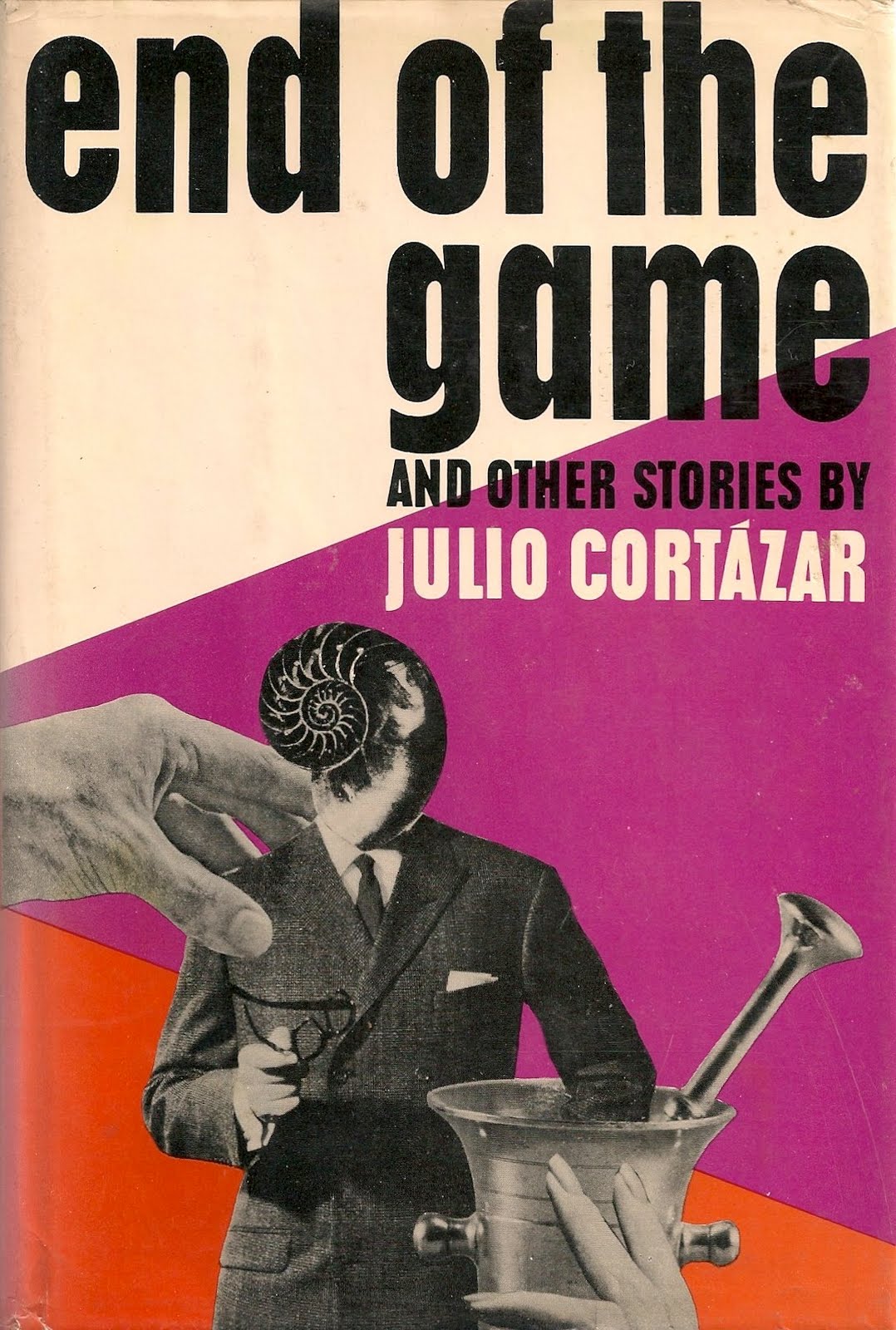 The idea of translating selections from Cortázar's work must have been in Paul Blackburn's mind at least from April 1958, when the Argentinian wrote him a friendly letter, in the course of which he outlined the books he had published to date and mentioned that he had just completed a long story, "El perseguidor" ("The Pursuer") based on Charlie Parker. Blackburn seems to have turned his hand first to Cronopios and Famas, although that book wouldn't appear in its entirety until 1969. By 1962, Cortázar was writing to Sara Blackburn (Paul's wife, and Cortázar's US editor) about a translation of "Las armas secretas" (apparently just the title story, not the entire volume) by Hardie St. Martin:
It seems formidable to me. It's very faithful, very precise, and it has all of the atmosphere of the original. I marked two or three little things that can be corrected without great effort... I would be delighted if someone would be moved to translate "The Pursuer" and the other stories in the book, but above all "The Pursuer."I'm not sure what became of St. Martin's translation, but in 1967, after Pantheon had already published The Winners and Hopscotch, End of the Game appeared, containing Blackburn's translations of most of the contents of Bestiario, Las Armas Secretas, and Final del Juego, including the Parker story, "Axolotl," "The Idol of the Cyclades," and twelve other pieces. By then Antonioni's film Blow-Up, which is loosely based on Cortázar's "Las babas del diablo," was about to appear, and so the story was retitled "Blow-Up," a felicitous change as the original title translates to something like "the devil's spittle." When the Collier Books edition appeared a year later the title of the entire volume was changed and a still from the movie became the cover art.
In the late '70s or early '80s a Harper paperback edition restored the original title, but the subsequent Vintage edition that remains in print is once again Blow-Up.
The original surrealist-derived cover art from the hardcover edition is credited to one Hoot von Zitzewitz, whose identity appears to be a bit mysterious. In a letter to Paul Blackburn and his wife Sara (who was his editor at Pantheon), Cortázar wrote: Dear Sarita, many thanks for the copy of End of the Game, which is very nice. I have the impression that we have chosen the sequence of stories well, and that some critics will say some interesting things about them.The same letter also alludes with regret to Sara's decision to leave Pantheon. By 1969 she and Paul Blackburn had divorced and Paul had married for a third time. (Translations are mine, from the three-volume Alfaguara edition of Cortázar's Cartas.)
Cortázar: Hopscotch

In the final paragraph of a letter to Paul Blackburn written from Vienna in September 1961, Cortázar shared a bit of news with his agent and friend. "Last week I finished La Rayuela (Hopscotch, you know). It is, I humbly believe, a very beautiful thing." Blackburn must have expressed puzzlement, because two weeks later the author explained: "La Rayuela is a novel, Mr. Agent. Of about 650 pages." And so it was. It was published in Buenos Aires in June 1963, although the American edition would not appear for another three years. During that time Pantheon's chosen translator, Gregory Rabassa, then a novice at the craft, worked closely with the author, struggling to devise creative solutions to the sometimes nightmarish obstacles the book posed. Years later, Rabassa recalled:
Hopscotch was for me what the hydrographic cliché calls a watershed moment as my life took the direction it was to follow from then on. I hadn't read the book but I skimmed some pages and did two sample chapters, the first and one further along, I can't remember which. Editor Sara Blackburn and Julio both liked my version and I was off and away.When not busy translating One Hundred Years of Solitude, Paradiso, Conversation in the Cathedral, and dozens of other books, Rabassa went on translate five more of Cortázar's, the last being A Certain Lucas in 1984. His memoir, If This Be Treason: Translation and Its Dyscontents, was published by New Directions in 2005.
Cortázar, who was himself an experienced multilingual translator, was delighted with everything about the American edition -- except for this colorful jacket byGeorge Salter, which he claimed to have removed and thrown in the wastebasket as soon as his author's copy arrived.
Monday, July 19, 2010
Bad Guys

Jorge Luis Borges had already made a name for himself, at least in Argentine literary circles, as a poet and essayist years before he turned to the short fiction on which his broader international renown would largely come to be based. When he did so, like many an artist he began by borrowing from the masters, in his case with a volume of retellings and translations of tales gleaned from Mark Twain and the Thousand and One Nights as well as Herbert Asbury's Gangs of New York, the Encyclopedia Britannica (Eleventh Edition), and other, less familiar sources. Most of the stories and anecdotes in Historia universal de la infamia deal with some kind of treachery or violence, usually both, and together they make up a little guided tour of a few of the lower precincts of Hell, the ones reserved for those whose crimes can't be easily ascribed to mere misplaced love or folly.
The only declaredly original story, describing the fatal dénouement of a confrontation at knifepoint at a Buenos Aires dance hall, is "Hombre de la esquina rosada," the title of which is here translated, felicitously if not entirely accurately, as "Streetcorner Man." Most of the pieces were originally published, in many cases pseudonymously, in Argentine literary magazines and supplements in the 1930s; one of the headings used for their appearance was "Museo" ("Museum"), which seems particularly appropriate. The arts of collecting and of presentation are here given equal footing with the art of creation. Borges scrupulously provides the source for each piece, and if a few of those attributions turned out, on closer examination, to be fictions, who was to know?
In the preface to the 1954 edition, written with nearly two decades of hindsight, Borges was fairly dismissive about the volume's merits, but, in contrast to his attitude towards several early works that he actively sought to suppress, he evidently managed to come to terms with its shortcomings (which may well strike the reader as no shortcomings at all).
The very title of these pages flaunts their baroque character. To curb them would amount to destroying them; that is why I now prefer to invoke the pronouncement “What I have written I have written (John 19:22) and to reprint them, twenty years later, as they stand. They are the irresponsible game of a shy young man who dared not write stories and so amused himself by falsifying and distorting (without any esthetic justification whatsoever) the tales of others. From these ambiguous exercises, he went on to the laboured composition of a straightforward story – “Streetcorner Man” – which he signed with the name of one of his great grandfathers, Francisco Bustos, and which has enjoyed an unusual and somewhat mystifying success...As Borges had remarked in the preface to the first edition, the stories are not, and do not try to be, psychological.
The theologians of the Great Vehicle point out that the essence of the universe is emptiness. Insofar as they refer to that particle of the universe which is this book, they are entirely right. Scaffolds and pirates populate it, and the word “infamy” in the title is thunderous, but behind the sound and fury there is nothing. The book is no more than appearance, than a surface of images; for that reason, it may prove enjoyable. Its author was a somewhat unhappy man, but he amused himself writing it; may some echo of that pleasure reach the reader.
The di Chiricoesque cover painting of this edition, in which nefarious characters from various eras -- probably intended to represent specific antiheroes from the tales themselves -- lurk among the cracking pillars of a looming colonnade, is by Peter Goodfellow, who created several other Borges covers for Penguin UK in the 1970s. The translations above are by Norman Thomas di Giovanni, who had the advantage of working closely with Borges himself. Sadly, his translation is out of print, having been replaced by one commissioned -- largely, it appears, for pecuniary reasons -- by the author's widow.
Subscribe to:
Posts (Atom)