Showing posts with label Katazome. Show all posts
Saturday, March 01, 2014
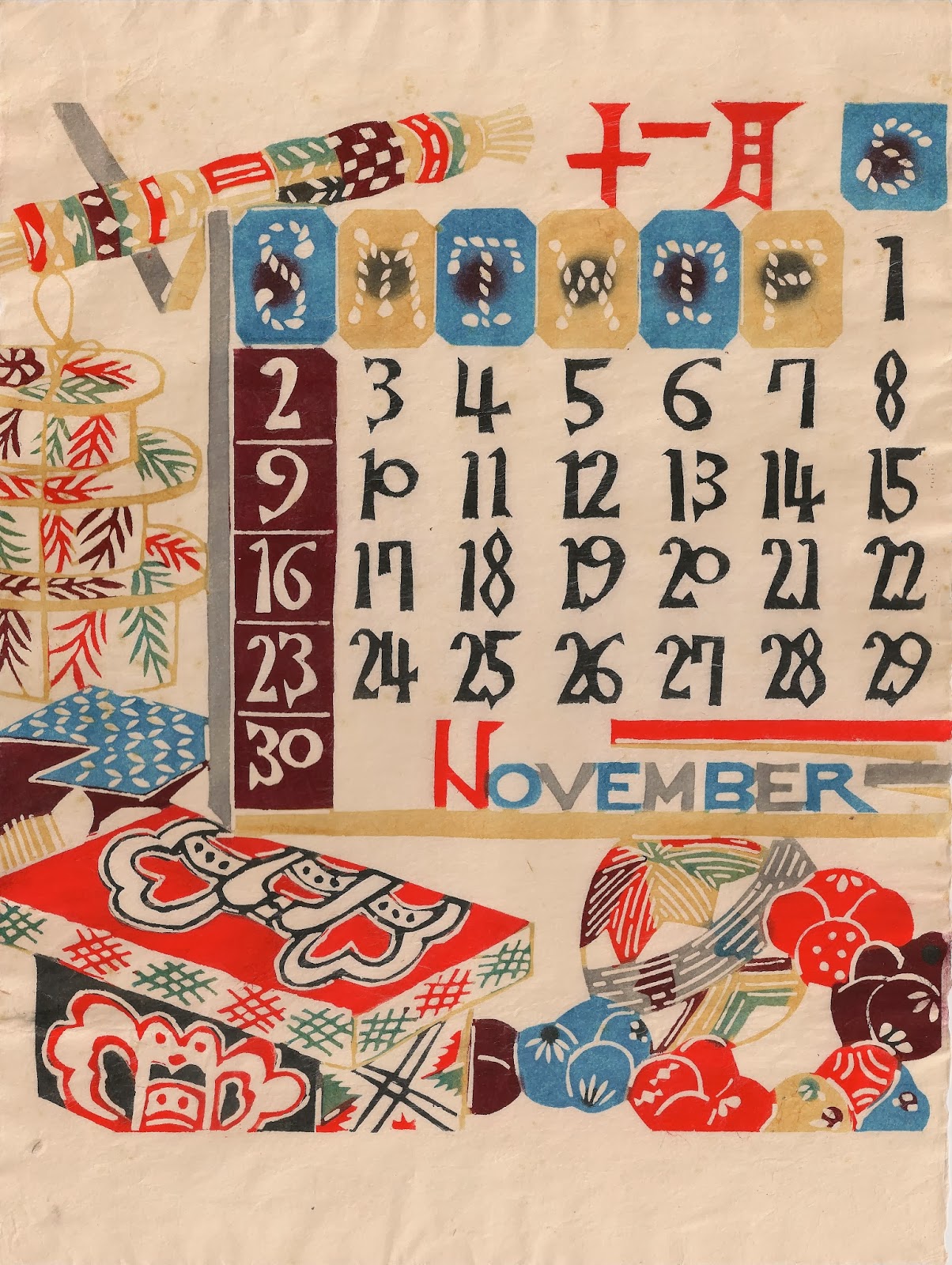
Keisuke Serizawa: 1969 Calendar
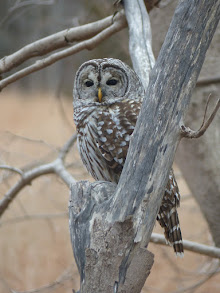
This hand-printed calendar was produced by the Japanese katazome (stencil-dyeing) master Keisuke Serizawa, whose mark can be seen just below and to the left of the bird on the cover print (see following image). He produced calendars, with different designs each year, from 1946 until the mid-1980s; at least one associate and friend, Takeshi Nishijima, produced his own similar calendars during part of that period.
This particular production is relatively restrained. On most of the individual panels it is the numbered squares or circles, rather than the accompanying illustrations, that are the dominant design element; many of the spaces not needed for dates are filled with little vignettes.
For the August print below, Serizawa worked the letters of the name of the month into the first row of the calendar, but since he was one square short he combined the last two letters into one space.
November, I think, is my favorite. Notice that the "S" for Saturday is displaced to a line above the other days, again because there was no empty square available for it.
All of these pages were printed on handmade paper, so the originals are not as neat and square as the images shown here imply.
A variant of this calendar has the name of the Western Automobile Co., Ltd. (the Japanese affiliate of Mercedes-Benz) printed on each page; the image below is from an auction listing.
I am relying on George Baxley for identification on this calendar as the work of Keisuke Serizawa. There are relatively few English-language sources on the artist, with the fine exhibition catalog Serizawa: Master of Japanese Textile Design (Yale University Press, 2009) being the notable exception.
Labels:
Japan,
Katazome,
Printmaking
Saturday, November 24, 2012
More Katazome
According to the label, these katazome (stencil-dyed) calendar pages were "made by Haruo Kuriyama in Kyoto" and distributed by Yasutomo Co. in San Francisco. The artist who designed them, however, is almost certainly Takeshi Nishijima. The page for February is missing from this set.
Click on the katazome label below for earlier related posts.
Labels:
Calendars,
Japan,
Katazome,
Printmaking
Wednesday, December 01, 2010
December

Katazome (stencil-dyed) calendar page by Keisuke Serizawa (1895-1984). (Scanned from a commercially issued reproduction.)
Labels:
Japan,
Katazome,
Printmaking
Tuesday, January 05, 2010
Katazome calendar: Takeshi Nishijima

This folio of stenciled prints is the work of a katazome artist who designed a number of calendars that were produced from 1969 or 1970 to 1980 (and perhaps outside that range of years as well). If he is the same Takeshi Nishijima listed on Artfacts.Net then he was born in 1929 and died in 2003.
According to the descriptive text that accompanies the folio, Nishijima was both a professor of art at Kyoto University and "a graphic and textile designer [who] exhibited in numerous one man shows and won the coveted Grand Prize at the Kyoto Art Exhibit." He was associated with Haruo Kuriyama of the Wazome Kogei company, which was probably the publisher of this calendar. I've been told that Kuriyama was a friend of Keisuke Serizawa, the best known katazome artist, who produced calendars annually beginning in 1946.
Given the similarity in technique and layout between the work of the two calendar makers, Nishijima may well have studied with Serizawa; if so, he was also effectively a competitor, as Serizawa's calendars continued to appear through the 1970s. His work isn't as intricate as Serizawa's, which shows a greater fondness for rich geometrical ornament, and it appears to have received little attention outside of Japan. These calendars were, nevertheless, clearly aimed at Western audiences, as all the names of the months are in English.
Grateful acknowledgment is due to the printmaker Brian Garner for providing these images. I have cropped them square for the web, but they were printed on handmade paper and the bottom edges are in fact untrimmed. Below each image I have added the interpretive text for each month that was provided by the publisher on a separate sheet (see the last image below).

"During January people come to pray at Heian Shrine, Kyoto, for peace and good luck throughout the year."

"February brings tranquility in Plum Tree Park at Tsukigase, Kyoto."

"March is the time when water orchids rise to impart a springlike charm and grace."

"In April the tree peony is a delightful harbinger of the joys of spring."

"The rose which blooms in May is the universal symbol of love."

"June tells of farm dwellings at the castle town, near Nara prefecture."

"As summer progresses into July we are present as a storm passes, with clouds running at the ridge."

"The first yield of fruit in August tends to refresh the eye as well as the palate."

"September is the month for typhoons. Here willow trees sway in the wind at Nijo Castle, Kyoto, to protest the approaching violence."

"October's autumn flowers are handsomely framed by a Chinese jar of the Sung era."

"The sunset symbolizes approach of the year's end. The landscape of Japanese inland sea Seto is November's setting."

"As December arrives we note that Kyoto's farmers have completed their work. The harvest is in and we see a serene community of farmhouses."

Here are some katazome links:
- Explanations of the technique at Wikipedia and by John Marshall.
- George Baxley has information on Keisuke Serizawa's calendars, with numerous examples.
- Kit Eastman is an American illustrator who employs the katazome technique.
- Another artist, M. Joan Lintault, has several interesting posts on her work with the technique.
- The Japan Society has organized an outstanding exhibition dedicated to Keisuke Serizawa, which runs through January 17, 2010. A catalog is available from Yale University Press.
- And finally, my earlier posts, with illustrations of a full calendar set possibly by Serizawa, another set that is probably by Takeshi Nishijima, and a review of the Japan Society show.
Labels:
Calendars,
Japan,
Katazome,
Printmaking
Saturday, October 10, 2009
Serizawa at the Japan Society

I've just returned from the Japan Society's beautifully mounted exhibition, Serizawa: Master of Japanese Textile Design, devoted to the work of Keisuke Serizawa (or Serizawa Keisuke, if you prefer), a master of the use of stencil dyeing techniques for printing fabric and other materials. This was the show's first weekend, and I was lucky enough to share a nearly private guided tour of the rooms.
Serizawa (1895-1984) was already a professional textile designer in the 1920s, when he came under two influences that were to shape his long career. One was Yanagi Sōetsu, the guiding spirit of the mingei or folk art movement in Japan; the other was his introduction to the Okinawan dyeing technique known as bingata.
The pieces on exhibit include kimonos and sashes, folding screens, wall scrolls and noren, as well as calendars and book design.


This one's a bit of trompe l'oeil; there are no cords here, only stencilling:

Here's a mandala designed in honor of President John F. Kennedy:

As he became popular Serizawa was much sought after for book covers and illustrations. This one is from a Japanese edition of Don Quixote.

For those who can't make it to the show there is an excellent full-color catalog published by Yale University Press, but to appreciate the vivid colors and subtle textures you really need to make the trip. Both the tour and admission were free this weekend, although there is normally an admission fee. The Japan Society is located at 333 East 47th Street, just across the street from Dag Hammarskjold Park.
Labels:
Japan,
Katazome,
Printmaking
Wednesday, July 15, 2009
Kit Eastman / Annie Bissett
Two American artists who, working separately, have each adapted traditional Japanese techniques for use in their work.
First, Kit Eastman of Silver Minnow, who uses the stencil-printing method known as katazome, as in this splendid egret, who seems to be taking an avid interest in the minnows swimming in the margins:

Below is the original stencil:

As I understand it, the katazome technique (see my earlier post) makes use of a paste that resists pigment. As Eastman explains the process, "the open areas of the stencil allow the rice paste to flow through. The brown paper masks the fabric, so these areas will eventually be dyed with a variety of pigments."
The method can be applied to a variety of surfaces, usually cloth or paper. Of her adoption of katazome she writes:
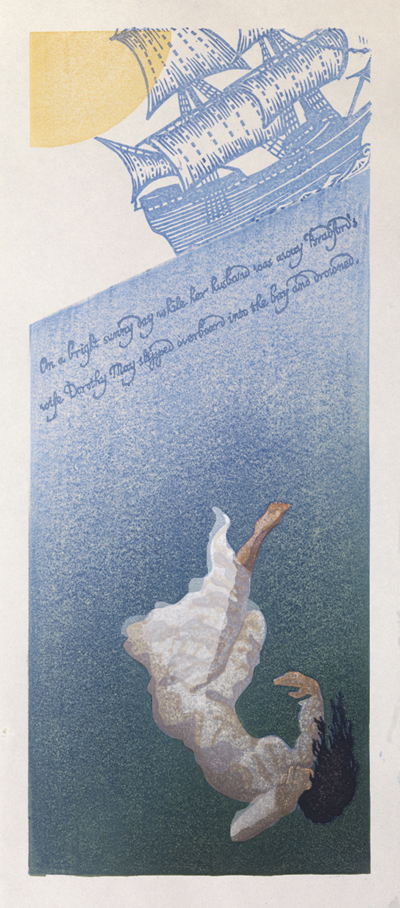
I feel I have at last come home — this technique suits my sensibilities in so many ways. With textile art and craft, there are often periods of waiting due to the requirements of the materials. This rhythm draws me deeper into the work. I find myself contemplating the idea of time, as measured in natural cycles, including my own experience.The woodblock print below, by Annie Bissett, depicts Dorothy Bradford, a Mayflower pilgrim who fell -- or leaped -- to her death in Provincetown Harbor in 1620, and is part of a group of works entitled We Are Pilgrims.
Click through to read the inscription, which seems to be based on the original account of the incident as recorded by Cotton Mather.

(I'm afraid the colors of this image are not coming through very faithfully here; try this link to the original.)
Bissett describes the technique she employs:
I use the traditional Japanese method, called moku hanga or ukiyo-e, where a block is carved for each color and then the blocks are printed successively with water-based pigments using a hand-held burnishing tool. This time-consuming and somewhat arduous process (a single print edition can take two to three months to complete) has become a welcome counterbalance to the fast-paced, deadline-driven digital work I've done for 20+ years as a commercial artist.There is a fuller explanation of moku hanga on Bissett's blog, Woodblock Dreams.
Labels:
Katazome,
Printmaking
Subscribe to:
Comments (Atom)