Showing posts with label Literary magazines. Show all posts

Monday, February 07, 2022

Time Capsule

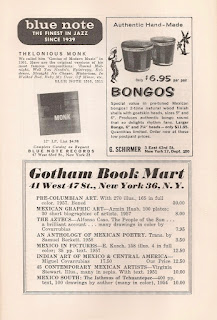
Above, a page of ads from Barney Rosset's Evergreen Review, Vol. 2. No. 7 (Winter 1959). This was a themed issue devoted to Mexico, but it also included a long essay on Thelonious Monk, so these particular advertisements were presumably chosen with that in mind. Bongos are more usually associated with Cuba, but these "pre-tuned Mexican bongos" would have been the perfect accessories for beatniks, or at least for the Hollywood version of them. Other ads in this issue included one for the Living Theatre and for the Circle in the Square production of Brendan Behan's Quare Fellow, directed by José Quintero.

Sadly, the Gotham Book Mart is no more, but as of this writing at least one of the contributors, the Mexican writer Elena Poniatowska, is still with us after sixty-odd years.

Sunday, May 30, 2021

New World Journal

This little magazine edited by Bob Callahan had a brief run of five numbers in the 1970s; there was one double issue (2-3). It was published in Berkeley, California by the Turtle Island Foundation "for the Nezahaulcoyotl [sic] Historical Society, a non-profit corporation engaged in the study of the history and literature of the New World." The name of the historical society is spelled at least three different ways in the journal's pages; both the society and the foundation were evidently Callahan's own creations and perhaps one-man operations. According to a manifesto in No. 1 (Fall 1975),
The New World Journal will attempt to provide an ongoing review of significant writings in the field of American Literature and American Cultural History. The current plan calls for both republication of a number of early pieces that many of our readers may have missed as well as the solicitation of original works by contemporary writers and cultural historians.

The insistence of Space remains the central preoccupation of the American writer, be he or she poet or historian, and the distribution of culture and culture trait—aboriginal as well as modern—from origin point to the extant [sic] of their natural or forced perimeter remains a theme of enduring concern. Thus the recent work of Charles Olson and Carl Ortwin Sauer is invoked—yet there are issues that can be traced back through the literature at least as far as to Herman Melville and Francis Parkman, as far back perhaps as to the anonymous authors of the origin and migration myths of the Quiche [sic] Maya and the Delaware. The American writer tends to see Space in terms of Elapsed Time. Apparently he always has. Other Orders are acknowledged, often respected, but as for Cosmology, Space—and here we would allow a glyph—(Time)—is all the American writer need require.
Along with poetry by Olson, the Nicaraguan radical priest-poet Ernesto Cardenal, and (in later issues) the pianist Cecil Taylor, the journal included posthumous contributions by scholars whose work tended to mark them (fairly or not) as outsiders of one kind or another: the folklorists Jaime de Angulo and Zora Neale Hurston, the economic botanist Edgar Anderson, the anthropologist and Lovecraft collaborator Robert Barlow, and the historical geographer Carl Sauer. Only the last, who died in July 1975 and arranged with Turtle Island for the republication of some of his work, had any evident personal connection with Callahan.
The journal's West Coast orientation was clear; it had little affinity with skeptical Europe or with those urban-oriented East Coast writers for whom "the insistence of Space" might not have been a central concern. With its interest in Native America, the Southwest, and Mesoamerica, it was aligned with the shamanic blending of anthropology and poetry known as ethnopoetics. As eccentric and personal as it was, it was arguably ahead of its time in terms of multiculturalism, interdisciplinarianism, and attention to the natural environment.
Turtle Island seems to have remained active as a book publisher until at least 1991 before disappearing. (There's a Turtle Island Foundation in Canada that is unrelated to it.) Callahan himself had an interesting career, writing or editing books on Irish-Americans, comic strips (he was a Krazy Kat expert), and the JFK assassination. He was also involved in some way with Ishmael Reed's Before Columbus Foundation, which continues to exist. He died in 2008.

Below is a brief excerpt from Edgar Anderson's "The Iris," originally published in a scholarly publication in 1927 and reprinted in New World Journal 2-3. The subject is a native wildflower that seemed to expand its distribution with the spread of livestock-raising.
Years ago, Father Paradis, a mixture of saint and scalawag, founded a little colony of French Canadians in a sandy bay at the northern end of Lake Timagami. The colony finally died out but Father Paradis hung on, preaching to the Indians at the Hudson Bay Post, prospecting for gold, and raising a small herd of cattle. Today Father Paradis is dead and the forest is marching back into his little outpost clearing; his barns have fallen in, and chipmunks build their nests in his chapel. But where his cattle used to graze in a marshy pasture close to the lake, Iris versicolor grows by the thousands. When it blooms in mid-July, it is the strangest Iris garden on the continent. Bounding the horizon are the rocky cliffs and forested slopes of Lake Timagami. Except for the little clearing and the ruined walls of the farm buildings there is no sign of man. Overhead towers Father Paradis's rude wooden cross, set on a bare rock with boulders piled about its base. And for a hundred yards or so the meadow all about is blue with Iris versicolor.

Sunday, October 16, 2011

Wormwood, and Others


Marvin Malone, who was the editor of the Wormwood Review for almost its entire long run, sounds like he must have been an interesting person. A pharmacologist and educator with a long resumé of scholarly papers and professional accomplishments, he somehow found time to more or less single-handedly put out this little saddle-stitched avant-garde quarterly, which regularly featured such (now) well-known contributors as Charles Bukowski and Billy Collins as well as a host of other writers whose names would have been familiar mostly only to each other, if that.

The Wormwood Review got its start in 1959 in Mt. Hope, Connecticut and almost disappeared after its second number. Malone got involved with #3, eventually took it with him when he relocated to California, and kept at it until the final regular issue, number 144, which appeared posthumously in 1997. A bit of a writer and artist himself, he often used pseudonyms — A. Sypher, Ernest Stranger — to mask his own contributions. The cover art shown here, including the anamorphic design of issue #72, is probably all his work.


Some of the numbers were special issues devoted to the work of one poet, which is why #63 is Ronald Koertge's Cheap Thrills! on the cover and #59 is Lyn Lifshin's Paper Apples. For #70 he created a quasi-anagram from the title.


Each of the above issues was limited to 700 numbered copies, a few of which were signed. There's an excellent website devoted to the Wormwood Review, by the way, featuring a history, complete index, and tributes from some of Malone's regular contributors.

Perhaps due to geographic accident, there's no mention of Malone or of Wormwood Review in Steven Clay and Rodney Phillips's A Secret Location on the Lower East Side: Adventures in Writing, 1960-1980, which documents many of the little magazines which were published around the same time, particularly in New York and San Francisco. Their book does, however, mention Dennis Cooper's Little Caesar, shown below, which featured some of the same contributors and ran from 1976-1980. Little Caesar included a few photographs and had a bit of a fanzine style but overall it had the same home-made, one-man shop feel as Wormwood Review.


Nausea, edited and published by one Leo Mailman out of Long Beach, California, was another small magazine of the time, in the same trim size and saddle-stitched format as the ones above. This number, from the Fall of 1975, includes Collins and Wormwood Review regular Gerald Locklin among its contributors. Nausea imitated Wormwood Review in devoting a page or so at the back to the addresses of similar publications.


Finally, not a journal but very much from the same publishing scene is this chapbook from 1975, Tarzan and Shane Meet the Toad which collects the work of three poets, all of whom would have been familiar to the readers of Wormwood Review. It was published by the Russ Haas Press, also in Long Beach.


How lastingly significant was any of this? (Keep in mind that there were dozens, probably scores of comparable magazines at the time, each reflecting the interests and talents of their editors and contributors.) I can't honestly say that most of the material here appeals to my particular literary taste, and some of it is frankly no better (and no less narcissistic) than what appears in the average college or even high school literary magazine, but at least it was lively, it was energetic, and now and then these little chapbooks may have rescued a few gems from oblivion. Everything shown above came from one library book sale I went to a number of years ago. If I hadn't happened to be there that day, if these copies had wound up unsold and pitched in a dumpster, would anyone have been better or worse off? I can't answer that question. The small magazine scene lives on, of course, and today it's often integrated with web-only publications, but I hope in its anarchic way it will continue to leave a paper trail here and there.

Tuesday, October 27, 2009

The Pleasures of Drabness


As a rule I'm a sucker for loud, garish colors, the more the merrier, but the images below celebrate the lost, enforced virtues of tight publishing budgets, matte stock, and limited color palettes. (And also of age, dirty fingerprints, and exposure to sunlight.)


The best American literary magazine of the 1920s, the Dial was home to Pound, Eliot, Yeats, Amy Lowell, E. E. Cummings, D. H. Lawrence and just about every other major American and English modernist. The design is a bit formal, in keeping with its highbrow tone.


Twice a Year, a hefty hardbound journal, had a run of several years in the 1940s.


A postwar Schocken edition of Kafka. Beneath the jacket the book itself was green, with a nice title stamp on the spine. I think Schocken's other Kafka titles from the same period probably shared the same design.


The Pantheon edition of one of Flann O'Brien's best books, erroneously dated 1940 but actually published several years later. I'm not sure whether the typographic arrangement on the front cover was supposed to suggest bird's feet.


A slender Irish periodical, with a nice woodcut. Here's the advertising on the back:


Below is another Irish pamphlet, front and back. The Dolmen Press was a highly regarded printer active for more than thirty-five years.


Finally, I imagine the name of this periodical, which had a brief run in the 1970s, was meant to allude to the better-known Poetry. The editor or editors responsible for its creation are uncredited within.

Monday, October 26, 2009

Antaeus, 1970-1994


In later years it would become just another literary magazine, albeit a very good one, but in its first decade there really was something special about Antaeus, which was founded in 1970 in Tangier, Morocco by Daniel Halpern at the instigation of and with the assistance of the novelist and composer Paul Bowles. It was refreshingly if selectively international, a little bit like a North African version of Paris Review, (it even imitated the latter in presenting interviews with literary figures, at least at the beginning) and it featured a number of excellent writers who were then undiscovered or forgotten in the US. Much of its uniqueness must have been due to the influence of Bowles, its "consulting editor," who as a longtime expatriate had contacts with literary circles on several continents.

I was a bit young for it when it first appeared, but by the mid 1970s I had discovered it and become a subscriber, and I eagerly devoured each new number and looked forward to the arrival of the next, which might be six months off if it was a double issue. At some point I believe it switched from a quarterly to a semiannual publication. I can think of any number of moments of pleasure or illumination I gained from its pages, but here are just a handful of favorites:
  • Laura (Riding) Jackson's over-the-top diatribe, in response to a request for suggestions for a list of "Neglected Books of the 20th Century," in issue #20
  • Bowles's own "Istikhara, Anaya, Medagan and the Medaghanat" from the "Special Essay Issue" #21/22
  • J. G. Ballard's disturbing "Low-Flying Aircraft" from the "Popular Fiction" double issue #25/26
  • The Yannis Ritsos poetry feature, from #28
  • Harry Mathews's droll short story in the form of a recipe, "Country Cooking from Central France: Roast Boned Rolled Stuffed Shoulder of Lamb (Farce Double)" from #29

Eventually Antaeus became quite successful and influential, at least as literary magazines go, and by the mid-1980s it had relocated from Tangier to New York and had became slicker, thicker, and to my mind rather tame, devoting way too much space to the same inbred roster of American poets that every other lit mag was publishing. But maybe I was the one who changed. It spawned a publishing company, the Ecco Press, which for a while did a commendable job of restoring to print writers like Bowles and Cormac McCarthy who were then out of fashion. (Sadly, the Ecco Press is now just another imprint of Rupert Murdoch's HarperCollins.)


I love these early covers, which were printed on matte stock, as were all the issues of Antaeus until #54. The curious little grotesques on the ones shown here are by the Moroccan artist Ahmed Yacoubi, a friend of Bowles; the one exception is number 8, which is based on an artifact from Crete.