Showing posts with label Orkney. Show all posts
Showing posts with label Orkney. Show all posts
Tuesday, July 21, 2026
Digging in Orkney
The producers of Time Team have released a 75-minute video covering the excavations at Orkney's Ness of Brodgar, which were conducted over a twenty-year period ending in summer 2024. Rather than the typical Time Team episode, in which a team of archaeologists swoop in and excavate a site in real time over a limited period, this is more of a straight documentary, and a very good one at that. The only recognizable Time Team regulars here are Tony Robinson, who contributes some voice-over, and the geophysicist John Gater, who has longstanding connections to the site. The other archaeologists seen on camera, including the site's director, Nick Card, are veterans of the dig at the Ness.
Orkney prehistory is fascinating. The Ness complex, dating to roughly 3000BC, is one of the most important Neolithic sites in Britain. Despite Orkney's isolation, it was no cultural backwater. In addition to the Ness, the islands are home to important stone circles, the chambered tomb at Maes Howe, and the settlement of Skara Brae. Whoever the ancient Orcadians were, they had sufficient time and energy to devote to craftsmanship and public architecture; the impressive fine stonework at the Ness is featured in the documentary.
When the excavation concluded, the site was reinterred to protect it, but during the final stages of that work a geophysical survey revealed an intriguing circular feature outside the limits of the original excavation, and the investigation of that feature (rumored to be a large Neolithic hearth) will be the subject of a future Time Team episode. The analysis and publication of the finds at the Ness is expected to go on for many years.


Thursday, September 04, 2025
Islander

I never saw myself as, and resist becoming, the wholesome ‘outdoors’ type. But the things I experience keep dragging me in. There are moments that thrill and glow: the few seconds a silver male hen harrier flies beside my car one afternoon; the porpoise surfacing around our small boat; the wonderful sight of a herd of cattle let out on grass after a winter indoors, skipping and jumping, tails straight up to the sky with joy.I came upon Amy Liptrot's memoir "by accident," by way of the film adaptation starring Saoirse Ronan. But what constitutes an accident? Most of The Outrun takes place in Orkney, a place that has long interested me because of its geography and long history of human occupation, and if it had been set elsewhere I might never have been aware of it.
I am free-falling but grabbing these things as I plunge. Maybe this is what happens. I've given up drugs, don't believe in God and love has gone wrong, so now I find my happiness and flight in the world around me.
Liptrot was raised in Orkney (of English parents) but as a teenager couldn't wait to get away from it. She spent a decade in London going to clubs, finding and losing jobs, and — most of all — drinking. She tried and failed to get off the bottle various times, but finally succeeded, with the help of a treatment program, when it became clear that she was facing a choice of either life or booze. She retreated to Orkney, got a summer job with the Royal Society for the Protection of Birds counting elusive corncrakes, then rented a cottage on the tiny, treeless island of Papay (population less than one hundred).
The memoir and the film adaptation both have merits, but they're different merits. The movie is darker and more intense (and occasionally frustratingly non-linear); it focuses more on Liptrot's hellish and frenetic London years; the book is retrospective and meditative, following Liptrot as she retunes herself to the rhythms of the islands. Overall the film is faithful, and Ronan's high-energy performance is wonderful.
There is, of course, a movie tie-in edition with Saoirse Ronan on the cover, but I opted for this earlier Canongate paperback edition with cover art by an artist who works under the name Kai and Sunny.
Saturday, February 19, 2022
The Lost Altar
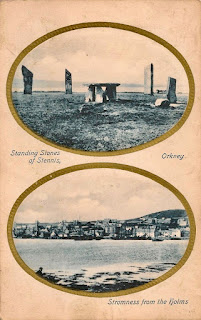
The central "altar" or "dolmen" shown in the view of the neolithic Standing Stones of Stennis (or Stenness) was a "reconstruction" from 1907, possibly inspired by Sir Walter Scott's interpretation of the site. It was dismantled under murky circumstances in 1972 and only the uprights were put back in place. A century earlier a landowner had vandalized the site extensively, resulting in the loss of much of the surrounding circle of stones.
Despite its barren northern location, Orkney has some of the most extraordinary neolithic monuments in Britain. I haven't been there (my wife and daughter have), but perhaps someday I will make a visit.
Subscribe to:
Posts (Atom)