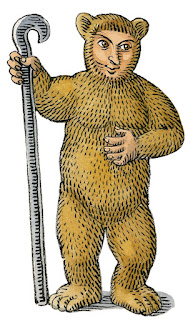
The above illustration by the late French artist Jean-Claude Pertuzé is from a version of a folktale known in French as "Jean de l'ours," that is, John of the Bear or John the Bear. The story of a hero, born to a human mother and an ursine father, who is kept in a cave until he is old enough to roll away the stone that encloses it, and who later descends into the underworld to rescue three princesses, the tale was found throughout Europe and has been carried into the Americas. The German philologist Friedrich Panzer traced a series of parallels between the folktale and the saga of Beowulf, whose name may mean "Bee-wolf," that is, "bear."
The classicist Rhys Carpenter went further, connecting the story, by arguments too intricate to describe here, with the Odyssey, and suggesting a common legendary tradition ultimately deriving from memories of a Eurasian bear-cult. The bear, an animal that immures itself and passes the winter in death-like torpor, has often been conceived of as a messenger to the Other World (as among the Ainu), perhaps as their lord himself. Carpenter mentions the case of the bear-like Thracian hero-god Salmoxis, who, according to Herodotus, built a great hall and regaled his guests with promises of eternal life, before disappearing, apparently dead, into an underground chamber for three years, only to return. In Strabo the same figure becomes co-regent of the underworld.
Is it too much to find here an echo in the New Testament, where the stone is rolled away from the tomb of the risen Jesus after the harrowing of Hell?
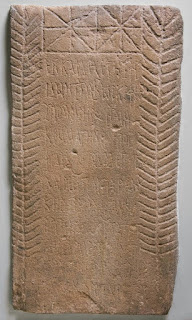
Let some traveller, on seeing Hermes of Commagene, aged sixteen years, sheltered in the tomb by fate, call out: I give you my greetings, lad, though mortal the path of life you slowly tread, for swiftly have you winged your way to the land of the Cimmerian folk. Nor will your words be false, for the lad is good, and you will do him a good service.
The Hermes in this third-century Greek inscription isn't the winged messenger of the Greek gods but a teenager who died and was memorialized on what is now known as the Brough Stone, preserved in the Fitzwilliam Museum, Cambridge. (Original Greek text and details here.) He had done some travelling of his own before he met his end in Roman Britain; Commagene, where he was born, was a small kingdom in what is now eastern Turkey. The Cimmerians, to whose land he flies after death, were a barbarian people known, if hazily, to the Classical world, but in the Odyssey Homer locates their country in the dark regions of the far north, just this side of Hades.
Curiously, Robert Fitzgerald doesn't use the word "Cimmerian" (the Greek is Κιμμερίων) in his translation of Book XI, line 14, but refers instead to "the realm and region of the Men of Winter." It's in Pound's Cantos, though:
Came we then to the bounds of deepest water,
To the Kimmerian lands, and peopled cities
Covered with close-webbed mist, unpierced ever
With glitter of sun-rays
(I'm dusting off this old post in honor of Bob Dylan's just-released Nobel Lecture, which, among other things, cites the Odyssey. Michael Leddy has a related post.)
Until about a week ago [in 2007], the last time I read the Odyssey was, as far as I remember, more than thirty years ago, during my freshman year in college, when I devoured the whole thing in two marathon sessions over a weekend. (My classmates were presumably off doing other things that were perhaps, in their way, equally memorable.) It wasn't assigned reading; then as now I read it for the pure pleasure of the thing, in Robert Fitzgerald's translation which still strikes me as a miracle of naturalness and narrative ease.
More often than not, when I revisit the reading enthusiasms of my youth after a span of time has passed I find it a little hard to understand what I ever saw in them. Either my standards have been raised over the years or I've become jaded, I couldn't say which. But nothing like that happened when I picked up the Odyssey again. If anything I got more out of it this time, picking up on things that wouldn't have registered back then.
The curious episode of the Ancient of the Sea, for instance. To bring this worthy under their power, Meneláos and his companions must seize hold of him while he sleeps, then hold on tight as he passes through a rapid series of transformations, from lion to serpent to boar and so on. Thirty years ago I wouldn't have known that the capture of the Ancient is strikingly echoed in the British fairy ballad of “Tam Lin,” the earliest known version of which postdates the Odyssey by roughly two thousand years. While it's possible that the incident in the ballad is an independent invention, it seems more likely that the motif had been floating around in the European folk memory for all that time, waiting for an opportunity to emerge, along with much else that didn't find the surface and has been lost forever.
Nor had I really ever thought about how much the meeting with the assembled shades of the dead, a scene in which the poet pulls out all the stops, prefigures both the Inferno and Hamlet. And though I remembered the set piece of carnage in which Odysseus and and his son dispatch the suitors who had besieged Penélopê in his palace, I don't think I ever felt the full horror of the chilling sequel, in which the Telémakhos deals out summary justice to the twelve maids who had been sleeping with the enemy. The atrocities of our own time have a long pedigree:
He tied one end of a hawser to a pillar
and passed the other around the roundhouse top,
taking the slack up, so that no one's toes
could touch the ground. They would be hung like doves
or larks in springès triggered in a thicket,
where the birds think to rest — a cruel nesting.
So now in turn each woman thrust her head
Into a noose and swung, yanked high in air,
to perish there most piteously.
Their feet danced a little, but not long.
The creator of the Odyssey has been variously held to be, among other things, a blind man, a woman, and a committee. Since we have no reliable biographical information about him — or her — we are left to rely on internal evidence, which is beyond my ability to weigh and which is, in any case, apparently not sufficiently conclusive to tell us much that would make a difference. At least for the sake of convenience, then, it seems harmless to suppose that the poem was composed from start to finish by a single Homer, who may well not have been called Homer but who may as well be thought of as Homer as by any other name.
The epic that Homer concocted is a corker of an adventure, a book of marvels as inventive as anything that has been written since, but it's something else as well. Along with the Iliad, which may or may not be by the same hand and which I confess I have no immediate urge to reread [but did], it's the first real window into an interior life of a kind that is recognizable to us today, the oldest surviving record of people thinking, scheming, doubting, worrying, wondering, longing for home, in ways that we immediately and viscerally relate to. Before that there are outlines, flickers, fading traces of a consciousness we know must have been there if only anyone had possessed the language in which to record it, the language that Homer could perhaps be said to have invented, though he must of course have drawn from traditions now long lost.
That's one excuse for the title of this piece, which was lifted from a song that can be found on The Basement Tapes. Another is the following passage, in which Penélope, addressing a man whom she takes for a stranger though he is in fact her long-absent husband, speaks to him of the nature of dreams:
Friend,
many and many a dream is mere confusion,
a cobweb of no consequence at all.
Two gates for ghostly dreams there are: one gateway
of honest horn, and one of ivory.
Issuing by the ivory gate are dreams
of glimmering illusion, fantasies,
but those that come through solid polished horn
may be borne out, if mortals only know them.
But we don't ever know them, do we? What's behind the door, the lady or the tiger? We're all addicts of illusion, of hopes and dreams that will never be borne out. The truth slips by, undetected. But that's part of what being conscious entails; the ability to see things as they are supposes a like ability to imagine things as they are not. We inhabit a fixed world of chemical bonds and gravitational forces, but we also live in the unsteady, ever changing country of the mind. Shut the door to illusion and the world goes dark.
Caminante, son tus huellas el camino y nada más; Caminante, no hay camino, se hace camino al andar. Al andar se hace el camino, y al volver la vista atrás se ve la senda que nunca se ha de volver a pisar. Caminante, no hay camino sino estelas en la mar.