Showing posts with label Mexico. Show all posts

Thursday, October 06, 2022

Macario

I enjoyed this seasonally appropriate 1960 Mexican film directed by Roberto Gavaldón, with cinematography by Gabriel Figueroa. Macario is based on a short story by B. Traven, which is in turn based on a folktale called (in one of its many versions) "Godfather Death." It tells of a poor woodcutter (Ignacio López Tarso) who can barely feed his family enough tortillas and beans to fill their stomachs. Since his one wish in life is to have an entire roast turkey for himself, his devoted wife (Pina Pellicer) finally steals one and cooks it for him. As he sits down to eat it he receives in succession three visitors, whom we realize are in turn the Devil, God (or Jesus), and Death. Each asks to share his meal, but on the basis of some quite logical reasoning he agrees to invite only the third, who, in return, gives Macario a magic liquid that will enable him to cure the dying. There is a catch, however; if Macario sees Death standing at the feet of the patient, he may perform his cure; if Death stands at the head of the bed, the patient is his and Macario must not intervene. Macario makes use of the potion and becomes, in time, a rich man, until the Inquisition gets wind of his activities.

One of the things I liked about the film is that it plays down the potentially garish visual aspect of the story. (That aspect is, in part, reserved for the opening credits, which feature a troupe of folkloric skeleton marionettes.) The Devil, for instance, is a bit of a snazzy dresser, but he doesn't have horns and a goatee, nor is Death a skeletal figure with a flail. Macario, in his unassuming way, recognizes them for who they are nevertheless, and he isn't excessively impressed with either, or with the Señor. López Tarso is particularly good at giving Death skeptical looks at the bedside of patients who are obvious goners but whom Death assures him can still be saved. Really, this one? (Shrug.)

Gavaldón made at least two other films based on Traven novels or stories, Rosa Blanca and Días de otoño. I haven't seen either one, although I've read the story the latter is based on and it could be interesting. Ignacio López Tarso, at this writing, is still alive at the age of 97, which suggests that he set aside a bit of that potion for himself. Sadly, Pina Pellicer, who starred in Días de otoño, died at age 30 of an overdose of sleeping pills.

I'm not sure about the current availability of Macario on DVD or from streaming services; I watched an older DVD release that has subtitle options in both English and Spanish. A version of the folktale can be found in the Lore Segal / Maurice Sendak edition of The Juniper Tree and Other Tales from Grimm, one of those perfect books that belong in every household.

Monday, February 07, 2022

Time Capsule

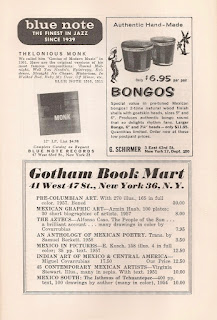
Above, a page of ads from Barney Rosset's Evergreen Review, Vol. 2. No. 7 (Winter 1959). This was a themed issue devoted to Mexico, but it also included a long essay on Thelonious Monk, so these particular advertisements were presumably chosen with that in mind. Bongos are more usually associated with Cuba, but these "pre-tuned Mexican bongos" would have been the perfect accessories for beatniks, or at least for the Hollywood version of them. Other ads in this issue included one for the Living Theatre and for the Circle in the Square production of Brendan Behan's Quare Fellow, directed by José Quintero.

Sadly, the Gotham Book Mart is no more, but as of this writing at least one of the contributors, the Mexican writer Elena Poniatowska, is still with us after sixty-odd years.

Sunday, March 14, 2021

Notebook: Stephens at Palenque

From 1839 to 1841 the American traveler John Lloyd Stephens and the British artist Frederick Catherwood traveled throughout Mexico and Central America exploring and meticulously describing Mayan antiquities, which were then barely known to the English-speaking world (and even to many living in the region). Here Stephens relates his thoughts as they leave the site in Mexico known by the Spanish name of Palenque.
There was no necessity for assigning to the ruined city an immense extent, or an antiquity coeval with that of the Egyptians or of any other ancient and known people. What we had before our eyes was grand, curious, and remarkable enough. Here were the remains of a cultivated, polished, and peculiar people, who had passed through all the stages incident to the rise and fall of nations; reached their golden age, and perished, entirely unknown. The links which connected them with the human family were severed and lost, and these were the only memorials of their footsteps upon earth. We lived in the ruined palace of their kings; we went up to their desolate temples and fallen altars; and wherever we moved we saw the evidences of their taste, their skill in arts, their wealth and power. In the midst of desolation and ruin we looked back to the past, cleared away the gloomy forest, and fancied every building perfect, with its terraces and pyramids, its sculptured and painted ornaments, grand, lofty, and imposing, and overlooking an immense inhabited plain; we called back into life the strange people who gazed at us in sadness from the walls; pictured them, in fanciful costumes and adorned with plumes of feathers, ascending the terraces of the palace and the steps leading to the temples; and often we imagined a scene of unique and gorgeous beauty and magnificence, realizing the creations of Oriental poets, the very spot which fancy would have selected for the "Happy Valley" of Rasselas. In the romance of the world's history nothing ever impressed me more forcibly than the spectacle of this once great and lovely city, overturned, desolate, and lost; discovered by accident overgrown with trees for miles around, and without even a name to distinguish it. Apart from everything else, it was a mourning witness to the world's mutations.
Unlike many early observers who attributed the ruins to a civilization originating in the Old World, Stephens ultimately concluded, correctly, that the builders were the ancestors of the same Maya people who still inhabited the region. I visited several of the sites, including Palenque, in 1980, by which time conditions for travelers, distinctly rough in 1840, were vastly improved. The fine Dover editions of the four volumes of Stephens's travels are still in print.

Monday, May 13, 2019

"Mala Cosa" (Cabeza de Vaca)


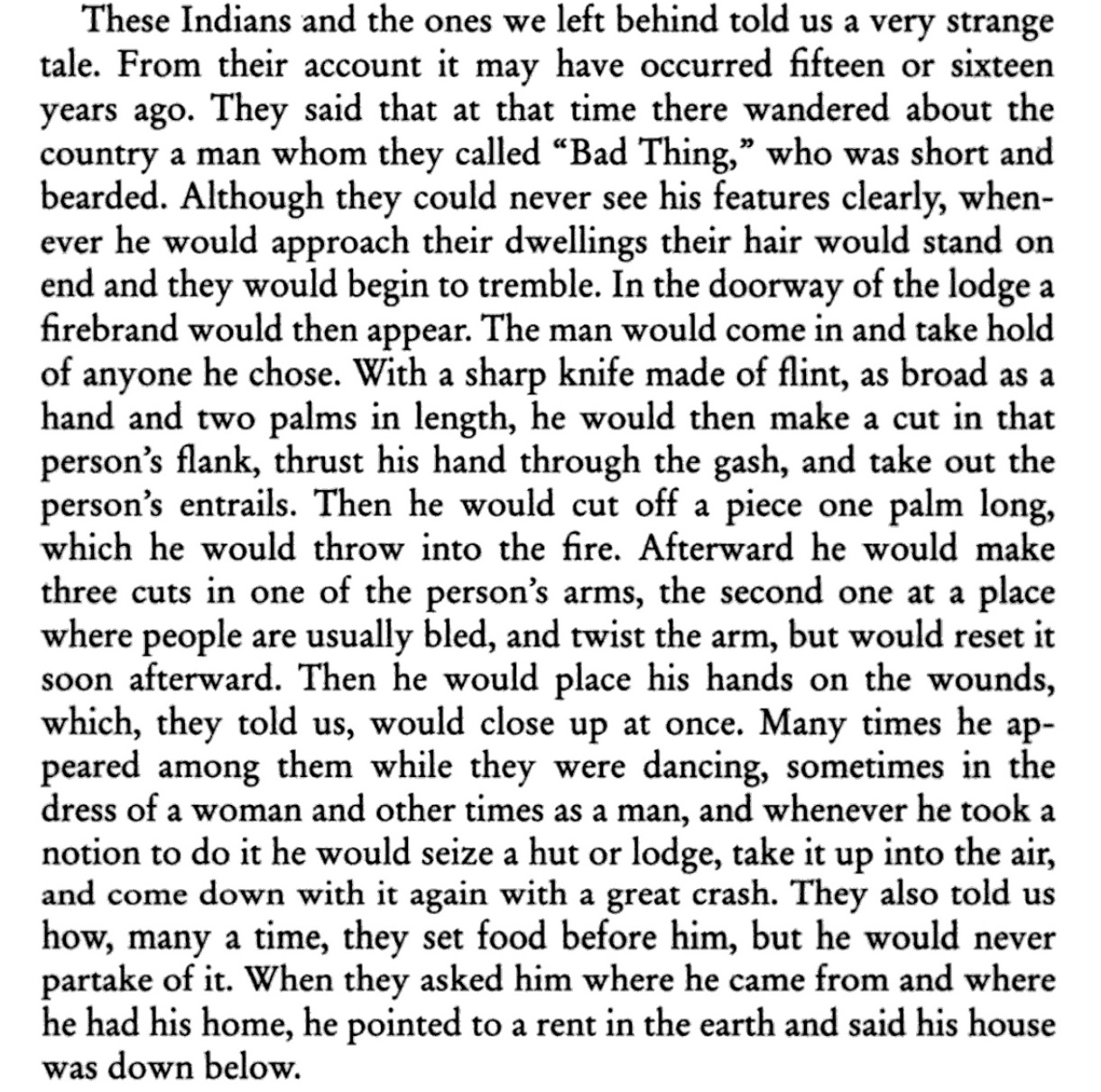
The Spanish explorer Álvar Núñez Cabeza de Vaca recounts an incident that was related to him by Native Americans he encountered during his long sojourn across the southern US and northern Mexico:


Narrative of the Narváez Expedition, edited by Harold Augenbraum.

Cabeza de Vaca was one of a handful of survivors of a 16th-century expedition to Florida that went catastrophically wrong. The accuracy of his account of his travels on many points has been questioned, but few things in it are as difficult to believe as the one thing that is unquestionably true, which is that he and three other men did survive eight years wandering among various Native American peoples before finally meeting up with a group of his countrymen near Culiacán in Sinaloa. Along the way he found himself cast in the role of faith healer, and claimed to have performed countless miracles on ailing (and very grateful) Indians.

The passage above has been much pondered. It appears to record some kind of shamanic performance reminiscent in some ways of modern "psychic surgery" cons and fortune-telling bujo scams. How the Indians understood what they told Cabeza de Vaca, and how it differed from what he recorded, is impossible to say. It's the oddest passage in the book.

Wednesday, February 06, 2019

Roma: Words Unspoken


I had been looking forward to seeing Alfonso Cuarón's Roma as soon as it made it to a local theatre, and it didn't disappoint. I'm not a movie critic and won't attempt a synopsis or analysis of the film*, but in a very quick summation it's about a few months in the lives of a well-to-do (but perhaps downwardly-mobile) Mexico City household around 1971. (Cuarón drew on his own family memories, and he has meticulously — even obsessively — recreated the texture of the world he grew up in.) At one crucial point the family's story intersects dramatically with the tumultuous course of the broader history of twentieth-century Mexico. The film is beautifully designed, acted, and shot (in black and white), and has the sweep and richness of a great novel. I'll be watching it again.

Pictured above is Cleodegaria (played by newcomer Yalitza Aparicio), one of the family's Oaxacan servants and the film's emotional center. One criticism that has been leveled at the film is that we don't really get to learn much about what she thinks and feels, but I think that apparent silence is itself the point. (As it happens, I think we can get a fair idea of what she thinks and feels, but to do so requires attention to more than words.) Roma isn't your typical Hollywood have-it-both-ways movie in which all conflicts are resolved and all the characters overcome the limits of their personal histories, their class or racial backgrounds, and are at last fully revealed as equal agents. Being constrained and unheard is part of the social reality of Cleo's life (as it is, in different ways and degrees, of the lives of the family she serves); for a director to pretend otherwise would be a betrayal.

* For a full and thoughtful review, Alma Guillermoprieto's NYRB review, "The Twisting Nature of Love" is a good place to start.

Tuesday, February 21, 2017

"No Amount of Walls"


"At the extreme, if climate change wreaks havoc on the social and economic fabric of global linchpins like Mexico City, warns the writer Christian Parenti, 'no amount of walls, guns, barbed wire, armed aerial drones or permanently deployed mercenaries will be able to save one half of the planet from the other.'" — Michael Kimmelman, "Mexico City, Parched and Sinking, Faces a Water Crisis," the New York Times, February 17, 2017

Also this week, Mike Males writes, in the Los Angeles Times:
Over the last two decades, California has seen an influx of 3.5 million immigrants, mostly Latino, and an outmigration of some 2 million residents, most of them white. An estimated 2.4 million undocumented immigrants also currently live in the state...

And yet, according to data from the FBI, the California Department of Justice, and the Centers for Disease Control, the state has seen precipitous drops in every major category of crime and violence that can be reliably measured. In Trump terms, you might say that modern California is the opposite of "American carnage."...

Before the early 1990s, California had one of the country’s highest rates of violent death. It has since fallen by 18%, and did so as the average rate of violent death across the rest of the country rose 16%. Overall, Californians are 30% less likely to die a violent death today than other Americans.

In fact, compared with averages in all other states, California now has 33% fewer gun killings, 10% fewer murders overall, and 30% fewer illicit-drug deaths. When overdoses from illicit drugs rose 160% in the rest of the country, between 1999 and 2015, they rose only 27% in California.

In nearly every respect, California’s statistics contradict the image of America painted by Trump in his inaugural address — a place of rampant violence, drugs and crime, all stoked by liberal immigration policies.

Saturday, August 30, 2014

The Beast (Óscar Martínez)


A few years ago when I was doing some volunteer tutoring, one of my students was a young man from Guatemala (I'll call him S., though that wasn't his initial) who already spoke and understood English fairly well, even though he was a bit embarrassed not to be able to speak the language better than he did. I don't know whether he was in the country legally (it was none of my business), but he was fortunate in having found a fairly regular full-time job that was a solid step above unskilled casual labor. I have no doubt that he was good at what he did, and it sounded like he got along well with his employer and co-workers, most of whom knew no Spanish. I worked with him for the better part of a year and in the course of the lessons we talked about a lot of things — whatever served as a way of practicing his conversational English — including his job, his life back home, what he did on the weekends, and so on.

Most of the Central American students I worked with had a good sense of humor and were fun to be around, and S. was certainly bright and likeable, but he was a little more serious than most of the others. He didn't seem depressed, like the occasional student who really seemed to be suffering serious culture shock — in fact I think he was fitting in pretty well — but it was clear that he'd been through a lot and was haunted by his experiences. He volunteered one time, without going into details, that Americans had no idea of what people like him had gone through in getting to this country, and I could tell by the look in his eyes that whatever he had personally gone through had to have been pretty bad.

Óscar Martínez is a young journalist from El Salvador who has investigated what may be the grimmest aspect of the ongoing migration crisis: not the crossing of the border itself but the nightmarish journey of Central American migrants through Mexico, an ordeal that annually subjects thousands to rape, murder, and organized kidnappings for ransom as well as to lethal falls from the northbound freight trains known as "the Beast." Unable to travel openly because of their undocumented status, these migrants are preyed upon by violent criminal syndicates who have either bought off local authorities or intimidated them into submission. At every step of the way they are fleeced or threatened; some resist and are killed, others make it through to the border only to be turned around by US authorities. Increased enforcement at the US-Mexico border has only exacerbated the situation, as newly built sections of border wall have funneled migrants into the most dangerous crossing routes, where many are extorted or forced to serve as mules for drug smugglers. Given the odds against them, the motivation that drives them must be powerful indeed. Some come for economic reasons, but as Martínez makes clear, many come simply to save their skins, having been directly threatened by local gangs or having lost family members to violence in what are currently some of the most dangerous societies on Earth: El Salvador, Honduras, and Guatemala.

The Beast (the Spanish title is Los migrantes que no importan — "the migrants who don't matter") originated as a serious of articles for the online publication El Faro. Originally published in book form in Spain in 2010, it appeared in Mexico in 2012 and has now been issued in English by Verso Books. It predates, but clearly foreshadows, the recent upsurge in migration from Central America that is being driven by ongoing violence in the region. As a work of primary first-hand journalism, it makes no attempt to propose comprehensive solutions for the migration crisis, but in providing a powerful sense of the human dimension of that crisis its value is immeasurable.

For an update, see the same author's "Why the Children Fleeing Central America Will Not Stop Coming" in the Nation, August 18/25, 2014.

Saturday, September 21, 2013

Notes for a Commonplace Book (12)


The preferred reading matter of the Mexican writer and photographer Juan Rulfo, as described in Luis Harss & Barbara Dohmann's Into the Mainstream: Conversations with Latin-American Writers (1967):
He was always particularly fond of Russian literature — Andreyev, Korolenko — and, above all, a great admirer of Scandinavia literature: Selma Lagerlöf, Bjørnson, Knut Hamsun, Sillanpää. "Once upon a time I had a theory that literature had been born in Scandinavia, then gone down to Central Europe and spread from there." He is still an assiduous reader of Halldor Laxness, whom he considers a great renewer of European literature, from a position diametrically opposed, say, to that of French intellectualism. United States literature, he thinks, has also has a salutary influence in latter years. But Rulfo, with his love of the diaphanous, favors the Nordics, because of their "misty atmosphere."
Rulfo's own books are set entirely in rural Mexico, but literature is not a respecter of borders.

Sunday, March 20, 2011

Pleasures of the Macabre


Thomas Ott is a Swiss artist and graphic novelist whose work consists largely of wordless images rendered with scratchboard and whose tastes run decidedly towards the gruesome. These images are from a work, "Recuerdos de México," that so far I've only seen on the web, although it has appeared in some collections in Argentina (in the wonderfully named comics magazine Suda Mery K.!) and in Europe. It is scheduled to appear in the US in Ott's collection R.I.P: Best of 1985-2004, which will be released in April 2011 by Fantagraphics Books.

The country that produced José Guadalupe Posada would seem like a natural source of inspiration for Ott, and these pictures bring to mind Octavio Paz's oft-cited and splendidly garish words from The Labyrinth of Solitude:
The word death is not pronounced in New York, Paris or in London, because it burns the lips. The Mexican, in contrast, is familiar with death, jokes about it, caresses it, sleeps with it, celebrates it; it is one of his favorite toys and his most steadfast love.


All of the above images are from El blog de la muerte, which has quite a few others as well.

Below are the covers from two of Ott's other books, both of which were also published here by Fantagraphics (although the Cinema Panopticum cover shown is from the French edition). Given a choice, I would start with Cinema Panopticum, which is a collection of several tales linked by a frame-tale, but both are worth exploring. There is more at Ott's website.


Friday, June 19, 2009

Posada for Children


Though the Mexican engraver José Guadalupe Posada is best known for his topical broadsides and ghoulishly whimsical depictions of skeletons at play, he produced thousands of engravings, spanning a wide range of subject matter, in his forty-year career. The images here spotlight his work as an illustrator of inexpensive books for children.


The dog in the above image has some of the same anthropomorphic expressiveness of the dogs in Maurice Sendak's early work. Since Sendak is a notorious magpie -- I mean that as a compliment, naturally -- it's possible that he was familiar with the image or others like it. The proper Mexican couple below are quite fetching.


All of these pictures are from a delightful book published in 2005 by Editorial RM in Mexico City, Posada: Illustrator of Chapbooks by Mercurio López Casillas. (There's also a Spanish-language version, entitled José Guadalupe Posada: Ilustrador de Cuadernos Populares.) The compact little hardbound volume contains hundreds of color images, including interior art as well as covers, organized into three categories: Songbooks, Children's Books, and "Divers Manuals" (a miscellany, not books on diving).

A good jumping-off place on the web for the whole of Posada's work is this post at Bibliodyssey.

Tuesday, March 24, 2009

The use of memory (Carla Rippey)


The artist and printmaker Carla Rippey is a native of Kansas City who has lived and worked principally in Mexico since the 1970s, long enough that she has probably come to be more generally regarded as a Mexican artist rather than as an American one, though in fact she is both. Unlike many other American expatriate artists, she has put down permanent roots in Mexico and raised two sons there, and the bulk of her exhibitions have been in Mexican galleries and museums. She seems to be less well known in the US; the few monographs and exhibition catalogs devoted to her work — difficult but not impossible to find here — have been issued by Mexican publishers and museums. The one that I've been able to examine to date was published in 1994, and bears the title El uso de la memoria, which also happens to be the title of her comprehensive (and much more up to date) bilingual blog, an excellent starting point for those who might be interested in her work.

Rippey works in a range of media and with a variety of found materials, especially photographs. In some cases she creates drawings or paintings based on individual photos or assemblages of photos she has found at flea markets or in popular periodicals; at other times she subjects the photos themselves, or reproductions of them, to a variety of overlays and modifications, staining them or sewing thread through their surfaces, for instance. There is a political or feminist edge to many of her images, but the overriding theme is how people are remembered or forgotten or altered over the course of time. The sense of impermanence her work produces echoes her own history as a migrant, one who remembers, moreover, that her ancestors too were immigrants from elsewhere, and who knows that possession of place as of life is illusory and fleeting. Her use of photographs serves to underline the ways in which what we see before us, apparently solid, is subject to being transformed into an image, a two-dimensional ghost that has lost its original vital presence but which, as a memory trace, acquires its own afterlife.
 
Among her recent projects is a treatment of an old black and white photograph of an ornate building, either in ruins or in the process of construction. Rippey has printed the image onto the cover of what appears to be a handmade paper box. When the box is opened it reveals another copy of the image, printed on a much larger sheet of either cloth or paper and folded or bunched up inside the box. The effect is both striking and disconcerting; the building, once so monumental, has become a mere wisp, a thin tissue that could be folded into a pocket or blown away by the wind.

Rippey was a friend of the late Roberto Bolaño, a writer who was himself a multiple migrant, and who reportedly portrayed her in the guise of the minor character of Catalina O'Hara in his novel The Savage Detectives. Both were fascinated by the femicidios of Ciudad Juárez, Mexico, the string of largely unsolved killings that since 1993 have taken the lives of hundreds of Mexican women in the vicinity of that troubled border city. Marcela Valdes's excellent article in the Nation (December 8, 2008), which not coincidentally is illustrated by Rippey, is an indispensable source regarding both the Juárez killings and Bolaño's posthumously published masterpiece 2666, which is partly based on them. The section of 2666 that recounts the murders — often in harrowing detail — has much the same disconcerting effect as Rippey's art, as Bolaño's fictionalized retelling simultaneously flattens the actual victims into two dimensions and indelibly preserves an unsettling memory of them that would otherwise have been entirely lost.

Tuesday, February 12, 2008

A village in the distance


1.

Here are the opening paragraphs of the first chapter of Three Dollars a Year (Delphic Studios, New York, 1935) by G. Russell Steininger and Paul Van de Velde:
San Pablo Cuatro Venados, a small and somewhat inaccessible Mexican village, hangs on a slope of the high western Sierras. It is a curious and primitive community the inhabitants of which are Zapotecan Indians. Life offers them little. Their lot is both meagre and hard — a situation that seems not to distress them in the least.

The natural setting of San Pablo is one of majestic but tortuous grandeur. Mountains overlap and tower above mountains. Their sides drop precipitously into deep barrancas only to rise again, sheerly and suddenly, into more formidable and gigantic ranges. The tremendous scale of this scenic background is intensified by the almost dwarf-like stature of the natives — a physical characteristic reflected in the low doorways of their houses.

San Pablo sprawls over the mountain side and in appearance is merely a collection of thatched-roofed huts tucked here and there on an occasional patch of level ground. The whole is dominated by a twin-towered church of little merit. Throughout the five or six hundred years of the pueblo's existence comparatively few foreigners have trod the steep winding trails which serve as village streets.

For centuries however, in either nearby mine or distant market place, the San Pableños have known the white man and his ways. Christian teaching and European methods followed swiftly on the heels of the Spanish Conquest. Despite these alien influences old customs and habits still persist and the current life of the San Pablo Indian is essentially the same as that of his forefathers.

The fate of the San Pableños was sealed centuries ago. They perhaps do not realize that their institutions and activities — that they themselves — are the inevitable result of ancient causes which they are almost powerless to modify. In their present position they are encompassed by futility and should they desire to better themselves, which plainly they do not, they would have no choice but to abandon their village. Fear and physical geography have determined their history, their psychology and their economics. A long-standing and unending feud with the neighboring pueblo of Cuilapam and an impoverished soil make this a certainty. The direct route from San Pablo to the market place in Oaxaca leads through Cuilapam, but this road the San Pableños dare not take. Instead they trudge another five miles for the sole purpose of avoiding enemy territory. The crushing force and mounting burden of adverse circumstances seem to indicate that, in the long run, these Indians are bound to lose out and that, within the course of time, their village may disappear.

The history of San Pablo can be summarized as a series of escapes. From the very beginning of its existence the inhabitants have endured the constant menace of extermination. Blood has flowed and continues to flow: the blood which has forever been a symbol of Mexico from pre-Conquest sacrifices to recent revolutions. San Pablo was established as a Zapotecan Indian military outpost, a buffer settlement representing the advance guard of one warring tribe against another, and accepted the dangers, privations and sufferings which always accompany such a role. The warriors of this encampment incessantly watched the activities of their enemies — Mixtecan Indians who lived in Cuilapam, at that time a small village nestled at the foot of Monte Albán.

November 25, 1521 was a crucial day in the affairs of the little Indian garrison of San Pablo. It was then that the Spaniards, bent on conquest and captained by Francisco de Orozco, entered the Valley of Oaxaca. For the San Pableños the arrival of Orozco and his band practically constituted a miracle and had the Spaniards not appeared exactly when they did it is probable that today San Pablo would not exist. When the Conquistadores reached the valley a bitter civil war was in progress. It was a war of revenge and a fight to the finish. The Mixtecs had determined to conquer the Zapotecs beyond any hope of recovery and were on the point of achieving complete success when a common foe — the white man — arrived. The Indians temporarily dropped their grievances and united against the invaders. San Pablo was saved.

Time however has increased the hatred of original enemy tribes and their descendants are now hereditary foes. Not so long ago the entire population of San Pablo deserted the village and fled to the mountains, fearing complete annihilation at the hands of the Mixtecs. Intervention on the part of Paul Van de Velde and of the Mexican authorities undoubtedly prevented a catastrophe and the San Pablenos are again back in their homes, at peace for the moment but not knowing how long it will last.

Caught in this whirlpool of fear and hate and condemned to an unending struggle with a topography angular and stubborn, the San Pablo Indians should be a morose and sullen lot. Certainly life for them is often little less than a mere existence. Food and clothing frequently fall short of actual necessities. But here is the paradox. Notwithstanding a life of seeming misery and bare sufficiency — often extreme poverty — these Indians are fundamentally happy and contented.
2.

According to the Editor's Note at the beginning of the book, Three Dollars a Year was based on the researches of Paul Van de Velde, a Belgian scholar who was a member of the Sociedad Mexicana de Geografía y Estadística and various other scholarly organizations, and who was the author of a number of works on Oaxaca and its environs. The book was actually written by G. Russell Steininger, a landscape architect from Reading, Pennsylvania who had assisted Van de Velde in his researches. As far as I can tell it was Steininger's only published work. Though the book is a bit disjointed and marred by its condescending manner and confident assurance that the San Pableños are satisfied with their lot in life, it contains a number of evocative photographs and some interesting material on the customs, history, and material life of a small village in the Sierras.

The authors make it clear that the centuries-old animosity between Zapotecan San Pablo Cuatro Venados and the nearby Mixtec village of Cuilapam (now more of a town, and generally spelled Cuilapan) was one of the central facts of life in San Pablo. The animosity could be traced in competing maps, surveys, and legal actions, as well as in violence. According to an appendix, in just one brief period in the 1920s and early '30s the murders or disappearances of fourteen citizens of San Pablo as well as two Cuilapeños were attributed to the feud. The backwardness and isolation of San Pablo appear to have been exacerbated by its unfortunate location. Trapped between hostile Cuilapan and the rugged terrain of the Sierra Madre, the villagers were forced to work marginal agricultural lands. The “three dollars a year” of the title refers to the average annual income of the San Pableños, a meaningless figure for people who hardly belonged to an economy wider than their village boundaries at all.

It would be easy to assume that the description of San Pablo in the book is now completely out-of-date, and perhaps it is. But one aspect apparently remains unchanged: the occasionally violent feud between San Pablo and its lower-lying neighbor continues unabated. In 1929, in arbitrating a boundary dispute between the two localities, the Mexican Supreme Court had granted 522 hectares to San Pablo and 3,112 hectares to Cuilapan. That ruling was upheld by a presidential decree in 1970, but the San Pableños rejected it and continued to squat on land granted to Cuilapan. In 2001 another court returned 1,565 hectares to San Pablo. And just in the last few days (February 2008) there has come a report of yet another outbreak of hostilities. What follows is a rough translation:
There were tense moments in the municipios of Cuilapan de Guerrero and San Pablo Cuatro Venados, where residents of the two communities were on the point of a confrontation yesterday morning as a result of the dispute over communal lands in El Cucharito and Acapixtla districts, where the sound of gunfire was even heard. Fourteen inhabitants of San Pablo, among them Wenceslao Sánchez, president of Bienes Comunales, were detained by a group from Cuilapan as a means of pressuring (the San Pableños) to abandon the 400 hectares that they had invaded and deforested indiscriminately, in addition to diverting the course of the Río El Valiente, which supplies water to both communities.

It all began at 6:00 AM, when residents of Cuilapan, most of them women armed with sticks and machetes, set up blockades on the highway to San Pablo, first in San Pedro Acapixtla and then in El Cucharito, which is identified as the zone in conflict.

For his part, the Secretary General of the government issued a call to avoid bloodshed and to seek ways to solve the problem, which is more than 200 years old.
So even in an era of globalization — or perhaps especially in an era of globalization — ancient local conflicts over land, water, and tribe continue to flare in the Sierra Madre.

3.

I've never been to San Pablo Cuatro Venados, but I may well have stared at it from a distance. The village is barely a dozen miles from the major pre-Columbian archaeological site of Monte Albán, which were constructed by the distant Zapotec and Mixtec ancestors of the warring villagers. The ruins, which I visited in 1980, occupy a plateau above the city of Oaxaca and provide an excellent prospect in all directions of the surrounding valley and the mountains beyond. Somewhere out there, to the southwest, is San Pablo, though I didn't know it at the time.