Showing posts with label Antiquities. Show all posts

Tuesday, February 22, 2022

A Buried Book

Archaeologist Alan Hardy describes a find that emerged during the excavation of a long barrow in the Berkshire Downs:
A book was found within deposit 3001, located immediately south of the southern ditch section, and approximately 0.23 m below the present ground. The book was a buckram bound copy of Demonology and Witchcraft by Walter Scott, published in 1831 (Plate 4.5). The inside front cover was daubed with red ink and crudely inscribed with the words 'Demon de Uffing'. Some decay was evident to the cover and the edges of the pages although it was generally in very good condition. Its state of preservation may well have been due to the surrounding matrix of chalk and soil, which maintained a dry environment. The excavator was confident that the ground around the location of the book's burial had not been recently disturbed, and therefore a pre-excavation joke by persons unknown was ruled out. In theory the book could have been deposited during the 19th-century excavations, but it is more likely that its burial is related to one of the more recent revivals in the mystical aspects of the White Horse and its surroundings.

D. Miles et al., Uffington White Horse and Its Landscape: Investigations at White Horse Hill, Uffington, 1989-95, and Tower Hill, Ashbury, 1993-4
Related posts:
Up in the Downs
The Lay of the Hunted Pig

Saturday, February 19, 2022

The Lost Altar

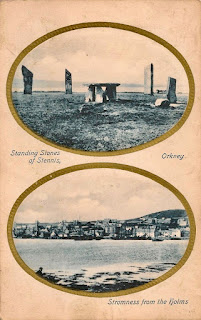
This double-view postcard of scenes from Orkney was issued by J. M. Stevenson, a longtime stationer in Kirkwall and Stromness. It also bears the initials of V. & S. Ltd., that is, Valentine & Sons of Dundee, the actual printer. There's no writing on the back of the card, but I'm guessing that it dates from around 1910. "The Holms" are two small islets just across the water from Stromness.

The central "altar" or "dolmen" shown in the view of the neolithic Standing Stones of Stennis (or Stenness) was a "reconstruction" from 1907, possibly inspired by Sir Walter Scott's interpretation of the site. It was dismantled under murky circumstances in 1972 and only the uprights were put back in place. A century earlier a landowner had vandalized the site extensively, resulting in the loss of much of the surrounding circle of stones.

Despite its barren northern location, Orkney has some of the most extraordinary neolithic monuments in Britain. I haven't been there (my wife and daughter have), but perhaps someday I will make a visit.

Tuesday, March 07, 2017

Recognition


Walking a woodland trail the other day through an area with a number of dramatic rock outcroppings, I zeroed in on this particular boulder incised with what, to my eye at least, very much resembled the profile of a crow, a raven, or perhaps a buzzard, with a second, more ambiguous profile directly behind it. The resemblance — the protruding beak, the circular eye — became more convincing the longer I looked.

It's at least dimly possible that a human hand has been at work here, perhaps in adding detail to a stone that originally looked only vaguely avian, but I suspect it's entirely the chance work of nature. With different light, from a different angle, on a different afternoon, the "profile" might not be evident at all. But our psychological impulse to find facial figures even in inert matter must be very strong, and lies, I suspect, at the origin of many things — art, language, religion. The ability to recognize a pattern, to transform that pattern into an information-bearing symbol, is surely the first step down the road to reading. And yet the ability must long predate us; animals too know instinctively what a face is, and even if differences in vision and psychology make it unlikely that they would see anything at all in this particular boulder, they are alive to all kinds of signs — visual, aural, olfactory — whose interpretation is a key part of their mental world.

Below are two more woodland presences: a stone cat (with a bit of imagination), and a howling Ovidian wood-beast.


Update: Below: the Dog.

Wednesday, March 18, 2015

Ruins


"One day we walked out, a little party of three, to Albano, fourteen miles distant; possessed by a great desire to go there by the ancient Appian way, long since ruined and overgrown. We started at half-past seven in the morning, and within an hour or so were out upon the open Campagna. For twelve miles we went climbing on, over an unbroken succession of mounds, and heaps, and hills, of ruin. Tombs and temples, overthrown and prostrate; small fragments of columns, friezes, pediments; great blocks of granite and marble; mouldering arches, grass-grown and decayed; ruin enough to build a spacious city from; lay strewn about us. Sometimes, loose walls, built up from these fragments by the shepherds, came across our path; sometimes, a ditch between two mounds of broken stones, obstructed our progress; sometimes, the fragments themselves, rolling from beneath our feet, made it a toilsome matter to advance; but it was always ruin. Now, we tracked a piece of the old road, above the ground; now traced it, underneath a grassy covering, as if that were its grave; but all the way was ruin. In the distance, ruined aqueducts went stalking on their giant course along the plain; and every breath of wind that swept towards us, stirred early flowers and grasses, springing up, spontaneously, on miles of ruin. The unseen larks above us, who alone disturbed the awful silence, had their nests in ruin; and the fierce herdsmen, clad in sheepskins, who now and then scowled out upon us from their sleeping nooks, were housed in ruin. The aspect of the desolate Campagna in one direction, where it was most level, reminded me of an American prairie; but what is the solitude of a region where men have never dwelt, to that of a Desert, where a mighty race have left their footprints in the earth from which they have vanished; where the resting-places of their Dead, have fallen like their Dead; and the broken hour-glass of Time is but a heap of idle dust! Returning, by the road, at sunset! and looking, from the distance, on the course we had taken in the morning, I almost feel (as I had felt when I first saw it, at that hour) as if the sun would never rise again, but looked its last, that night, upon a ruined world."

Charles Dickens, Pictures from Italy

Image above: Rodolfo Lanciani, Ancient Rome in the Light of Recent Discoveries

Sunday, August 08, 2010

Notes for a Commonplace Book (6)


According to several ancient accounts, in a temple on a remote peninsula on the Gulf of Messenia there once stood a statue that possessed the curious property of displaying more than one likeness depending on the vantage point of the viewer. Approached from the west, it bore the appearance of a girl entering the first flower of womanhood; seen from a few steps to the north, an indomitable warrior suddenly came into view; and so on as one proceeded around to the east: here a tyrant scowled severely down, only to be supplanted by a weathered crone with weary eyes — the authorities part company on exactly how many figures there were in all. The transformation from one likeness to the next was instantaneous and absolute, and no matter how closely one examined the contours of the stone it was impossible to determine through what means the illusion was effected.

Pausanias, who claims to have visited the site, reports that the statue sustained minor damage in an earthquake and thereafter lost its remarkable qualities, but he neglects to say which of its various forms — if any — was left frozen in the marble thereafter. The ruins of the temple have not been identified.

Friday, March 26, 2010

Up in the Downs


Artwork by Richard Doyle from The Scouring of the White Horse by Thomas Hughes. These illustrations are not in the copy I have, which is the American edition published by Ticknor & Fields in 1859. The elaborate titling, which I'm guessing is supposed to evoke the twisted branches of a hedgerow, reads The Scouring of the White Horse / A Country Legend.

The scene depicted, of stout Saxon warriors exuberantly memorializing King Alfred's victory over the Danes in 871 AD, is anachronistic, as it is no longer believed that the stylized hill figure known as the Uffington White Horse has anything to do with Alfred or with Anglo-Saxon England at all. It was carved into the chalk of the Berkshire Downs, in essentially the design in which it appears to this day, in the late Bronze Age (c. 800-1000 BC), and would have disappeared long ago had it not been periodically "scoured" of encroaching turf. That more than a hundred generations of Celts, Romans, Anglo-Saxons, and Normans not only refrained from obliterating the carving but actually went to the trouble of renewing it from time to time is, when you think about it, fairly astonishing. Perhaps it served as a convenient excuse for merrymaking -- it certainly did so in Tom Hughes's day. Whether the horse -- if that's indeed what it is -- was originally intended as a religious symbol or as some kind of territorial or tribal marker no one now knows.

The White Horse is located above the village of Uffington in what used to be part of Berkshire but is now Oxfordshire. From Oxford, where we were staying, it can be reached by taking a bus to the market town of Wantage, which has an excellent small museum devoted to the history of the region, and then a second bus that stops at the isolated crossroads below White Horse Hill. We scaled the hill the hard way, across its face through pastureland that was muddy in spots, not realizing that there was a paved road to the top of the ridge. Even on a fair March day -- there were paragliders soaring above us, and the views were splendid from the summit -- the site was uncrowded. A small flock of sheep just a few meters from the carving ignored our approach and only broke away when we strode right through their midst.

We sat down to catch our breath near the head of the figure, and while we were there passed our copy of an illustrated guidebook to a fellow climber so that he could prove to his skeptical son that he was indeed standing next to a giant horse, as the full outline of the carving, which measures more than 100 meters from nose to tail, is best seen from a distance or from above. Above and behind the horse, on the crest of the hill, are the earthworks of an Iron Age fort known as Uffington Castle. The Ridgeway, an ancient trail that runs through the Downs and on to Avebury, passes over the hill, and if you follow it west for a mile or so you will come to Wayland's Smithy, a fine Neolithic chambered long barrow sheltered in a beech grove.

There's no gift shop or visitor's center on White Horse Hill, and I for one hope there never is, as the bleak, peaceful solitude of the place allows one to better contemplate the views of the surrounding countryside as well as the vast expanses of time that are in evidence. There was a lone vendor selling ice cream from a van; we passed on the ice cream but took him up on what he solemnly promised was the best hot chocolate in the world. And it wasn't bad at that.

Tom Hughes's novel The Scouring of the White Horse is still enjoyable reading, although more reliable for its glimpses of Berkshire folklife than for its archaeology. Kate Bergamar's Discovering Hill Figures, in the Shire Classics series, is an excellent portable guide to the Horse and similar figures, most of which are far more recent in origin. The latest archaeological evidence is surveyed in Uffington White Horse in its Landscape, by C. Gosden et al.

Photo by Maddie.

Friday, January 29, 2010

The Lay of the Hunted Pig


A specimen of dialect poetry, collected from Berkshire, England and included in The Scouring of the White Horse (1859) by Thomas Hughes.

The White Horse of Uffington (formerly in Berkshire, though it is now incorporated within Oxfordshire) is a prehistoric hill figure once often popularly associated with King Alfred, though it's apparently very much older. In order to keep the figure from being obscured, it must be periodically "scoured" of encroaching turf and replenished with chalk. The scourings, which have been conducted at irregular intervals for centuries, have been accompanied by various games and festivities. One of the games, at least in the mid-19th century, was a greased pig contest. Needless to say, this was likely more fun for the human participants and spectators than it was for the luckless porker.

The stanzas that follow should be fairly comprehensible if you understand that the standard English voiceless f and s sounds have become voiced v and z. Peg = pig, wur = was, dree = three, un = him, etc. Backswryd (backsword) was some kind of fighting contest involving sticks; spwoort = sport.

"Vathers, mothers, mothers' zons!
You as loves yer little wuns!
Happy pegs among the stubble,
Listen to a tale of trouble;
Listen, pegs in yeard and stye,
How the Barkshire chaps zard I.

"I wur barn at Kingstone-Lisle,
Wher I vrolicked var a while,
As vine a peg as e'er wur zeen
(One of a litter o' thirteen)
Till zome chaps wi' cussed spite
Aimed ov I to make a zite,
And to have a 'bit o' vun,'
Took I up to Uffington.

"Up, vorights the Castle mound
They did zet I on the ground;
Then a thousand chaps, or nigh,
Runned and hollered arter I —
Ther, then, I, till I wur blowed,
Runned and hollered all I knowed,
When, zo zure as pegs is pegs,
Eight chaps ketched I by the legs,
Two to each — 't is truth I tell 'ee —.
Dree more clasped I round the belly !
Under all they fellers lyin' —
Pegs! — I thought as I wur dyin'.

"But the Squire (I thenks I zee un),
Vanner Whitfield ridin' wi' un,
Fot I out o' all thuck caddle,
Stretched athurt the varmer's zaddle —
Bless 'em, pegs in yeard and stye,
Them two vrends as stuck to I.

"Barkshire men, vrom Hill and Vale,
All as ever hears this tale,
If to spwoort you be inclined,
Plaze to bear this here in mind —
Pegs beant made no race to win,
Be zhart o' wind, and tight o' skin,
Dwont 'ee hunt 'em, but instead
At backswyrd break each other's yead
Cheezes down the manger rowl —
Or try and clim the greasy powl.

"Pegs! in stubble yeard and stye,
May you be never zard like I,
Nor druv wi greasy ears and tail,
By men and bwoys drough White Horse Yale."

The reference to rolling cheeses down "the manger" alludes to a race in which participants run pell-mell down a steep hill into a nearby depression sometimes supposed to be the White Horse's feeding ground. The winner gets a cheese wheel, which as Hughes wryly observes must be rather a hard variety to survive the descent.

Illustration: "Chasing the Greased Pig" by Richard Doyle, from The Scouring of the White Horse by Thomas Hughes. Image scan by George P. Landow, courtesy of the Victorian Web.

Sunday, December 13, 2009

Old stuff


NYU's Institute for the Study of the Ancient World is currently featuring a new exhibit entitled "The Lost World of Old Europe: The Danube Valley, 5000 - 3500 BC." The objects on display, most or all of which were excavated in Bulgaria and Romania, belong to Neolithic cultures that are still relatively little known here, in part because of their extreme antiquity (they predate the invention of writing), and also no doubt because of the limited interchange of scholarship between East and West before 1989. Manhattan's Upper East Side may be as far removed from the world of the makers of these artifacts as it would be possible to travel, but nevertheless, here they are, until April 25, 2010. Admission is free, and this may be your one chance to see them. If you can't make it there is a companion catalog, which I haven't yet seen.

The term "Old Europe" was coined by the late archaeologist Marija Gimbutas, who believed that large parts of Neolithic Europe were characterized by common traditions of matriarchy and the worship of a "Mother Goddess," traditions that were supplanted or subsumed when new, patriarchal, cultures from further east penetrated the Balkans. Gimbutas's work has come under heavy criticism in recent years, and David Anthony, one of the co-authors of the exhibition catalog, is among the critics, but the "Old Europe" description itself has evidently stuck. The current exhibit seeks a nuanced view, pointing out that the archaeological evidence for matriarchy is now considered to be more ambiguous that it was a generation or so ago.

None of which should interfere with the enjoyment of what is on display, including, for instance, this remarkable pair of fired clay figurines from Hamangia in Romania.


The male figure on the left has been dubbed, inevitably, "the Thinker," although the exhibit notes that his posture may in fact indicate mourning. Whatever the truth is, there is nothing "primitive" about the artistry of these pieces, created at least 6,600 years ago.

Here's a clay vessel, 4200-4050 BC:


My daughter and I both concluded that this was a doll's house:


We weren't "serious," of course, but it raises an interesting question: when does a religious figurine become a "toy," or vice versa. Is a crèche, whatever else it is, not a toy set, and if not, why? Are figurines no longer "toys" when adults "play" with them? Is there really an absolute gap between the "serious" religious or magical practices of adults and the imaginative play of children? I suspect the distinction would have had no meaning when these pieces were created.


The above are not museum groupings of similar objects but actual assemblages as found in place; the lower one has been called, somewhat speculatively, "the Council of the Goddess."

From an essay by Douglass W. Bailey, included in the exhibition catalog but also available online (PDF):
Contemporary psychological studies have shown that something very odd happens to the human mind when one handles or plays with miniature objects. Most simply put, when we focus our attention on miniature objects, we enter another world, one in which our perception of time is altered and in which our abilities of concentration are affected. In a well-known set of experiments, the psychologist Alton Delong showed that when human subjects were asked to imagine themselves in a world where everything was on a much smaller scale than everyday reality, or when they engaged in activities in smaller than normal environments, they thought that time had passed more quickly than in fact it had and they performed better in tasks requiring mental agility. Importantly, the subjects of these studies were not conscious of their altered experience of time or concentration.
This one was interesting:


Called a pintadera (there were several other examples in the exhibit), it is, in effect, an early printmaking tool, used to stamp patterns on skin, cloth, or even bread.

The above images are from a slide show on the website of The New York Times; there is an accompanying article by John Noble Wilford. The Institute, which is located at 15 East 84th Street, provoked controversy when it was founded in 2006, because its principal benefactors, Leon Levy and Shelby White, had in the past been accused of purchasing looted antiquities for their own private collections. As far as I know the objects in the current exhibit have been legitimately loaned by museums in the countries where they were first located and their presence in the exhibit hasn't been challenged.