Showing posts with label Photography. Show all posts

Sunday, March 24, 2024

Youth

My father's namesake in a photo taken in September 1897, when he would have been about six. According to the inscription on the back, part of which is not legible, the location is Seventh Avenue and Thirteenth Street in N. Y. City, by which I assume Manhattan is meant. I would like to think that the object he's holding in his hand is a pencil box.

The boy later served in the First World War and received a Distinguished Service Cross, which I still have, for his actions at Meurcy Farm on August 1, 1918. The award was posthumous, as he died in battle on October 15th of the same year. The Army chaplain Father Francis P. Duffy decribed him as "one of the best liked youths in the regiment."

Wednesday, March 31, 2021

Blues


The great blue herons at the local pond I frequent tend to be skittish, flying off as soon as they see me coming down the path, but for whatever reason this one felt like showing off. I walked up to the shore as quietly as I could and finally settled down on a rock just across from the dead branch where it was perching. It gave me a casual glance or two but then settled back into its routine of alternatingly preening and peering into the water. It seemed to be trying out poses and hairstyles, and I have to admit that its full feathered regalia was impressive.
There was a second heron on the other side of the pond that was a bit more standoffish. It also seemed to be a bit smaller and more submissive. Eventually it settled on a branch of its own, but the first heron quickly joined it and chased it off. Maybe it was jealous of those flashy white chest feathers.

Saturday, October 17, 2020

Homage to E. B. White


I found these two grave markers in an out-of-the-way spot a few minutes' walk from the more accessible family pet cemetery I posted photos of a few years back (earlier post here). Strangely enough, though these two are only a foot or so apart and I've known about Wilbur's stone for some time, I never noticed Charlotte's until today. It must have been hidden by the moss and leaves. In a few years no doubt it will disappear entirely.

Tuesday, May 26, 2020

Cypripedium acaule


I'll always associate pink lady's-slipper or moccasin flower with my childhood, because there was a secluded spot in the woods about a mile or so from my house where they could be found quietly growing, if you were observant and if you went at the right time of year. I haven't been back for decades and I have no idea if they're still there, though I wouldn't be surprised if they were. These native orchids require just the right habitat and are said to be extremely difficult to cultivate.

I know of another place where they still grow in relative abundance, though, and over the weekend I trekked into the woods and found several dozen of them in bloom. They're not visible from a main trail, but are easily reached if you happen to know where they are. Two other hikers walked right past them while I was there, but they either didn't notice them or weren't interested (or maybe they were just giving a wide berth to the eccentric kneeling on the ground with a camera).


The white moth on the specimen below is Tetracis cachexiata. I know that fact not because I keep that kind of information in my head, but because an online search for moths associated with the plant immediately brought it up. The moth has been spotted on lady's-slippers many times in various locations over the years, but no one knows quite why. It's not believed to be a pollinator of the flower (which is pollinated by bees), nor does it derive any apparent nourishment from it. One theory is that it obtains some kind of pheromone from the plant. Charley Eiseman at Bug Tracks has more information.

Saturday, January 18, 2020

On William Bullard


Portrait of David T. Oswell with His Viola, about 1900
William S. Bullard was an amateur photographer who lived in Worcester and Brookfield, Massachsetts and captured more than 5,000 glass-plate images in the course of a twenty-year period that ended with his suicide at the age of forty-one in 1917. His negatives were carefully preserved, first by his brother and then by a postman, and over the years some of his photographs were included in illustrated volumes of local history. After the plates were acquired in 2003 by a local collector, Frank Morrill, Bullard's output gained additional significance, for Bullard, who was white, had lived in an ethnically-mixed neighborhood in Worcester, and Morrill realized that among the photographer's subjects were hundreds of individuals belonging to the city's small but vibrant African-American community.

Countless professional and amateur portraits from the same era are floating around with little hope that the sitters will ever be identified, but Bullard used a logbook to record many of his plates and identify his subjects by name. The numbers in the logbook can be matched against numbers on the plates, and diligent digging by a team of researchers has been able to illuminate the biographies, connections, and in some cases living descendants of those pictured. In 2017, an exhibition devoted to some of these photos opened at the Worcester Art Museum under the title Rediscovering an American Community of Color. I missed out on it, but luckily a fine catalog is available under the same title.

Portrait of Angeline Perkins and Her Children Nellie and William, 1900
Bullard had no studio and did most of his work out of doors. Forswearing hackneyed props and costumes, he shot his subjects in their own surroundings and with their own clothes and belongings (though no doubt many put on their Sunday best). He occasionally sold a few prints for modest sums, and at one point he was employed as a school photographer, but whatever ideas of making a living from his hobby he may have had (and it seems he never made much of a living from anything else either), in the end he apparently just did it all for the love of it.

Portrait of Reuben Griffin Seated against a Tree, about 1901
Portrait of Raymond Schuyler and his Children, Ethel, Stephen, Beatrice, and Dorothea, about 1904
We evidently don't know much about Bullard. We know the particulars of his family, his birth and death, little traces here and there, but apparently there are no accounts by people who knew him, no writings in his hand except the logbook (which includes a poem or two), and so ultimately it's hard to say what made him tick. But in a sense, we have something much better: we can see through his eyes. We know that at specific moments in his life he stood in certain spots and talked to particular people — people he no doubt knew as neighbors and quite probably as friends. We know their names, we see their expressions and what they were wearing.

Portrait of Eugene Shepard, Sr., Seated in a Railcar, about 1905
Portrait of Richard and Mary Elizabeth Ward Wilson, about 1902
Darryl Pinckney once lamented, in the aftermath of Hurricane Katrina, that "in the US, white people are able to conceive of black people who are better than they are or worse than they are, superior or inferior, but they seem to have a hard time imagining black people who are just like them." Bullard seemed to have no such difficulty. He didn't treat his subjects as minstrel-show caricatures; he treated them as they saw themselves, as people who rode bicycles, joined fraternal lodges and women's groups, went for outings in the park, and cherished their children, just like white Americans. Worcester wasn't a paradise for black people — the color bar largely denied them factory employment — but it had a living black community of individuals who embodied fundamental principles of human equality, dignity, and fallibility in an era when too many white Americans, in places like Wilmington, North Carolina and Tulsa, Oklahoma, seemed determined to snuff all that out.

For more information: Rediscovering an American Community of Color

Saturday, November 23, 2019

Tuesday, September 10, 2019

Family reunion


Four years ago I posted the above image, dated 1887, of a young French woman named Alexandra Marie Fulton de Lipowski. Thanks to a message from a Lipowski descendant I can now post the following photo, which shows her older sister Marie.


The photographs were taken at the same studio, Photographie Prost in Meaux, and in all likelihood they were taken on the same day, as the clothing and pose are nearly identical except for the sisters' pins. Marie's photograph has remained with the family, but Alexandra's somehow wandered across the Atlantic, where I found it in an antique shop. The reverse of the photo is shown below.


Both of the sisters lived long lives. Alexandra, who was married at least twice, died in 1971 at the age of 97. Her sister Marie had died the previous year at 98.

Thanks JH for the information. Alexandra's photograph has now rejoined the family in France.

Monday, August 26, 2019

Ode


The larger the scale, the more predictable the world is. The planets and stars move on determined courses, the earth revolves, day becomes night, the seasons change, all obeying established patterns. The closer you focus, the murkier it becomes. Will it rain tomorrow? Will it be a harsh winter? Will the breeze blow down the last leaf this morning, or the next?


And then there are phenomena — things appearing to view. We can predict comets — some of them, at least — but not every flash of a meteor shower. We can't be sure of the consequences of all of our own actions, though with some the baneful results are easy enough to foresee. And why does a bird appear one evening, and not the next? They obey their own unknowable laws, and cross through our vision only by accident.


And yet that's too facile. We ourselves are on unpredictable courses, and our fellow beings are inextricably mixed up in ours, for better or worse. The bird at top is no wild thing but someone's racing pigeon, and bears a band of human possession. I saw it two days in a row at the same location on the summit of a nearby dam. It showed no fear of me, and perhaps was lost, or maybe it was just resting before heading home. On the third day it was gone.


As for the last creature, I found it on its back, not far from the dove, and set it aright, for someone else to ponder.

Wednesday, August 14, 2019

Gulley Jimson & Co.


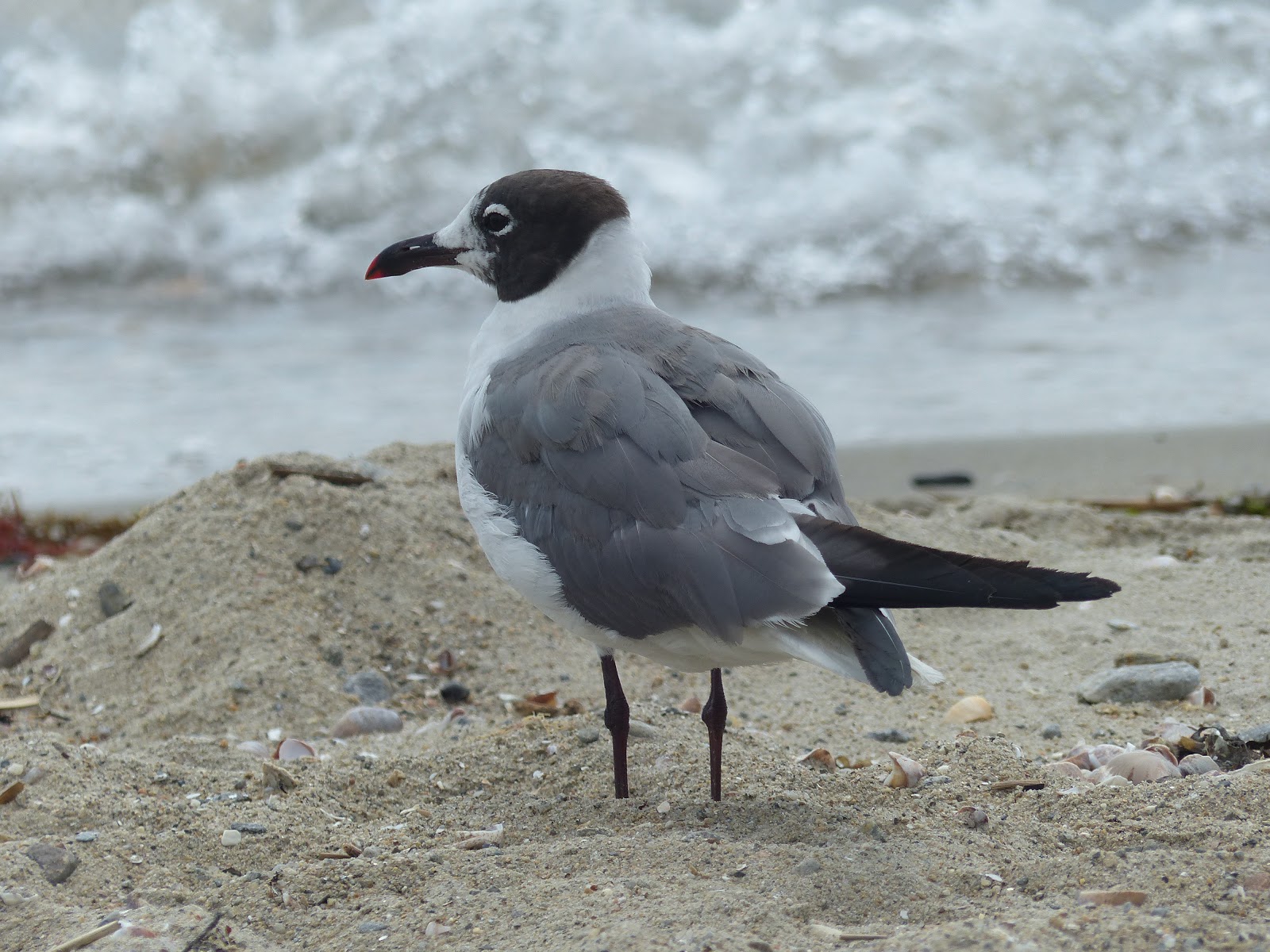
Because summer means going to the beach, and going to the beach means gulls.