Someone directed my attention today to this recording from a few years back, which had somehow escaped my notice. Human Geography US presents "spoken texts taken from the prose work of six 20th century American writers [Jack Black, Richard Brautigan, John Crowley, Edward Dorn, Thomas Pynchon, and Charles Willeford]; a booze-biased mapping of the US in a human geography of words, music and field recordings. The texts are recited by Peter Blegvad, poet, illustrator and musician. The guitar pieces, field recordings and concept are by Anthony Moore." The embedded version below is from a London radio station, Resonance FM; there was also a limited-edition LP version from Half-Cat Music, released in 2022 and presumably unavailable.
I find this project spooky and weird and beautiful (and calming), but given the current pathological state in which the "US" finds itself, it's hard to avoid the question of whether anything like this matters. (Presumably no more than a few hundred people have heard it, or ever will.) But if forced to make a choice of allegiance between the idiosyncratic vision of America that Human Geography US evokes and a disfunctional "republic" presided over by a sociopathic demagogue, I know which flag I'll be flying.
As it happens, I'm in the middle of reading Benjamin Nathans's To the Success of Our Hopeless Cause: The Many Lives of the Soviet Dissident Movement, which recently won a Pulitzer. I'm reading it because the subject has always interested me, not because its depiction of the tyranny and moral squalor against which the dissidents struggled is somehow "useful" in our own situation. But in the end, all political lies are the same, regardless of the ostensible ideology they serve; they're all just tools to gain consent, masks for corruption and abuse of power.
Showing posts with label Peter Blegvad. Show all posts
Showing posts with label Peter Blegvad. Show all posts
Friday, June 13, 2025


Monday, January 27, 2025
Resurrecting Birds

One of the most interesting aspects of the wren hunt is the suggestion that the "king of all birds" must be not only killed and paraded about but actually cooked and sacramentally eaten. (Some of the songs associated with the hunt make humorous declarations about the vast amount of food provided by the body of the tiny bird.) Although Lawrence doesn't discuss the Grimm Brothers' tale of "The Juniper Tree," which I briefly alluded to in my last post, this passage about the ritual cooking of the wren in a pot or pan immediately brought it to mind:
[...] the wren is destroyed and dismembered but will be miraculously reborn. Through immersion in the cauldron the bird is resurrected, and with it those who partake of the ceremonial feast will be themselves renewed and reborn.For those unfamiliar with "The Juniper Tree," it concerns a little boy who is murdered by his stepmother, dismembered, and cooked into a stew that is fed to his unknowing father. The boy's half-sister, who has witnessed the dismemberment, gathers up the bones and sets them beneath the titular tree, out of which a brilliantly-plumed bird magically resurrects. The bird then sings a beautiful song, which it will only repeat if given a gift. After collecting a gold chain, a pair of red shoes, and a millstone, it bestows these gifts in turn on the father, the half-sister, and the stepmother (who is crushed by the stone). Interestingly, a gold chain turns up in one verse of one version of the wren song:
God bless the mistress of this house,Here it's the mistress, not the father, who receives the chain, but that wouldn't suit the narrative of "The Juniper Tree," since the mistress will receive a fatal punishment instead of a reward.
A golden chain around her neck,
And if she's sick or if she's sore
The Lord have mercy on her soul
Another interesting case of the resurrection of a bird by eating it turns up in Peter Blegvad's song "Chicken," which describes how a man and a woman go for a walk carrying a chicken "in a gunnysack." After the man ("Frank") mysteriously disappears, the woman eats the chicken, gathers up the bones (accidentally overlooking one "finger bone"), and throws them down a well.
She calls "Come back, Frank, and find your wife."
When the sack hits the water it comes to life
The woman takes the handle and she turns the crank
Up comes the bucket and there sits Frank
He says "There's only one thing I don't understand."
He says "Where's the little finger of my left hand?"
In a live performance of the song ( St. Ann’s Church, Brooklyn Heights, NY, March 14, 1992) Blegvad introduced it by reading from Sigmund Freud's discussion of the case of "Little Arpad," a young boy who was bitten on the penis by a chicken and thereafter developed an obsession with the bird. Blegvad did not, however, mention that (according to Peter Gay) Arpad reportedly also said "One should put my mother into a pot and cook her, then there would be a preserved mother and I could eat her."
Wednesday, February 01, 2023
2 gueles 150 E.P.

Brotchie's biography of Alfred Jarry has been near the top of my list of books to read for several years, but I've never quite gotten around to it, in part because our local library system doesn't own a copy. I do have a copy of the Oulipo Compendium he edited with Harry Mathews.
Pataphysics, founded by Jarry, has been defined as "the science of imaginary solutions," and you may make of that what you will. Shortly before the pandemic broke out I took a trip into Manhattan, in part to see the outstanding exhibition at the Morgan Library devoted to Jarry. One can only wonder what he would have made of such a venue for his work, but I like to think he would have been amused. I haven't been back to the city since.
My condolences to Brotchie's family and friends.
Update: The Guardian now has an obituary of Brotchie written by his friend Peter Blegvad.
Thursday, February 10, 2022
Curiosity Cabinet
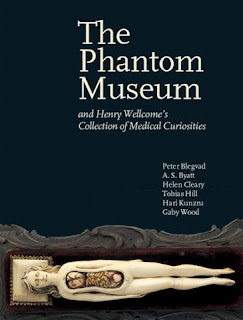
The Wellcome Collection is (or was) a vast assemblage of objects related to the history and anthropology of medicine. As one might expect, many of the objects are gruesome or bizarre. Henry Wellcome, who amassed the objects, died in 1936, and after his death much of the collection was apparently dispersed, though some of its holdings became accessible to the public in 2007. The editors explain the concept:
This book forms a companion volume to the catalogue of an exhibition on Henry Wellcome's collection held at the British Museum in the summer of 2003. The aim of the exhibition was to reunite a fraction of the collection back in one place. The exhibition catalog endeavours to present the facts of the collection, exploring its objects through documents and physical evidence. Here, in The Phantom Museum, the objects are investigated using a different method, that of the sympathetic imagination.Each of the six pieces in the volume is inspired by one or more of the Wellcome's objects. A. S. Byatt is the most familiar name among the writers. Peter Blegvad contributes an unclassifiable piece, but my favorite is a deft short story entitled "The Venus Time of Year," which follows two women, one modern and one in Roman Britain, who both have recourse to votive offerings in the form of a fertility figurine. Admirably, it doesn't try to do too much or look too far ahead in the women's lives. Of the author, the back flap notes, "Helen Cleary lived in Singapore, Wales and East Anglia before moving to London. She is working on her second novel and writes non-fiction for the BBC History website."
Oddly, I've found no evidence that either of the two Helen Cleary novels mentioned was ever published, nor any indication that she has published any additional fiction. She didn't disappear; she apparently has contributed to several documentaries and reference books.
In conjunction with the British Museum show, the Quay Brothers released an eccentric short documentary about the collection, which is also entitled The Phantom Museum.
Tuesday, August 10, 2021
Ambition
One day I hope to retire to grow the vegetable marrows, but until then I have only the window box. — Hercule Poirot
Il faut cultiver notre jardin. — Candide
I will arise and go now, and go to Innisfree,
And a small cabin build there, of clay and wattles made;
Nine bean-rows will I have there, a hive for the honey-bee,
And live alone in the bee-loud glade.
— Yeats, "The Lake Isle of Innisfree"
When a knight retires his only plan
is to live in peace and quiet like a gentleman.
He makes a modest living selling honey and cheese
and his golden helmet is a hive for bees.
— Peter Blegvad, "Golden Helmet"
Monday, March 29, 2021
Words & Music
An interesting sign of something, though I'm not sure what: all of a sudden a large number of the musicians I listen to regularly or occasionally have either come out with a book or have one in the pipe. The one I've been anticipating for some time is Richard Thompson's memoir, which is being published shortly, but just in the last week I've learned that Rickie Lee Jones is also releasing a memoir in April, and that Robin Hitchcock is publishing a hardcover volume of lyrics in July.
Just looking back four years and including only performers represented in my modest CD collection, I came up with the following short list:
- Loudon Wainwright III, Liner Notes: On Parents & Children, Exes & Excess, Death & Decay, & a Few of My Other Favorite Things (2017)
- Amy Rigby, Girl to City: A Memoir (2019) (reviewed briefly in this space here)
- Peter Case, Somebody Told the Truth: Selected Lyrics and Stories (2020)
- Peter Blegvad, Imagine, Observe, Remember (2020)
- Rickie Lee Jones, Last Chance Texaco: Chronicles of an American Troubadour (April 6, 2021)
- Richard Thompson, Beeswing: Losing My Way & Finding My Voice, 1967-1975 (April 13, 2021)
- Mary Gauthier, Saved by a Song: The Art and Healing Power of Songwriting (July 2021)
- Robyn Hitchcock, Somewhere Apart: Selected Lyrics 1977-1997 (July 2021)
- Roy Gullane (of the Tannahill Weavers), untitled memoir (tentatively 2021)
Most or all of these performers, some of whom have worked with each other in the past, have had to drastically reduce their touring schedules due to the pandemic, which may have given them the incentive and leisure time to shift their attention to the written word, but several of the volumes listed appear to have been at least contemplated before last year. A more likely explanation is that all of these artists have reached a point in their careers that a bit of retrospective seems to be in order, and no doubt any extra bit of revenue is welcome as well.
Thursday, August 01, 2019
The Folks Back Home

It's very difficult, at least for me, to make out the long inscription on this Real Photo postcard, but the language is apparently German, and it may be from Switzerland. It shows three women, two men, a boy holding a gun, and a dog, posing in a group in front of a vine-covered cottage. There's a flourishing garden in the foreground, possibly including poppies, and a whole social history in the hats the figures wear, no two of which are alike.

The very few bits I can make out in the inscription on the reverse of the card include the names Meinhof and Dietrich and a reference to an address of (I think) Kapellenstr[asse] 31, which might be in Bern or Basel. The most intriguing is a reference to America, including the name of the state of Kansas in parentheses. Perhaps some of the family members were now living in the New World.

Just a few scratch-marks in ink now, but they were presumably perfectly legible to the recipients, whoever they may have been.
Postscript: When I came up with a title for this post perhaps I had in mind these lyrics by Peter Blegvad:
I sent a card to the folks back home
a picture of a burning aerodrome
it came back stamped: address unknown
I was alone
in the meantime
Thursday, August 02, 2018
The Impossible Book

The CD insert for a radio play by Peter Belgvad and Iain Chambers, from the limited-edition version of The Peter Blegvad Bandbox. Astute listeners may recognize the voice of the distinguished British actress Harriet Walter in the role of Agatha Christie, as part of a cast that also features XTC founder and longtime Blegvad collaborator Andy Partridge. The insert design and art are by Blegvad.


Wednesday, July 25, 2018
Blegvad in a Box

Chris Cutler's ReR Megacorp has just released a snazzy boxed set bringing together the four albums that Peter Blegvad has recorded for the label, packaging them along with a two-CD compilation of live performances, previously unreleased tracks, and "eartoons" entitled It's All 'Experimental,' as well as an attractively designed illustrated 70-page booklet of notes and musings*, and (if you've plumped for the limited edition) an autographed CD of a radio play entitled The Impossible Book.
I came to Blegvad's musical output (he's also a cartoonist and graphic artist) first via Choices Under Pressure, a mostly solo recording from 2001 that I love but that many aficionados are lukewarm about, and then moved on to his fine 1990 Silvertone CD King Strut and Other Stories. The ReR recordings in this Peter Blegvad Bandbox, loosely focused on a core trio of Blegvad, Chris Cutler, and John Greaves, meticulously document one of the most sustained partnerships of his career, and contain much of his best work as well as some material that is perhaps only for the true devotee.
The most recent of the four ReR CDs, Go Figure, was reviewed briefly in this space when it was released last year. Of the other three, Just Woke Up , from 1995, seems the strongest, both musically and lyrically. Hangman's Hill, from 1998, is the weakest (despite the likeable title track), and 1988's Downtime falls somewhere in the middle. (The last features several Blegvad compositions that were originally recorded by Anton Fier's Golden Palominos during Blegvad's association with that shifting ensemble; by and large the Palominos versions are stronger.) The two-disc It's All 'Experimental' is a valuable omnium gatherum featuring, among other things, two versions of "King Strut," two versions of "Shirt and Comb," and a Blegvad-sung rendition of "A Little Something," originally sung by Dagmar Krause when she, Blegvad, and Anthony Moore made up a trio called Slapp Happy.
As for The Impossible Book, it will have to wait until the CD player in my car starts functioning again.
* The designer is Colin Sackett of Uniformbooks, and the booklet includes liner notes and annotations by Blegvad, Chris Cutler, John Greaves, and Karen Mantler, as well as photographs, Blegvad drawings, and whatnot.
Friday, March 23, 2018
Black Dogs

Kaye Blegvad's Dog Years is an appealing self-published illustrated story about her lifelong battle with depression, personified as a black dog (an animal associated in folklore with various nefarious doings). It originally appeared in Buzzfeed last fall, and has been made available in a hardcover edition through a Kickstarter campaign and probably via her website. It only takes a few minutes to read, and is worth a look.

Curiously, I have a dog who resembles Blegvad's, except for some white markings — but my dog is quite literal. He's actually rather sweet, although he is a handful.

Fans of Peter Blegvad's comic strip Leviathan may possibly recognize a small stuffed rabbit in one of Kaye's panels.
Thursday, December 28, 2017
Blegvadiana

For a guy who has been making records for something like forty-five years and has a long and complicated discography, Peter Blegvad manages to maintain a fairly low profile. His new CD, Go Figure, has been released by ReR in anticipation of a full bells-and-whistles Blegvad retrospective boxed set promised for early 2018. By my count a little shy of half of the 17 tracks on Go Figure are new songs, the others being new versions of tunes that originally appeared on earlier Blegvad or Slapp Happy records or that were premiered on the Radio Free Song Club. The band is made up of usual Blegvad confederates Chris Cutler, John Greaves, Bob Drake, and Karen Mantler, the CD package features various Blegvad doodles, and the whole thing was produced and engineered by Drake in the south of France, though not on the Côte d'Azur, a locale that prompts these typically frivolous Blegvadesque lines:
We're so richThe new version of "God Detector" doesn't seem like an evident improvement on the one included on Choices under Pressure, and nothing here strikes me as on a par with Blegvad compositions like "King Strut," "Hangman's Hill," or "How Beautiful You Are," but it's all tuneful and fun and it might grow on you. In the meantime there's that boxed set to look forward to.
we're out of reach.
We're at the top of the heap
at the bottom of which
people sleep on the beach.
Update (March 2018): After living with Go Figure for a few months, I think my favorites here are "Had To Be Bad," "Simon at the Stone" (a tribute to Blegvad's late friend, the photographer Simon Marsden), and the cheeky "Way To Play The Blues." The boxed set is still in the offing.
Sunday, August 20, 2017
Public Service Announcement
Some practical advice for eclipse-watchers, from Peter Blegvad and Andy Partridge.
Wednesday, February 18, 2015
Some rocks
for Michael Leddy


Top: Ogdred Weary (Edward Gorey), The Dancing Rock (bound with Dogear Wryde, The Floating Elephant), The Fantod Press, 1993. Shown: cover and sample page. Purchased at the Gotham Book Mart. Bottom: Peter Blegvad, Stones in My Passway, The London Institute of 'Pataphysics, 2002. Shown: cover, title page, and sample page.


Top: Ogdred Weary (Edward Gorey), The Dancing Rock (bound with Dogear Wryde, The Floating Elephant), The Fantod Press, 1993. Shown: cover and sample page. Purchased at the Gotham Book Mart. Bottom: Peter Blegvad, Stones in My Passway, The London Institute of 'Pataphysics, 2002. Shown: cover, title page, and sample page.
Monday, December 29, 2014
Incognitum

Two passages from Peter Blegvad's "Numinous Objects and Their Manufacture":
Objects proliferate as never before, but they are mostly dead husks, the shells of things, wherein no daemon resides. We own them merely, or covet them, we are not nourished. Meanwhile, the fundamental appetite for numinous objects grows ravenous. Never mind that it remains unconscious in most citizens and unacknowledged by the authorities. Only numinous objects can make possible the communication between people and so-called "dead matter" which must be established if we wish to avert calamity...Excerpted from Kew. Rhone. (Uniformbooks 2014).
The numinous objects which already exist in our environment are easily overlooked by our harassed and addled species. Education is the remedy, teaching people of all ages to resist distraction and become sensitive to the subtle radiation emanating from these items (which often masquerade as common refuse on the street). I imagine students returning, bright-eyed and exultant, from expedition to dumps, factories, zoos, firing-ranges, hospitals, quarries, ships, farms, forests, cinemas, circuses, cemeteries, and recording studios with their eclectic spoil. Objects thus collected would be tested, graded and catalogued before being made available to the public from a chain of lending libraries.

What is Kew. Rhone.? 1) "A phantom or spiritual skyscraper which is only visible to specific individuals, briefly, at a specific time and from a specific vantage, though these coordinates are never the same twice"; 2) a map of Kew, overlain with a map of the Rhone river (or vice versa); 3) an anagram of (among other things) KNOWHERE; 4) a 1977 long-playing record credited to John Greaves, Peter Blegvad, and Lisa Herman, or subsequent re-issues thereof in various formats, some of which are no longer supported by 21st-century operating systems; 5) a newly issued companion book to said record, published by Uniformbooks in the UK, and containing contributions by Blegvad (who is credited as the author), Greaves, and Herman as well as other participants, observers, and appreciators, "the aim being," in Blegvad's words, "to illuminate without dispelling the mystery of a work designed to resist interpretation even as it invites it."

Sunday, October 21, 2012
The Devil's Lexicon
Another video from Gonwards, the upcoming Peter Blegvad - Andy Partridge - Stuart Rowe collaboration, releasing October 22nd from Ape House Records. The whole package has been described as, in part, "a re-imagination of the myth of the Blues," and in this film (by Marina Lutz) this element comes through explicitly. But of course, this being a Blegvad-Partridge project (like the earlier Orpheus the Lowdown), the Devil not only meets the musician at the crossroads, he actually brings him into being out of the raw materials of creation.
Friday, September 21, 2012
From Germ to Gem
A video sneak peek at Gonwards, the upcoming Peter Blegvad - Andy Partridge - Stuart Rowe collaboration, due out October 22nd from Ape House Records. This should be fun.
Friday, February 03, 2012
Orpheus — The Lowdown (Blegvad & Partridge)

Peter Blegvad and Andy Partridge reportedly worked on this recording project off and on for twelve years, which works out to about two minutes and change a year of finished material, but if that's what it takes to create something this perfect then I'm all for it. Partridge was one of the founders of the rock band XTC and Blegvad has been, among other things, a member of the 1970s trio Slapp Happy, a cartoonist (Leviathan), and a solo singer / songwriter, but Orpheus — The Lowdown, which was released in 2003, isn't made up of "songs," though it does have words and music. What it is made up of is harder to explain; except for one wordless cut it's a suite of short texts recited or occasionally chanted by Blegvad over an aural environment composed of music, sound effects, squawks, and warbles, all organized around the mythological figure of Orpheus, legendary musician (a "lyricist" in the etymological sense of the word), charmer of beasts, and voyager to the underworld in search of his wife Eurydice, whom he won back from Hell by the beauty of his playing only to lose her on the return trip when he disobeyed an injunction not to look behind him as he ascended. Issued by Partridge's Ape House Records, the single CD comes accompanied by an illustrated booklet in which the lyrics (including some that are meant to be part of the project even though they aren't spoken aloud in the recording) are paired with effectively eerie artworks created by Blegvad and Partridge, of which the radiograph-like cover illustration is a representative example.
Blegvad's delicious deadpan narration — he manages to sound droll and legitimately profound at the same time — belongs to a category of declaimed performance that's relatively rarely encountered. Some of the texts he reads could pass for "poetry" (one of them is in fact an adaptation from Rilke), another is a quotation from an essay by the critic George Steiner, but most inhabit a hazy border zone between storytelling and incantation. The closest examples I can think of are John Cage's Indeterminancy pieces (also paired with music), and the work of the late Spencer Holst, though Holst's stories were, and were meant to be, light as a feather, while Orpheus — The Lowdown dives into deep mysteries of creation, death, and language.
Orpheus is a musician, but he is also a poet, a creator of words. In the first piece here he is revealed as a creator of worlds as well, able to build a city on the savannah out of nothing in order to win a bet against the gods. He is a distant cousin to Blegvad's King Strut (from the CD King Strut and Other Stories):
Imagination, like a muscle, will increase with exerciseOrpheus draws so much divine energy that he causes a "Brown-Out on Olympus." Later, in "Noun Verbs," the longest and one of the best of these pieces, Blegvad whispers that "what the dead lack / is substance..."
King Strut developed his by having dreams and telling lies
He'd describe a situation or a piece of merchandise
He could summon it from nothing to appear before your eyes
Time means nothing to them now, but words...In "Beetle," Orpheus deciphers the marks on paper made by an insect that he has first made to crawl through a pool of ink, and mutters excitedly "as image / after image / astonishes him / with its unexpected force and purity." In "Galveston," (a city "which he's heard is hell"), Orpheus tells a group of prostitutes:
speech,
hot air shaped by thought
into blobs and ribbons
of intelligible discourse,
words have not only substance
but value.
When you come into this world you find pockets in your pants, handlebars on your bike, put there by those who preceded you. You walk in their footsteps. But, as regards the entry into and possession of yourself, you're a solitary pioneer.There are brilliant illuminations like this throughout.
The aural backdrop to these texts can't be quoted and isn't easily described, but fortunately the CD can be heard, in full, by visiting the Ape House site. To fully appreciate Orpheus — The Lowdown, though (not to mention to support the artists), you'll want to get a hold of the physical package.
Blegvad and Partridge are reportedly in the final stages of assembling another CD, to be entitled Gonwards.
Monday, December 26, 2011
The Bleaching Stream (Peter Blegvad)

The modest-looking covers of this 80-page paperback conceal a number of curiosities and mysteries within and without, starting with the identity of the book itself, which is actually The Bleaching Stream by Peter Blegvad "in conversation with Kevin Jackson." The title page, which features an elaborate illuminated red letter "B," informs us that the words "the bleaching stream" are a literal translation of what the name "Blegvad" means in Danish. It also designates Peter Blegvad as the "President of the LIP" (London Institute of 'Pataphysics), an organization which apparently does exist, this being Number 3 of its journal, and identifies his interviewer or interlocutor Kevin Jackson as "Regent of the Collège de 'Pataphysique." The cover date ("Absolu 139 EP") corresponds to Alfred Jarry's 'pataphysical calendar, though in a concession to Gregorian reckoning it also includes "September 2011 vulg." in parentheses. There are actually two monograms on the cover, for in addition to the obvious one of the LIP at the bottom the drawing of a glass of milk (yes, it is milk) in the center slyly incorporates Blegvad's initials.
An introduction is probably in order. Peter Blegvad is, depending on your perspective, either a rock musician and songwriter who also draws, or a cartoonist and graphic artist who also engages in music-making. As a musician he has been a member of such ensembles as Slapp Happy, Henry Cow, and the Golden Palominos, has collaborated on the progressive rock landmark Kew. Rhone (the lyrics of which contain one of the world's longest palindromes, "Peel's foe, not a set animal, laminates a tone of sleep"), and has written a number of unusually verbally adept songs, including the ineffable "King Strut." As an artist he is best known for the cartoon strip Leviathan which ran for several years in the Independent, though he has always been doodling this and that, both professionally and for his own amusement. The full range of his activity is in fact greater than that, as he has written fiction and essays, delivered lectures ("performances" might be a better word), and compiled various aural collages and "eartoons" which have appeared on the BBC and elsewhere. Born in the US in 1951 (his Danish-born father is a prolific illustrator of children's books, his mother an author), he has lived mostly in Europe since his teens. He is 6' 7", which means that in several photographs included in this volume he is seen looming over everyone else in the frame.
The Bleaching Stream consists of a series of interviews covering Blegvad's childhood, creative activities, influences, and obsessions. The last, which have been remarkably consistent through his life, notably include milk (hence the monogram). Printed on glossy stock, the book is generously illustrated with drawings, photographs, album covers, and ephemera, mostly in black-and-white although there are a couple of color plates. (I haven't attempted to scan any of the interior art, which I couldn't really do without dismembering the book.)
The influence that Alfred Jarry and his disciples have had on Blegvad was not something I was aware of nor would necessarily have suspected, though when you read these pages it all makes good sense. Blegvad mentions, and wears with pride, the fact that he has several times been disparaged by critics or collaborators for his "flippant" attitude; the ludic element has been a constant in his work, whether in the elaborate image-and-text punning of Leviathan or the droll recitation over Andy Partridge's musical backdrop of the whimsical text of "The Cryonic Trombone," to be included on the forthcoming Ape House (UK) CD Gonwards.
Over the years Blegvad has worked with or for a surprising variety of people and enterprises. For a while he drew backgrounds for some books spun off from Charles Schulz's Peanuts; later he served as a personal assistant to the director Arthur Penn. At one point in the freewheeling mid-1970s he was working with a German record producer who, though Blegvad wasn't aware of it at the time, had ties to the Baader-Meinhof group. His own position, characteristically, is traced out in humor and paradox:
KJ: And you weren't very interested in revolutionary politics?Blegvad has long had a following, which, though perhaps never very large, has been enthusiastic and appreciative. (A footnote here mentions that a first pressing of Slapp Happy's debut record recently sold for £1,131.00.) The Leviathan strips have been collected in a wonderful volume which remains in print, although according to Blegvad it only includes about a third of the total run. Some of his earlier print projects were run off in small numbers and left in restaurant napkin holders and subway cars for people to find by chance. His musical output, both solo and collaborative, has been issued, discarded, re-recorded, and re-issued by a variety of record labels, most of them small and European; my favorite disc (though not everyone's) is the mostly acoustic Choices Under Pressure. Blegvad can be heard as a regular participant in the Radio Free Song Club, a podcast of (mostly) original songs contributed by a variety of songwriters.
PB: Everybody was, they were desperate times. But my "politics" came down to basically siding with the underdog. I wouldn't have been able to kidnap an industrialist because that would mean I'd immediately be on his side against me.
The present volume, which has been issued in an edition of 501 copies, is unlikely to bring Blegvad much additional recognition, though it should please, if not the audience he deserves, the audience that is devoted to him. A future LIP volume, collecting Blegvad's "scientific papers," is promised.
Subscribe to:
Posts (Atom)