Showing posts with label Japan. Show all posts

Thursday, November 03, 2022

Shuna's Journey (2022)

First Second Books in the US has released the first authorized English-language translation of Hayao Miyazaki's 1983 full-color manga Shuna no tabi (Shuna's Journey). I've written about the original Japanese version at length before (link); I speak no Japanese but was able to follow the story with the help of earlier fan translations. The readable new translation, by Alex Dudok de Wit, clears up a few points in the narrative here and there. The New York Times has a review. I'll confine myself below to a few technical points about the reproduction.

The American edition, printed in Singapore, respects the layout and orientation of the Japanese edition, that is, printing it back-to-front from a US perspective. The trim size has been increased by about 50% with a noticeable but not glaring decrease in sharpness, and unlike the original, which was a paperback, the book has a hardcover binding, which makes it easier to see into the gutter. The paper stock isn't coated, however, and the color palette, particularly the lovely rich blues of Miyazaki's original, is a bit washed out. Whatever image processing magic was required to replace the Japanese text with English seems to have gone smoothly. Devotees may want to seek out the Japanese edition (ISBN 9784196695103), which should be obtainable for under $20, so that they can appreciate the full beauty of the original in tandem with this welcome and overdue translation.

Friday, October 13, 2017

An Ainu Ceremony


From Jude Isabella's article "From Prejudice to Pride," about the history and current state of the Ainu, in the online Hakai Magazine. "Kamuy" means "god" or "spirit."
When Yahata and her non-Ainu husband purchased a used Suzuki Hustler, they decided to welcome the little blue car with the white top into their lives as a traditional Ainu family would welcome a new tool. They conducted a ceremonial prayer to the car's kamuy. On a cold, snowy December night, Yahata and her husband drove the car to a parking lot, bringing along a metal tub, some sticks of wood, matches, sake, a ceremonial cup, and a prayer stick.

The couple tucked the car into a parking space and made a little fireplace with the metal tub and wood. “Every ceremony needs to have fire,” Ishihara translates. For half an hour, the couple prayed to the car kamuy. They poured sake into an Ainu cup borrowed from the museum and dipped a hand-carved prayer stick into the cup to anoint the car with drops of sake: on the hood, the roof, the back, the dashboard, and each tire.

Their prayer was a simple one: keep them and other passengers safe. Of course, adds Yahata with a smile, they got insurance...

The ceremony was so much fun, Yahata says, that the couple held another when they changed from winter tires to summer tires.
The entire article is also available as a podcast via the link above.

Tuesday, January 12, 2016

The Journey of Shuna (anniversary re-post)


I'm re-posting this piece (with a couple of additional images) for two reasons: because I've just been leafing through my copy of The Journey of Shuna, which remains as beautiful and mysterious as ever, and because I notice that my original post is now exactly ten years old.

This delicate watercolor manga by Hayao Miyazaki has never been officially translated into English, which is a bit of a surprise, given the increasing popularity of Miyazaki's films worldwide and the ready availability here of his multi-volume manga epic Nausicaä of the Valley of the Wind. Perhaps the production cost of doing it in full color would be prohibitive — I don't really know (but see bottom of page).

The following is a brief outline of the story, as I can follow it and based on some available page-by-page fan translations.

Shuna is a young man living in a small village in what looks like some high-altitude country in Asia. (When this story takes place is deliberately unclear; the art and technology seem very old, but on the other hand there are a few primitive guns.) The country is windswept and the land barren; the villagers survive, but barely, on sparse harvests of grain.

One day a stranger, an old man, is found by the wayside and brought back to the village, barely alive. Before he expires he tells Shuna that he is a prince from a distant country. Long ago he, like Shuna, had encountered a lone traveler. The latter had given him a purse full of grain — grain so rich that it could bring plenty even to a harsh land. The old man still has the purse of grain, but after so many years it is useless. He has searched for years for the land where the grain is grown, somewhere far to the west, but he has never found it and now can go on no longer.

Shuna, of course, soon decides to leave the village and seek the land of the golden grain. He mounts his yakkul (an elk-like creature) and rides off. Like every good quest-hero, he travels through a wasteland; then he comes upon a derelict ship half-buried in the sand. There are shrouded inhabitants inside, who beckon him in, but, spooked by the sight of a pile of human bones, he steers away and camps a little ways off. During the night he is attacked by several shrouded figures (they are all apparently women), but he fights them off, severing the hand of one with a gunshot. (She later creeps back and silently retrieves the hand).

On the road he is passed by a large cart, drawn by several blue beasts and surmounted by several gunmen. They treat him rudely and continue on their way.


Soon afterwards, Shuna comes to an enormous bustling city. In the marketplace he finds a pile of the grain he seeks, but it is already threshed and dead; he is told that it comes from a distant place. He also learns of the city's flourishing trade in slaves. He sees a girl roughly his own age in chains, with a younger girl alongside. He tries to purchase their freedom but fails, and leaves the city.

He meets a hermit monk, who tells him that he can find what he seeks further west, in “the place of the god men, where the moon is born and returns to die,” a place from which no man has ever returned. The next morning Shuna wakes up and finds the hermit has gone.

He again encounters the cart with the gunmen. Inside are slaves, among them the two sisters he had met in the marketplace. He shoots the gunmen and releases the girls. Together they flee, as more armed men are seen coming from the city. They are followed to the top of a high cliff, the very precipice which overlooks the land of the god-men. Shuna sends the girls and his mount away to safety in the north, then evades his pursuers by sending them to their deaths over the precipice.

An enormous luminous face swifly crosses the sky above him and disappears over the edge of the precipice. Knowing that he has come to the place he seeks, Shuna begins to descend the cliffs. His descent seems to be, as well, a descent through time; he climbs over ancient monuments and the skeletons of antediluvian creatures and eventually reaches a sea in which enormous prehistoric beasts are swimming. He wades across to a dense and fertile land, populated by a variety of creatures, all of them, fortunately, benign.

The next few pages are strange and eventful, and I'm not sure I completely understand them — but here goes: an enormous green figure strides through the forest, then collapses, and is immediately consumed by a horde of beasts. More giants stride through the forest; Shuna passes them and comes to a clearing, where there is a vast tower which appears to be some kind of living being. He discovers that it is hollow. Just then the moonlike face crosses the sky and arrives at the top of the tower. It disgorges from its mouth a stream of human figures, slaves, apparently, acquired from the slave-traders. As they fall into the tower they are transformed into green giants; they emerge and spread out, spewing seeds from their mouths as they travel. Within hours the land becomes green — this, then, is the source of the golden grain.

Shuna grabs hold of several stalks of ripe grain. The giants howl with pain; Shuna flees, leaping into the sea.

We are now shown the two sisters. They have arrived in a village in the north, where they and the yakkul are ploughing a plot of land belonging to an old woman who has taken them in. One night they find a ragged traveler outside; it is Shuna. He is haggard and has lost his ability to speak, but around his neck he carries the precious golden grain.

The girls and Shuna plant the grain in a small plot; it sprouts. The old woman tells the older girl she is now of age and must marry one of the villagers. There is a bride-contest: the girl says that she will marry the suitor who can master the yakkul. Of course all the young men fail, until finally the mute Shuna succeeds.

The sprouted grain eventually bears fruit, after being protected by Shuna and the girls from a terrible hailstorm. Shuna recovers his speech. The three stay another year, harvesting another crop and fending off an attack from slave-traders, then depart for Shuna's native village, leaving half the grain behind for their hosts. The story ends there.

There's a lot that could be said about The Journey of Shuna, but I'm not going to try to interpret it, because, as with all great mythological stories, there seem to be so many different angles from which it can be approached. Despite the different setting, the affinities with the legend of Perceval and the grail seem very strong to me; there are also echoes of the Odyssey (the bride-contest, if nothing else), and, in the green men, similarities with Central American myths. It's also very much a Miyazaki story; other observers have commented on its connections with both the manga and film versions of Nausicaä of the Valley of the Wind, but the beginning of the tale, the departure of the hero, resembles the opening of Princess Mononoke.

There are some fascinating visual elements as well: in the background of the panels where the old traveler is dying there appear first a large upside-down female figure, then a pair of outstretched hands, as if a deity were carrying him away. This is not commented on in the text, and it has been suggested (I don't agree) that the apparent “deity” is just a painted decoration in the interior of the room where the man lies dying — in any case the effect is quite odd. The old woman who shelters the sisters reminds me, in one panel, of some of Sendak's old crones. Overall it's very rich and distinctive both visually and as story; I hope that American audiences will eventually get a full chance to appreciate it.

Update: An authorized English-language edition is now available.

Sunday, March 29, 2015

More Japanese Gothic


Satori Ediciones in Spain has published its second collection of translations into Spanish of the Japanese writer Izumi Kyōka (1873-1939), following in the wake of El santo del monte Koya, which I discussed here last year.

As with the previous volume, all of the stories (there are four) are fantastic in manner and draw on the long tradition of Japanese supernatural literature and lore. The title story is available in English (as "Of A Dragon in the Deep") but the edition is difficult to obtain and I haven't seen it; the longest of the tales, "El fantasma que esconde las cejas" (The Ghost Who Hid Her Eyebrows) has been translated by Charles Shirō Inouye and can be found in a volume entitled In Light of Shadows: More Gothic Tales by Izumi Kyōka, published by the University of Hawai'i Press. As far as I know the other two tales are not available in English.


Kyoka was a fascinating but sometimes difficult writer, who made of use of what Charles Inouye calls "an eccentric, highly convoluted narrative method that precluded his participation in the more mainstream attempt to accomplish an objective description of an exterior world and a psychologically depicted realm of an interior one." "His narratives," Inouye continues, "neither maintain a consistently stable and omniscient point of view nor do they present time as a steady flow of logically connected events that are contained in the past." Writing at a time when many of his contemporaries were embracing the conventions of the Western realistic and psychological novel, Kyoka held to his own way.

Two of the stories in Sobre el dragón del abismo describe the encounters of children with a unpredictable but not necessarily hostile supernatural world; the third, "La historia de los tres ciegos" (The Story of the three Blind People) is classic horror tale of the perils that lie in wait for those who trangress. The last narrative, "El fantasma que esconde las cejas," is a ghost story so many-layered (and impossible to summarize here) that Inouye includes a diagram in his edition to help visualize its intricately nested levels.

I've now read this final story twice in English and twice in Spanish, gaining insight into it with each reading, but I wouldn't pretend to have mastered it. Because of the richness of cultural allusions in Kyoka's tales, as well as the inherent difficulties of translating from Japanese into a European language, it's interesting to compare the two translations, Spanish and English. Since I know no Japanese, I naturally can't comment on their relative accuracy, but while they're generally complementary (and mutually clarifying) there are numerous passages that show fairly radical differences in interpretation. Below is just one sample passage; what follows is 1) Alejandro Morales Rama's Spanish-language text; 2) my rough English translation of the Spanish into English; and finally 3) Inouye's version:
1) Las montañas y el cielo estaban tan nítidos que parecía que los estuviese viendo a través de una capa de hielo. Los brillantes rayos del sol hacían que las agujas de los pinos y los árboles secos resplandecieran. Al mismo tiempo se veía volando una figura de un blanco cegador y en las profundides de la montána, donde el oso vive alejado de los hombres, la nieve se había tornado en una ventisca punzante como agujas.

2) The mountains and the sky were so clear that it seemed as if one were seeing them through a covering of ice. The brilliant rays of the sun made the needles of the pines and the dry trees shine. At the same time, a figure of blinding white was seen flying, and in the depths of the mountain, where the bear lives apart from men, the snow had turned into a blizzard as sharp as needles.

3) The mountains and sky became clear as ice. While the sun sparkled brilliantly in the pines and other wintering trees, something white began to fall from the sky. In the deep mountains, where bears stood on their rear legs like human beings, the snow came down like needles.
Inouye's "wintering trees" is a nice touch, but I don't much like "rear legs" (rather than "hind"). What's interesting, though, is the very different ways in which the reference to the bear or bears is understood. Whatever the truth of its accuracy, Rama's donde el oso vive alejado de los hombres (where the bear lives apart from men) is a beautiful lyrical touch, suggesting a fundamental if estranged kinship between the two species. Reading the two translations side-by-side provides an unstable but rewarding reading of an intricate masterwork of modern Japanese literature.

Sunday, March 22, 2015

Re-envisioning Japan


This merits a look: Re-envisioning Japan: Japan as Destination in 20th-Century Visual and Material Culture, a new "interactive archive and research project" created by Joanne Bernardi, associate professor at the University of Rochester, is now online. From a quick glance it looks like there's plenty of good stuff there, including a section devoted to the Japan Tourist Library, about which I've blogged previously. Lots of postcards too.

Saturday, September 20, 2014

Unearthly Loves


I started reading modern Japanese literature in Spanish translation because there were a couple of books I wanted to read that didn't seem to be available in English, but at this point I'm just doing it for fun — or perhaps in part because the psychological effect of reading a book in a foreign language — any foreign language — gives me the illusion that I'm reading it "the original," which in the case of Japanese is something I'm utterly unable to do. Plus I just like these editions from Satori in Spain. Putting aside such eccentricities, three of the four stories in Izumi Kyōka's El santo del monte Koya are readily available in English in a volume entitled Japanese Gothic Tales, translated by Charles Shirō Inouye and published by University of Hawaii Press.

And they're great stories, intricately told, shocking at times, richly atmospheric; each of them rewards — in fact demands — a second reading. I'll pass over the two shorter ones, as good as they are, and say a few words about the title story, which in Inouye's translation is called "The Holy Man of Mount Koya," and the novella-length "Un día de primavera" ("One Day in Spring"). Both can be found in the Inouye translation mentioned above.

The former follows a classic Japanese storytelling pattern: a lone traveler — here, a Buddhist monk — hiking through the remote countryside encounters a figure — in this case, a woman — who turns out to be other than what she appears. Kyōka, who died in 1939, was adept at nesting stories within stories, and the events in the tale are actually narrated by the monk to a traveling companion he shares a room with much later. As the monk recalls, during the original journey he had fallen in with a traveling salesman whose vulgar behavior had offended him; the two come to a fork in the road and the salesman chooses a path which, the monk is subsequently informed, will lead him to great danger, perhaps even certain death. After some hesitation, the monk decides that his Buddhist principles require that he set out to persuade the salesman to turn back, since allowing his personal antipathy to sway his duty towards the man would be a great sin. The route he thus follows subjects him to gruesome, skin-creeping horrors — told in vivid detail by Kyōka — but eventually he makes it through, only to find himself the guest of a kind of Japanese Circe, with whom he almost decides to remain forever.

As exemplary a tale as "The Holy Man of Mount Koya" is, it can't quite match the measured, uncanny beauty of "One Day in Spring." Again we have nested narratives, although in this case it is the frame-tale that involves a traveler, a lone figure who arrives at a remote temple and hears from the resident monk a bizarre tale about an earlier pilgrim, who had taken up residence in a nearby cottage and become obsessed with a beautiful woman with whom he had — in this world, at least — only the most fleeting of encounters. Drawn to an isolated spot by the sound of music, the pilgrim had witnessed an oneiric pageant in which he and the woman — or their semblances — appeared as the principle players; a few days later he is found drowned at the edge of the sea. Having heard this strange tale, the second traveler has his own encounter with the woman, then witnesses an appalling and unexpected denouement.

There's at least one additional collection of Kyōka's tales in English, also translated by Charles Inouye and published by the University of Hawaii Press; it's entitled In Light of Shadows: More Gothic Tales. I've ordered a copy.

Sunday, June 22, 2014

Destroying Angels


Kyūsaku Yumeno was the pen name of a prolific Japanese writer who died in 1936 and whose work is apparently relatively little-known in the English-speaking world. Satori Ediciones in Spain has just published El infierno de las chicas (The Hell of Girls), a Spanish-language translation by Daniel Aguilar of the three dark, intricate stories that were originally collected in Japanese as Shōjo jigoku. As far as I can tell the stories have never appeared in English.

All three tales included here are narrated largely or exclusively in epistolary fashion, though in each case we read only one side of the correspondence. One story makes use of fictional news articles, and now and then letters from third parties are nested within the letters of the primary correspondent. The first story, "No tiene importancia," (It's of no importance) takes the form of a long missive written by one physician to another, describing the case of a young woman who has worked as a nurse, first for the recipient and then for the sender. We are told from the first page that the woman, who goes by the name of Yuriko Himegusa, has killed herself; the remainder of the story, which is approximately one hundred pages long, is in effect an extended flashback explaining this act. Himegusa was, to all appearances, a model employee: pleasant, conscientious, skillful, and beloved by her patients. She was also, it seems, a pathological liar, and the eventual unraveling of the skein of lies she has wound around herself proves her undoing. Or does it? Both Aguilar, the translator of this volume, and Nathen Clerici, the author of a recent doctoral dissertation (PDF here) on Yumeno, point out that the final outcome of the story is in fact highly ambiguous; no body is found, and the "suicide" (revealed, naturally, by means of a letter) may simply be one more deception.

From the point of view of the doctor narrating her history, Himegusa represents simply an unfortunate if rather bizarre case of female psychopathology. But Himegusa sees herself as a victim of misunderstanding and suspicion, and her suicide — real or faked — amounts to a salvo in the drawn-out battle between women and a male-dominated world. This aspect is heightened in the two remaining stories in the volume, in both of which the central female characters are at once victims and avengers of the crimes of men. The briefest, "Asesinatos por relevos," (roughly, Murders by relay) takes the form of a series of letters written by a young woman who works as a conductor or ticket-taker on a bus, in which she seeks to dissuade a friend from leaving her rural home and taking up the same career. Her contention that such a career only serves to subject a woman to the whims and abuse of men is chillingly documented in the course of the correspondence, as a new male driver who appears to be a serial killer of women takes the wheel on the bus route she is assigned to.1 In the end, the man gets his comeuppance, although what amounts to a happy ending, in both this and the last story in the volume, may seem appalling to contemporary Western readers.

The final story, "La mujer de Martes" (The woman from Mars), which, like the first, is novella-length, is the most intricate of the three. It begins with a newspaper article about the discovery of a charred body after a fire in one of the outbuildings of a girls' school, and proceeds breathlessly through a series of follow-up reports, which document an increasingly bizarre and inexplicable series of events, including disappearances, a hanging, and the desecration of a cross inside a nearby Catholic church. Only after these events have been catalogued is the explanation teased out, in the form of a long letter from one of the students at the school (the gangly misfit whose nickname gives the story its title) to its headmaster, a pious bachelor who has inexplicably gone insane since the fire. As in the previous story, there is a woman wronged and vengeance to be exacted in disturbing — and in this case extraordinarily elaborate — fashion.

Daniel Aguilar notes that those stories are written from a feminine, almost feminist viewpoint, and there is something to that, bearing in mind the limitations of the time and place (1930s Japan). What is certain is that men don't come off well at all; if not all entirely depraved, they are nevertheless very bad at running things. But there's something more here too, a sense that the world is essentially amoral and devoid of meaning. The men, blinded by lust and vanity, may not acknowledge that fact, but the women know it all too well. In the words of Utae Awakawa, the "woman from Mars":
Little by little I began to feel with greater and greater intensity that the emptiness that lay in the depths of my heart and the emptiness that could be found above the blue sky were exactly the same thing. And I began to think, as well, that the act of dying was something simple and of no importance.2
This bleak sense of futility that emerges over and over throughout these stories may perhaps owe something to Buddhist thought, but in its incarnation into 20th-century urban Japan it takes on a character that is very much Yumeno's own brilliant creation.

1 The bus is staffed by two employees: the man at the wheel (conductor in Spanish), and the female cobradora or revisora who accepts tickets and provides assistance to the driver.
2 My translation from the Spanish version.

Saturday, March 01, 2014

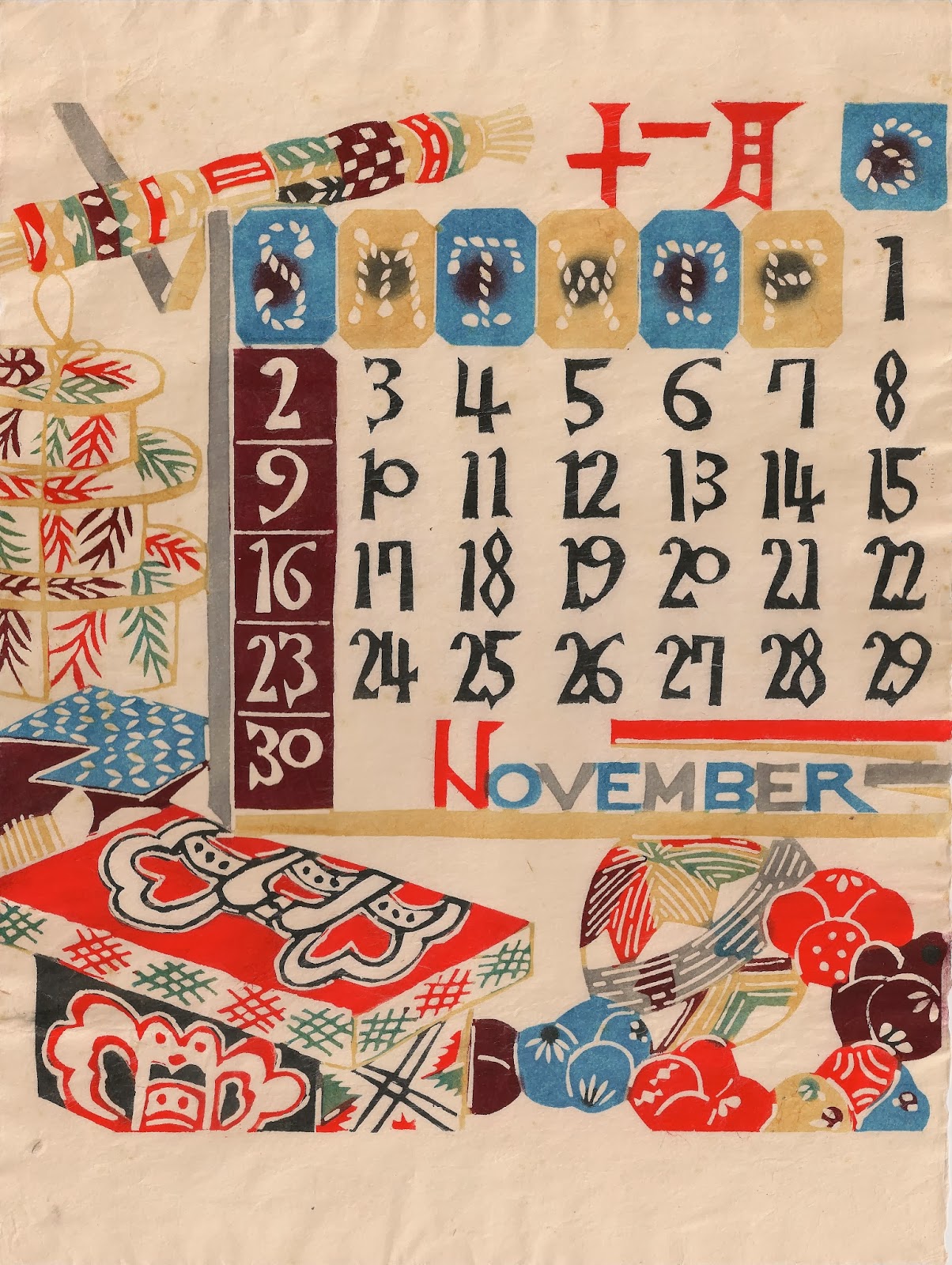
Keisuke Serizawa: 1969 Calendar


This hand-printed calendar was produced by the Japanese katazome (stencil-dyeing) master Keisuke Serizawa, whose mark can be seen just below and to the left of the bird on the cover print (see following image). He produced calendars, with different designs each year, from 1946 until the mid-1980s; at least one associate and friend, Takeshi Nishijima, produced his own similar calendars during part of that period.


This particular production is relatively restrained. On most of the individual panels it is the numbered squares or circles, rather than the accompanying illustrations, that are the dominant design element; many of the spaces not needed for dates are filled with little vignettes.


For the August print below, Serizawa worked the letters of the name of the month into the first row of the calendar, but since he was one square short he combined the last two letters into one space.


November, I think, is my favorite. Notice that the "S" for Saturday is displaced to a line above the other days, again because there was no empty square available for it.


All of these pages were printed on handmade paper, so the originals are not as neat and square as the images shown here imply.

A variant of this calendar has the name of the Western Automobile Co., Ltd. (the Japanese affiliate of Mercedes-Benz) printed on each page; the image below is from an auction listing.


I am relying on George Baxley for identification on this calendar as the work of Keisuke Serizawa. There are relatively few English-language sources on the artist, with the fine exhibition catalog Serizawa: Master of Japanese Textile Design (Yale University Press, 2009) being the notable exception.

Saturday, August 17, 2013

Living the disaster


Takashi Sasaki is a retired professor specializing in Spanish philosophy, with a number of translations into Japanese of the works of Unamuno and Ortega y Gasset to his credit. For a number of years, he has been blogging in Japanese under the nom de plume of Fuji Teivō (derived from the Spanish fugitivo, "fugitive"), and his posts have been collected in a series self-published books under the title Monodialogues (the word is borrowed from Unamuno). On March 11, 2011, he was at home where he lives in the city of Minamisōma in the prefecture of Fukushima, when the region was struck in quick succession by a severe earthquake, a massive tsunami, and the consequent nuclear accident at the Fukushima Daiichi Nuclear Power Plant. Fukushima: Living the Disaster, which thus far has been issued in Japanese, Spnaish, and a few other languages but not apparently in English, reprints the blog posts he wrote in the aftermath of those events. The handsomely produced edition shown above, the only one in a language I can read, was issued by the Spanish publishing company Satori Ediciones, which specializes in books about Japan.

The book begins with a post on March 10, the eve of the earthquake, and then, except for the text of a brief note hand-written on the 12th, breaks off until the 17th, when Sasaki was able to resolve some computer issues and resume blogging. By then, a great deal had transpired, but one of the curious things about this book is that Sasaki has relatively little to say about the tsunami, which devastated large parts of Minamisōma and claimed many lives there, and this may be due in part to the fact that he apparently lives a few miles inland from the coast. The book isn't really about the chain of events that made up the disaster, but about living through the aftermath, which of course was itself a kind of ongoing catastrophe (and still is) because of contamination from the damaged power plant. Rather than an eyewitness chronicle (though it is that to some extent as well), it is a moral examination centered around two questions: how the nation that had suffered the atomic bombing of Hiroshima and Nagasaki came to jeopardize the safety of its people by promoting nuclear power in one of the most seismically active regions on Earth, and how one chooses to act in the face of catastrophe.

Sasaki, though he makes no pretense of being an expert on nuclear energy, has some understandably scathing things to say about the actions of various Japanese politicians, scientists, and corporations both before and after the crisis. But as a student of philosophy, he also rigorously examines his own actions, and that examination is made more pertinent by his own particular circumstances.

At the time of the disaster, Sasaki, who is in his seventies, was living with his wife, who suffers from advanced dementia, his elderly mother, his son, and his granddaughter. Though the area where he lived was designated by the Japanese government as an exclusion zone (one of several, with varying degrees of restriction) after the nuclear accident, he elected to stay put and continue to care for his wife in their home, arguing that leaving would be both cowardly and irresponsible (he alleges, and I have no reason to doubt it, that a number of elderly citizens died from the trauma of being evacuated). Though the remainder of the family eventually relocated, he and Yoshiko stayed, and much of the book amounts to a chronicle of their efforts — and the town's efforts — to regain something approaching normal life. He is quite blunt about the frustration, and often fury, he feels in the face of what he sees as the duplicity and lack of humanity of various elected officials, bureaucrats, and corporate employees who stand in the way of that objective. When the book ends, in July 2011, he and Yoshiko are still at home, he continues blogging, and Minamisōma is slowly making a recovery, even as its future is shadowed by radioactive contamination and the still unstable state of the damaged nuclear reactors.

A final side-note: there is much wringing of hands at present about the future of the publishing business, and of the printed book. Fukushima: vivir el desastre is printed on good paper in a sturdy paperback format with French flaps and a nice cover painting by the artist Eva Vázquez. From what I've seen of the company's catalog, they seem to be producing a steady stream of high-quality, carefully focused books — and this in despite a Spanish economy that has itself been little short of disastrous. Granted, in Spain, as in a number of other European countries, books tend to be held in greater esteem than in the US, but perhaps more of our domestic publishers should take note of the example.

Sunday, March 03, 2013

Sapporo to Boston


Dear Dr. Wight,

How have you been since I left M. G. H.? I have arrived at Yokohama at the beginning of last June and I am now with all my family having happy time. Since I returned to Japan, I have been so busy that I could not write you. I am always thinking of you and others in White 4 Lab. How pleasant my life in M. G. H. was! I am dreaming to come over there once again in future. I do hope you work hard and in future in best health. Please remember me to all members in White 4 Lab.

With all best wishes to you.
Your friend
Terry.

The sender, Dr. Teruyoshi Hashiba, was a fellow in the neurosurgery department at Massachusetts General Hospital in 1953-1954; from the stamps and partially legible postmark it appears that the postcard was probably mailed in 1954. The recipient may have been Dr. Anne Wight (later Anne Wight Phillips), said to be the first woman to perform surgery at Massachusetts General. Coincidentally, the head of the hospital's neurosurgical service at the time, a man who Dr. Hashiba must also have known, was named White (Dr. James C. White), but it seems unlikely that Dr. Hashiba, who demonstrates a meticulous if slightly unidiomatic command of English, would have confused the names. (The building that housed "White Lab 4" was probably the George R. White Memorial Building, completed in 1939 and named after yet another White, the onetime president of the Potter Drug and Chemical Corporation.)

After he returned to Japan, Dr. Hashiba authored a number of papers in the field of neurology. According to the Department of Neurosurgery at Sapporo Medical University he died on February 2, 1982. Dr. Anne Wight Phillips died in 2009.

Saturday, November 24, 2012

More Katazome


According to the label, these katazome (stencil-dyed) calendar pages were "made by Haruo Kuriyama in Kyoto" and distributed by Yasutomo Co. in San Francisco. The artist who designed them, however, is almost certainly Takeshi Nishijima. The page for February is missing from this set.


Click on the katazome label below for earlier related posts.

Friday, November 04, 2011

The woman by the stream


A number of years ago I was invited to deliver a lecture at a summer conference on ethnobotany at the University of Tokyo. It was not my first visit to the country; I had been stationed there for two years shortly after the war, and had developed cordial relationships with a number of Japanese colleagues. Although I never learned to recognize more than a handful of kanji, I became fairly conversant in the spoken language, thanks largely to the instruction of my informal mentor, the highly regarded scholar Professor S. Matuzaki, one of the most cultured men I have ever known and most certainly the kindest. It was at the behest of Professor Matuzaki, who had kept careful track of my scholarly achievements in the intervening years, that I had been invited, and in fact it was his extremely generous offer to serve as my host for the duration of the conference that had prompted my immediate acceptance.

I was met at the airport by the professor, now a widower in his seventies, and by his daughter, herself already both an accomplished agronomist and the mother of two small boys, and taken by taxi to the modest apartment of the daughter and her husband, which is where the professor, by then semi-retired, stayed during his frequent visits to Tokyo. Though the presence of an extra guest must have inconvenienced my hosts, they never gave the slightest sign that this was the case, and my week in their company remains one of my fondest memories.

The conference was, as these affairs nearly always are, a mixture of tedium, moments of intense intellectual exhilaration, and more or less constant social activity, and it is the last of these, more than anything else, which eventually wears one down. Fortunately, Professor Matuzaki's impeccable considerateness had extended to an offer to spend the week following the conclusion of the conference "recuperating" at his country house in Hyōgo Prefecture, not far from the Hatsuka River, an area of great historical and biological interest, which, though somewhat remote from Tokyo, was where the professor had spent most of his childhood. As a true scientist is never really off duty, this kind offer was made even sweeter by the prospect of being able to make some short excursions to investigate the cultivars and traditional agricultural practices of the region.

My host had become somewhat frail over the years since I had last seen him, and if he had ever learned to drive he had given it up with age, so after devoting an initial day to rest we were chauffered about for most of the week by a wiry local man, himself in his sixties, who did odd jobs and served as caretaker when the professor was away. In his light Toyota pickup truck we explored fertile river valleys and rugged foothills, taking in only those few temples and historic sites that Professor Matuzaki deemed absolutely indispensable for the visitor from abroad, but making ample use of the opportunity to meet with local farmers, examine wild relatives of local crop plants in their natural settings, and get an overview of the range of geology and soil types to be found in those parts.

On the fifth day, however, our driver had business of his own to attend to, and the professor suggested that I might enjoy taking a day hike on my own through the hills in the immediate vicinity of his home, which, because of their discontinuous terrain, had as yet been largely unscathed by development. He provided me with a hand-drawn map and a simple lunch prepared by his housekeeper, a woman who lived a few houses down the road, and pointed me off in the right direction. It was an overcast and fairly damp morning, and I brought along a light coat, but as I climbed away from the main road the exertion soon made this more of an encumbrance than anything else. I am a strong hiker, accustomed to vigorous outings, but I was glad that the professor had not sought to accompany me out of an excess of courtesy, as the trail was steep and in some places largely overgrown.

I reached the summit of the ridge marked on the map a little after noon, and from there walked along the heights for several miles. Though the sun never really broke through as the day wore on, the morning mist had cleared off and above the intervening canopy of forest I was able to see many hectares of neatly tended farmland in the distance. There were a few old cottages dotting the sides of the ridge, and at one point I caught sight of a section of sinuous highway not far off, but I met with no one. After a while I descended the far slope, and as I did so I must have misread the professor's map, for I soon found that, having thought it unnecessary for me to bring a compass and not having the sun to guide me, I was no longer sure in which direction I was heading. On an undulating piece of ground I came upon the remains of an old orchard. It's not in the character of the Japanese to neglect things that require attention nor to let good land go unused, but these trees had obviously gone untended for several years at least; the fruit, much of which lay rotting in thick clusters on the ground, was stunted and mealy, and the trunks were surrounded with a dense overgrowth of suckers and weeds. At the lower end of the slope the land turned sodden, and little runnels arose that made my footing tricky as I picked my way down to the orchard's lower edge.

I heard a trickle of water running ahead of me, and soon emerged on the rocky bank of a shallow stream a few yards wide. Though I probably could have waded through, the farther side appeared impenetrably marshy and choked with reeds, so I decided to turn and walk upstream along the near bank, where a path had been trodden out which, though muddy in spots, was easy enough to follow. Here and there patches of iris were in flower along the stream.

After hiking for an hour or more over increasingly difficult ground, I emerged into a little clearing on a ledge above the water, where smoke was drifting from the chimney of a single small stone hut or cottage roofed with thatch, of a style so primitive I was surprised to see it still in use outside of a museum village or the like. The door was open and when I stuck my head inside and uttered a tentative greeting in Japanese I'm afraid I startled the lone occupant, who quickly put down what she had been doing and rushed in some embarrassment to usher me in. She was one of the most peculiar looking women I had ever seen, though I can not honestly say that her appearance was unpleasant -- in fact, quite the opposite. Well under five feet tall, she wore a long, trailing kimono printed with a curious mottled red pattern the like of which I had never seen before. Her hair was tied up but largely hidden by an elaborately folded hat, of the same pattern as her kimono, which she wore low on her brow. Her eyes were small and dark and I quickly got the impression that she was either blind or at best could not see well. Her nose was delicate, but her mouth, which she seemed to barely open even when speaking, was unusually broad, though her lips were thin. I could not hazard a guess at her age, which might have been anywhere between twenty-five and fifty.

Once she had recovered from the surprise of my unexpected arrival, for which I of course apologized as best I could, she seemed positively delighted to see me. Her fingers were unusually slender but proved quite agile as she set about making her guest some tea and a hastily prepared meal, which I dared not refuse for fear of giving offense, though I still had the lunch the professor's housekeeper had provided me tucked away in my knapsack.

The cottage had a dirt floor and there was little furniture, only a pair of low three-legged stools, an ancient iron stove, and some small rustic wooden cabinets she used for storing food and sundries. It was evident that she customarily slept on mats on the floor, and I saw no sign that she had any substantial wardrobe other than what she was wearing. When she was done cooking she handed me a bowl with some sticky rice and a few bits of what I took to be smoked eel, which proved to be unexpectedly delicious, along with a cup of a rather bitter but flavorful and invigorating tea. She had accepted without evident curiosity my awkward attempt to explain who I was and why I had intruded on her privacy, and gave no sign of recognizing the name of the professor or the village near which he lived. She seemed, on the other hand, quite interested in the condition of the stream outside, and whether it had overrun its banks in the meadows across from the old orchard. I got the impression that, in spite of the language barrier, she was quite glad to have someone to chat with, and I suspected that it had been some weeks or months since she had been provided with a similar opportunity.

After we had finished our meal and she had poured us each another cup of tea, she seemed to grow more serious, lowering her voice to just above a whisper, and began to intone a long story of which I'm afraid I could not follow even half, though it appeared that she was relating some kind of onomastic folk legend about a young girl many centuries ago and about a stream which I gathered was the very one outside her door. Some parts of the story were evidently quite humorous, as she several times broke into laughter, but here and there the telling brought her nearly to tears with the heartbreak of it. Spellbound by her manner more than the matter of the tale, I did my best to react appropriately at the proper times. When the story was done she seemed pleased, fell silent, then looked down meditatively into her empty cup for a long while. I noticed that it had begun to rain.

The downpour lasted until well after nightfall, and by then there was no question of my setting out again that day. The woman seemed untroubled by this. She had a small oil lamp that provided a few moments of flickering light, but as this dwindled she arranged a mat for me on the floor not far away from her own. Like many country folk who have not yet been told that their ways are "backward," she seemed unconcerned that this arrangement might be regarded as indelicate. As the product of a less innocent world, I confess that for a few moments some ungentlemanly thoughts did cross my mind, but the combination of my upbringing and fatigue swiftly put them to rest.

I was awakened in the night, in total darkness, by the feverish impression of a pair of lips on my own. I reached up with my hands and felt the woman's kimono slip from her shoulders. Tiny fingers were deftly undoing the buttons of my shirt...

In the morning chill, as the first pale light began to filter under the door, I heard the woman rise and stoke the fire. For a while I heard her bustling with dishes and pots, then in my weariness I fell back to sleep. When at last I did get up there was no sign of her. She had left some rice and tea, still warm, beside the fire, but though I waited nearly until midday I never saw her again. Absurdly, I left my card propped up on one of the stools, though I knew she would be unable to read it.

I began to follow the trail downstream, confident that, even though I didn't know exactly where I was, I would be able to find my way back to the professor's house by retracing my steps of the previous day. I had only gone twenty yards or so, however, when I was brought up short. In front of me, on a low shelf of stone just above the water, lay a Japanese giant salamander. I had seen one of these extraordinary creatures, among the largest amphibians in the world, once before, in a Tokyo aquarium, but the specimen I beheld now, with its beautifully mottled, pinkish skin still wet from swimming, was much larger and at nearly five feet from nose to tail must have been fully grown. I cursed myself for not having thought to pack my camera.

The creature eyed me neutrally for a moment -- indeed its expressionless, almost featureless face was probably incapable of displaying emotion in any case -- and then slipped smoothly but unhurriedly into the water. It swam downstream past me a few yards while I watched, then, reversing its course and drawing close to the bank, lifted its head just above the water and seemed to incline it in my direction. I scarcely breathed until, after circling back and forth three or four times, it dove down into the muddy current and disappeared from sight forever.

Though they suffer, like many species, from the loss of their native habitat to the activities of man, these salamanders are carefully protected in Japan and their population appears for the time being to be fairly stable throughout much of their range, which is confined to the islands of Honshu, Shikoku, and Kyushu. (A closely related species in China, sadly, is critically endangered.) Possessing few natural enemies once they reach adulthood, individual specimens can live for decades -- perhaps nearly a century. They breed in August and September.

I made it back to Professor Matuzaki's house at around two o'clock in the afternoon; he had been concerned, but not greatly alarmed, by my failure to return the previous night. I am afraid that my inability to provide a full explanation of my activities during my absence caused one of the rare moments of awkwardness in my otherwise highly productive and enjoyable sojourn in his company.

Sunday, June 19, 2011

There are some of them here yet


This postcard was mailed from Noboribetsu on Japan's northern island of Hokkaido on May 12, 1914 and addressed to E. J. Thompkins in Albany, NY. The inscription on the back reads "These people inhabited Japan before the Japanese came here and there are some of them here yet." The name of the sender seems to have been Henry Russell. Was he in Japan on business, as a tourist, or for some other reason? (Intriguingly, a Henry Russell, who had a Japanese mother, was born in Yokohama in 1880, but that may be pure coincidence.)

The town of Noboribetsu (the name is derived from the Ainu language and is said to mean something like "dark river") is today known for its hot springs. It also boasts an Ainu museum village. Though the photograph doesn't necessarily represent Noboribetsu itself -- it could have been elsewhere in Hokkaido -- I wonder whether the scene depicted might not have been a tourist trap even then.

The card, which was undoubtedly part of a series, was probably published by the Tomboya company in Japan. It lacks the little dragonfly in the front right-hand corner that was Tomboya's emblem (tombo or tonbo means dragonfly in Japanese), but there is a dragonfly on the back next to a row of characters. The photographer could have been Takaji Hotta, whose work was often published by Tomboya. The caption below the photograph (its true color is blue-green) has been printed so firmly that an impression can be felt on the back.


The block on Hamilton Street in Albany where E. J. Thompkins lived apparently no longer exists.

Sunday, June 05, 2011

A temple bell in Kyoto, Japan


The image above, hand-dated 1905, probably depicts the bell at the Chion-in Temple, which is said to be Japan's largest. It appears to be a hand-tinted collotype; there is no dot pattern that would indicate lithography.

The card is addressed to "Mrs. Militz" at the Home of Truth in Alameda, California, presumably Annie Rix Militz, a prominent New Thought minister who had co-founded the Home of Truth that year before traveling abroad. The initials on the front also read A.R.M., so she may have mailed it home to herself as a souvenir. The stamp has been torn off, no doubt for a collector's album, obliterating with it most of what must have been the original Japanese postmark. There is no message on the back, as postal reservations at the time reserved that space for the address alone.

The Russo-Japanese War had concluded a few weeks before this card was mailed. Lafcadio Hearn had died in Tokyo one year earlier; the great San Francisco earthquake, across the bay from Alameda, still lay a few months off.

Wednesday, December 01, 2010

December


Katazome (stencil-dyed) calendar page by Keisuke Serizawa (1895-1984). (Scanned from a commercially issued reproduction.)

Saturday, October 16, 2010

Sakhalin Rock


A couple of footnotes to my last post, on Kayano Shigeru's Our Land Was A Forest.

Kayano devotes one chapter of his memoir to his work with an older scholar named Kindaichi Kyōsuke, with whom he collaborated for several years on the transcription of Ainu yukar (epic poems). Although I didn't at first make the connection, this Kindaichi must be the same as the Kyōsuke Kindaiti who contributed the volume on Ainu Life and Legends to the Japanese Government Railways Tourist Library series. (The Tourist Library volumes use an alternate system of Romanization for Japanese names, which is why the spelling of his name is different.)


While some of Kindaichi's comments in that 1941 volume may now seem condescending towards the Ainu (whom he reported were rapidly striving to assimilate into Japanese culture) there's no question of his importance as a scholar, and Kayano remembered him fondly. Here, from Our Land Was a Forest, is a picture of the two of them together.


Below is an interesting video, "Sakhalin Rock," from a group called the Oki Dub Ainu Band.


Although I don't understand the lyrics (other than the few snippets that are in English), it's fairly clear what this is about. Now part of Russia (though it has also been at various times under Japanese control), Sakhalin Island was once part of the Ainu world, but the remaining Sakhalin Ainu were forcibly deported to Japan by the Soviets after the end of World War II. The video includes snippets of a map of the island, archival photographs, Ainu artifacts and designs, as well as, towards the end, images of what appear to be Russian women. It serves as a useful reminder that cultural memory is not always passed on in the ways that outsiders and preservationists might choose.

The traditional instrument Oki is playing is called a tonkori, no doubt the same instrument illustrated in the woodcut below from Ainu Life and Legends, where it is described as "a kind of harp."

Friday, October 15, 2010

From a Green World (Kayano Shigeru)


About all I knew about this book when I bought it was what was implied in the title: Our Land Was a Forest: An Ainu Memoir. The author, Kayano Shigeru, turns out to have been an extraordinary individual, and his modest autobiography, written in Japanese and translated by Kyoko and Lili Selden, is well worth reading.

Born in 1926 in the tiny village of Nibutani on the northern Japanese island of Hokkaidō, Kayano grew up amid dire poverty and severe social discrimination, left school at 15, and supported himself for many years by felling trees in the island's forests, yet somehow, inspired by a tireless passion to preserve the artifacts and culture of his people, before his death in 2006 he wrote or compiled scores of books, founded a number of schools and at least one museum, and became the first member of his nation to serve in the Japanese Diet. Throughout his life, as both an amateur scholar and an activist, he struggled to defend the rights and and record the traditions of the people who once held sway over the whole extent of the island they call Ainu Mosir as well as in the Kurile Islands and Sakhalin to the north.

Kayano's memoir beautifully evokes the pride, the sadness, and the occasional bitterness of an ancient people struggling to survive.
The Ainu have not intentionally forgotten their culture and their language. It is the modern Japanese state that, from the Meiji era on, usurped our land, destroyed our culture, and deprived us of our language under the euphemism of assimilation. In the space of a mere 100 years, they nearly decimated the Ainu culture and language that had taken tens of thousands of years to come into being on this earth.
Though the count of the remaining Ainu population is disputed, the number of speakers of the language has dwindled to the point that its continued existence as a living tongue is unlikely. Kayano's efforts, and those of his fellow Ainu and a handful of scholars from outside, came not a moment too soon.

Monday, February 15, 2010

Two mountains


I was already finding the repetitive images in these stamps a little disturbing even before I figured out what they were. The topography in the background of the 5 centavo and 10 centavo stamps is symbolic, not real, as it places Mt. Fuji in Japan in juxtaposition with Mt. Mayon on the island of Luzon, roughly 2,000 miles to the south. The stamps were, in fact, issued by the Japanese government for use during the occupation of the Philippines during the Second World War. The original sheets were larger, but as parts of multiple rows have been removed I've cropped the images square for the web.


Like most postage stamps, the ones above were designed to be separated and put to use one or two at a time, but somehow their sinister uniformity when viewed like this speaks volumes about the aspirations of conquerors and empires, in any era.