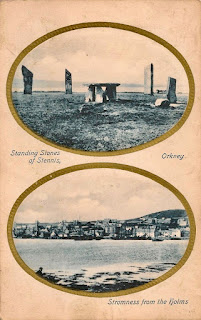
This double-view postcard of scenes from Orkney was issued by J. M. Stevenson, a longtime stationer in Kirkwall and Stromness. It also bears the initials of V. & S. Ltd., that is, Valentine & Sons of Dundee, the actual printer. There's no writing on the back of the card, but I'm guessing that it dates from around 1910. "The Holms" are two small islets just across the water from Stromness.
The central "altar" or "dolmen" shown in the view of the neolithic Standing Stones of Stennis (or Stenness) was a "reconstruction" from 1907, possibly inspired by Sir Walter Scott's interpretation of the site. It was dismantled under murky circumstances in 1972 and only the uprights were put back in place. A century earlier a landowner had vandalized the site extensively, resulting in the loss of much of the surrounding circle of stones.
Despite its barren northern location, Orkney has some of the most extraordinary neolithic monuments in Britain. I haven't been there (my wife and daughter have), but perhaps someday I will make a visit.
Showing posts with label Postcards. Show all posts
Saturday, February 19, 2022
Thursday, August 01, 2019
The Folks Back Home
It's very difficult, at least for me, to make out the long inscription on this Real Photo postcard, but the language is apparently German, and it may be from Switzerland. It shows three women, two men, a boy holding a gun, and a dog, posing in a group in front of a vine-covered cottage. There's a flourishing garden in the foreground, possibly including poppies, and a whole social history in the hats the figures wear, no two of which are alike.
The very few bits I can make out in the inscription on the reverse of the card include the names Meinhof and Dietrich and a reference to an address of (I think) Kapellenstr[asse] 31, which might be in Bern or Basel. The most intriguing is a reference to America, including the name of the state of Kansas in parentheses. Perhaps some of the family members were now living in the New World.
Just a few scratch-marks in ink now, but they were presumably perfectly legible to the recipients, whoever they may have been.
Postscript: When I came up with a title for this post perhaps I had in mind these lyrics by Peter Blegvad:
I sent a card to the folks back home
a picture of a burning aerodrome
it came back stamped: address unknown
I was alone
in the meantime
Friday, August 12, 2016
María
This postcard portrait of a woman who signed only her first name was addressed to one Señora Doña Leonora de Esteban in Castro Urdiales in northern Spain. There's no date or trace of a stamp or postmark; the elegantly-penned inscription reads "To demonstrate once again the love that your friend professes for you, she dedicates to you this little memento." María was clearly not only well educated but possibly (if the desk is any indication) an educator. She wears heavy, dark clothing with an elaborate embroidered motif. I imagine her as unmarried, part of a nascent class of independent female professionals, writing to a former colleague who had married and moved away, but that's basically nothing but speculation. I'm not sure if this portrait was taken in a studio or (more likely) on location, but the use of the window to open up the background is an effective touch.
Rafael A. Idelmón, a native of Madrid, opened a photographic studio in Valladolid in January 1860 and another in Palencia four years later; his descendants were reportedly still in business at least until 1927, and a living descendant named Enrique del Rivero Cuesta is active as a professional photographer, continuing a family association with the camera lasting more than a century and a half. The portrait of María is presumably from the first decades of the twentieth century, and may be the work of one of Rafael's sons or an employee of the firm. I'm not sure what the initials G.I.F.A.G. stand for, though I'm guessing that they indicate membership in a gremio or trade association.
Labels:
Postcards,
Real Photo,
Spain
Sunday, March 22, 2015
Re-envisioning Japan
This merits a look: Re-envisioning Japan: Japan as Destination in 20th-Century Visual and Material Culture, a new "interactive archive and research project" created by Joanne Bernardi, associate professor at the University of Rochester, is now online. From a quick glance it looks like there's plenty of good stuff there, including a section devoted to the Japan Tourist Library, about which I've blogged previously. Lots of postcards too.
Monday, March 02, 2015
On the town
Two men with lit cigars and a third man, seated, whose own smoke is still tucked in his pocket. Though the postcard was never addressed or mailed and the location is unknown, we may be looking at the interior of a nickelodeon or amusement parlor; an advertising sign behind the men, difficult to make out, may read "Isis Moving Pictures" or "Isis Motion Pictures," and the stirrups of what could possibly be a coin-operated horse appear at left. There were establishments bearing the Isis name in various cities. Or maybe we're looking at something else entirely.
"Jack Begley" is probably too common a name to assign to any identifiable individual; "Bedsoe" is a bit more unusual. But like the man in the dark suit, they've had their time.
Velox Real Photo postcard, c.1907-1914.
Labels:
Postcards,
Real Photo
Friday, February 13, 2015
Kansas
"Just a few of our crowd and guess you will know the majority of them. If not will tell you of them later." Mailed from Salina, Kansas to nearby Culver in either 1906 or 1908. The recipient was a Miss Blanche Caldwell.
"Made by Frank E. Mohler McPherson Kans." The Mohler family name was common among the members of the Church of the Brethren, a pietist (and historically pacifist) sect with roots in Schwarzenau, Germany. The individuals in this photo may have been associated with McPherson College, a Brethren-founded institution.
The fact that Frank E. Mohler had his name and address pre-printed on the back of the card suggests that he may have been a professional photographer, at least briefly. His identity is complicated somewhat by the fact that various records mention a Frank Ellis Mohler and a Frank Martin Mohler, both of whom had ties to religious institutions and to Kansas. Frank Martin Mohler, who seems to have been the elder of the two by a few years, attended Washburn College in Topeka and later went to Oxford as a Rhodes Scholar, before serving for a number of years as a Y.M.C.A. missionary in China. The less distinguished Frank E. Mohler was a teacher in McPherson during World War I, but then seems to have headed west; a man by that name is recorded as having sold water heaters in San Diego around 1930, having operated a bookstore there in the later 1940s, and having died in 1960.
The image above, taken by the Garver studio in Dodge City, Kansas, shows the Prough family. The Artura stock on which it was printed was manufactured from 1908-1924. There are various records of that family name in Dodge City during those years, but I haven't been able to identify the family more specifically.
All three of these photographs were printed as Real Photo postcards.
Labels:
Kansas,
Photography,
Postcards,
Real Photo
Friday, July 26, 2013
Three portraits
Three more Real Photo postcards, possibly from western Pennsylvania. The one above has the following inscription on the reverse of the card:
Mother Moser [or possibly "Moses"]This conceivably could be the Mariah Knotts who was born in 1836 and died in Franklin, Pennsylvania in 1915. The Cyko cardstock on which the image is printed was manufactured from 1904 into the 1920s. The other two cards, which bear no inscriptions, are on Azo stock that is roughly contemporary.
Mother's Sister
Mariah Knotts
& Son & his child
Labels:
Photography,
Postcards,
Real Photo
Saturday, July 20, 2013
Scenes of Rural Life
The images on this page reproduce part of a group of Real Photo postcards that may have originated in western Pennsylvania. The one above is probably the oldest; it's printed on postcard stock, in this case sold by an unknown manufacturer, that became obsolete around 1907, when postal regulations were updated to permit including a message, in addition to the mailing address, on the reverse of the card. The wall behind the adolescent boy has been decorated with a variety of posters and advertisements, though it's difficult to read the lettering because of the angle and the exposure. Even so, the central image of the boy and his horse is nicely composed.
The remainder are later, printed on Azo postcard stock manufactured from 1918-1930, and may be the work of a single photographer, one who developed his own images but hadn't quite mastered the printing process. In the first, an oval frame was employed, but only on the right side. Note the rungs on the tree to enable climbing. The name "Harold Bixler" is written on the back.
The image below, of a woman holding a cat, is even more askew (these scans are aligned with the axes of the cardstock, not of the print).
In the composite below, I have juxtaposed the two cards to show how the ragged edge and the dark background on the left side apparently align. If I'm correct, the two prints must have been made at the same time.
The awkwardly exposed image below may also belong with the previous two; if rotated 90° to the left, it also is a possible candidate for aligning with the top of the print of the woman with the cat.
The dark backgrounds framing these three prints appear to be previously exposed film. I don't really understand the developing technique involved here, but it's clear the photographer was improvising, probably with minimal training and rudimentary equipment. That would make sense given the general poverty and isolation of the scenes, but it says something that he or she was driven, even under less than optimal conditions, to preserve a little bit of the surrounding world.
None of these postcards were ever addressed or mailed.
Sunday, March 17, 2013
Views of Bohemia
These two postcards were mailed five years apart, the first to an address in Kutná Hora (or Kuttenberg) in Bohemia and the second from Kutná Hora to Cleveland, Ohio. Both recipients were named Čermák, and if the abbreviated first name on the first card is Antonín, as I suspect, then the two cards were either mailed to the same person or to two (probably related) people of the same name.
Čermák seems to be a fairly common family name, but during the period these cards were mailed a prominent violin maker named Josef Antonín Čermák was active in Kutná Hora, and the later card appears to be signed either Jusef or Josef. Coincidentally or not, one of the violin maker's students, Jan Baptista Vavra, was active in Smichov in Prague, which was where the first card was postmarked. The signature on the front of the card, however, is definitely not that of Vavra.
The printed message at the top of the first card reads Podrav ze Smíchova! -- "Greetings from Smichov!" It was issued by F. J. Jedlička, a well-known publisher of postcards in Prague. There's a somewhat uncanny quality about the left side of the image, which shows a couple walking together along a deserted street that hardly seems to belong with the view of the Vltava to the right. The view of Kutná Hora was published by one Josef Zajíc.
I can't read Czech and can't transcribe the handwriting on the later card, so for now that's about as much as I can say.
Sunday, March 10, 2013
The platform
Three women in elaborate hats, two men in railway uniforms, a third man — and a very large dog. Real Photo postcard, location unidentified but evidently rural; printed on a variety of Azo photographic paper reportedly manufactured between 1904-1918. There's no inscription or address on the back.
Sunday, March 03, 2013
Sapporo to Boston
Dear Dr. Wight,
How have you been since I left M. G. H.? I have arrived at Yokohama at the beginning of last June and I am now with all my family having happy time. Since I returned to Japan, I have been so busy that I could not write you. I am always thinking of you and others in White 4 Lab. How pleasant my life in M. G. H. was! I am dreaming to come over there once again in future. I do hope you work hard and in future in best health. Please remember me to all members in White 4 Lab.
With all best wishes to you.
Your friend
Terry.
The sender, Dr. Teruyoshi Hashiba, was a fellow in the neurosurgery department at Massachusetts General Hospital in 1953-1954; from the stamps and partially legible postmark it appears that the postcard was probably mailed in 1954. The recipient may have been Dr. Anne Wight (later Anne Wight Phillips), said to be the first woman to perform surgery at Massachusetts General. Coincidentally, the head of the hospital's neurosurgical service at the time, a man who Dr. Hashiba must also have known, was named White (Dr. James C. White), but it seems unlikely that Dr. Hashiba, who demonstrates a meticulous if slightly unidiomatic command of English, would have confused the names. (The building that housed "White Lab 4" was probably the George R. White Memorial Building, completed in 1939 and named after yet another White, the onetime president of the Potter Drug and Chemical Corporation.)
After he returned to Japan, Dr. Hashiba authored a number of papers in the field of neurology. According to the Department of Neurosurgery at Sapporo Medical University he died on February 2, 1982. Dr. Anne Wight Phillips died in 2009.
Labels:
Japan,
Migrations,
Postcards
Saturday, February 16, 2013
The exchange
This postcard of Stockholm was mailed from that city in 1903 by one Annie Sundberg and addressed to Mademoiselle Candelaria Benítez Inglott of Las Palmas in the Canary Islands. My first assumption, due in part to the vaguely Nordic sound of "Inglott," was that the two women (or more likely adolescents) were either cousins or schoolmates, though precisely how the Spanish-Swedish connection would have come about was a mystery. On further reflection and with a bit of research, however, it now seems likely that they had never met nor even corresponded before Annie sent this card.
The tip-off is the brief message on the front: "Acceptez-vous l'échange" — "Do you accept the exchange?" Knowing no Spanish, and suspecting that the recipient in her turn would know no Swedish, Annie Sundberg posed the question in French, the one language that two educated women at the beginning of the 20th century might have been expected to have in common. Note too, that in writing to a complete stranger she uses the formal "vous."
As to the nature of "l'échange," it almost certainly alludes to the early 20th-entury craze for sending and collecting postcards, the more exotic the better. How Annie Sundberg obtained Candelaria's name is unknown; it could have been through a mutual contact, but it's also possible that Candelaria had advertised publicly for correspondents, a practice which was not uncommon.
Thus far I haven't been able to identify Candelaria Benítez Inglott, but she was almost certainly at least a distant relation of the same prominent Canary Islands family that produced Wenceslao Benítez Inglott (1879-1955), a scientist and admiral in the Spanish navy; Miguel Benítez Inglott (1890-1965), a lawyer, composer, and friend of Federico García Lorca; and Luis Benítez Inglott (1895-1966), a poet, journalist, and translator of Shakespeare. The far-flung Inglott line, which appears to be ultimately of English origin but was long established in Malta, probably came to the Canaries as part of a significant wave of Maltese immigration during the latter half of the eighteenth century.

The word written in on the top of the reverse appears to be "trycksak": printed matter. The street address in Las Palmas, which Annie Sundberg may not have had correctly, may be "López Botas, 9"; if so, that address is now a nursing home run by the Hermanos de la Cruz Blanca.
Recent photographs of the Strömgatan show an almost unchanged view, except for the addition of another bridge.
Labels:
Postcards
Saturday, July 21, 2012
Blick auf die Unterstadt

This postcard "view of the lower town" of Eupen, Belgium, was printed by Kunstverlag Ferdinand Schweitzer in Aachen, across the German border, probably between 1935 and 1940.
Once part of the Duchy of Limbourg, Eupen was incorporated successively within France, Prussia, and the German empire. Transferred to Belgium by the Treaty of Versailles, it became a hotbed of pro-German and pro-Nazi sentiment between the world wars, and was annexed to the Third Reich in 1940. Having survived fierce fighting during the Battle of the Bulge and the loss of a substantial portion of its male population to conscription into the German Army, the town was once again returned to Belgium at the end of the war.
"Luftkurort," in the lower margin, is, according to Wikipedia, "a title given to towns or cities ... which are health resorts which have a climate and air quality which is considered beneficial to health and rest."
Below, from st.vith.com, is an advertising label produced by the Schweitzer company.
Labels:
Postcards
Saturday, May 12, 2012
Group Portrait on a Hillside

The first few times I looked at this Real Photo postcard, without benefit of magnification, I succumbed to an optical illusion so strong that I still struggle with it even after multiple viewings and close inspection. In the middle distance, running horizontally across some two-thirds of the image, I saw what was apparently a body of water, with a white line of sand at the base of the hills in the background, and two small white sailboats, one at the far left and the other just below the man's left hand... except that none of it is real. The shoreline is in fact the apex of what appears to be a single long roof, the "sails" are architectural features of that roof, and there is no "middle distance," as the building — whatever it is — blocks out what lies behind it. There may be a river on the valley floor, but if so we can't see it.
That illusion, and the fact that we are so high up relative to the long building that nearly all we can see of it is its roofline, is only one of the unusual elements of this photo; note also that the photographer appears to have shot from a very low angle, right down in the weeds, probably in order to get the hills in the distance in the same frame. There's an incredible amount of detail in the background, much of which emerges only when the image is blown up: houses, outbuildings, smoke rising from a chimney, railway trestles.
On the right side of the close-up below, just to the left of the sharply sloping filigreed roof of another building, is a dark vertical object that may be a pipe or some kind of cast-iron structure, and running across its base are two faint parallel lines that may be telegraph wires.
Even further to the right, and completely invisible to the naked eye without magnification (at least, invisible to my naked eye), is one more ghostly, chimneyed building, so faint it almost blends into the distant hills:
In the center of the frame we see three women and one man, probably the husband of the woman whose hand he barely touches. Someone's straw boater has been set down among the tall weeds at their feet. If you look back to the full image you can see that there's a well-worn path directly behind them, visible on the left side.
The card, which was printed on a variety of Velox photographic paper manufactured from 1903-04, bears no postmark, mailing address, or other clues to the identity of the subjects or the location; the topography should be identifiable but is unfamiliar to me. The hills in the background are mostly barren, as if they had been clear-cut recently, and the houses look like new construction. I'm guessing that we're looking at a boom town, perhaps in a mining area. (Manitou Springs, Colorado has been suggested.)
Labels:
Photography,
Postcards,
Real Photo
Saturday, April 07, 2012
Two group portraits

These two Azo Real Photo postcards date from roughly the same period (c. 1904-1918) and may or may not have any connection with each other. Only the first, which has "Mary Ertwine Bloomsburg Pa" penciled on the back, has any kind of identification. Because of the mix of ages of the women, and the informal attire of the two kneeling men, I suspect that we're looking at a group of fellow employees rather than, for instance, students at Bloomsburg's Normal School, and the four women in the rear are standing on what is probably the end of a loading dock. Some of the women pictured appear quite cheerful, although the one at far left, clutching what may be a folded outer garment, seems lost in thought and, like one or two of the others, isn't looking in the direction of the camera at all. Overall it looks like the work of a professional photographer, though there are no marks on the back to prove that. There are two six-pointed stars on either side of the central platform, and the arm closest to the door of each star has been truncated.

The second photo shows what is probably a school group, mixed in age with the girls on the left and the boys on the right. The foreground is unpaved and stony and the kids don't look particularly well-off, although one of the boys on the far right is wearing a necktie, as if his parents had dressed him up for the day knowing that this picture would be taken. Some can be assumed to be siblings based on their proximity and matching dress. Hardly anyone is showing anything that could be taken for a smile, and the male teacher (if that's what he is) is staring off into the distance. You can see through the window into the interior of the building but it's hard to make out what's inside.
Labels:
Photography,
Postcards,
Real Photo
Thursday, March 15, 2012
Secrets

This postcard of the Connecticut River at Greenfield, Massachusetts was postmarked in nearby Turners Falls on January 29, 1909 and sent to a Miss Ruth L. Smith at the Northfield Seminary in East Northfield a few miles away. Founded by the noted evangelist Dwight Lyman Moody in 1879, Northfield was an all-girls school, religious in orientation, though it doesn't appear to have been intended to train clergy in the way that the word "seminary" is usually understood. Moody also founded a school for boys not far away and the two eventually merged. The combined institution still exists but the former Northfield Seminary campus is currently unoccupied.
The inscription on the front is an example of a Masonic or "pigpen" cypher, in which the symbols are obtained by the use of two pairs of grids, one dotted and the other undotted. In the example below, for instance, which is taken from Wikipedia, the letter A would be represented by something like a backwards letter L, while the sign for the letter Z would resemble an upside-down V with a dot in the center.

The above assumes that one begins the grid with the letter "A" and continues in an orderly progression, but there's no reason why one need stick to that arrangement; you could assign the letters randomly as long as both sender and recipient know the key. Even then, in principle the cipher should be readily crackable by the same techniques used to solve newspaper cryptograms, at least if one is sure which language is being represented and that there are no additional levels of trickery involved. So far, however, I haven't managed to decipher this one.
At first glance it shouldn't be difficult to solve. There are some one- and two-letter words, a sequence of repeated words, and some double letters, all of which should be helpful, but there are also some puzzling features. Of the first 20 characters in the inscription, only two appear more than once, as if the writer had deliberately chosen words that contained as many different letters as possible. There are several signs that incorporate a tiny "x" instead of a dot, and I don't know whether or not they should be regarded as distinct letters.
Feel free to take a crack at it and let me know if you come up with anything. In he meantime, below is a roughly contemporary view, complete with piano or portable organ, of another Moody-founded institution, Camp Northfield, which also still exists.

The card was addressed to Gillio Cassari of North Haven, Connecticut, and signed by Coriena [Cassari], both of whom, if my identifications are correct, were born in the 1890s. Gillio died in 1975; Coriena in North Haven in 1985 at the age of 94.
Labels:
Enigmas,
Missionaries,
Postcards
Thursday, March 01, 2012
Untitled (Woman with dog)

We seem to have an innate need to tell stories, even when the raw material is lacking. I suppose that it's part of our way of making sense of the world, of explaining why it's the way it is and not some other way that might have been equally conceivable if things had been just a little different, or maybe it's simply how we try to reassure ourselves that our existence isn't utterly meaningless, that there's a narrative to it all, improbable as that seems. In other words, whistling in the dark.
This Real Photo postcard bears no inscription and was never mailed; about all that can be said in the way of external evidence is that the style of Azo photographic paper it was printed on was manufactured between 1904 and 1918. The location must have been far enough north to require a heavy (if seemingly threadbare) coat in the winter. I don't know enough about the history of women's fashion, or about the woodworking we see in the background, to know whether there's more here that could be gleaned by someone with a trained eye.
We start inventing, imagining. Because of her skin color and maybe her bonnet we think that she might have been a domestic servant, that she had just pulled on her coat a moment before and stepped out on the porch so that the photographer -- a friend? a family member? her employer? -- could capture her likeness. The woman faces the lens of the camera head on, but the dog's eyes are intent on something just to the side, so maybe there's a child or another dog running in the yard or across the street, leaving only the most indirect of traces as it passes. But the truth is that what we deduce, and what we can try to guess, will always be less than what we can't know, beginning with her name, her background, her character, her fate, and everything else that really matters.
So I think we should resist the temptation and leave her as she is, posed for the flick of a shutter that will preserve what may be -- but how can we know? -- the only memory of her that still survives, one fleeting, indelible moment of tenderness.
Sunday, January 22, 2012
The Rotograph Project

I have spun off a separate blog, The Rotograph Project, to serve as a virtual gallery for the display and interpretation of the American view postcards created c.1904-1911 by the Rotograph Co. of New York. This new arrangement should give those images more room of their own without unduly monopolizing the webspace here.
Friday, January 13, 2012
The truth

This photographic postcard, most likely created between 1907-1914, depicts a family group against the backdrop of a snowy field. The identities of the subjects and the photographer are unknown, and there's no inscription or address on the reverse. The only external information is the mark of photographic paper (Velox) and the existence of another image, not in my possession but evidently taken on the same day, that shows only the man, the boy, and the woman on the far right, and thus perhaps can be taken as an indication of which of these figures are the boy's parents.
So in this picture we see four women, one man, a boy -- and a cat. But of course one more person is present, the photographer, who may have been a professional but more likely was another member of the family, an amateur shutterbug. His or her possible role in the family, even though it can't be determined, shouldn't be overlooked.
I'm not an expert on period clothing nor am I particularly good at reading family relationships from facial features, and in the end there's only so much information to be gleaned from a photograph like this. Still, there are a number of curious things here that leap out, things that, without telling us anything more for certain about these people and what they were like, at least open up some suggestive possibilities.
Let's start with the background. It's a barren, snow-covered field, at least part of which is hilly, and there's a line of trees, perhaps other hills, in the far distance. There is a pole on the left that at first sight looks like a utility pole, but it's too short and the apparent crosspiece at the top seems to be an illusion caused by a horizontal line of brush behind it. There's at least one other vertical structure some distance back, but I suspect it's just a small tree. If the field is barren in winter it may be pastureland; there's no sign of stubble left over from a summer harvest.
The woman on the right is clutching a small potted evergreen with one hand, almost as if it had been set there temporarily and might fall over if she didn't support it. At least one and more likely two similar trees are partially hidden by the human figures. It seems a curious way to pose, but maybe the bucolic effect of the greenery was deliberately sought. It's also possible that the evergreen on the right is a Christmas tree. Perhaps the image was taken to be used as a Christmas greeting, though since it's a photographic print and not a lithographic reproduction there's no certainty that this is not the only copy ever made. The dark diagonal shadow at the bottom of the picture may be a developing flaw -- or it may just be a shadow.
The formidable-looking old woman at center, the only seated figure, may be a widow; in any case she seems to be the unquestioned center of authority in the family. She wears an elaborate lace collar, perhaps of her own making. The woman in the dark dress immediately behind her -- her daughter or granddaughter? -- peers at the photographer with a look that could be called anxious or just curious; in either case she seems to be accustomed to a subordinate role. The woman on the far left might be a family member (she bears some resemblance to the seated woman), but she could also be a domestic. She wears an apron, one of her eyes behind her spectacles doesn't look quite right, and the awkwardly downturned corners of her mouth might be an indication of Bell's palsy.
The man, who is quite far back in the group, appears to be a bit of a dandy, at least for out in the country. He's wearing a lively cap and a bow-tie and clearly hasn't been laboring with his hands today. He may work in an office in town or perhaps has simply dressed up for the occasion. His son, obscured except for his face, appears to be about five years old. Off to the right, with the barest hint of a smile and a distinctly independent bearing, is the boy's mother.
Finally, there is the cat. From his body language he is evidently feeling the cold. No one else appears to have noticed his presence (though the photographer no doubt sees him) and he seems to have crept into the margins of the group with the deliberate intention of being included in the shot.
I'm not sure that there's anything terribly profound to be learned from this particular photograph. If you looked at thousands, or tens of thousands of similar images from the same period (many millions exist) then you could, if you wanted, make interesting deductions about how people lived and thought about themselves, and perhaps reach conclusions that would tell you things you didn't already know about the broader social and economic currents of the period, but that's not my intent, at least here. My interest instead is epistemological, perhaps even metaphysical. This photo is an indication that the people in this image once existed, it's potentially evidence for who they were and how they existed, but in the end it's also a reminder that, whatever conclusions we may reach about them, the truth will always be something quite different, something forever out of reach, something that in one fleeting instant on a snowy hillside left an indelible, inscrutable trace.
Saturday, December 31, 2011
The Lost Tower

This postcard of the Brooklyn Bridge and the adjacent waterfront, published by the Rotograph Co., was postmarked in 1905. Offering a view of the bridge at a time before automobile traffic had begun to transform the city, and of the rough-and-tumble district that, considerably scrubbed-up, is now anchored by the South Street Seaport, it's interesting for a number of reasons, but there's one particular detail that leaps out, and that's the curious structure on the far right that appears to be some sort of obelisk or monument, and which hardly seems to belong in the picture at all.
A bit of research soon revealed that the tower was not a ceremonial structure or an observatory for turn-of-the-century sightseers but, in fact, an industrial building constructed to serve a very specific purpose. It was one of two cast-iron "shot towers" designed by the 19th-century architect James Bogardus for use in the manufacture of lead shot. From a vat near the summit of the building, molten metal would be poured through a sieve; as the droplets fell from the heights they would be shaped by surface tension into tiny spheres, which would then harden when they fell into a tank of water at the bottom. This particular tower, which stood at 82 Beekman Street and rose some 215 feet high, was built for Tatham & Brothers around 1856; its construction followed by a year or so that of a similar but shorter structure which Bogardus had built further uptown for the McCullough Shot and Lead Co.
A pioneer of cast-iron construction, which relied on prefabricated elements that could be strikingly ornate, James Bogardus designed a number of important commercial buildings in Manhattan and elsewhere, but only a handful are still standing, including buildings at 75 Murray Street, 63 Nassau Street, and 254 Canal Street. A plaque at City Hall memorializes the McCullough Tower, and in TriBeCa a street sign officially designates James Bogardus Triangle.
The New York Times reported, in 1892, that the formerly dull red Tatham Tower had recently been repainted a yellow so vivid that "you can hardly see anything else as you look off toward the river." The color shown in the Rotograph postcard is not reliable, as it has been layered onto an image taken from a black-and-white original. Over the years the building suffered at least two serious fires, which were reported in the Times on February 8, 1895 and June 28, 1899. The image below depicts the earlier incident, which resulted in one death. Both shot towers were demolished in 1907.

The definitive volume on James Bogardus is Cast-Iron America: The Significance of James Bogardus, by Margot and Carol Gayle.
Labels:
Architecture,
New York,
Postcards
Subscribe to:
Comments (Atom)