Sometimes Valène dreamt of cataclysms and tempests, of whirlwinds that would carry the whole house off like a wisp of straw and display the infinite marvels of the solar system to its shipwrecked inhabitants; or that an unseen crack would run through the building from top to bottom, like a shiver, and with a long, deep, snapping sound it would open in two and be slowly swallowed up in an indescribable yawning chasm; then hordes would overrun it, bleary-eyed monsters, giant insects with steel mandibles, blind termites, great white worms with insatiable mouths: the wood would crumble, the stone would turn to sand, the cupboards would collapse under their own weight, all would return to dust.
Life A User's Manual (translation by David Bellos)
Thursday, July 21, 2022
Demolition
Georges Perec:


Friday, July 08, 2022
Fugitive lyrics
In 1975 I took a course taught by a folklorist who had a parallel career as the producer of a number of commercial recordings of folk music. Though the course was aimed at grad students and I was only a sophomore, I was allowed to enroll, which probably wasn't such a great decision all around as it turned out, but the semester did at least leave a few lasting impressions. In particular, I recall two songs he played us in class that came from recordings he had made in the course of field work in the UK. I still remember parts of them almost verbatim (no doubt because they were off-color), and since I can't find any trace of the exact lyrics (though they must be documented somewhere), I present them here.
The first was a version of the notorious comic song known as "Seven Nights Drunk" or "Our Goodman." The premise of the song is that the singer, a habitual drunkard, is being cuckolded by his wife. When he presents her with the evidence of this, which is increasingly unmistakeable as the song progresses, she blames it on his drunken befuddlement and comes up with one far-fetched explanation after another to account for what he thinks he sees. A typical first verse goes as follows:
As I went home on Monday night as drunk as drunk could beThe lyrics go downhill from there, depending on the version, but the final one below is typical:
I saw a horse outside the door, where my old horse should be
So I called me wife, the curse of me life, will you kindly tell to me
Who owns that horse outside the door where my old horse should be.
Ay you're drunk, you're drunk you silly old fool
As drunk as drunk can be
That's a lovely sow that me mother sent to me
Well it's many a day I've travelled, a hundred miles or more
But a saddle on a sow, sure I never saw before.
As I went home on Sunday night as drunk as drunk could beThe last verse I remember was similar, but instead of a tin whistle it's "a rubber tree" or "a rubber tree plant," and the last line (which I've probably Americanized) was "But a rubber tree plant with hair at the roots I never done seen before."
I saw a thing in her thing where my old thing should be
Well, I called me wife and I said to her: Will you kindly tell to me
Who owns that thing in your thing where my old thing should be
Ah, you're drunk,
you're drunk you silly old fool,
still you can not see
That's a lovely tin whistle that me mother sent to me
Well, it's many a day I've travelled a hundred miles or more
But hair on a tin whistle sure I never saw before
I haven't been able to identify the other song, which was sung by two British sisters who weren't professional performers. With the tape recorder running the song had a refrain of "Just you remember when you're kissing your man / he's trying to get another kiss from you as soon as he can!" Only when the machine was turned off would they agree to sing the saltier version, which ran "Just you remember when you're kissing your man / he's trying to get another rattle out of your tin can!"
Looking back now, I wonder how much my memory has distorted the details. (Did I, perhaps, borrow the "rubber tree plant" from "High Hopes"?) But in a way that distortion is the whole point: that's how oral tradition twists and preserves material from one generation to the next.
Monday, July 04, 2022
Ambition (III)
Georges Perec:
She’d have done better to sell up and go back to the farm where she’d been born. Rabbits and chickens, some tomato plants, and a couple of beds for lettuces and cabbages -- what more did she need? She would have sat by her fireside amongst her placid cats, listening to the clock ticking, to the rain falling on the zinc drainpipes, and the seven-o’clock bus passing by in the far distance; she’d have carried on warming her bed with a warming pan before getting into it, warming her face in the sun on her stone bench, cutting recipes out of La Nouvelle République and sticking them into her big kitchen book.The woman in question, Madame Moreau, is the sole proprietor of a prosperous hardware manufacturing business employing 2,000 people.
Life A User's Manual, translated by David Bellos
Monday, June 27, 2022
Articles of Faith
Things as I see them.
There is no God.
There is no Heaven, no Hell, no Devil. There are no angels or demons or ghosts. There are no miracles.
There is no afterlife, no reincarnation. Whatever the "soul" can be said to be, it dissipates when the body dies.
There was no Original Sin, no Fall, and thus nothing to redeem. There was no Incarnation. Whatever the truth about his sayings and doings, Jesus was an ordinary human being. His mother was not "conceived without sin" any more or less than everyone else, nor was he the product of "virgin birth." He did not "die for our sins," he was not resurrected, nor will he return.
The universe is not concerned with our existence. In fact, even to say that it is "indifferent" is to engage in indefensible metaphysics. The universe is not capable of having an attitude towards our existence or its own. It simply exists. Why and how there is something instead of nothing is a question that neither theologian nor scientist is capable of illuminating.
Morality and ontology have nothing to do with each other. A godless universe is no more or less moral than a universe with a god in it. I once heard an Episcopalian priest, in the aftermath of one human-produced atrocity or another, say that if he thought for one moment that what had happened was God's punishment for our sins, he would put aside his priestly garments and walk out of the church forever. And so, in his place, would I.
The only true "sin" is cruelty, and the most fundamental virtue is compassion. There are more virtues than sins, because all sins ultimately come down to the same thing.
Religious institutions and religious leaders are susceptible of the same virtues and failings as everyone else. Many do good work, but many are corrupt and hypocritical. Much of the cruelty in the world is the outcome of religious belief, but much is not.
If religion gets you through the night, keeps you off the sauce, and maybe makes you a slightly kinder person, then more power to you, but if it serves as a cover for hatred and oppression, you'll get no respect from me.
Friday, June 17, 2022
Effingers (Coming Attractions)
One to watch out for: a promised English-language translation of Gabriele Tergit's family saga Effingers, which was originally published in Germany in 1951 but only recently "rediscovered" and reissued there to general acclaim. Robert Normen has a description on the website of The German Times:
In the best way, this epic 900-page novel resembles another historic family saga: Thomas Mann’s Buddenbrooks. Mann’s story of four generations runs from 1835 to 1877. It may be no coincidence that Tergit’s book begins the very next year. Effingers is set against the backdrop of a changing German society steeped in the comforts of Bismarckian Prussia. Modernization and an economic boom bring affluence and changing norms, which are reflected in the contrasts between the city of Berlin and Karl’s and Paul’s small hometown in southern Germany. After World War I, anti-Semitic sentiment slowly but surely takes hold and the Effinger family must reluctantly learn that they are not the German clan they aspired to be.NYRB Books has previously published a translation by Sophie Duvernoy of Tergit's earlier novel Käsebier Takes Berlin, and they have signed Duvernoy up for Effingers as well, though apparently no date has been announced. In the meantime, a snazzy-looking Spanish-language version has just been issued by Libros del Asteroide in Barcelona.

Friday, June 03, 2022
Cardboard Box of Batteries
The death of Kelly Joe Phelps on May 31st got me thinking about my favorite Kelly Joe song, so I've dug out and updated some notes I made back in 2005. First, here are the lyrics, based on the liner notes for Tap the Red Cane Whirlwind, with a few minor changes to punctuation.
make a dent in the shovelIt doesn't quite "tell a story," but as a mood piece or character sketch it's about as precise as you can get. Memories, regrets, hopes — they're "all in the bag with the coins" (to quote another KJP song). I've highlighted everything that refers to prospecting, money, metal; it's a vein (so to speak) that runs through the whole thing. Some of the imagery is homely and eccentric — has anyone else used the word “tetherball” in a pop song? — other bits (“a pretty girl as a pretty nun”) just raise questions.
run the mud through a sieve
paste your hopes on a windmill blade
and plant 'em up on the hill.
a pencil sharpened with a putty knife
a pretty girl as a pretty nun
maybe you wake and think this is great
i just want somewhere to run.
oh, the walls blend into ceilings, and the faces they disappear.
never enough time to think it out only time to forget i'm here.
oh, and the bill is on the table but i've got no coins for pay
a beer half circle around her name, and what the hell did she say?
ah, the wise are playing tetherball and the ball's eyes they look like mine
rollin' around all on the end of the cord i can't make up for down
oh, i'm a streamlined engine with a cog chipped out of the wheel
i remember a dirty joke or two but i can't remember the feel.
i remember a dirty joke or two but i can't remember the feel.
too much time alone i spend, a miser with a nickel worn
starving like a mother, well, but i can't let go.
i'll spit the hours across the room and I'll kick 'em out that door
hell, you can have them. another thing i've got no use for.
well and it's funny that this comes out dark, it is not that bad
Oh, there's still a sparkle of silver in my cavity that plays music in the winter
i've a cardboard box of batteries hidden in a tire swing
a miner's hat with a light on top and a handful of wedding rings.
a miner's hat with a light on top and a handful of wedding rings.
a miner's hat with a light on top and a handful of wedding rings.
It's a melancholy picture, but there's that little "sparkle" at the end. The looseness in the fit between the lyrics and the tune adds something when Kelly Joe sings it, making it seem more spontaneous and conversational. And then there's the acoustic guitar, which after the intro mostly stays in the background but then bursts into extravagant arabesques at the end of some of the lines.
Kelly Joe was clearly a complicated guy, both personally and musically. He had a jazz background that shows in his playing, but his well-received first record, Lead Me On, was a collection of acoustic blues covers featuring slide guitar. He could probably have stuck to that indefinitely and made a career out of it and session work, but instead he repeatedly reinvented himself, abandoning the slide for fingerpicking (and occasionally, banjo) and becoming a gifted if sometimes frustratingly cryptic songwriter. In what turned out to be his final record, Brother Sinner & the Whale, he created a kind of unassuming Old Testament gospel music (if that's not a theological contradiction).
About ten years ago Kelly Joe said he needed a break and stopped touring and recording. At the time there was some mention of ulnar neuropathy, but as the years went on it was clear that something else was going on. His fans waited to see what new iteration of Kelly Joe Phelps might eventually emerge from the ferment, but for whatever reason it never happened. Maybe we'll know more in time, but maybe Kelly Joe just preferred his privacy.
Thursday, June 02, 2022
Kelly Joe Phelps 1959-2022
And it's funny that this comes out dark, it's not that badWord is that Kelly Joe Phelps died on Tuesday. The Guardian has an obit. A fine guitarist and singer — and eventually, songwriter as well — whose career encompassed jazz, blues, original songs, and gospel, he took a break from the music business about a decade ago and sadly never came back. Few details are available at this point.
There's still a sparkle of silver in my cavity that plays music in the winter
I've got a cardboard box of batteries hidden in a tire swing
A miners hat with a light on top and a handful of wedding rings.
Maybe I'll have more to say when this has sunk in for a bit. For now, here are two examples of Kelly Joe in happier days.
Saturday, May 28, 2022
Stepping up to the plate
Two forceful and anguished statements in the wake of yet another mass shooting indicate that the stereotypical image of the American professional baseball player is seriously out of date or simply wrong. First, Nationals pitcher Sean Doolittle:
It just feels like we’ve reached a point where if not now, when? We should have done something after Sandy Hook; we should have done something after Vegas; we should have done something after Pittsburgh; I mean, you can go down the list. We should have done something after Virginia Tech. How far back do you want to go? And then the conversation inevitably always changes to mental health or bulletproof backpacks. We’re talking about ballistic blankets. We’re talking about renovating schools so there is only one entrance and one exit. We’re talking about arming teachers.Perhaps even more remarkably, San Francisco Giants manager (and former player) Gabe Kapler, on why he won't be coming out of the dugout during the playing of the national anthem:
You’re describing a prison, and you’re bargaining and negotiating with people’s lives instead of just addressing the common denominator in every single one of these issues. It’s really frustrating, and I would like to think that in this country we’re capable of some common-sense reforms that a majority of Americans support that don’t infringe on your Second Amendment rights ... Who am I? I’m on the injured list. I’m a middle reliever on a team that unfortunately is in last place right now ... But we’re still members of societies and our communities, and there are people who look up to us as athletes, who listen to what we have to say as athletes.
And I think if you could start some of these conversations, or you can participate in some of these conversations and maybe get people to listen or put pressure on elected officials to do something, the reality is that you have a little bit more sway than the average person. And when it comes to making changes in your community, you can help move the needle on any number of issues that are important to you.
Source
I’m often struck before our games by the lack of delivery of the promise of what our national anthem represents ... We stand in honor of a country where we elect representatives to serve us, to thoughtfully consider and enact legislation that protects the interests of all the people in this country and to move this country forward towards the vision of the "shining city on the hill." But instead, we thoughtlessly link our moment of silence and grief with the equally thoughtless display of celebration for a country that refuses to take up the concept of controlling the sale of weapons used nearly exclusively for the mass slaughter of human beings.
We have our moment (over and over), and then we move on without demanding real change from the people we empower to make these changes. We stand, we bow our heads, and the people in power leave on recess, celebrating their own patriotism at every turn.
Source
Saturday, May 14, 2022
Turtle Diary


Thursday, May 12, 2022
Nobody's business

I'll state my bias: human beings don't procreate spiritually, we procreate as bodies. We are no different in this regard from other animals, and anyone who thinks differently has a lot of special pleading to do. There is, therefore, no more basic level of individual rights than that which pertains to the body and to reproduction. The recognition of those rights, in the face of determined opposition, has been one of the most important advances of modern society. It is, paradoxically, the defense of the fundamental dignity of the physical, of our nature as animals, that defines us as modern human beings.
To deny a woman the right to control her reproduction is as outrageous an affront to human dignity as can be imagined. We pride ourselves — rightly — on the declared principles of freedom of speech and the free exercise of religion, but what is more intrusive, forcing others to keep their thoughts and beliefs to themselves, or telling a woman that even her own body is not hers to control? Defenders of abortion rights often point out — rightly — that it would be unthinkable and cruel to force a rape victim to carry her rapist's child to term, but that argument, legitimate as it is, is ultimately superfluous. It is for women to decide under what circumstances they are willing to bear a child. And it's no one else's business.
Roe v. Wade established a reasoned balance, informed by medical science, between the interests of society and a woman's rights. That balance has been steadily undermined by legislation and previous court decisions, but the essential principle underlying it has been preserved — until now. There is little short-term prospect, given the nature and dire condition of or political system, that the overturning of Roe can itself be undone. The damage will be profound, both to women and to American democracy.
It has to be understood that those who would deny a women's right to decide when or whether to have a child, and who more generally reject the whole idea of a right to privacy, don't really believe that human beings have inherent, independent rights at all. They recognize only power and its privilege to compel those who are subject to it. The fact that the right to abortion has long been acknowledged and supported by a majority of Americans will count for little. I have no doubt that reversal will be robustly cheered in the states that will be lining up to enact restricive legislation and competing to see how extreme that legislation can be made.
This country has been morally problematic from its inception, but it's hard to see how it will survive in any real sense. Even before this decision, we have come as close to fascism as we have ever been, and the danger has in no way receded.
Thursday, May 05, 2022
Owl report

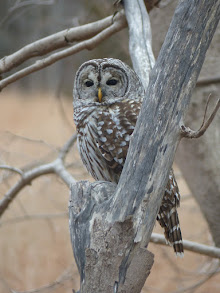
On my way out I thought I heard the same hissing sound but it was too faint for me to be sure; on the way back, though, there was no mistaking it. I walked off the trail a few yards in that direction until I located the owl high up in a very tall tulip poplar. I wasn't close enough to see it well, but since I didn't want to spook it I let my camera zoom in and do the looking. After a few minutes I moved to a slightly different angle, then started to walk away. A single distinct "hoot" from nearby stopped me in my tracks. I looked up: a large adult owl was perched, by itself, in another large tree about fifty yards from the first, keeping a wary eye on me. I took some pictures and headed home.
I thought there might have been a second owl in the first tree, but couldn't tell for sure. It was only when I downloaded the images that I realized that there were no less than four, probably all juveniles. (One is largely concealed behind a limb in the shot below.) Had I known they were there, I would have made a better job of getting them all in the frame.

Saturday, April 16, 2022
Non-buyer's remorse

When you really should have bought the book: the Taschen edition of the Augsburg Book of Miracles, published in 2014, is now out of print and available in the second-hand market only at prices starting at $250 (and increasing steeply from there). Oh well.
Earlier post: Signs and Wonders. The Marginalian has a selection of the illustrations.
Thursday, March 31, 2022
Night haul
The tackle creaks as the net is pulled in. On the lantern-lit deck the crew plant their feet and strain at the rope.
Spilled out on the boards, the finned and tentacled creatures blink and gape, but even as the men gather around them their irridescence fades and their jewel-like colors dim. Outlines blur. The seething multitude becomes still, then melts away into brine and breeze.
They cast the net out again and sail on, dragging the dead dark sea towards morning.
Friday, March 25, 2022
Honest Things
Eleanor Clark, on the Oysterman's Cooperative building in Brittany, where "there is just about everything there you could ever need in oystering, from women's dark blue canvas pants and the beautiful fishermen's blouses up to the heaviest cable":
A lovely store, in which nothing has been advertised, nothing is packaged, no patronage is solicited, no brainwashing is done, no profit is to be made and therefore it is most unlikely that anything bought will break or otherwise go to pieces the first time it is used. Oh, the long-lost delight of this decency! For the general American public there is nothing left that begins to approach it but the small-town hardware store, where a nail is still a nail and had better be a good one, and there is apt to be a good deal of junk and vanity even there. Besides, in this place with its crude heavy counters and air of a warehouse, the aura of the single trade, of the beau métier with all its sea-depths and adventure, hangs around every item, for not a bolt or rope or pair of gloves there is meant for any other purpose, and it is remarkable what beauty it casts over everything. Beauty depends after all on what you come from, what you are being cleansed and relieved of, and in the pass we are in nowadays an American lady of the buying type might be tempted to come away from this place with a batch of pulleys, the way her grandmother acquired a little replica of the Venus de Milo.Clark was writing in the early 1960s, and no doubt many things are different now. Except for The Oysters of Locmariaquer and Rome and a Villa, her books seem to have gone out of print. She moved in Trotskyite circles for a time and apparently knew the man himself, if briefly, in his Mexican years; later she married Robert Penn Warren.
But no, that wouldn't do, would it? The beauty of all these honest things, aside from their fine conjunction of textures, is in their being together and being there, not somewhere else, in the above-mentioned association, in the simple appropriateness of it all. It is not to be bought; the poor lady will have to go back to the square, with its tasteless souvenirs.
Monday, March 14, 2022
"This is my city"
Sergio Borschevsky, the translator of Borges, Cortázar, Neruda, García Márquez, and other writers into Ukrainian, is staying put in Kiev with his wife. From an interview with the Argentinian news website Infobae:
Why should we have to leave? This is my city. It doesn't belong to Putin or to his general staff or to the Russian Ministry of Defense... This is my city and my apartment. I live here. When I was a boy I saw all this destroyed by German Nazis. I saw it, because I was born in 1946 and I saw Kiev in ruins, I was born a year after the war. And now when I see these images of cities destroyed by the Russian Army, I remember my childhood. And I can tell you that I'm not thinking of leaving. I will die in this city. Now or later? I don't know, but in this city.The full interview (in Spanish) is available here.
Update: A version in English, though imperfect, can be read here.
Friday, March 11, 2022
Carlos Barbosa-Lima 1944-2022
A good friend let me borrow this LP of Scarlatti transcriptions for the guitar when we were in high school and I've always remembered it, in particular the last track, the Sonata in G major*, K.380, which still strikes me as one of the most perfectly poised pieces of music I know. The record has never been issued on CD, but at least we have this uploaded version.
The Times has an obituary of the guitarist, Carlos Barbosa-Lima, who died in São Paulo on February 23rd.
* Scarlatti's original key seems to have been E major.
Thursday, March 10, 2022
Briefly Noted
Some news items of potential interest to readers of this space.
The translator Edmund Keeley has died. Known for his versions of the work of modern Greek poets like Yannis Ritsos, George Seferis, and C. P. Cavafy, he taught for many years at Princeton University, where he directed the creative writing program. The New York Times has an obituary.
Musician and songwriter Peter Case is the subject of a new documentary by Fred Parnes entitled A Million Miles Away, which is premiering at the Santa Barbara International Film Festival this month. No word yet on wider distribution.
Hayao Miyazaki's 1983 graphic novel Shuna no tabi (Shuna's Journey) will finally have an authorized English translation when it is published this fall by First Second Books. The translator is Alex Dudok de Wit. A news report can be read here.
Saturday, March 05, 2022
Stasys Eidrigevičius: "Ukraina"

Eidrigevičius, who was born in Lithuania but has lived in Poland for many years, works in many media but is particularly known for posters and (in the US) for illustrations for children's books. In his work, objects, animals, and human figures mingle and morph, caught up in mutual webs of dependence. His website is here.
Thursday, March 03, 2022
From the Archives: A Letter
The post below was posted in a different venue in 2006; I'm dusting it off in honor of Michael Leddy's post at Orange Crate Art.
I've never read Rose Macaulay's novel The Towers of Trebizond and I suspect that I'm never going to get around to it. But I still have the hardcover copy that I bought at a used book sale a number of years ago, and I'm not quite ready to give up on it. That's only partly because everything I've ever heard about the book is positive; when you come down to it, I suspect, the book is probably not really my thing at all. The real reason I'm hanging onto it is the following letter, which I found neatly folded inside the front cover when I bought it.
TELEPHONE: TEMPLETON 8-7440
CABLES - SECNARFS, NEW YORK
654 MADISON AVE
NEW YORK, 21, NEW YORK
April 6, 1959
Mr. James H. Sachs
Bedford, New York
Dear Jimmy:
It was so sweet of you to think of us and to introduce us to the Schaffners. As the result of The Tower of Trebizond we are going to get a wonderful trip to Europe.
We are sailing with them on the Giulio Cesare on the 9th and will see Ravello, Sicily and trans-Appenine Italy. Mr. Schaffner thinks that he can enjoy me more completely on board. I don't know just what it means but it sounds alarming. Thanks so much. If I survive maybe I will send you a postal card.
Sincerely yours,
Rose
Rose Macaulay
At first sight this seems like the kind of witty missive a cosmopolitan, well-educated older British woman like Macaulay might have written to a social acquaintance in the mid-20th century. The hint of naughtiness in the second paragraph, the learned reference to “trans-Appenine Italy,” the British “postal card,” instead of “postcard,” all seem fit to type. But there's a problem: the date. Rose Macaulay died on October 30, 1958, a full five months before the letter was supposedly written. Moreover, as far as I have been able to determine, she was not in New York at any time in the last months of her life, making a simple dating mistake of a year or so (but how likely would that have been anyway?) less than probable.
The closer I examine the letter, the less genuine it seems. The date is in American style, not British. The title of the book is wrong — it's Towers not “Tower,” and in fact what the correspondent originally typed was “Trevizone”; the correct spelling is overwritten in pencil. (It's true that the errors involve contiguous pairs of letters on the keyboard, so it's possible she — whoever she was — was simply a bad typist.) And why would the real Rose Macaulay write gratefully of the prospect of “a wonderful tour of Italy” as if she were not a seasoned, independent traveler herself?
If the letter is not really by Rose Macaulay, and it seems very doubtful that it is, then two possibilities come to mind. The first one, unlikely but consistent with the signature, is that it was written by another woman named Rose Macaulay, who somewhow, as the “result” of the odd coincidence of her name with that of the famous author, was invited to see some of her namesake's old stomping grounds.
The other possibility is that the writer of the letter was not named Rose Macaulay at all. She was simply a woman who, perhaps as the outcome of a conversation about The Towers of Trebizond, was invited to Europe by a wealthy couple she had just been introduced to. The signature, then, would have been just a little joke for the benefit of “Jimmy.”
In either case, I wonder if she survived the trip.
Update: The James H. Sachs to whom the letter was addressed appears to be the individual of that name who was one of the founders of Newsweek and later a publisher of Horizon magazine. He also donated a few acres of land to a preserve where I occasionally hike. If the identification is correct he died in 1971. The New York Times obituary is here.
Tuesday, February 22, 2022
A Buried Book

A book was found within deposit 3001, located immediately south of the southern ditch section, and approximately 0.23 m below the present ground. The book was a buckram bound copy of Demonology and Witchcraft by Walter Scott, published in 1831 (Plate 4.5). The inside front cover was daubed with red ink and crudely inscribed with the words 'Demon de Uffing'. Some decay was evident to the cover and the edges of the pages although it was generally in very good condition. Its state of preservation may well have been due to the surrounding matrix of chalk and soil, which maintained a dry environment. The excavator was confident that the ground around the location of the book's burial had not been recently disturbed, and therefore a pre-excavation joke by persons unknown was ruled out. In theory the book could have been deposited during the 19th-century excavations, but it is more likely that its burial is related to one of the more recent revivals in the mystical aspects of the White Horse and its surroundings.Related posts:
D. Miles et al., Uffington White Horse and Its Landscape: Investigations at White Horse Hill, Uffington, 1989-95, and Tower Hill, Ashbury, 1993-4
Up in the Downs
The Lay of the Hunted Pig
Subscribe to:
Posts (Atom)