Tuesday, November 11, 2025

Hawthorne in Salem

Van Wyck Brooks:
He had a painter's delight in tone. He liked to throw a ghostly glimmer over scenes that he chose because they were ghostly. It was a taste like Claude Lorrain's for varnish. He liked to study chimneys in the rain, choked with their own smoke, or a mountain with its base enveloped in fog while the summit floated aloft. He liked to see a yellow field of rye veiled in a morning mist. He liked to think of a woman in a silvery mantle, covering her face and figure. A man's face, with a patched eye, turning its profile towards him; an arm and hand extended from behind a screen; a smile that seemed to be only a part of a smile, seen through a covering hand; a sunbeam passing through a cobweb, or lying in the corner of a dusty floor. Dissolving and vanishing objects. Trees reflected in a river, reversed and strangely arrayed and as if transfigured. The effects wrought by moonlight on a wall. Moonlight in a familiar sitting-room, investing every object with an odd remoteness, — one's walking-stick or a child's shoe or doll, — so that, instead of seeing these objects, one seemed to remember them through a lapse of years. Hawthorne could never have said why it was that, after spending an evening in some pleasant room, lighted by a fire of coals, he liked to return and open the door again, and close it and re-open it, peeping back into the ruddy dimness that seemed so like a dream, as if he were enacting a conscious dream. For the rest, he was well aware why he had withdrawn to this little chamber, where there was nothing to measure time but the progress of the shadow across the floor. Somewhere, as it were beneath his feet, a hidden treasure lay, like Goldthwaite's chest, brimming over with jewels and charms, goblets and golden salvers. It was the treasure of his own genius, and it was to find this precious treasure that he had sat at his desk through summer and winter.

The Flowering of New England (1936)
Does anyone still read Van Wyck Brooks? Sometimes I think of inaugurating a series of posts with titles beginning Does Anyone Still Read...? or maybe Doesn't Anyone Still Read...? As far as I can tell, most or all of his books are long out of print. When I was first haunting bookstores and book sales, dog-eared copies of his work were as common as the old Scribner paperbacks of Fitzgerald and Hemingway (both edited, as it happens, by Brooks's childhood friend Max Perkins). But they must have been dated even then, and I can't say that I'm surprised that Brooks's blend of literary biography and cultural criticism has gone out of fashion. Learned as he was — and he seemed to have read and judiciously weighed not only every word of all the major writers and historians but reams of the work of justly forgotten figures as well — his concerns aren't really our concerns today, and his ex cathedra manner and assumption that his readers will already know much that a more modern biographer would feel obligated to explain, in the way of cultural and historical references, can be a bit irritating. The above passage is an example of both his cavalier attitude towards documentation (how does he know in such detail what Hawthorne saw and thought?) and his talent as a writer. There's no bibliography in the book, and the footnotes, which are fairly numerous, are generally devoted to digressions. But the brisk fluidity of his style, and the novelistic brilliance with which he imagines inner lives, should still earn him a few appreciative readers. If nothing else, there are the colorful capsule portraits of figures like the polyglot blacksmith Elihu Burritt, "who made a version of Longfellow in Sanskrit and mastered more than forty languages, toiling at the forge or in the evening" — and who recorded in his diary that he labored twelve hours at the smithy on a day when he felt "unwell." And there are glimpses of a lost cultural world in which women working in Lowell mills "all seemed to know Paradise Lost by heart and talked about Wordsworth, Coleridge and Macaulay in the intervals of changing bobbins on the looms."

Wednesday, October 22, 2025

Pencils

Sleepy Hollow Cemetery, Concord, Massachusetts.
We found the Thoreau family plot first, and thought that maybe the offerings of writing implements on Henry's grave might be an allusion to his innovations in pencil manufacture, but as we walked on we saw that the same tribute was afforded to the other writers who are interred nearby.
Louisa May Alcott received by far the most pencils (and a few pens), as well as some corn dollies, flowers, and hand-written notes.
All of these graves (as well as Emerson's, not shown), along with those of many of their family members, lie within a few steps of each other on a little knoll.

Sunday, October 19, 2025

Autumn

Three people I used to know fairly well at various times in my life have died this year. One was a childhood friend I hadn't seen since the Nixon adminstration (our lives diverged); the other two were midlife colleagues and friends from the book business I lost touch with when I retired. As far as I know, all three were active and healthy a year ago. Unsettlingly, all three were also more or less my age — but that's how it goes, you know. Once you reach a certain age, if your contemporaries aren't starting to predecease you it's only because you're the one to go first.

In the meantime, the political condition of the country is as bad as it's been in my lifetime, and there seems to be no prospect of improvement in the offing. The people holding the reins are not only corrupt and sociopathic but actually grotesque; that many of us are endorsing this or accommodating ourselves to it is the surest indication that the republic as a whole is politically and morally dead. We no longer seem able to discern right from wrong or true from false, but that's hardly surprising when our public and private lives are increasingly given over to fakery and superficiality. (End of screed.)

And suddenly the seasons have changed. In spite of some lovely mild October weather, I'm waking in the dark and in the cold now. Afternoons still linger a bit but that will change when we turn the clocks back. After a seemingly endless (and mostly rainless) summer it's hard to wrap my head around the idea that it will be half a year before I can start planting things outdoors again.

The corn and peaches are gone from the local farmstands and weekend markets, but there are pumpkins and winter squashes and beautiful apples in abundance. I've broken out the first Dickens for winter reading and the jigsaw puzzles await patiently in their cardboard boxes.

The wild turkeys above are from a group of twelve that overnighted in a local graveyard. Just down the road at our favorite local farm there's a small flock of their white domestic cousins enjoying their last weeks of life before Thanksgiving. The world turns, and the harvest goes on.

Sunday, October 05, 2025

Ivan Klíma (1931-2025)

The Czech writer Ivan Klíma has died; the New York Times has a full obit.

Klíma has long been a favorite writer of mine, and I revisited at least one of his books earlier in the year. Of the ones that have been translated and that I've read, My First Loves, My Golden Trades, and My Merry Mornings are all worth reading, as is the weightier (and occasionally ponderous) Judge on Trial; the English-language edition of his novel Love and Garbage, however, is marred by a stilted translation. His memoir My Crazy Century covers the same ground as some of his fiction, and includes some philosophical musings that could easily have been skipped. My earlier posts can be found by clicking the tag at the bottom of this post.

I find it somewhat irritating that at least one obit pigeon-holes Klíma as an "author and anti-communist dissident." The latter designation isn't literally wrong, but it's a cliché (and arbitrary at that — he was also "a concentration camp survivor"), and I doubt that it's how he would have wanted to be remembered. Klíma wasn't an ideologue, he was a novelist.

Update: The Guardian also has an obit.

Monday, September 22, 2025

London sublime


A few weeks back Michael Leddy at Orange Crate Art posted a passage from Henry Mayhew's The Great World of London in which Mayhew described looking down at London from the basket of a hot-air balloon, and did so in a style that struck me as surprisingly lyrical and "literary" from an author who is usually associated with the meticulous (though not colorless) oral histories collected in London Labour and the London Poor.

As it turns out, though, the passage wasn't without precedent. I came across a similar bird's-eye view description in a 1971 volume entitled The Unknown Mayhew, which was edited by Eileen Yeo and E. P. Thompson, and which presented selections from rarely reprinted newspaper articles that Mayhew contributed to the Morning Chronicle in 1849-50. The whole extraordinary passage, a kind of overture to Mayhew's journalistic project, is too long to quote here, but it begins with a climb inside the dome of St. Paul's for a survey of the city and continues with a visit to the Custom House for a perspective of the docks and ships along the Thames. Then Mayhew considers the city at night, in a long paragraph that could have been plucked out of Our Mutual Friend or Bleak House.
Those who have only seen London in the day-time, with its flood of life pouring through its arteries to its restless heart, know it not in its grandest aspect. It is not in the noise and roar of the cataract of commerce pouring through its streets, nor in its forest of ships, nor in its vast docks and warehouses, that its true solemity is to be seen. To behold it in its greatest sublimity, it must be contemplated by night, afar off, from an eminence. The noblest prospect in the world, it has been well said, is London viewed from the suburbs on a clear winter's evening. The stars are shining in the heavens, but there is another firmament spread out below, with its millions of bright lights glittering at our feet. Line after line sparkles, like the trails left by meteors, cutting and crossing one another till they are lost in the haze of the distance. Over the whole there hangs a lurid cloud, bright as if the monster city were in flames, and looking afar off like the sea by night, made phosphorescent by the million creatures dwelling within it.
Mayhew was clearly a gifted writer, in addition to his accomplishments as a "social investigator" (a term Yeo and Thompson employ), but lest we think that he was guilty of merely aestheticizing the panorama of London with no regard for the conditions of the inhabitants of the great metropolis, here is the very human continuation of the passage quoted above:
At night it is that the strange anomalies of London are best seen. Then, as the hum of life ceases and the shops darken, and the gaudy gin palaces thrust out their ragged and squalid crowds, to pace the streets, London puts on its most solemn look of all. On the benches of the parks, in the nitches of the bridges, and in the litter of the markets, are huddled together the homeless and the destitute. The only living things that haunt the streets are the poor wretches who stand shivering in their finery, waiting to catch the drunkard as he goes shouting homewards. Here on a doorstep crouches some shoeless child, whose day's begging has not brought it enough to purchase it even the twopenny bed that its young companions in beggary have gone to. There, where the stones are taken up and piled high in the road, and the gas streams from a tall pipe in the centre of the street in a flag of flame –– there, round the red glowing coke fire, are grouped a ragged crowd smoking or dozing through the night beside it. Then, as the streets grow blue with the coming light, and the church spires and chimney tops stand out against the sky with a sharpness of outline that is seen only in London before its million fires cover the town with their pall of smoke –– then come sauntering forth the unwashed poor, some with greasy wallets on their back, to hunt over each dirt heap, and eke out life by seeking refuse bones or stray rags and pieces of old iron. Others, on their way to their work, gathered at the corner of the street round the breakfast stall, and blowing saucers of steaming coffee drawn from tall tin cans, with the fire shining crimson through the holes beneath; whilst already the little slattern girl, with her basket slung before her, screams watercresses through the sleeping streets.
The publication history of the Morning Chronicle articles and of London Labour and the London Poor (which grew from them) is convoluted, but Janice Schroeder has a useful summary at Branch. One interesting point that she makes is that a scholarly bias in favor of versions of texts that have been bound in book form has obscured the importance of Mayhew's original periodical work, which some critics argue is his best.

Update: Information on Christopher Anderson's fine recent biography of Mayhew is available here.

Friday, September 12, 2025

Logbook: Porcupines (2)

When I was out walking yesterday morning in one of my regular haunts, keeping an eye out for the deer and rabbits I often see if I arrive first before someone else has spooked them, I heard a rustling just off the trail and spotted a large porcupine with a beautiful dark coat. I was having camera trouble, and while I was fumbling with the zoom lens, trying to get it to co-operate, I figured the creature would note my presence and get itself out of sight. But porcupines have their own agendas, and also aren't very perceptive — they don't really need to be — and soon this one ambled out of the brush directly in front of me and went for a stroll down the middle of the trail for several hundred feet while I followed a few yards back. It only quickened its pace when it came under some hickory trees where some squirrels were chewing up husks and raining the remnants onto anyone or anything passing by.


Eventually it diverged from the trail but stopped for a moment, perhaps to register my presence before resuming its travels.

Thursday, September 11, 2025

Little impalpable worlds

Nathaniel Hawthorne:
One afternoon, he was seized with an irresistible desire to blow soap-bubbles; an amusement, as Hepzibah told Phoebe apart, that had been a favorite one with her brother, when they were both children. Behold him, therefore, at the arched window, with an earthen pipe in his mouth! Behold him, with his gray hair, and a wan, unreal smile over his countenance, where still hovered a beautiful grace, which his worst enemy must have acknowledged to be spiritual and immortal, since it had survived so long! Behold him, scattering airy spheres abroad, from the window into the street! Little impalpable worlds were those soap-bubbles, with the big world depicted, in hues bright as imagination, or the nothing of their surface. It was curious to see how the passers-by regarded these brilliant fantasies, as they came floating down, and made the dull atmosphere imaginative about them. Some stopped to gaze, and, perhaps, carried a pleasant recollection of the bubbles onward as far as the street-corner; some looked angrily upward, as if poor Clifford wronged them, by setting an image of beauty afloat so near their dusty pathway. A great many put out their fingers or their walking-sticks, to touch, withal; and were perversely gratified, no doubt, when the bubble, with all its pictured earth and sky scene, vanished as if it had never been.

The House of Seven Gables
Image: Joseph Cornell, Soap Bubble Set (1949-1950), one of a number of works the artist devoted to the theme.

Thursday, September 04, 2025

Islander

Amy Liptrot:
I never saw myself as, and resist becoming, the wholesome ‘outdoors’ type. But the things I experience keep dragging me in. There are moments that thrill and glow: the few seconds a silver male hen harrier flies beside my car one afternoon; the porpoise surfacing around our small boat; the wonderful sight of a herd of cattle let out on grass after a winter indoors, skipping and jumping, tails straight up to the sky with joy.

I am free-falling but grabbing these things as I plunge. Maybe this is what happens. I've given up drugs, don't believe in God and love has gone wrong, so now I find my happiness and flight in the world around me.
I came upon Amy Liptrot's memoir "by accident," by way of the film adaptation starring Saoirse Ronan. But what constitutes an accident? Most of The Outrun takes place in Orkney, a place that has long interested me because of its geography and long history of human occupation, and if it had been set elsewhere I might never have been aware of it.

Liptrot was raised in Orkney (of English parents) but as a teenager couldn't wait to get away from it. She spent a decade in London going to clubs, finding and losing jobs, and — most of all — drinking. She tried and failed to get off the bottle various times, but finally succeeded, with the help of a treatment program, when it became clear that she was facing a choice of either life or booze. She retreated to Orkney, got a summer job with the Royal Society for the Protection of Birds counting elusive corncrakes, then rented a cottage on the tiny, treeless island of Papay (population less than one hundred).

The memoir and the film adaptation both have merits, but they're different merits. The movie is darker and more intense (and occasionally frustratingly non-linear); it focuses more on Liptrot's hellish and frenetic London years; the book is retrospective and meditative, following Liptrot as she retunes herself to the rhythms of the islands. Overall the film is faithful, and Ronan's high-energy performance is wonderful.

There is, of course, a movie tie-in edition with Saoirse Ronan on the cover, but I opted for this earlier Canongate paperback edition with cover art by an artist who works under the name Kai and Sunny.

Friday, July 11, 2025

John Martin

The founder and former publisher of Black Sparrow Press, John Martin, has died. The Times has a nice obit by Adam Nossiter, who can be forgiven for a throwaway reference to the press's authors as "offbeat literary rebels." The online version even includes the cover art for my favorite Black Sparrow book, Paul Bowles's Things Gone and Things Still Here. Martin is survived by his wife, Barbara, who was responsible for the elegant design of the Black Sparrow volumes.

Friday, July 04, 2025

The Deceiver

At first glance this is a typical example of the kind of cheap fiction for adolescents that was popular in the early decades of the twentieth century. The publisher, A. L. Burt Company, was known for reprinting authors like Horatio Alger, whose books are indeed advertised in the back matter, specifically under the heading of "Books for Boys." Even though Reynard the Fox isn't by Alger, the figure on the front seems like a typical Alger hero: an adolescent boy on his own, staff and bag in hand, ready to find his way in the world. In fact, though, the cover is a complete work of misdirection. To begin with, where is the fox of the title?

The author of this book, or rather its editor and adapter, was Joseph Jacobs, a well-regarded Australian-born scholar who wrote a number of books on folklore and fairy tales as well as on Judaica. He states in the book's Preface that he sought to "provide a text which children could read with ease and pleasure, and at the same time give their parents, their cousins, and their aunts a short résumé of the results which the latest research in folklore and literary history has arrived at with regard to the origin of the book." There is a fairly learned Introduction and occasional footnotes, as well as amusing drawings by W. Frank Calderon.

The book's full title is The Most Delectable History of Reynard the Fox; it was originally published by Macmillan in 1895. Jacobs explains that he has reworked a text published by one Felix Summerley (a pen name for Sir Henry Cole, who is credited with the first commercially marketed Christmas cards). Summerley / Cole in turn took his material from a volume published in the 1490s by William Caxton, who drew on a Flemish version of stories that had been shaped and reshaped since at least the twelfth century. With all those hands involved you might expect something fairly watered-down, but Jacobs's Reynard is actually quite lively and readable, and it has been reprinted several times, notably by Schocken Books. Reynard is classified by folklorists as a typical animal "trickster," but in these pages he's more of a sociopath, a serial murderer, thief, and fabricator. His story doesn't have a tidy moralistic ending; instead, deceit is rewarded, Reynard triumphs over everyone he has wronged, but he's so engaging that of course we root for him all the way.

There's no adolescent boy in the book, let alone an obviously modern one, and the closest the text ever comes to justifying the Burt edition's cover art is a scene where Reynard is described holding a staff and bag of his own. So the question is, was the cover meant to depict the typical reader, rather than the protagonist, of Reynard the Fox, or was it simply a case of bait-and-switch? The bizarre alternate cover below, also published by A. L. Burt, suggests that it may be the latter.
Needless to say, there are no Native Americans or canoes in Reynard the Fox.

Postscript: Twice in the narrative the text refers to two minor animal characters as "the leopard and the loss." "Loss" puzzled me, as I could find no definition for an animal by that name (but Jacobs thought it unnecessary to add a footnote). With a little research I found that Caxton had "losse," and this is from the Dutch "los," meaning "lynx." So this is our old friend the lonza.

Friday, June 27, 2025

Anathematizing All Islands

Celia Thaxter:
Boone Island is the forlornest place that can be imagined. The Isles of Shoals, barren as they are, seem like Gardens of Eden in comparison. I chanced to hear last summer of a person who had been born and brought up there; he described the loneliness as something absolutely fearful, and declared it had pursued him all through his life. He lived there till fourteen or fifteen years old, when his family moved to York. While living on the island he discovered some human remains which had lain there thirty years. A carpenter and his assistants, having finished some building, were capsized in getting off, and all were drowned, except the master. One body floated to Plum Island at the mouth of the Merrimack; the others the master secured, made a box for them, all alone the while, - and buried them in a cleft and covered them with stones. These stones the sea washed away, and, thirty years after they were buried, the boy found the bones, which were removed to York and there buried again. It was on board a steamer bound to Bangor, that the man told his story. Boone Island Light was shining in the distance. He spoke with bitterness of his life in that terrible solitude, and of "the loneliness which had pursued him ever since." All his relatives were dead, he said, and he had no human tie in the wide world except his wife. He ended by anathematizing all islands, and, vanishing into the darkness, was not to be found again; nor did his name or any trace of him transpire, though he was sought for in the morning all about the vessel.

Among the Isles of Shoals

Wednesday, June 25, 2025

Foraging

A cronopio out for a drive spies a cardboard box at the side of the road marked FREE. He stops and investigates. Inside the box are some pots and pans, a green bowl, a blender, and a child's pail and shovel. Because a cronopio is the soul of consideration he carefully removes the objects, arranges them on the ground, puts the empty box in the back of his car, and drives away.

(Shameless imitation.)

Saturday, June 14, 2025

No Kings

A few scenes from today's well-attended and upbeat demonstration in Portsmouth, New Hampshire, which merged amicably with a scheduled street fair. I heard only one or two hecklers; the town was ours.
There was even music, courtesy of the Leftist Marching Band.

Friday, June 13, 2025

Human Geography US (Peter Blegvad & Anthony Moore)

Someone directed my attention today to this recording from a few years back, which had somehow escaped my notice. Human Geography US presents "spoken texts taken from the prose work of six 20th century American writers [Jack Black, Richard Brautigan, John Crowley, Edward Dorn, Thomas Pynchon, and Charles Willeford]; a booze-biased mapping of the US in a human geography of words, music and field recordings. The texts are recited by Peter Blegvad, poet, illustrator and musician. The guitar pieces, field recordings and concept are by Anthony Moore." The embedded version below is from a London radio station, Resonance FM; there was also a limited-edition LP version from Half-Cat Music, released in 2022 and presumably unavailable.


I find this project spooky and weird and beautiful (and calming), but given the current pathological state in which the "US" finds itself, it's hard to avoid the question of whether anything like this matters. (Presumably no more than a few hundred people have heard it, or ever will.) But if forced to make a choice of allegiance between the idiosyncratic vision of America that Human Geography US evokes and a disfunctional "republic" presided over by a sociopathic demagogue, I know which flag I'll be flying.

As it happens, I'm in the middle of reading Benjamin Nathans's To the Success of Our Hopeless Cause: The Many Lives of the Soviet Dissident Movement, which recently won a Pulitzer. I'm reading it because the subject has always interested me, not because its depiction of the tyranny and moral squalor against which the dissidents struggled is somehow "useful" in our own situation. But in the end, all political lies are the same, regardless of the ostensible ideology they serve; they're all just tools to gain consent, masks for corruption and abuse of power.

Saturday, May 24, 2025

Harry Mathews, re-issued

Dalkey Archive Press / Deep Vellum Publishing is re-issuing seven books by Harry Mathews, according to Publishers Weekly, which notes that "the reissued editions will feature new cover designs and never-before-seen archival photographs of the author, as well as introductions by such writers as Jonathan Lethem, Lucy Sante, and Ed Park." Three of the volumes will appear this year, with the others scheduled over the next few years.

I can't help adding, given the current climate in the nonprofit world, "if the money holds out." It's good to see Mathews getting respectful attention, although I wonder how many potential readers of his work are out there who don't already own earlier editions.

Monday, May 19, 2025

Landscape (Thomas Pynchon)

Thomas Pynchon:
They took the North Spooner exit and got on River Drive. Once past the lights of Vineland, the river took back its older form, became what for the Yuroks it had always been, a river of ghosts. Everything had a name — fishing and snaring places, acorn grounds, rocks in the river, boulders on the banks, groves and single trees with their own names, springs, pools, meadows, all alive, each with its own spirit. Many of these were what the Yurok people called woge, creatures like humans but smaller, who had been living here when the first humans came. Before the influx, the woge withdrew. Some went away physically, forever, eastward, over the mountains, or nestled all together in giant redwood boats, singing unison chants of dispossession and exile, fading as they were taken further out to sea, desolate even to the ears of the newcomers, lost. Other woge who found it impossible to leave withdrew instead into the features of the landscape, remaining conscious, remembering better times, capable of sorrow and as seasons went on other emotions as well, as the generations of Yuroks sat on them, fished from them, rested in their shade, as they learned to love and grow deeper into the nuances of wind and light as well as the earthquakes and eclipses and the massive winter storms that roared in, one after another, from the Gulf of Alaska.

Vineland
I first read this novel in 1990, shortly after it was published. I thinned one copy out of my library a few years ago but kept this UK edition with cover art by Stephen Martin and jacket design by Peter Dyer. By the time I picked it up the other day to revisit it I remembered little about the book except that it was largely set in California, which makes little illuminations like the one above all the more refreshing.

Pynchon is said to have a new book, Shadow Ticket, scheduled for publication later this year.

Thursday, May 01, 2025

Thirst

The neighborhood where I grew up was built on a hill overlooking a small artificial lake, and at the summit of the hill, tucked into the woods, stood an old wooden water tower that stored drinking water pumped up from the lake. According to the kind of legend that kids make up and only tell each other, a creature lived inside the tower. What kind of creature it was wasn't made clear — an enormous serpent, a furtive carnivorous mammal, or some beast unknown to zoology — but most of the time it minded its own business, emerged nocturnally if at all, and posed no threat. One summer there was a terrible drought, the lake shrank to a stagnant pond, and the water tower went dry. It was then, one heard, that the creature emerged at night to slake its desperate thirst, and the hideously dessicated corpses of squirrels, cats, and other animals were found in the woods nearby. I'm not sure how it ended. Did a group of men from the neighborhood open the tower and evict its occupant, or did the creature resume its unseen existence when the rains came? The tower must be long gone by now, but I haven't been back.

Saturday, April 26, 2025

Peculiarities

There's a curious disclaimer on the copyright page of the Dalkey Archive Press reprint of Vincent O. Carter's book about his experiences as an African-American expatriate in Switzerland. The Bern Book, written in the 1950s in part to explain the obvious question — Why Bern? — was published in 1973 by the John Day Company (a copyright date of 1970 is also listed), and sank with barely a trace. Carter died in 1983, leaving one unpublished novel, Such Sweet Thunder, which finally came out twenty years later. This Dalkey Archive volume, with a Preface by Jesse McCarthy, was issued in 2020 amid growing appreciation for Carter's work. The disclaimer states that "There are peculiarities of style in this book, which we decided to keep from the original edition."

It's not clear exactly what "peculiarities of style" the publisher had in mind, or why they would have even considered altering the book, but of course they made the right decision in not doing so. The Bern Book is unique, to be sure, but little on the Dalkey Archive list counts as conventional, and the book poses no major challenges to a reasonably open-minded reader. I half-wondered whether "peculiarities of style" was a euphemism for "offensive material," but there's no more of that in the book than in the writings of any other frank African-American writer of Carter's day.

It's true that once or twice Carter seems to lose track of a thought in mid-sentence, but that could only have been fixed in consultation with the author, and in any case the muddles are barely noticeable. The Dalkey Archive edition, which in general is commendable, seems to have introduced a few minor typographical eccentricities in the form of superfluous hyphens that were presumably line-breaks in the first edition, and because of an apparent OCR error the name of a Swiss architect appears alternatively as Brechbühler and Brechbiihler [sic] on the same page. But this is trivial.

I suspect that Carter himself may have slipped up at the beginning of this lovely paragraph:
I had seen the city at four A.M. and six A.M. I had heard the first streetcar rumble down the street and beheld with wonder from the center of the Bahnhofplatz the last magical moment when all the streetcars stood in the station filled with the homebound who had been to the movies and to the tearooms or dancing or to choir rehearsal, strolling or working late, huddled in a tight little group under the shelter when it rained, and ranging freely, leisurely, under the strain of a pleasant fatigue when the moon shone and a warm breeze wafted them on: waiting—having boarded now the streetcars, paid and pocketed their transfers—for the signal, a short blast of a whistle. It blew! as the bell in the tower of the Evangelical church rang, and all the cars moved silently in the eleven directions from the heart of the city, while the buses coughed and whined through the shifting crowds of pedestrians which dispersed like sparks of fire before the wind.
Carter perhaps meant to write "at four A.M. and six P.M.," but the Dalkey Archive editors, if they noticed the issue at all, were right to respect the original reading.

Vincent Carter apparently spoke only rudimentary German at the time he wrote the book, and while he was familiar with the writings of Goethe and Kant he implies that he hadn't read much contemporary Swiss literature. One writer I suspect he did not know was his fellow flâneur Robert Walser, whose death came, as it happened, during the years that Carter was writing the book. In spite of their very different backgrounds, there is a not-too-distant kinship in the mixture of innocence, formality, and irritability evoked in this passage:
One day I encountered a young man upon the street who approached me in a very familiar manner, addressing me by my first name, which I found a little uncomfortable because I did not recall ever having made the gentleman's acquaintance. He presented his card and asked me if he might speak to me. "Oh, I guess so," I replied, and we went into a rather pleasant café, which was near at hand, where he ordered coffee, over which he suggested that we might speak more comfortably. And when he made it clear to me that he was paying for the coffee I relaxed in my chair and gave the young man my undivided attention, for, as you can well imagine, I was a little curious as to the nature of his business.
The appalling comic outcome of the anecdote, however, would not have happened to Walser: the young man represented a chain of supermarkets and wanted Carter, as the one black resident in Bern, to provide publicity for the opening of a new branch by donning a colorful uniform and selling bananas. Needless to say, Carter declined the offer.

Monday, April 14, 2025

Mario Vargas Llosa (1936-2025)

It's a fool's errand to try to be succinct about Vargas Llosa, who died on Sunday. Does one talk about the "giant" of literature that he indisputably was (both the BBC and the Guardian use that word in their obits) or about the increasingly grotesque political stances he came to adopt in the name of free-market "liberalism," an ideology that seemed to blind him to the fascist tendencies of Latin American figures of the extreme right like Javier Milei and Jair Bolsonaro? Does one talk about his spirited advocacy for other writers, including those — like his friend Julio Cortázar — who were firmly on the left, or engage, as some have done, in ad hominem attacks on his family life? For better or worse, there has been no comparable figure in the US. He was an inexhaustible novelist, literary and cultural critic, essayist, and — notably — candidate for president of Peru. (As much as I differ politically with Vargas Llosa, it's hard to believe that he would have been a worse president than the man who defeated him, Alberto Fujimori.)

I took a quick look on my shelves this morning and counted about thirty volumes of his work, in Spanish or in translation or both, including a few major books that I've never quite gotten around to (La casa verde, for one). Some I have no inclination to re-read, but nothing can change my opinion that Conversation in the Cathedral is one of the finest novels of the twentieth century, a work so ambitious in conception and sophisticated in technique as to be nearly impossible to account for. Few funnier novels have come out of Latin America than Pantaleón y las visitadoras, and even a relatively late work like El sueño del Celta (from 2010) shows an admirable humanism and mastery of narrative. Perhaps now that he's dead we can leave the unhappy aspects to his biographers and appreciate the excellence of his best work for what it is.

Sunday, April 06, 2025

Lillebjørn Nilsen (1950-2024)


For the last week or so I've been revisiting Lillebjørn Nilsen and Andy Irvine's Live in Telemark CD, which I bought soon after it first came out in 2021 (original post here). I was enjoying it enough (again) to look up Lillebjørn Nilsen and see what he was up to these days, and now I find that not only is he dead, but that he died more than a year ago and that the news somehow escaped my notice. (So much for instant news and social media!)

Nilsen was a beloved and important figure in his native Norway, but he wasn't widely known outside of Scandinavia, so I can't really be surprised that virtually no English-language sources seem to have carried the news of his death. One exception is the NewsinEnglish.no website, which has a full obituary. Nilsen did have American connections, though; he apparently spent some time in Chicago, and memorialized it in this song, which (according to the Live in Telemark liner notes) is about a chance meeting in a pub with a fellow expatriate, a Norwegian au pair.


Nilsen was a fine singer, songwriter, and multi-instrumentalist. The Telemark concert with Andy Irvine was recorded in August 1994, and although Andy mentions having been very nervous, the performance captures their joy and comradeship as musicians whose backgrounds were different but whose temperaments and talents were congenial and complementary. Nilsen apparently stopped recording new material around that time, though he remained somewhat active. His health had reportedly declined in the years before his death.
Live in Telemark can be ordered, in digital and CD versions, from Bandcamp. There is a brief documentary tribute to Nilsen (in Norwegian) here.

Saturday, March 22, 2025

Guy Fleming, Revisited

There is now a website (link here) dedicated to the life and work of Guy Fleming, the artist and book designer responsible for, among other things, the dust jacket art for the first American edition of One Hundred Years of Solitude. I was delighted to recognize some book art I hadn't realized was Fleming's, including this handsome trio of Willa Cather covers for Vintage Books.
In addition to his book jacket designs, the website features a bio of Fleming and reproductions of his paintings and other artworks.

Related post: "Guy Fleming Jackets."

Monday, February 24, 2025

Stonewalking

I'm sure an oceanographer or geologist who had thought about the matter could come up with an explanation for why most of the stones on one stretch of beach would be rough and irregular while a few hundred yards away, just around a little rocky spit, there would be a collection of smooth and sometimes strikingly symmetrical cobbles, but I'm happy just to take it for granted. Some of these stones look like they could have been shaped by human hands; others look like bird's eggs (and you can see why some shore birds have evolved to lay eggs that look like stones).
After a stretch of cold weather and an accumulation of snow, yesterday the weather was fine and we went for a walk when the tide was out. A wide expanse of sandy flat came up from the water's edge, with a band of stranded seaweed at its upper margin, and then the ridge of stones where only the highest tides reach. I picked up a couple of the smaller and more perfect ones to bring home as paperweights or curios, but they were best appreciated in situ.
I spotted one well-worn brick that had undergone the same process as the natural cobbles and had long since lost any trace of the markings of its maker. And although most of the shapes were abstract, the stone below, which melded two different types of rock, reminded me of a ram's head in profile.
Eventually these stones will erode away or will be buried deep in the sand, never to be seen again, mixed in with twisted scraps of broken lobster pots, gull feathers, and the empty carapaces of crabs. But for now they seem to offer a quiet witness to something, though what it is isn't clear or lies beyond our ability to understand.

Saturday, February 22, 2025

Ogreweed Day

Today marks the one hundredth anniversary of the birth of the artist and author Edward Gorey. As it happens, I can pinpoint my first encounter with Gorey's work quite exactly. It was June 1974, I was graduating from high school, and two friends and I went to a local stationery and book store in search of a collective teacher present for a woman who was not only a favorite teacher but also the mother of three friends of ours. (As it happens, I would later work in the same store, but that was several years in the future and another story.) We spotted an oversize book with an inscrutable title — Amphigorey — and upon opening it found a collection of amusing, vaguely Victorian drawings, mostly in black and white, accompanying a series of tales and rhymes, sometimes droll, sometimes sinister, but generally both. The book included an assortment of relatively clean limericks (some in French), an abecedarium cataloguing various horrible deaths suffered by small children, a poem narrating the abduction and ritual sacrifice of one Millicent Frastley at the hands of giant insects, a wordless, enigmatic story set in the west wing of an enormous mansion, and on and on. I at least had never encountered anything like it, nor had I heard of its creator. We bought the book and presented it, and as far as I know it was a success.

I didn't know at the time that Edward Gorey was a well-known figure in the book trade, that his slim individual volumes were avidly collected, and that he had illustrated children's books and created paperback book cover art for Anchor Books in its heyday. In time I would learn all that and come to keep an eye out for his distinctive style whenever I was browsing at a book sale or in a library. I saw him in the flesh at least twice, once browsing in the old Gotham Book Mart, with which he was closely associated, and once striding impassively up lower Fifth Avenue in his familiar fur coat, being cajoled by a young woman who was apparently assigned to capture him for a photo shoot. His theatre designs, his opening sequence for the old PBS Mystery! series, and his illustrations for Eliot's Old Possum's Book of Practical Cats would eventually bring him at least a modest bit of renown, but I don't think he cared much for any of that. He died in 2000 and his house on Cape Cod is now a museum dedicated to his work.

There isn't much, outside of Mexico perhaps, that can compare with Gorey for innocent delight in the macabre. There's no sadism in his work, but neither is there any tolerance for sentimentality or piousness. (Nor does he smirk.) If the Beastly Baby meets a beastly end (he explodes), that's only as it should be, and even the ghastly fate of inoffensive Millicent Frastley is more satisfying than disturbing. I don't think anyone who can appreciate Edward Gorey can ever be capable of real harm.

Every winter, when the nights get long, I break out a jigsaw puzzle of his book cover art. The silly title of this piece, by the way, is my feeble tribute to Gorey's fondness for anagrams of his name. I have, for instance, a little flip-book autographed by "Dogear Wryde."

Monday, January 27, 2025

Resurrecting Birds

The subject of my last post led me to anthropolgist Elizabeth Atwood Lawrence's 1997 book Hunting the Wren: Transformation of Bird to Symbol. In that book, which sadly is out of print, Lawrence does an outstanding job of tracing as much of the history of the wren hunt as can be reconstructed, and of exploring the dense symbolic networks surrounding it. She examines various latter-day interpretations of the practice in relation to totemism, the dying-and-resurrecting god motif, Christian iconography, and so on.

One of the most interesting aspects of the wren hunt is the suggestion that the "king of all birds" must be not only killed and paraded about but actually cooked and sacramentally eaten. (Some of the songs associated with the hunt make humorous declarations about the vast amount of food provided by the body of the tiny bird.) Although Lawrence doesn't discuss the Grimm Brothers' tale of "The Juniper Tree," which I briefly alluded to in my last post, this passage about the ritual cooking of the wren in a pot or pan immediately brought it to mind:
[...] the wren is destroyed and dismembered but will be miraculously reborn. Through immersion in the cauldron the bird is resurrected, and with it those who partake of the ceremonial feast will be themselves renewed and reborn.
For those unfamiliar with "The Juniper Tree," it concerns a little boy who is murdered by his stepmother, dismembered, and cooked into a stew that is fed to his unknowing father. The boy's half-sister, who has witnessed the dismemberment, gathers up the bones and sets them beneath the titular tree, out of which a brilliantly-plumed bird magically resurrects. The bird then sings a beautiful song, which it will only repeat if given a gift. After collecting a gold chain, a pair of red shoes, and a millstone, it bestows these gifts in turn on the father, the half-sister, and the stepmother (who is crushed by the stone). Interestingly, a gold chain turns up in one verse of one version of the wren song:
God bless the mistress of this house,
A golden chain around her neck,
And if she's sick or if she's sore
The Lord have mercy on her soul
Here it's the mistress, not the father, who receives the chain, but that wouldn't suit the narrative of "The Juniper Tree," since the mistress will receive a fatal punishment instead of a reward.

Another interesting case of the resurrection of a bird by eating it turns up in Peter Blegvad's song "Chicken," which describes how a man and a woman go for a walk carrying a chicken "in a gunnysack." After the man ("Frank") mysteriously disappears, the woman eats the chicken, gathers up the bones (accidentally overlooking one "finger bone"), and throws them down a well.
She calls "Come back, Frank, and find your wife."
When the sack hits the water it comes to life

The woman takes the handle and she turns the crank
Up comes the bucket and there sits Frank
He says "There's only one thing I don't understand."
He says "Where's the little finger of my left hand?"

In a live performance of the song ( St. Ann’s Church, Brooklyn Heights, NY, March 14, 1992) Blegvad introduced it by reading from Sigmund Freud's discussion of the case of "Little Arpad," a young boy who was bitten on the penis by a chicken and thereafter developed an obsession with the bird. Blegvad did not, however, mention that (according to Peter Gay) Arpad reportedly also said "One should put my mother into a pot and cook her, then there would be a preserved mother and I could eat her."

Sunday, January 19, 2025

The King of All Birds


Ideally I should have posted this on St. Stephen's Day (December 26th according to the Western Christian calendar), but the elements didn't come together until this week.

Back in December my wife and I went to our local music venue for a performance by two Irish-born musicians, John Doyle and Mick McAuley. The concert was billed as "An Irish Christmas" and was accompanied by a CD entitled This Christmas Time. At one point early on in the evening one of the two men (I think it was John Doyle) joked that birds were going to be mentioned in every song that night, and while this didn't turn out to be literally the case there were in fact two notable songs about wrens, specifically, about the Eurasian wren (Troglodytes troglodytes), which we don't have here.

The first song, "Gleann na n-Éan," was a Doyle original, although the story it tells dates back at least to Plutarch (who attributed it to Aesop). The birds gather to choose a king, the crown to be awarded to the bird that can fly highest. The boastful eagle outlasts all the other contestants, but just as he proclaims his triumph the wren, who had ridden to the top concealed on his back, proclaims that he in fact is the highest.

The status of the wren (or in some cases the similarly sized goldcrest, which sports a gold "crown") as king of the birds persisted through the Middle Ages, and a peculiar custom developed of ritually killing a wren every year on St. Stephen's Day, parading it through town on a pole, and begging for money to pay for its interment. The second wren song performed that evening was thus a version of the ditty that was traditionally sung as the procession moved from door to door. (The practice of ritually killing a king at the end of each year did not go unnoticed by Frazer in The Golden Bough). The custom still persists in parts of Ireland, although thankfully no actual birds are now harmed.

Those two songs were still in my head when I came to the crossword puzzle in the New York Times for January 18th, where I found this clue:
48 Across: Avian symbol of good fortune in Celtic culture
It didn't take me long to fill in the four letters of the bird's name. And then I remembered another curious appearance of the Eurasian wren, in Elizabeth Hand's story "Pavane for a Prince of the Air" (from Saffron and Brimstone) which is set in Maine. Hand's tale follows the terminal illness and eventual death of a man named Cal, an old friend of the narrator. After Cal dies and is cremated, his grief-stricken wife and the narrator sift through his uncrushed ashes, picking out fragments of bones and the remains of trinkets that had been placed in the coffin. When they're done they go outside and shake out the sheet bearing the fine particles that are left behind. (The story makes explicit reference to "The Juniper Tree," where the bones of a murdered child are gathered up and placed beneath a tree, only to return to life in the form of a brilliant bird.) While the widow travels the world, scattering portions of Cal's ashes and seeking his next incarnation, it is to the narrator that the title "prince" or king seems to reappear, in the form of a bird not found in Maine at all.
Still, the bird is here. I researched it online, and in some books of folklore I have, and learned that the European wren is the bird that was the subject of the annual wren hunt, an ancient pre-Christian ritual of death and resurrection, still practiced in obscure parts of Ireland and the Isle of Man. It is a creature known for its cheer and its valor, its bravery suiting a bird of far greater size; and also for its song, which is piercingly sweet and flutelike, carrying for miles on a clear day.
As the narrator continues to write at her desk, the bird watches her work. The story concludes:
It sings, day after day after day, and sometimes into the night as well. I never cease to marvel at the sound.

Wednesday, January 08, 2025

Logbook: Porcupines

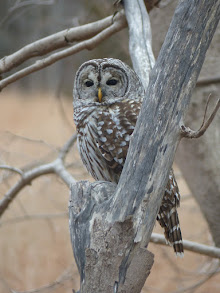
Moving to Maine has meant, among many other things, crossing into the range of the North American porcupine. We didn't see much of them for the first year, except in the form of roadkill, but this winter they've been very evident. I spotted the adult above high up in a pine tree in a little wood, and at first mistook it for an owl (which we also have here). With some difficulty I managed to get underneath it and take some photos; the animal undoubtedly knew I was there but showed no reaction.

The juvenile below showed up on the side of a mostly unused dirt road one day and lingered in the same spot for the three or four succeeding days. Porcupines may be slow to sense the presence of another creature, even one walking a dog on a leash, but eventually this one would move off. There may be sillier sights on earth than a juvenile porcupine waddling across a dirt road, but there can't be many.

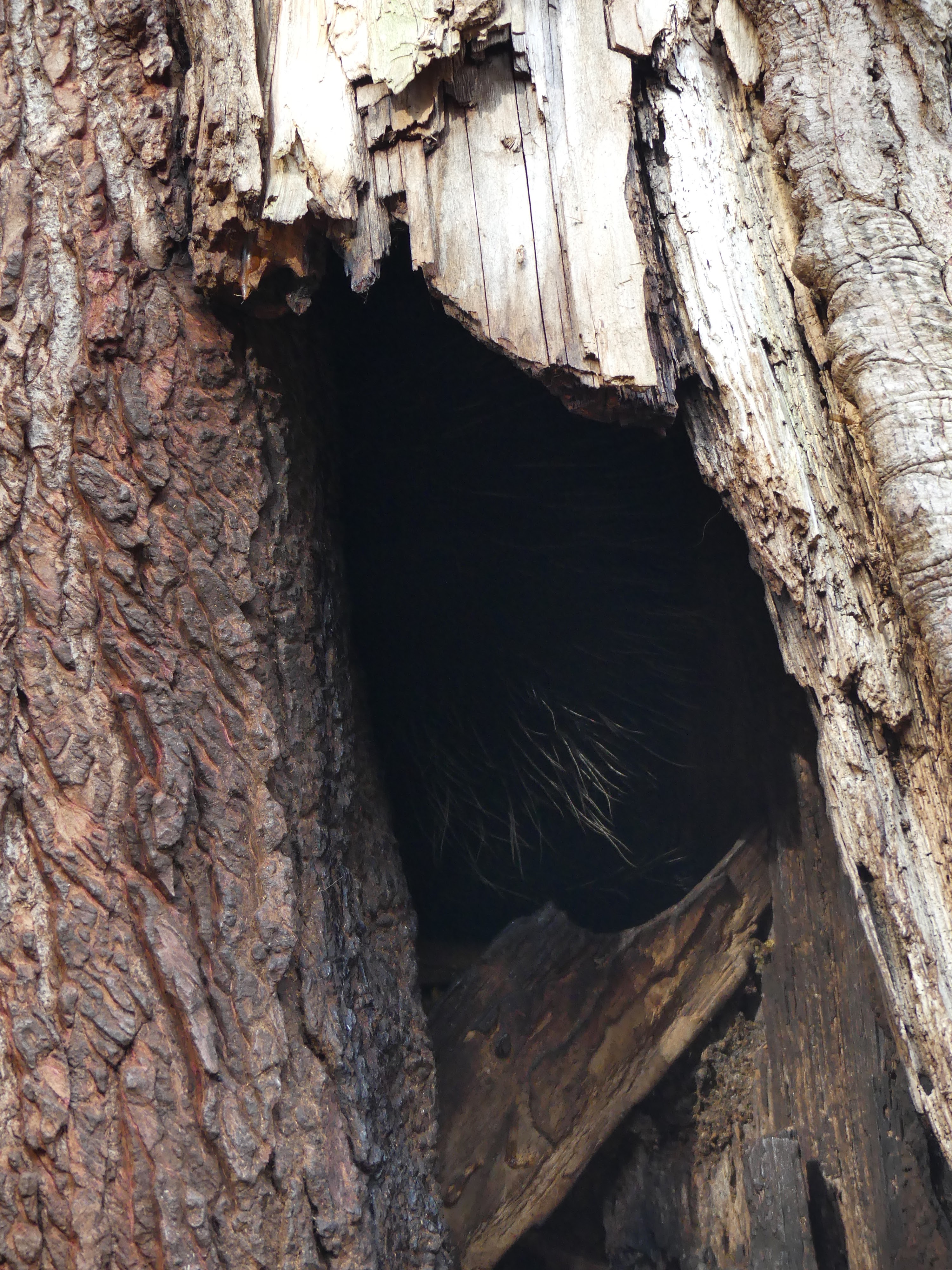
In another location, probably far enough away to represent a different territory, I've been keeping an eye on an active den in a dead tree, which judging from the depth of the pile of porcupine droppings around it has probably been in use for some time. Porcupines will den up together, so it's hard to say how many occupants this one may have, but by getting a bit closer I can see that there's definitely at least one.

Thursday, January 02, 2025

The Monster (Charles Dickens)


On a dreary afternoon, Harriet Carker pauses from her needlework to gaze at the scene outside her window.
She often looked with compassion, at such a time, upon the stragglers who came wandering into London, by the great highway hard by, and who, footsore and weary, and gazing fearfully at the huge town before them, as if foreboding that their misery there would be but as a drop of water in the sea, or as a grain of sea-sand on the shore, went shrinking on, cowering before the angry weather, and looking as if the very elements rejected them. Day after day, such travellers crept past, but always, as she thought, in one direction—always towards the town. Swallowed up in one phase or other of its immensity, towards which they seemed impelled by a desperate fascination, they never returned. Food for the hospitals, the churchyards, the prisons, the river, fever, madness, vice, and death—they passed on to the monster, roaring in the distance, and were lost.

Dombey and Son

Wednesday, January 01, 2025

Resolutions for a New Year

(Since a certain public figure is distasteful to me, I refuse to refer to him by name. We all know who "he" is.)

Do something he wouldn't do.
Be something he isn't, and know something he'll never know.
Read something he'll never read. (That one is easily accomplished.)
Listen to music he'll never have the joy of. (Bonus points for live music.)
Care about something.
Care for someone.

Live in the real world.
Slow down. Unplug.
Go somewhere on foot. Look around.
Cook something from scratch.
Do something for the hell of it.
Live in spite of.

Tell the truth. Don't believe bullshit. Know the difference.
Know thyself.

Forget nothing.
Take the long view.
Don't expect things.