Wednesday, January 23, 2019

Owl


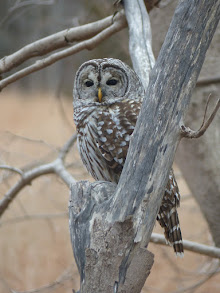
Winter can be a frustrating time for the saunterer, but now and then you get a lucky break. On a mild Sunday afternoon in January I put the dog in the car and drove a few miles to a park where there are four thousand or so acres of woodlands and fields. The park road up the hill I wanted to visit was closed, so I left the car at the bottom and took a trail that hooked around to the top. The trail was deserted and the woods silent except for the occasional sound of a jet passing overhead. At the summit, stone camping shelters stood empty and alone among unmown fields and scattered oaks, their fires cold, but solitary electric lights burned, even in daylight, to mark the entrances to the rest rooms. On our way back down I heard an owl hoot several times in quick succession not far off in a stand of pines, but I never spotted it. As we drove out a hawk crossed in front of us and alit in a tree. I pulled over but I knew it would fly off if I opened the car door and so made no attempt to get a better look.

On the way home I decided to turn onto a back road I don't usually take. I saw a jogger up ahead of me on the left, and as I slowed I noticed something in the neglected field on my right: a barred owl, perched on a dead tree. I pulled over, turned on the four-way flashers, reached for my camera, and rolled down the window.


I see owls with some regularity, sometimes by accident and sometimes by intention, but most often by having the intention of seeing them by accident. Contrary to the assumptions many people have, they're not necessarily exclusively nocturnal, and barred owls, which are frequently active by day, aren't particularly skittish. Still, I've never had one pose so cooperatively, at eye level just a few yards off and in decent light.


Fortunately, the dog, who barks or howls at anything from squirrels to Canada geese, either didn't see it or didn't register it as potential prey. He no doubt wondered why we had stopped. I took pictures for several minutes, while the owl kept an eye on the field and now and then swiveled its head to regard me with apparent neutrality. I kept expecting it to fly off but it never did. Eventually it was I who drove away instead.

Tuesday, January 15, 2019

Measureless Nights


Winter mornings, waiting for dawn. (But then with the streetlight right outside the window it's never truly dark.)

John Steinbeck and Ed Ricketts: "An ocean without its unnamed monsters would be like a completely dreamless sleep." They had mariners in mind but they could easily have reversed the simile. A dreamless, utilitarian sleep is like a disenchanted sea. Nothing emerges from it that we don't already know.

Or we dream but remember nothing, our dream-selves wandering off through rooms we will never see. Borges, on the philosophers of Tlön, who held that "While we sleep here, we are awake elsewhere and in this way every man is two men." He might have added, "or none."

Saturday, January 12, 2019

Thaw


A scene from Paweł Pawlikowski's Cold War, the follow-up to his Oscar-winning Ida from five years ago, which was one of my favorite movies of the last twenty years. I'd rate Cold War one notch below the earlier film, mostly for some choppiness in the latter half and an ending I didn't much care for, but it's still a very consequential movie (and with some of the same cast members, notably Joanna Kulig, who had a cameo in Ida but utterly dominates here). And of course it's in black and white, as all films worth watching should be. (I'm exaggerating, of course, a little.)

Cold War is about various things but the action principally concerns music makers making various kinds of music, and there's an almost programmatic sequence, from a bagpiper at the film's opening who's playing sounds that could be a thousand years old to more recent folk and classical music to jazz and kitsch and Bill Haley and the Comets (heard above). All of the music, as far as I could tell, is diagetic (that is, it's either being performed as part of the action or is listened to by the characters) except for the Goldberg Variations accompanying the credits.

Claire Messud has a thoughtful appraisal in the New York Review and Lisa Liebman at Vulture has a good article on the music in the film.

Monday, December 31, 2018

Out with the Old Year


The committee for 2018 has officially concluded its final report. And good-bye to all that.

Monday, December 17, 2018

Season's Greetings


Art by Tom Gauld. Hat tip to Tororo.

Update: A memorial notice published in the New York Times on December 23, 2018, may contain a reference to Beckett's Endgame. Addressing herself to "My darling Alvin," the writer declares, "I celebrate the years of our connection and all that you taught me about life, on and off the stage. No one with whom I'd rather have shared a trash can."

Thursday, December 13, 2018

Destinies


Vera Brittain:
When I was a girl at St. Monica's and in Buxton, I imagined that life was individual, one's one affair; that the events happening in the world outside were important enough in their own way, but were personally quite irrelevant. Now, like the rest of my generation, I have had to learn again and again the terrible truth of George Eliot's words about the invasion of personal preoccupations by the larger destinies of mankind, and at last to recognize that no life is really private, or isolated, or self-sufficient. People's lives were entirely their own, perhaps — and more justifiably — when the world seemed enormous, and all its comings and goings were slow and deliberate. But this is so no longer, and never will be again, since man's inventions have eliminated so much of distance and time; for better, for worse, we are now each of us part of the surge and swell of great economic and political movements, and whatever we do, as individuals or as nations, deeply affects everyone else. We were bound up together like this before we realized it; if only the comfortable prosperity of the Victorian age hadn't lulled us into a false conviction of individual security and made us believe that what was going on outside our homes didn't matter to us, the Great War might never have happened.
Testament of Youth (1933)

Sunday, December 02, 2018

Intruders


For a couple of years when I was a kid my father and I used to traipse through the woods on what had once been farmland, looking for old foundations that might indicate a household dump somewhere not far off, where, if we were lucky and dug carefully with a trowel or a shovel, we might find patent medicine bottles in amber or cobalt blue, or maybe even a handblown flask whose glass would be flecked with bubbles of nineteenth-century air. If we were on water supply property we'd bring our fishing rods for cover — angling was permitted, trespassing was not — but as far as I remember no one ever called us on it, and encounters with anyone else in those woods would have been few and far between. Now and then we'd find a ruined building that was still standing, surrounded by vegetation, its insulation mixed with mouse nests and its shingles decaying, but those were too new to bother with, offering nothing but beer cans and waterlogged magazines.

My father was a surveyor by profession, and the company that employed him secured a large contract for laying out lots on a tract of a thousand acres or so that had been purchased for development. Most of it was second growth woodland, hilly and criss-crossed with stone walls, but there was also a low area that still served to grow corn up until the time the developers started work. There was an abandoned house still standing on the property, and under the pretext of reconnoitering for purposes of the survey we went one day to take a look around. I don't remember much about it now except that the building had at least three stories and must have been a comfortable farmhouse a few decades before.

We found a way in and walked the rooms. How many years they'd been unoccupied is hard to say; there was some story about an elderly widow living in a nursing home who had finally died. Certainly there was nothing useful still in the house; whatever furnishings had any value had long been sold or taken away by relatives or just looted, and the only thing I remember with certainty is that there was a cupboard that was still — bizarrely — neatly stocked with glass jars of vichychoisse or borscht. As we were exploring we heard footsteps on the wooden floor and a kind of desperate wail, and after a few seconds a very large and frightened Great Dane appeared. It couldn't have been left behind by the former owner — it had been too long — and no doubt it had found a way in as we had, and maybe couldn't find its way out. My father shooed it away and it disappeared deeper into the house.

We left empty-handed. The house was torn down not long after. There's no trace of it now.

Friday, November 30, 2018

Notes for a Commonplace Book (23)

Charles Morgan:
In each instant of their lives men die to that instant. It is not time that passes away from them, but they who recede from the constancy, from the immutability of time, so that when afterwards they look back upon themselves it is not themselves they see, not even—as it is customary to say—themselves as they formerly were, but strange ghosts made in their image, with whom they have no communication.
From The Fountain, quoted by Vera Brittain in Testament of Youth

Wednesday, November 28, 2018

Representative Man


David W. Blight:
Over more than fifty years, 1841-1894, Douglass sat for approximately 160 photographs and wrote some four essays or addresses that were in part about the craft and meaning of pictures. In engravings and lithographs his image graced the pages or cover of all major illustrated papers in England and the United States. His picture was captured in all major forms of photography, from the daguerreotype to stereographs and wet-plate albumen prints. Photographers, some famous and some not, all across the country sought out Douglass for his image. As the historians of his image have shown, the orator performed for the camera. He especially presented himself without props, his own stunning person representing African American "masculinity and citizenship." He helped to choose the frontispieces for his autobiographies, which carried his photograph, and he especially sought to create for a wide audience successive images of the intelligent, dignified black man, and statesmanlike elite, at the same time he understood that photography had evolved into a "democratic art," allowing almost anyone to leave an image for posterity. Visually, by the 1870s and 1880s, Douglass was one of the most recognizable Americans; the dissemination of photographs of him became, therefore, a richly political act.
— From Frederick Douglass: Prophet of Freedom

Image: Frederick Douglass, from a full-plate daguerreotype in the collection of the Onondaga Historical Association.

Wednesday, October 31, 2018

Fog


Reservoir views, Halloween morning. The sharp-eyed may notice a passing bird or two in some of the images below.

Tuesday, October 30, 2018

Responsibility


Adam Serwer, writing in The Atlantic:
Ordinarily, a politician cannot be held responsible for the actions of a deranged follower. But ordinarily, politicians don’t praise supporters who have mercilessly beaten a Latino man as “very passionate.” Ordinarily, they don’t offer to pay supporters’ legal bills if they assault protesters on the other side. They don’t praise acts of violence against the media. They don’t defend neo-Nazi rioters as “fine people.” They don’t justify sending bombs to their critics by blaming the media for airing criticism. Ordinarily, there is no historic surge in anti-Semitism, much of it targeted at Jewish critics, coinciding with a politician’s rise. And ordinarily, presidents do not blatantly exploit their authority in an effort to terrify white Americans into voting for their party. For the past few decades, most American politicians, Republican and Democrat alike, have been careful not to urge their supporters to take matters into their own hands. Trump did everything he could to fan the flames, and nothing to restrain those who might take him at his word.
"Trump's Caravan Hysteria Led to This," October 28, 2018

Saturday, October 27, 2018

Enough is Enough


Image credit: The Dallas Holocaust Museum, via the website of Syracuse Cultural Workers, which notes, "This powerful artwork is a signature image of the DHM which hosts thousands of school children each year."

Thursday, October 25, 2018

Monk's Mood


What to listen to when you're out driving before dawn, and the streetlights are lit up because it's never really dark anymore, and the traffic lights aren't working right and already the cars are starting to fill the streets and people are on their way to do things that give them no joy but there's another day to get through, and to hell with the ones getting into their limos who will be rolling the dice for all of us today, because it's Monk, dammit, Thelonious Monk and John Coltrane at Carnegie Hall, 1957, and open your ears and show a little respect for once for the things that really matter.

Sunday, October 07, 2018

"What Is Jazz?"


The poem below was printed in a local newspaper in 1966. As the name of the poet would mean nothing to anyone who didn't know her personally I choose to keep it private.
What Is Jazz

jazz is America's song
it's freedom
it's bebop and blues
it's bourbon street and harlem
jazz has a pulse
not a beat
(jazz is a live beast
not a metronome)
it skids and slides
it laughs and sobs
jazz can talk
it talks about yesterday and tomorrow
but mostly about today
about right now
about steamy cellars, hot coffee
and that guy sitting next to you
his troubles
his blues
and that girl he loves
jazz is young
it's always the new thing
it's always out
it wanders
alone
it's tough; it's gutsy
jazz is brave
it does what it feels
not what's right
not what's good
jazz is people who are out
people who walk the streets
it doesn't hide
lice on rats
cold-water flats
jazz gets in
it's real
it's dirty
but jazz never lies to you
it tells you when it hates
it tells you when things are rotten
then it throws back its head
and laughs
it says
man, don't let things get you down
relax baby
enjoy yourself
like this, man
then it bops off
and lets off with a good earthy roar
and ya smile and say
hi bud can I buy you a beer?
what is jazz?
jazz is life, fella
jazz is life.

Tuesday, September 18, 2018

Black Wall of Certainty


Amar, a Moroccan adolescent, hides out on the roof while the house he has been staying in is raided by the French, who are looking for members of the Istiqlal, an underground independence movement:
He listened: they were going back down the stairs, back along the galleries, back through the house, and away. They had parked their jeeps somewhere far out in the fields, for he waited an interminable time before he heard the faint sound of doors being shut and motors starting up. When they were gone he turned over and sobbed a few times, whether with relief or loneliness he did not know. Lying up here on the cold concrete roof he felt supremely deserted, exquisitely conscious of his own weakness and insignificance. His gift meant nothing; he was not even sure that he had any gift, or ever had had one. The world was something different from what he had thought it. It had come nearer, but in coming nearer it had grown smaller. As if an enormous piece of the great puzzle had fallen unexpectedly into place, blocking the view of distant, beautiful countrysides which had been there until now, dimly he was aware that when everything had been understood, there would be only the solved puzzle before him, a black wall of certainty. He would know, but nothing would have meaning, because the knowing was itself the meaning; beyond that there was nothing to know.
Probably my favorite of Paul Bowles's novels, The Spider's House, which was published in 1955, represents its author's most sustained attempt to depict the interior lives of Moroccans, even if the passage above seems to borrow as much from twentieth-century existentialism as it does from cultural anthropology. Other sections of the book deal, more conventionally, with an expatriate American novelist named John Stenham and a wayward young American woman named Lee Veyron. As the narratives converge, the mutual failure of understanding across cultures comes to the fore. The French colonizers, in the meantime, are depicted as cloddish torturers, while the members of the Istiqlal, who drink alcohol and sport Western clothing, are regarded by Amar (and presumably by Bowles) as corrupt and un-Islamic. Stenham, who speaks Maghrebi Arabic, deplores the encroachments of the modern world into traditional Morocco; Veyron welcomes them.

All of this no doubt reads very differently now than it did when the book was first published; the attempt of an outsider to depict (and thereby define) the consciousness of an inhabitant of a third-world country would probably be regarded as presumptuous if not downright offensive, and Bowles's pessimism about decolonization, like Naipaul's, would be seen as serving the interests of imperialism. But though Stenham seems, on the surface, an obvious stand-in and mouthpiece for Bowles, the writing of fiction exacts its toll on the characters. Stenham is a nostalgist for the primitive, but he is also an insensitive boor who ends by availing himself of his privilege as a Westerner to flee a situation that Amar has no escape from. Bowles the novelist is already a step ahead of his potential critics.

Thursday, September 13, 2018

Monday, September 03, 2018

V is for ...


A case of a ghastly linguistic muddle involving, in one sentence, no fewer than five languages:
Euclides da Cunha, who was a fanatical republican, a man totally convinced of the necessity of the republic in order to modernize Brazil and create social justice in the country ... was working at that time as a journalist in São Paulo and wrote vehement articles against the rebels in the northeast, calling this rebellion "our vendetta" because of the French reactionary movement in Britain against the French Revolution.
The passage above is from Mario Vargas Llosa's A Writer's Reality, based on a series of lectures he delivered (in English) at Syracuse University in 1988. The context is a discussion of the Brazilian writer Euclides da Cunha, whose non-fiction work Os Sertões, regarded as one of the foundation stones of his country's literature, describes a millenarian (and, at least in part, monarchist) uprising in Northeast Brazil towards the end of the 19th century. (Vargas Llosa used the same revolt as the basis for his own novel, La guerra del fin del mundo.) But Euclides da Cunha, who wrote in Portuguese, never called the events in Canudos (where the revolt was centered), "our vendetta"; he called them nossa Vendée, that is, "our Vendée," in allusion to the French counterrevolutionary uprising of 1793. Not writing in his native Spanish, Vargas Llosa has mistakenly employed a false English cognate of Italian origin that in fact has no relation to the French word used in the Portuguese text; moreover, he has apparently confused Britain with Brittany, which is at least vaguely in the same part of France as the department of the Vendée.

The moral of the story, perhaps: never be your own translator.

NB: Os Sertões has been translated into English at least twice, once by Samuel Putnam as Rebellion in the Backlands, and in a recent Penguin Classics translation as Backlands: The Canudos Campaign. Vargas Llosa's novel, which has considerable merit of its own, has been translated as The War of the End of the World.

Thursday, August 09, 2018

City


I'm walking the dog home across a city that bears little relation to the real one, as if Robert Moses had succeeded in his nefarious scheme to plow an expressway through lower Manhattan. On a quiet Greenwich Village street I notice a small garden with a few plants and decorations, and I say to myself, "A real hippy must live there." Up ahead, a pickup truck approaches; as it passes I see a young woman standing in the back. She's singing these words:
I'm proud to be a New York City hippy
I'm proud of dirty feet and dirty hair
I'm proud of living with the cock-a-roaches
I'm proud of living in a garbage can*
I recognize the song, and the woman is stunned when I join in halfway through. The truck keeps going. There's nothing left for me to do but pick my way east through the cloverleafs and dead ends, heading home.

* Actual song by David Peel, c. 1972.

Thursday, August 02, 2018

The Impossible Book


The CD insert for a radio play by Peter Belgvad and Iain Chambers, from the limited-edition version of The Peter Blegvad Bandbox. Astute listeners may recognize the voice of the distinguished British actress Harriet Walter in the role of Agatha Christie, as part of a cast that also features XTC founder and longtime Blegvad collaborator Andy Partridge. The insert design and art are by Blegvad.