Monday, April 30, 2018
Tower
In the office on the 73rd floor, high above the city, the president of the company passes me a handful of letters to mail and a note with the deli order for lunch. "Quickly!," he shouts, and I rush to the elevator, which swiftly descends the great steel and glass tower until its doors open at the ground floor. A rush of wind hits me as I exit through revolving doors, and the letters are blown from my hand and scattered. Pedestrians hurrying in and out of the building trample the letters and leave their footprints on them. I gather them up and enter the deli, but there's a crowd ahead of me struggling to be served and in the confusion I drop the letters again. Now they're torn, soiled with beef blood and grease. I run outside looking for a mailbox, for a place to wash my hands, but all in vain...


Friday, April 27, 2018
Notes for a commonplace book (22)
Pablo Neruda:
It is very appropriate, at certain times of the day or night, to deeply observe objects at rest: the wheels that have covered long, dusty distances, bearing heavy loads of vegetables or minerals, sacks from the coal yards, barrels, baskets, the handles and grips of the carpenter's tool. The contact of man with the universe exudes from these things a lesson for the tormented poet. The worn surfaces, the wear that hands have inflicted on things, the often tragic and always wistful aura of these objects, lend to reality a fascination not to be taken lightly."On Impure Poetry," as translated by Mark Eisner in his biography Neruda: The Poet's Calling.
The confused impurity of human beings is displayed in them, the proliferation, materials used and discarded, footprints and fingerprints, the permanent mark of humanity inundating all objects from within and without. That is the kind of poetry we should strive for, worn away as if by acid from the labor of hands, impregnated with sweat and smoke, smelling of urine and lilies, and seasoned by the various professions that operate both within and outside the law.
A poetry impure as old clothes, as a body, with its food stains and shame, with wrinkles, observations, dreams, vigilance, prophecies, declarations of love and hate, beasts, blows, idylls, manifestos, denials, doubts affirmations, taxes.
Tuesday, April 24, 2018
Man or name?
Two translations of the last lines of Pablo Neruda's "Ars Poetica," from Residence on Earth:
but the truth is, suddenly, the wind lashing my chest,Leaving aside the other differences between the versions (I generally prefer Walsh's, from the New Directions edition, to Eisner's, which is quoted in his new biography of Neruda), there's a significant disagreement that has nothing to do with translation methods or styles; it has to do with the text of the Spanish original. The last words in the Spanish text that Walsh is translating (his edition is bilingual) are un hombre, a man; Eisner is evidently following a text that reads un nombre, a name. Spoken aloud they would be indistinguishable (the h is silent), but which text is correct?
the infinitely dense nights dropped into my bedroom,
the noise of a day burning with sacrifice
demand what there is in me of the prophetic, with melancholy
and there's a banging of objects that call without being answered,
and a restless motion, and a muddled name.
(Mark Eisner)
but the truth is that suddenly the wind that lashes my chest,
the nights of infinite substance fallen in my bedroom,
the noise of a day that burns with sacrifice,
ask me mournfully what prophecy there is in me,
and there is a swarm of objects that call without being answered,
and a ceaseless movement, and a bewildered man.
(Donald D. Walsh)
I find hombre a more satisfying conclusion to the poem, with the catalogue of objects and motions ending up producing, wittily, a confused man, but the other reading isn't implausible either, given that Neruda, throughout Residence on Earth, frequently juxtaposes adjectives and nouns in seemingly inscrutable combinations. Eisner seems to be following the text of the 1999 Obras completas I edited by Hernán Loyola. At least one scholar (Tim Bowron) regards Loyola's "un nombre" as "an obvious error," but further research is needed.
Monday, April 16, 2018
On Robyn Hitchcock

I have loved you from a distance
Loved you from up close
Like the tiny frog that breathes
I can nestle in your cloak
I'm a bit of a latecomer to the Robyn Hitchcock party, having discovered him in 2004 (i.e., some thirty years into his career) as a result of Spooked, which he recorded in collaboration with Gillian Welch and David Rawlings. I played Spooked regularly for a while, but I hadn't listened to it all the way through for years until I dusted it off again after seeing Hitchcock perform live a week ago (he was great, by the way, polka-dot shirt and all).
Hitchcock is also a painter, in a surrealist vein matching his songs; the image above is the full version of the piece that was cropped to serve as the cover art for the CD.
Hard-core Hitchcock fans don't necessarily like this collaboration (too brooding), but I think it holds up. He played only one song from it ("Full Moon in My Soul") at the gig I attended; I like that one well enough, but I think "Television" — the ultimate ode to the seductions of the medium — and "Flanagan's Song" are my favorites. Here they are:
Thursday, April 12, 2018
On the Cultivation of Mushrooms
Leonora Carrington:
I had received a royal summons to pay a call on the sovereigns of my country.From "The Royal Summons," in The Complete Stories of Leonora Carrington (Dorothy Project, 2017). Carrington, a British-born painter as well as the author of mischievous tales, was the daughter of a wealthy industrialist and actually was presented (though very much against her will) at the court of England's George V. She left the country at the first opportunity and spent most of her very long life in Mexico.
The invitation was made of lace, framing embossed letters of gold. There were also roses and swallows.
I went to fetch my car, but my chauffeur, who has no practical sense at all, had just buried it.
"I did it to grow mushrooms," he told me. "There's no better way of growing mushrooms."
"Brady," I said to him, "you're a complete idiot. You have ruined my car."
Sunday, April 08, 2018
On Friendship (Elena Poniatowska)

Elena Poniatowska's Leonora is a biographical novel that closely follows the eventful life of her longtime friend, the artist and writer Leonora Carrington, who, like Poniatowska, was European-born but Mexican by choice or accident. (Carrington died in 2011, aged 94, and Poniatowska, one of Mexico's most distinguished writers, is now in her mid-80s.) In the early 1940s, following the fall of France and a traumatic stay in a mental institution in Spain, Carrington migrated to New York City alongside a host of artistic luminaries, including her former lover Max Ernst, who by that time was romantically involved with the wealthy arts patron Peggy Guggenheim. Poniatowska's chapters covering this period are peppered with the familiar names of her fellow emigrés Marcel Duchamp, André Breton, Luis Buñuel, and Marc Chagall, but the appearance of one name in particular caught my eye. Carrington and Ernst remain close, and often spend the day together exploring Manhattan. Poniatowska writes:
They wandered the shores of the Hudson, along which steamed long freighters that Bell Chevigny saw pass by from her window on Riverside Drive.Chevigny is not otherwise identified, and in fact never mentioned again, but I recognized her name, because many years ago I took a college course taught by one Bell Chevigny, a literary scholar and the author of a biography of Margaret Fuller. She would have been a young girl in the 1940s, and as far as I know had no direct connection to Carrington and the surrealist exiles in New York. So what is she doing in the pages of Leonora? One of her other areas of interest is modern Latin American literature (as it happens, I translated a few pages for a book on the subject that she co-edited) and she and Poniatowska have apparently known each other for years. Perhaps Poniatowska remembered Chevigny telling her how the ships would pass by her family's window when she was a child, and slipped her name into the text by way of a friendly wink.
Wednesday, April 04, 2018
Drue Heinz 1915-2018
Drue Heinz, the former publisher of Antaeus and the Paris Review, has died. The Pittsburgh Post-Gazette has a lengthy obit.
The past year or so has seen the deaths of two of my favorite writers, Charles Simmons and Harry Mathews (and no doubt others I've forgotten for the moment), as well as New York Review of Books editor Robert Silvers. For better or worse, the literary and intellectual world I grew up in is dwindling to an end. Something will replace it (though not for me). Time moves on.
My appreciation of Antaeus can be found here.
Friday, March 23, 2018
Black Dogs

Kaye Blegvad's Dog Years is an appealing self-published illustrated story about her lifelong battle with depression, personified as a black dog (an animal associated in folklore with various nefarious doings). It originally appeared in Buzzfeed last fall, and has been made available in a hardcover edition through a Kickstarter campaign and probably via her website. It only takes a few minutes to read, and is worth a look.

Curiously, I have a dog who resembles Blegvad's, except for some white markings — but my dog is quite literal. He's actually rather sweet, although he is a handful.

Fans of Peter Blegvad's comic strip Leviathan may possibly recognize a small stuffed rabbit in one of Kaye's panels.
Wednesday, March 14, 2018
Farewell, Liam

The great Irish piper Liam O'Flynn has died, according to RTÉ and other sources.
I owe my interest in Irish music directly to O'Flynn, whose uilleann piping on Planxty's "Sí Bheag, Sí Mhór" from their debut album released in 1973 caught my ear when I heard it on the old Pacifica Radio program Echoes from Tara.
With their long hair, Balkan time signatures, and exotic bouzoukis, Planxty were a fairly radical group within Irish music when they started out, but no matter how far they strayed O'Flynn was always there to give them trad cred. He once said, of his fiendishly difficult instrument:
The old pipers used to say that it takes twenty-one years to make a piper: seven years of learning, seven years of practicing and seven years of playing. I think there's a lot of truth to that because it's a complex instrument and requires a lot of co-ordination to play a tune. You're learning all the time.Below is another clip of Liam and Planxty, from a reunion concert in 2004, with O'Flynn playing a set of pipes that formerly belonged to another great piper, Willie Clancy, as well a documentary from a few years back (mostly in Irish, with English subtitles).
Update: The New York Times now has a nice obituary of O'Flynn.
Saturday, March 10, 2018
Conversations

Mario Vargas Llosa, on the composition of his 1969 novel Conversación en La Catedral, which is set in Peru during the dictatorship of Manuel Odría (1948-1956):
I knew that I wanted to write a novel about the dictatorship of Odría, which was more corrupt and corrupting than violent, although there was violence as well. The story that I wanted to tell was how a dictatorship of that nature infiltrates itself into private life in order to destroy relationships between parents and children, to destroy a vocation, to frustrate people. I wanted to show how a dictatorship winds up demoralizing even those who have a good core, who have natural decency. If a good person wants to advance in that world, he finds himself obliged to make moral, civic, and political concessions. I wanted to relate how that affected all levels of society: the oligarchy, the tiny middle-class sector, but also the popular sectors. I was interested in portraying a society in which political dictatorship has an effect on activities that are at the furthest remove from politics: family life, professional life, people's vocations. The political infects everything and creates a kind of deviation within the hearts of families and the citizens themselves that would never have existed without the corrupting force of political power.The passage above is from Conversación en Princeton con Rubén Gallo, a book that presents a series of discussions carried out a few years ago between Vargas Llosa, Professor Rubén Gallo, and a group of Princeton University students. The bulk of the book is made up of detailed exchanges revolving around four of Vargas Llosa's novels and his memoir A Fish in the Water. The book was published in 2017 and hasn't appeared yet in English (it undoubtedly will at some point), so the above rough translation is mine.
Vargas Llosa, now in his eighties, has had a long career as a novelist, critic, and politician (he ran unsuccessfully for president of Peru in 1990), and there have been ups and downs along the way. All of that is a story for another day, but he remains intellectually a force to be reckoned with, even, or perhaps especially, when I think he is wrong.
Conversación en La Catedral, which is readily available in an imperfect but readable English version by Gregory Rabassa, is Vargas Llosa's third, and I believe longest, novel. There's no "cathedral," except as the name of a bar in Lima where the long conversation that serves as a framing device takes place. One party in this dialogue is Santiago Zavalla, a thirty-something déclassé journalist from an upper-middle-class family; the other is his family's former chauffeur, Ambrosio, whom he has just run into by chance. The narration is largely made up of an intricate web of flashbacks, and the characters range widely over Peru's social classes (though not its Quechua- or Aymara-speakers). Vargas Llosa deliberately uses techniques that keep the reader off-balance, interspersing scenes that take place years apart, sometimes in the same paragraph or sentence, so that seeming non sequiturs uttered in one chapter may not take on full significance until much later. The bewilderment the reader experiences, at least initially, is not unintended by the author, who has referred to the book as a rompecabezas: a jigsaw-puzzle. He has said that its writing caused him the most difficulty of any of his books, but it may well be his greatest achievement.

Saturday, February 24, 2018
Borrowed Time
I'm climbin' this ladder,
My head in the clouds
I hope that it matters,
I'm havin' my doubts.
I'm watchin' the skaters
Fly by on the lake.
Ice frozen six feet deep,
How long does it take?
I first heard this song one evening in 1977 while browsing in the old St. Mark's Book Shop in the East Village, a few blocks away from where I was living at the time, and it has stuck in my mind ever since. That the melody was lifted (although only in part) from the Rolling Stones' "Lady Jane" was obvious even to me, but Young's song (which openly owned up to the appropriation) seemed direct and affecting where the faux-Renaissance "original" struck me as just affected. You take your inspiration from wherever you can get it.
I didn't hear "Borrowed Tune" again for years; for a long time I didn't even know that it was called "Borrowed Tune," nor what album it had appeared on. I knew some of Neil Young's records fairly well; then as now I've had mixed feelings about him in general, enjoying a lot of his music without ever quite buying into the whole mystique. (This tends to be my default attitude.)
Eventually I came across a copy of Young's Tonight's the Night on CD, and there it was. For those not familiar with the story, Young recorded most of that album in 1973 in the aftermath of the drug overdoses of two friends, one a fellow musician named Bruce Whitten and the other a roadie named Bruce Berry; it wasn't released, however, until 1975. It was ragged, dark, and commercially unpromising, full of references to death and drugs; even in "Borrowed Tune" Young sings of being "wasted" while he composed it. I'm not alone in liking it as much as anything he's ever done, but it clearly wasn't destined for AM radio.
When I listen to "Borrowed Tune" now, every now and then, something in it takes me back forty years and still lives. The qualities that first caught my ear, its plaintiveness, its vulnerability, its uneasy serenity (I don't think that's an oxymoron, in this case), have endured through time — but at the same time I know that other ears might find nothing there at all, or just dismiss it as old news, one more pathetic drug-addled product of post-hippie burnout. But that's how one's moments in time are: irreducible, non-transferable, not valid for tender or exchange. The ones that mean something never quite go away.
Sunday, February 11, 2018
Rainwalking

Hiking in the woods in a steady February drizzle is understandably not everyone's idea of fun, but it does have its upside. For one thing, you'll be unbothered by crowds. Except for a young couple treading on the ice of a pond that probably wasn't all that safe, and that at the very beginning of the walk, I saw no one. The human world fell away, except for the stone wall remnants of another era.
In the mist, the green of the mosses and lichens seemed to deepen, forming a muted palette with the stones and brown leaves that might be less evident on a clearer day.
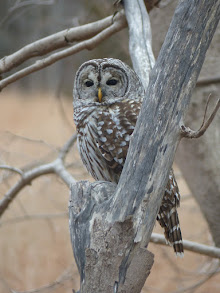
I half-expected to hear spring peepers, but it must be too early still. In compensation, I spotted a screech owl peering warily from a nest box. It wasn't what I went looking for at all, which is, of course, the best part.

Saturday, January 27, 2018
January

Miscellaneous midwinter finds. Above, snail shell (untenanted). Below, Trametes betulina, lichen and fungus, frost on woodpecker hole, wild turkeys, stone.


Tuesday, January 09, 2018
Roundabout

Colin Sackett's Uniformagazine is a pamphlet-sized quarterly, published in the UK, that ranges eclectically over various themes, but especially the intersections of landscape, human activity, and memory. Most of its contributors are unknown to me. In issue No. 3, published in Spring–Summer 2015, Ian Waites revisits the publicly funded council estate where he grew up, finding a zone that has been deregulated and privatized to the point that it is no longer the center of anything that might be called a community:
I went back to the estate to photograph my playground only to find that it had all gone. The slide, the swings and the roundabout had all been removed, leaving behind a set of modern yet suddenly ancient earthworks: concentric circles of grass, concrete and disintegrating synthetic playsurfacing. Once there were roundabouts, and children who were given the chance to play in a changed society that valued social democracy, progress and community. But now all we are left with are archaeological traces of a future that was never quite allowed to come off, and which only I seem to notice. These earthworks act like conduits in space and time, carrying me back to my childhood, and to this estate as it was in its hey-day.Ian Waites, "Once there were roundabouts," Uniformagazine No. 3.
Uniformbooks has published Waites's related book, Middlefield: A postwar council estate in time.
Sunday, December 31, 2017
Meetings with Remarkable Sheep

By longstanding custom, the origins of which are murky, part of every New Year's Eve is devoted to paying social calls on local livestock. A brief proclamation is read, a few hasty carols sung, and the sheep tolerate the proceedings with benign indifference.


Thursday, December 28, 2017
Blegvadiana

For a guy who has been making records for something like forty-five years and has a long and complicated discography, Peter Blegvad manages to maintain a fairly low profile. His new CD, Go Figure, has been released by ReR in anticipation of a full bells-and-whistles Blegvad retrospective boxed set promised for early 2018. By my count a little shy of half of the 17 tracks on Go Figure are new songs, the others being new versions of tunes that originally appeared on earlier Blegvad or Slapp Happy records or that were premiered on the Radio Free Song Club. The band is made up of usual Blegvad confederates Chris Cutler, John Greaves, Bob Drake, and Karen Mantler, the CD package features various Blegvad doodles, and the whole thing was produced and engineered by Drake in the south of France, though not on the Côte d'Azur, a locale that prompts these typically frivolous Blegvadesque lines:
We're so richThe new version of "God Detector" doesn't seem like an evident improvement on the one included on Choices under Pressure, and nothing here strikes me as on a par with Blegvad compositions like "King Strut," "Hangman's Hill," or "How Beautiful You Are," but it's all tuneful and fun and it might grow on you. In the meantime there's that boxed set to look forward to.
we're out of reach.
We're at the top of the heap
at the bottom of which
people sleep on the beach.
Update (March 2018): After living with Go Figure for a few months, I think my favorites here are "Had To Be Bad," "Simon at the Stone" (a tribute to Blegvad's late friend, the photographer Simon Marsden), and the cheeky "Way To Play The Blues." The boxed set is still in the offing.
Wednesday, December 20, 2017
News

Thomas Pynchon:
Rachel and Roony sat on a bench in Sheridan Square, talking about Mafia and Paola. It was one in the morning, a wind had risen and something curious too had happened; as if everyone in the city, simultaneously, had become sick of news of any kind; for thousands of newspaper pages blew through the small park on the way crosstown, blundered like pale bats against the trees, tangled themselves around the feet of Roony and Rachel, and of a bum sleeping across the way. Millions of unread and useless words had come to a kind of life in Sheridan Square; while the two on the bench wove cross-talk of their own, oblivious, among them.V.
Saturday, December 09, 2017
World of Wonders

I read this book by the late Stephen Jay Gould shortly after it was published in 1989, and more or less randomly grabbed it off the shelf and re-read it recently. I'm not a scientist, let alone an invertebrate paleontologist, so the impressions that follow are strictly those of a layperson.
To be as brief as possible (and with no pretense of doing justice to a rich and intricately argued book), Gould's immediate subject was the rare assemblage of soft-bodied fauna discovered, a century ago, by Charles Doolittle Walcott in the geological formation known as the Burgess Shale in the Canadian Rockies. Walcott, a geologist who was the Secretary of the Smithsonian Institution at the time, classified (Gould's word is "shoehorned") his new discoveries into existing taxa (mostly of arthropods), but subsequent work by Harry Whittington, Simon Conway Morris, Derek Briggs, and others revealed that many of the creatures properly belonged in previously unknown classes or even phylla that later become extinct. These Cambrian fossils, Gould reasoned, provided evidence that in the aftermath of the Cambrian explosion that produced the ancestors of the metazoan animals with which we are familiar (e.g. crustaceans, molluscs, vertebrates — and of course us) there was a wide diversity or disparity of body plans, many of which ultimately proved to be evolutionary dead ends. Instead of a steady progress of expanding diversity from a small number of original phylla, the analysis of the Burgess Shale fauna suggested a winnowing over time of possible avenues for evolutionary development. There may be more species now, but the roster of higher-level taxa was greater during the Cambrian than now. (Or so it seemed.)
Gould's broader argument, which he used the Burgess Shale reclassification to support, centered on the importance of contingency to the evolutionary history of life on earth. The lineages that became extinct were not necessarily essentially inferior to the lineages that survived; they perished because of circumstances that were equivalent, at least in part, to a roll of the dice. Climates changed, continents moved around, asteroids impacted the earth, etc. The fact that these lineages no longer exist (while others do) proves, in a certain sense, that they were less fitted to the challenges that followed, but since the challenges themselves were contingent and not predictable we can't say that a different roll of the dice might not have produced an entirely different outcome. A minor shift might well have led to the premature extinction of the chordates and hence precluded our own existence. (Gould's title alludes explicitly to Frank Capra's film It's a Wonderful Life, in which one small change holds the possibility of triggering a cascade of altered consequences.)
In the past thirty years continuing analysis of the Burgess fauna has, inevitably, complicated the picture considerably. It's no longer as clear as it seemed in 1989 that all of the re-classified species are true "weird wonders" that can't be contained within the familiar major phyla and classes. That process is highly technical and well beyond my ken, but although Gould, had he lived, might have been disappointed by the implications of more recent developments for his thesis, he was well aware of (and specifically notes) the fact that science proceeds by a grinding process of error and rectification. ("One cannot hope to do anything significant or original in science unless one accepts the inevitability of substantial error along the way.") His larger point, reading the role of contingency, remains open.
Ironically, one of Gould's main sources (fully credited and repeatedly praised in the book), Simon Conway Morris, has been one of Wonderful Life's most vigorous detractors. For Conway Morris, who has made a particular study of convergent evolution, the logic of evolution imposes such constraints that certain outcomes can be said to be predictable or even inevitable; one of them, in his opinion, is higher intelligence of the kind that we possess. Even if the chain of contingent events had been modified, for instance, so as to extinguish the primate lineage, "humanoid" intelligence would have been highly likely to evolve (or would eventually evolve) in another. Underlying Conway Morris's argument are his Christian beliefs and his philosophical antimaterialism (although criticism of Gould's book is not limited to those who hold such beliefs).
Though both scientists — Gould and Conway Morris — have used specific paleontological evidence to buttress their positions, the broader logical and philosophical arguments are fairly resistant to easy resolution by mere fact, and one suspects that if and when the classification of the Burgess fauna is finally settled, the debate will simply be continued in another venue. Regardless, Wonderful Life seems to me to hold up as a landmark of intelligent science writing for a general audience.
Saturday, December 02, 2017
Chicoutimi
One year when I was a kid we took a family camping trip to Quebec. I don't remember much about the trip except that we stayed at least a night or two in both Montreal and Quebec City; by now whatever specific memories of those cities I obtained at the time have long since merged with those of earlier trips and a later one I made as an adult. But I know that we headed north out of Quebec City, probably traveling through the Parc national de la Jacques-Cartier, stopping at campgrounds that I remember as being sparsely occupied, and here and there fishing meandering streams and ponds with cobbled shores. The road snaked through swamps and forests, and there were probably beaver lodges and maybe a moose or two. It was a Francophone area, and one morning when I was dispatched to fetch water from the campground's well a boy a year or so younger than me (he was the son of the couple who ran the campground) ran ahead of me, took my bucket, and worked the well-pump for me. When he was done I said merci — probably the only French word I knew — and he responded merci beaucoup, distinctly emphasizing the second word. Was he correcting my manners, or simply acknowledging that I had respected his assigned domain? For a long time I puzzled over the significance of this trivial exchange.
We continued north, heading for a small city that is today simply a borough of the larger city of Sanguenay, which stands on the river of the same name. I don't know why we had chosen that destination — possibly it was just mere curiosity — but as we entered the city we could see the river ahead of us, or at least that's how I remember it now. As we passed through an intersection a car ran a red light and collided with the front bumper of our truck. No one was hurt. When the police arrived they spoke to the young woman who was at the wheel of the car. Permis?, they asked. She didn't have one. She was barely older than I was, and had taken her parent's car without their knowledge.
Calls were made to insurance companies and, language barriers having been overcome, a local body shop was found. We probably spent a night in Chicoutimi, but if so I remember nothing about it. As soon as the damage was set to rights we headed south for home.
Fallen leaves

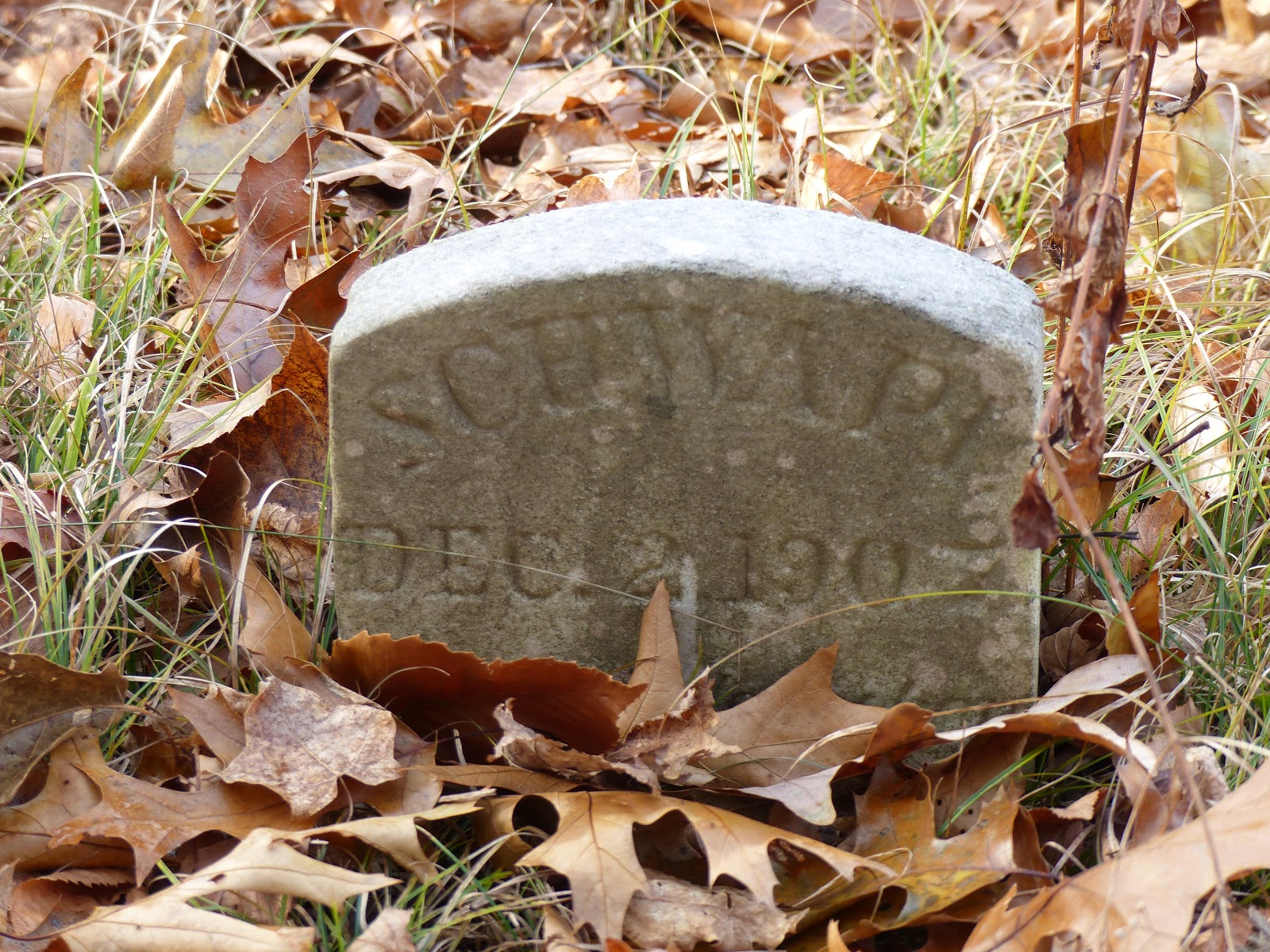
Above, and following: headstones in a burial ground on a former estate, now a public park.


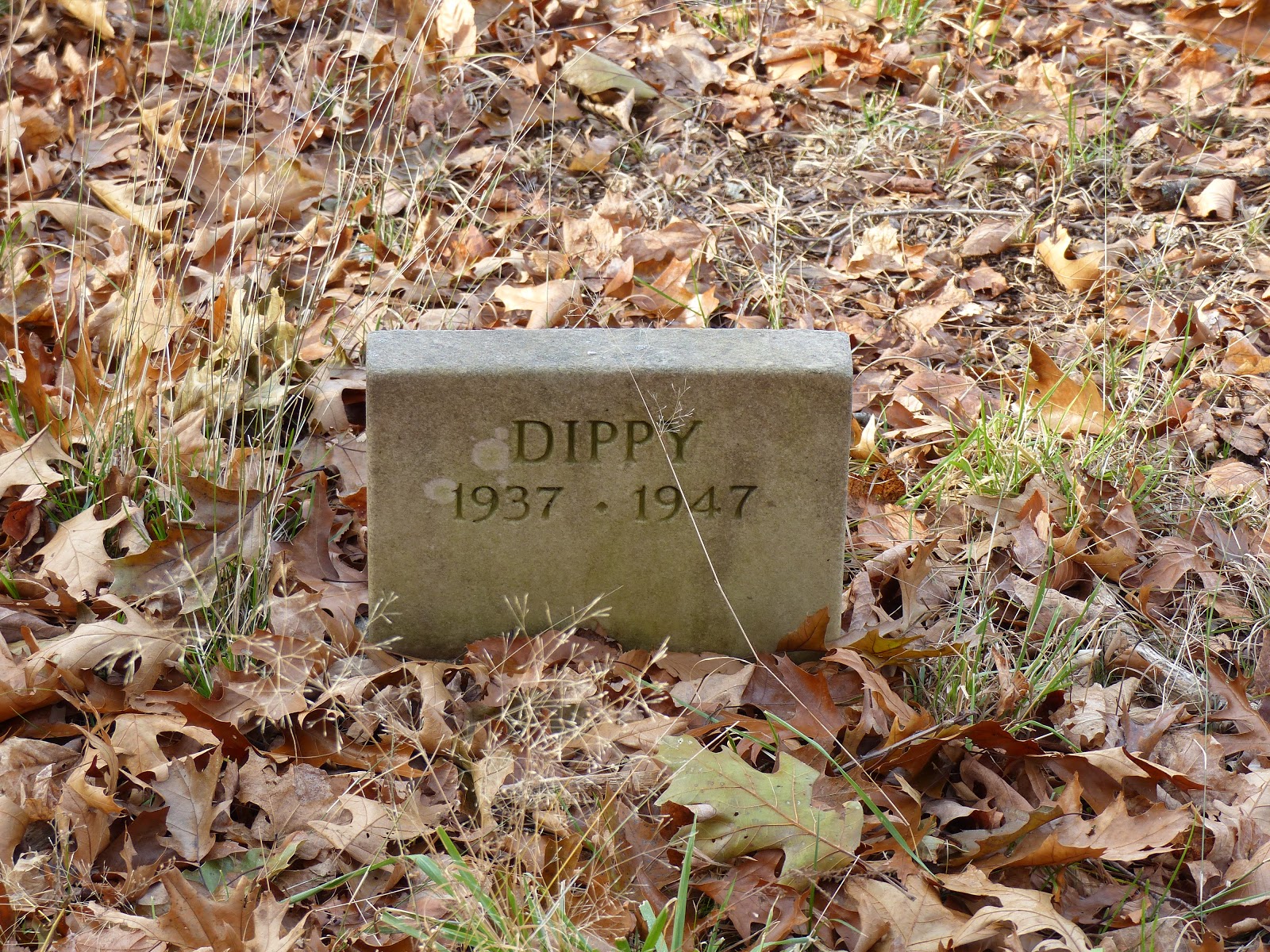


Below: the deceased are not sent into the other world unprovided for.

Subscribe to:
Posts (Atom)