Tuesday, November 24, 2020
Circular
There are few things in life I enjoy as much as acquiring books — maybe even moreso than reading them — but I've reached a point where doing so on more than an occasional basis can no longer be regarded as responsible. It's not so much the expense — like many people I should be economizing, but the world is awash in cheap used books — as it is a question of space and of what will have to be done with my modest horde after I'm gone. More fundamentally, it's a question of what the point is of accumulating additional books. I'm not a "collector" in any serious sense, and I can't claim to be rescuing and preserving material that isn't readily available elsewhere, so the personal library I have put together can only serve me, either for reading or for reference, and thus it all boils down to what I "need" to read.
When you're young the world unfolds with seemingly infinite avenues for exploration; only in time do those avenues close themselves off one by one, eventually leaving only the one narrow track you've chosen (or that is chosen for you). And so it is with reading. At first there are countless new books and authors to be encountered; gradually you learn which are most suited to your tastes and interests. You are solemnly instructed that there is a "canon" (or "canons") of sorts — books that one is supposed to read — and you read some of those and maybe never catch up with others. But eventually you realize that reading everything of merit isn't an achievable or even a desirable goal. You preserve an openness to the unencountered but you accept that the world doesn't actually care if you've read Proust (I haven't).
So now I find myself reading not in linear fashion, as if I were steadily checking off the list of books I am obliged (by whom?) to read, but in a circle, re-reading often, sometimes reading the same book twice in quick succession, and now and then incorporating things that I never thought of reading but reached for more or less at whim (New Grub Street). I love Dickens (and contrariwise have no desire to read Henry James again), but I would rather read Bleak House repeatedly than grimly force myself through Martin Chuzzlewit* or Barnaby Rudge out of some mistaken sense of completeness or duty. Do I "miss out" in this way? In a sense, but nothing is subtracted if one is always reading something from which one gets joy, or enlightenment, or whatever it is one seeks as one turns the pages.
So like many people I keep a list of prospective reading, but I recognize that I'm never going to get around to most of those books, and that it doesn't matter. I'll get to some, will only think about others, and will live without the rest. And that's a good thing, because there will always be something good beckoning just over the horizon.
* Update: I eventually read Martin Chuzzlewit. I loved it.


Sunday, November 22, 2020
That White House story...

In the "stories" section, the standout is "The White House Story," which I've heard Peter tell live at least once (it's twice, if memory serves), and which he swears is gospel truth. I won't spoil the tale by summarizing it, but let's just say it involves a Spanish newspaper, a Secret Service agent, and an unnerving late-night ride through the streets of Washington DC.
Somebody Told the Truth bears the imprint of Boom & Chime Books and is distributed by Phony Lid Books, but it should be obtainable through Bookshop.org, and elsewhere.
Saturday, November 07, 2020
Joy
Today was a beautiful day and I'm not just thinking of the blue skies and unseasonably mild weather here in New York State. I'm a skeptical person by nature; I have no illusions about the obstacles that lie ahead for both the country and the Biden-Harris administration. Nor should anyone underestimate the tenacity of the paranoia and corruption that are rooted in our public life. But with all that it comes as a deep relief that in the middle of a terrible pandemic Americans in unprecedented numbers not only managed to find a way to cast their ballots but saw through all the dishonesty and bigotry and found the moral clarity to do the right thing. The pall that has hung over us for four years has been driven off. A celebration is indeed in order.
Monday, November 02, 2020
When the Ship Comes In
Arlo Guthrie's version of an early Bob Dylan composition feels like just what I need today.
And the sands will roll
Out a carpet of gold
For your wearied toes to be a-touchin’
And the ship’s wise men
Will remind you once again
That the whole wide world is watchin’
Monday, October 26, 2020
Turning out
Saturday was the first day of early voting where I live. My wife and I have already voted by absentee ballot, but yesterday I happened to walk by the local early voting site, which is in pool complex in our village park, and was surprised by how many people were lined up to vote -- wearing masks -- with a steady stream of cars discharging more. I live in a reliably blue district in a safely blue state, but it was heartening to see so many people taking this election seriously, even if one party doesn't think that "rank democracy" is as important as property rights and in fact has based its entire strategy on an anti-democratic electoral college and on erecting as many hoops as possible to make it difficult for people to vote.
In ordinary times a president who has lied and blustered his way through four terrible years, who continues to downplay a pandemic that has killed more than 230,000 Americans and done long-term damage to the economy, who can't even pretend to feel empathy, who has contempt for science, and who has thrown in his lot with violent militias and bonkers conspiracy theorists, would have no chance of re-election. And, if the polls are correct*, he doesn't. Ojalá.
I refer anyone who is stil wavering to the endorsements -- all of them unprecedented -- from Scientific American, Nature, and USA Today.
* The polling wasn't all that accurate, frankly, but the prediction of the final result was correct.
Saturday, October 17, 2020
Homage to E. B. White


Wednesday, September 30, 2020
Notes for a Commonplace Book (28)
Charles Dickens:
I had no thought that night — none, I am quite sure — of what was soon to happen to me. But I have always remembered since that when we had stopped at the garden-gate to look up at the sky, and when we went upon our way, I had for a moment an undefinable impression of myself as being something different from what I then was. I know it was then and there that I had it. I have ever since connected the feeling with that spot and time and with everything associated with that spot and time, to the distant voices in the town, the barking of a dog, and the sound of wheels coming down the miry hill.
Bleak House
Tuesday, September 22, 2020
At the equinox
This ill-starred year grinds towards its end but still has ample time to accumulate additional misfortunes. My body remains on summer schedule, attuned to neither the clock nor the sun. I lie in the dark and wait for signs of daylight, then rise and perform the little rituals of waking up the house. I draw curtains open, put water on to boil, make breakfast. Outside I've already pulled up the tomatoes and summer squash, and the okra is bearing more slowly as the daylight dwindles and temperatures begin to drop. I wrap up the butternut squash fruits in pillow-cases at night to keep the deer from eating them before they're ready to cut off the vine. The resident hummingbirds still buzz around their feeder, but the swallowtail butterflies that feasted on our zinnias all summer have moved on.
Gardening plans, early morning walks, things not accomplished, will have to be deferred. There's a sense, in general, of being balanced on the cusp — but of what? Winter's grim days and long nights can't be avoided, and spring now seems very far away.
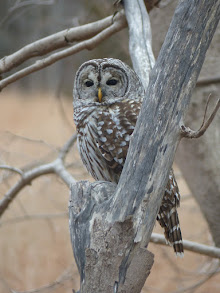
One late afternoon I came across a barred owl at the edge of a wood. I wasn't looking for it, nor it for me. It settled on a branch and looked me over, but not so intently that it couldn't be distracted by a hawk calling in the distance. Somehow it will probably make its way through the winter. I'll keep an eye out for it next year.
Saturday, August 29, 2020
One a day (conclusion)

One hundred days ago I set myself the task of reading The Decameron at the rate of precisely one tale a day, and this morning I finished it, right on time. For those who are only vaguely familiar with the work (as was I), Boccaccio's collection has particular relevance at the moment, as the frame-tale that supports it supposes that a group of young Florentines escape from the plague-stricken city into the safety of the countryside, where they regale each other with stories until it's time to go home.
Presumably conditions improved a bit in their absence; in the summer of 2020, sadly, the world is still very much a mess. (Where I live COVID-19 cases are, for now, down significantly, which is something, at least.)
But back to Boccaccio. Escapist as it may be, it's a delightful book. I'm not sure I regret not reading it earlier; some things (like Moby-Dick) arguably benefit from being encountered later in life. The Signet Classics translation by Mark Musa and Peter Bondanella that I used is lively and readable. Some of the tales are little more than anecdotes, and a few of those rely on snappy repartee that perhaps loses something out of its cultural context, but there's plenty of variety and entertainment here. As with any self-confident writer, Boccaccio plays both sides at will, alternately upholding virtue and openly advocating infidelity, bad-mouthing women for their fecklessness and defending them against jealous and tyrannical husbands. Piety, thankfully, is in short supply, and the clergy come in for a robust helping of abuse.
Below are a few of the tales that struck me as being particularly memorable.
Third Day, Tenth Story: basically a classic dirty joke, grounded in feminine gullibility and clerical misbehavior.
Fifth Day, Fourth Story: a pleasingly modern tale, ending happily, of young lovers caught in flagrante by the girl's parents.
Fifth Day, Eight Story: a gruesome supernatural horror story in which a woman is punished eternally for refusing her favors.
Eight Day, Seventh Story: the account of the vengeance of a spurned lover and scholar. (This one is particularly long and vindictive, perhaps suggesting a grudge on the part of the author.)
Tenth Day, Ninth Story: a nicely balanced story of the mutual generosity of an Italian nobleman and the Muslim general Saladin (who is, dubiously, depicted as being fluent in Italian).
Tenth Day, Tenth Story: a narrative of the unspeakably cruel manner in which a husband tests the virtue and submissiveness of his absurdly long-suffering wife, wrapping up, improbably, with tutti contenti.
I'll leave the last words to the author, who concludes: "The time has come to end my words and to humbly thank Him who with His assistance has brought me after so much labor to my desired goal, and may His grace and peace be with you, lovely ladies, and if, perhaps, reading some of these stories has given any of you pleasure, please do remember me."
Tuesday, August 25, 2020
Last train out
Maybe it's the unearthly shade of red in the evening sky or the rumbling sensation below your feet, but something tells you that this time it's for real. You take inventory: what needs to come, what can be carried, what has to be battened down or left to fend for itself. Things for the road, in case...
Some people aren't budging. Take no notice, get it done. It's too late for those arguments now.
All the things you never got to: papers to organize, phone calls to make. The peonies that should have been divided years ago. Little regrets. Nothing for it.
You should have done it last year, you should have done it years ago. Maybe it's too late. No matter. Just get on with it.
In the end, one suitcase and a cloth bag with some food and a thermos. You think you must be forgetting something, but it seems to matter less with every moment that goes by. The cold feeling when you lock the door. Don't look back.
Along the road, clusters of travelers, some rushing, some hesitant. Familiar faces, no time for chat. Caught in a funnel. Momentum.
At the station, little formalities that now seem quaint. Less of a crowd than one thought. Maybe tomorrow. Maybe it's just a false alarm, after all.
As the train pulls out you don't look through the window, but the whirl around you leaves you suddenly weak at the knees. Jostle through the aisle and into a seat. A sip of cold water to settle you.
Later, passing through unfamiliar country, the grief drains away. Nothing but weariness now. What was it you forgot?
Wednesday, July 22, 2020
Abundance

As this anxious summer wears on I've been making regular visits to a little pond not far away, one that, in spite of its diminutive size, hosts an astonishing array of wildlife, all of it unconcerned with our troubles. In addition to hundreds if not thousands of frogs of various sizes, which dash into the water with cries of alarm as I circle the shore, there are snapping and painted turtles, at least one water snake, small fish, and several species of dragonfly. As I arrive great blue herons fly up, issuing unearthly raucous cries, and rabbits, deer, and wild turkey browse the adjacent meadows.

The rabbits have apparently become accustomed to human presence and continue nibbling until I'm almost on top of them, a complacency that may be ill-advised as there are foxes, coyotes, and other predators in the vicinity. The dragonflies don't seem to care much about me either; they dart about, carefully avoiding hungry mouths lurking below the surface of the pond, and rest here and there on rocks and vegetation, only flitting away when I come within an arm's length. The green one immediately below is (I'm told) a female eastern pondhawk, which is a wonderful and appropriate name, for this is very much a hunting creature.


The frogs must be the keystone species here, their sheer numbers guaranteeing their own perpetuation as well as the survival of those who prey upon them. Over the past weeks the young ones have been slowly metamorphosizing from tadpoles. Some are still confined to the water, while others now hop about, soon to lose the remnants of their tails. They're utterly absurd creatures, and as such instantly recognizable as our kin.


Thursday, July 02, 2020
The Chaos of the Age (Leo Perutz)

(The Emperor Rudolf II addresses his lover, by means of a mutual dream.)
"In the dark hours of the day, when the chaos of the age weighs on me like a nightmare and the noise and bustle of the world is about me with all its perfidy and cunning, its lies and treachery, my thoughts fly to you, you are my comfort and consolation. With you there's clarity, when I'm with you I feel as if I could understand the way of the world and see through the lies and penetrate to the truth behind the perfidy. Sometimes I feel lost and call you, call you aloud, though in such a way as not to be overheard — but you don't come. Why don't you come? What holds you back when I call you? What prevents you?"
No answer came.
— By Night Under the Stone Bridge
Sunday, June 07, 2020


Friday, June 05, 2020
Dreaming Again (Zachary Richard)
From singer, musician, bilingual songwriter, and all-around good guy Zachary Richard, a beautiful, moving, and timely new song of hope. Downloads (here) benefit the New Orleans Musicians' Clinic.
When the danger at long last is gone,
And peace has returned to this land.
When we can all embrace without fear or disgrace
And all come home safely again.
I hear the thunder, and I am afraid,
Of the darkness that seems not to end.
But then I remember that you are always with me,
And I go back to dreaming again.
Tuesday, June 02, 2020
Quote of the day
Robert Hendrickson, Rector at St. Philip's Episcopal Church in Tucson, Arizona (via Daughter Number Three):
This is an awful man, waving a book he hasn’t read, in front of a church he doesn’t attend, invoking laws he doesn’t understand, against fellow Americans he sees as enemies, wielding a military he dodged serving, to protect power he gained via accepting foreign interference, exploiting fear and anger he loves to stoke, after failing to address a pandemic he was warned about, and building it all on a bed of constant lies and childish inanity.I can't even bear to look at the photo in question. It turns out that the last refuge of a scoundrel isn't patriotism after all. I'm not religious and I'm not sure I know what "the soul" means, but I know when someone doesn't have one.
Tuesday, May 26, 2020
Cypripedium acaule

I'll always associate pink lady's-slipper or moccasin flower with my childhood, because there was a secluded spot in the woods about a mile or so from my house where they could be found quietly growing, if you were observant and if you went at the right time of year. I haven't been back for decades and I have no idea if they're still there, though I wouldn't be surprised if they were. These native orchids require just the right habitat and are said to be extremely difficult to cultivate.
I know of another place where they still grow in relative abundance, though, and over the weekend I trekked into the woods and found several dozen of them in bloom. They're not visible from a main trail, but are easily reached if you happen to know where they are. Two other hikers walked right past them while I was there, but they either didn't notice them or weren't interested (or maybe they were just giving a wide berth to the eccentric kneeling on the ground with a camera).

The white moth on the specimen below is Tetracis cachexiata. I know that fact not because I keep that kind of information in my head, but because an online search for moths associated with the plant immediately brought it up. The moth has been spotted on lady's-slippers many times in various locations over the years, but no one knows quite why. It's not believed to be a pollinator of the flower (which is pollinated by bees), nor does it derive any apparent nourishment from it. One theory is that it obtains some kind of pheromone from the plant. Charley Eiseman at Bug Tracks has more information.

Monday, May 25, 2020
Notebook: Seeing Music
Christy Moore:
When I go to West Clare I can see the music in the hills and stony fields. Today I look out upon the Sheep's Head and over Dunmanus Bay to Mount Gabriel and I can see many things: the beauty of it all, the bay, the beacons — as one man tries to quietly fish in it another hungry man seeks to poison it. I can see God's work everywhere but I cannot see the music. In West Clare you can see the fiddle music, you can stand looking over a stone wall into a poor little field and it is there as plain as day. I saw concertina music on the square in Kilrush in 1964 and the vision never left me. Coming up from The White Strand in Milltown Malbay I met chanter music, and on the windswept Hill of Tulla (East Clare) I met the man that wrote Spancilhill. The music scarpered off the big fields of Meath and Kildare — there is no sign of it at all. I have seen it in Ahascragh too, and above in Ardara and you can plainly see the flute music in Fisher Street. You'd always have a better chance of glimpsing it around stony half acres, but seldom if ever on the ranches brimming with sleek shiny bullocks full of antibiotics and growth hormones. Show me a scrawny auld heifer unable for a bull and I'll show you a slow air with a slip jig traipsing after it. The combine harvesters have driven the music out of the John Hinde-coloured pastures where it has been forced to live in exile in libraries and museums. It needs the birdsong and the meadow to breathe, the wind through the furze, the distant corncrake in the meadow, the smell of the fair day."Spancilhill" (or "Spancil Hill"): a song associated with Robbie McMahon, a version of which appears on Christy Moore's 1970 album Prosperous. John Hinde was a popular photographer and creator of nostalgic colored postcards.
From One Voice: My Life in Song (Hodder & Stoughton, 2000).
Friday, May 22, 2020
One a Day
I've never read The Decameron before, but coming across vivid passages from Boccaccio's own introduction to the work quoted in the pages of Philip Ziegler's The Black Death reminded me that its one hundred stories are held together by a frame-tale set in Florence during the bubonic plague outbreak of 1348. Ten well-heeled Florentines, happening to encounter each other in church, resolve to flee together to the countryside, and in the course of their wanderings they relate tales to each other at the rate of one per person per day.
The tales aren't long, and it occurs to me that by slowing down the travelers' pace tenfold I can read a single story every day, leaving abundant time for other reading, and I should be done right around September 1st, at which point perhaps we'll all have a better idea of the state of our current plague, or rather plagues. I'll be reading the Signet Classics version translated by Peter Bondanella and Mark Musa. My copy has a sprinkling of annotations, in ink, by its former student owner, the kind of thing I might once have found irritating but now find adds a level of amusement.
For an update, see: "One a day (conclusion)."
Thursday, May 14, 2020
Streetcars (Albert Camus)
The Plague:
During all the late summer and throughout the autumn there could daily be seen moving along the road skirting the cliffs above the sea a strange procession of passengerless streetcars swaying against the skyline. The residents in this area soon learned what was going on. And though the cliffs were patrolled day and night, little groups of people contrived to thread their way unseen between the rocks and would toss flowers into the open trailers as the cars went by. And in the warm darkness of the summer nights the cars could be heard clanking on their way, laden with flowers and corpses.The hardest part of The Plague to read at the moment is the chapter in which the narrator recounts the increasingly desperate measures the authorities in Oran resort to in order to dispose of the mounting number of victims. Individual graveside ceremonies — simplified a bit, to be sure, as a concession to public hygiene — give way in time to furtive disposal in a common pit. Thus far it hasn't gotten that bad here, but the very image gnaws away at our complacency. Few notions horrify us more.
(Translation by Stuart Gilbert)
Tuesday, May 05, 2020
Signs and wonders

I've discovered that my old Picassa slideshow of images from the Augsburg Book of Miracles no longer works, but rather than try to recreate it I'll simply post my favorite image (above) and refer the curious to Marina Warner's review (from 2014) at the website of the New York Review of Books. Strange days indeed.
Subscribe to:
Posts (Atom)