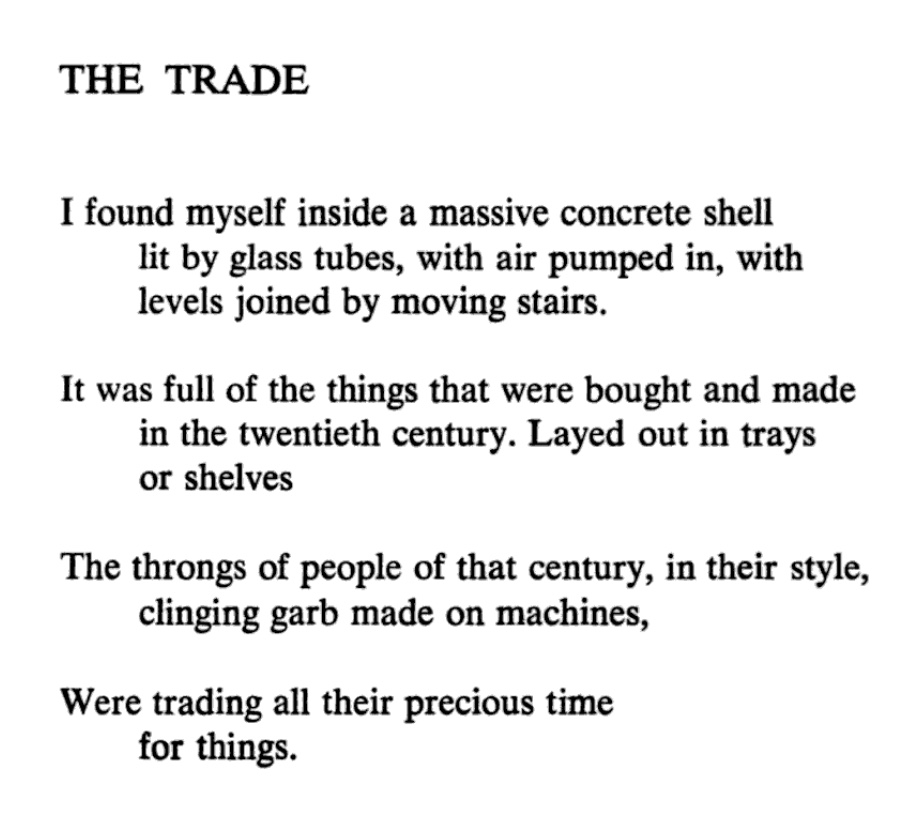
The Paris Review has inaugurated a new blog, Pinakothek. Written by Luc Sante, it's devoted to "miscellaneous visual strata of the past." Here's an excerpt from the second post, "Arcade":
Getting yourself photographed was a pastime and an existential necessity. It reminded you that you existed outside your own head. It showed you your face as others would see it. It gave you an opportunity to compose yourself, although few had the skill to do so successfully, and often the photographer’s haste and hard sell would mitigate against it. Most people come off in arcade pictures as if they had suddenly been shoved onstage to face an audience of thousands.
"Pinakothek" (from a Greek and Latin word for a picture gallery) was also the title of a short-lived feature that Sante maintained on his website a number of years ago.
Her sons are out of college and living lives of their own by the time her husband leaves. She could stay on in the house but every room has bad memories, so she winds things up and moves back to the river town where she was born. It's the same river but the people have moved on. Old acquaintances, when she happens to bump into someone she recognizes, are pleasant enough but their faces are burdened with histories she no longer shares. Downtown there are newcomers, refugees from a faraway war that has disappeared from the headlines. She rather likes the women, who are friendly, direct, and tough, but finds the men a harder read. She volunteers a bit and joins a gym, and keeps the few grey-haired men who seem to sense an opportunity at arm's length.
On overcast days she likes to walk through town and over the bridge and watch fishermen drop their lines into the dark water. Sometimes the drawbridge rises and a barge goes by, its wake slowly rippling until it breaks on the shore. She wonders what the barges carry and where they are bound, upriver empty and downriver full. Semis cross the bridge and sometimes sound their horns at her; she thinks they wouldn't bother if they could see the lines in her face.
The mail brings letters, catalogs, bills. She keeps her rooms tidy, cooks casseroles that last for days, reads into the night, rises with the dawn. Sometimes she sees great flocks high above and hears the faint cries of birds returning to Canada for the summer. She resolves to make the same trip some spring, when the moment is ripe and the last ice floes have broken up.
This lucky woman, Joan, with her job and her lover and her striking looks—more remarked upon now than ever before in her life (she is as thin as she was at fourteen and has a wing, a foxtail of silver white in her very short hair)—is aware of a new danger, a threat she could not have imagined when she was younger. She couldn't have imagined it even if somebody had described it to her. And it's hard to describe. The threat is of change, but it's not the sort of change one has been warned about. It's just this—that suddenly, without warning, Joan is apt to think: Rubble. Rubble. You can look down a street, and you can see the shadows, the light, the brick walls, the truck parked under a tree, the dog lying on the sidewalk, the dark summer awning, or the grayed snowdrift—you can see all these things in their temporary separateness, all connected underneath in such a troubling, satisfying, necessary, indescribable way. Or you can see rubble. Passing states, a useless variety of passing states. Rubble.
Charles Wesley, one of the founding fathers of Methodism, is said to have penned some 6,500 hymns, among them "Hark, the Herald Angels Sing." I can't say for sure — not having heard them all — but I suspect he never wrote another as weirdly beautiful as "Idumea":
And am I born to die?
To lay this body down
And as my trembling spirit fly
Into a world unknown?
A land of deepest shade
Unpierced by human thought
The dreary region of the dead
Where all things are forgot
Soon as from earth I go
What will become of me?
Eternal happiness or woe
Must then my fortune be
Waked by the trumpet's sound
I from my grave shall rise
And see the judge with glory crowned
And see the flaming skies
The peculiarities begin with the title itself, which seems to have come not from Wesley but from a later arranger. Why "Idumea"? According to reference works, Idumea (or Edom) was an ancient kingdom south of the Dead Sea. It is mentioned in the Bible, though not, as far as I can tell (and I'd welcome an exegesis) in any context that would explain the lyrics above. The noted folklorist A. L. Lloyd, in his liner notes to the version of the song performed by the English folk group the Watersons, thought it unnecessary (or was it impossible?) to explain the allusion.
Then there's the way the song begins: in mid-sentence, in mid-thought. Hymns tend to speak in a collective voice; this one is first-person singular and sounds almost like a monologue spoken in character, along the lines of Spoon River Anthology. Even the hymn's theology seems a tad unorthodox. Christianity, as a religion that offers, in effect, a choice of afterlives, has long alternated in its vernacular forms between a kind of "Joy to the World / God is Love" cheeriness and a darker strain, whether expressed in threats of hellfire and brimstone or in the death-obsessed pessimism of the danse macabre and Blind Willie Johnson's "You Gonna Need Somebody on Your Bond." But Wesley's description of
The dreary region of the dead
Where all things are forgot
sounds more like the pagan, antinomian conception of the underworld (peopled by Homer's "exhausted dead") than it does the Christian vision of a place where sinners are sent to be paid back for their misdeeds. Is this because the speaker's voice is supposed to be an ancient, Idumean one? Is it because Wesley, though an evangelist and missionary, was also a classically educated scholar for whom the tropes of Greek and Roman literature would have been part of his intellectual training? Or was Wesley, good Methodist, really a secret Modernist avant la lettre (Pound's Cantos, after all, also begins with "And …")? All the elements are there: cryptic reference to antiquity, fragmented monologue …
According to Lloyd, the hymn fell out of favor in England, but remained popular among parishioners in what he calls "remoter settlements of the Upland Southern states of America." One can only wonder what they made of it.
The above note was originally published in A Common Reader's blog Book Case in 2003. I have dusted it off and revised a few points.
Three installments from Anne Barnetson's droll comic about the adventures of a lupine bookshop clerk. Having served in that role for many years in an earlier phase of my life I can vouch for its essential accuracy.
Our greatest adventure we found at Mérigon. Mérigon, with its face to the sunny roadside and its back to the dark gorge where the Volp rushes past the Plantaurel, has been the haunt of something wild and sinister. The peasants called it la Peur, the Fear. All one summer it blasted the valley. Crops drooped, cattle died. There were cries in the night, whirring of wings where no birds flew. At last the men of Mérigon set out to hunt la Peur. Guns in hand they scoured the fields, the river, the rocks, until some one—with a silver bullet—shot it down. He brought back no trophy, only the vague word of having killed "something like a bird," but from that moment the blight was lifted from the countryside. To-day you can not find a man in Mérigon who will admit participating in that hunt. But there is something in the atmosphere of the valley suggesting that if la Peur should rise again, there would still be men to hear the flutter of its wings.
This appealing book is the product of two American women, Ruth Otis Sawtell (1895-1978), a noted anthropologist and academic (and, later, author of mystery novels), and Ida Treat (1899-1978), who was, among other things, a journalist, academic, and New Yorker contributor in the Shawn era. There couldn't have been many American women engaged in the serious study of the European Paleolithic during the Roaring Twenties, but there certainly were two, and their account of their caving adventures and fieldwork, though obscure now, is more substantial than the typical Americans-abroad fare of the day. It was handsomely produced by D. Appleton & Co. with lots of drawings* and photos of artifacts and cave art and a gold-stamped front cover (at least in my copy — there seems to be a variant with a plain red binding). It's out of date now (even the famous paintings of Lascaux were unknown when they wrote it), but still enjoyable.
My copy, which I bought at one book sale or another years ago, came with the business card shown below paper-clipped to the title page. Francis G. Wickware was an editor at Appleton, and may well have been the editor of the book (he had a background in geology and was probably of a scientific bent). If the book was a gift from him the circumstances are somewhat puzzling, as "the late" has been scrawled above his name. Primitive Hearths in the Pyrenees was published in 1927, thirteen years before Wickware's death; perhaps just before he died he set a copy aside for someone he knew would be interested.
* The drawings were executed by Paul Vaillant-Couturier, one of the founders of the French Communist Party. He was married to Ida Treat at the time (they later divorced) and participated in the fieldwork.
Update: Below is the cover art for one of Ruth Sawtell Wallis's mystery novels. I suspect that this is not how she actually dressed during her excavations.
These three slender books by the Guatemalan Jewish writer Eduardo Halfon are published by Libros del Asteroide, a Barcelona-based company that publishes a wide range of modern literature, all in the same attractive format. Two of the three, or more accurately two and a half of the three, have been published in English translations by Bellevue Literary Press, along with another Halfon book (which I haven't read) entitled The Polish Boxer.
Each book succeeds as an individual work, but they're also part of a larger whole in which characters and events may be alluded to in one but more fully developed in another. Halfon, who spent part of his childhood in the US and is bilingual (though he doesn't do his own translations), has underlined the fluidity of his project by lifting sections of Signor Hoffman and combining them with the contents of Duelo for the US translation.
All three are narrated by someone named Eduard Halfon who is a Jewish-Guatemalan writer exploring the details and consequences of his personal and family history (but who should nevertheless not be confused with the author). Imagined events aren't necessarily deprecated in favor of real ones; thus Duelo (a title that can mean both "mourning" and "duel") centers around a half-remembered story about an uncle who drowned as a child in Lake Amatitlán. The fact that the drowning never happened both is and isn't less important than the ways it is (mis)remembered. The narrative begins in Guatemala but eventually travels to Florida and Germany (and to Italy and Poland in the English version).
The books have an understated force that becomes cumulative when they are read together (in whatever arrangement or order). Halfon doesn't bludgeon the reader, even when he deals with weighty matters (the Holocaust is a shadow over the entire enterprise), but instead prefers to work by indirection. His books echo each other but they also reverberate across entire fields of history.
I had been looking forward to seeing Alfonso Cuarón's Roma as soon as it made it to a local theatre, and it didn't disappoint. I'm not a movie critic and won't attempt a synopsis or analysis of the film*, but in a very quick summation it's about a few months in the lives of a well-to-do (but perhaps downwardly-mobile) Mexico City household around 1971. (Cuarón drew on his own family memories, and he has meticulously — even obsessively — recreated the texture of the world he grew up in.) At one crucial point the family's story intersects dramatically with the tumultuous course of the broader history of twentieth-century Mexico. The film is beautifully designed, acted, and shot (in black and white), and has the sweep and richness of a great novel. I'll be watching it again.
Pictured above is Cleodegaria (played by newcomer Yalitza Aparicio), one of the family's Oaxacan servants and the film's emotional center. One criticism that has been leveled at the film is that we don't really get to learn much about what she thinks and feels, but I think that apparent silence is itself the point. (As it happens, I think we can get a fair idea of what she thinks and feels, but to do so requires attention to more than words.) Roma isn't your typical Hollywood have-it-both-ways movie in which all conflicts are resolved and all the characters overcome the limits of their personal histories, their class or racial backgrounds, and are at last fully revealed as equal agents. Being constrained and unheard is part of the social reality of Cleo's life (as it is, in different ways and degrees, of the lives of the family she serves); for a director to pretend otherwise would be a betrayal.
* For a full and thoughtful review, Alma Guillermoprieto's NYRB review, "The Twisting Nature of Love" is a good place to start.
Winter can be a frustrating time for the saunterer, but now and then you get a lucky break. On a mild Sunday afternoon in January I put the dog in the car and drove a few miles to a park where there are four thousand or so acres of woodlands and fields. The park road up the hill I wanted to visit was closed, so I left the car at the bottom and took a trail that hooked around to the top. The trail was deserted and the woods silent except for the occasional sound of a jet passing overhead. At the summit, stone camping shelters stood empty and alone among unmown fields and scattered oaks, their fires cold, but solitary electric lights burned, even in daylight, to mark the entrances to the rest rooms.
On our way back down I heard an owl hoot several times in quick succession not far off in a stand of pines, but I never spotted it. As we drove out a hawk crossed in front of us and alit in a tree. I pulled over but I knew it would fly off if I opened the car door and so made no attempt to get a better look.
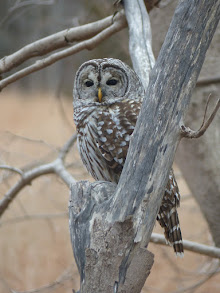
On the way home I decided to turn onto a back road I don't usually take. I saw a jogger up ahead of me on the left, and as I slowed I noticed something in the neglected field on my right: a barred owl, perched on a dead tree. I pulled over, turned on the four-way flashers, reached for my camera, and rolled down the window.
I see owls with some regularity, sometimes by accident and sometimes by intention, but most often by having the intention of seeing them by accident. Contrary to the assumptions many people have, they're not necessarily exclusively nocturnal, and barred owls, which are frequently active by day, aren't particularly skittish. Still, I've never had one pose so cooperatively, at eye level just a few yards off and in decent light.
Fortunately, the dog, who barks or howls at anything from squirrels to Canada geese, either didn't see it or didn't register it as potential prey. He no doubt wondered why we had stopped. I took pictures for several minutes, while the owl kept an eye on the field and now and then swiveled its head to regard me with apparent neutrality. I kept expecting it to fly off but it never did. Eventually it was I who drove away instead.
Winter mornings, waiting for dawn. (But then with the streetlight right outside the window it's never truly dark.)
John Steinbeck and Ed Ricketts: "An ocean without its unnamed monsters would be like a completely dreamless sleep." They had mariners in mind but they could easily have reversed the simile. A dreamless, utilitarian sleep is like a disenchanted sea. Nothing emerges from it that we don't already know.
Or we dream but remember nothing, our dream-selves wandering off through rooms we will never see. Borges, on the philosophers of Tlön, who held that "While we sleep here, we are awake elsewhere and in this way every man is two men." He might have added, "or none."
A scene from Paweł Pawlikowski's Cold War, the follow-up to his Oscar-winning Ida from five years ago, which was one of my favorite movies of the last twenty years. I'd rate Cold War one notch below the earlier film, mostly for some choppiness in the latter half and an ending I didn't much care for, but it's still a very consequential movie (and with some of the same cast members, notably Joanna Kulig, who had a cameo in Ida but utterly dominates here). And of course it's in black and white, as all films worth watching should be. (I'm exaggerating, of course, a little.)
Cold War is about various things but the action principally concerns music makers making various kinds of music, and there's an almost programmatic sequence, from a bagpiper at the film's opening who's playing sounds that could be a thousand years old to more recent folk and classical music to jazz and kitsch and Bill Haley and the Comets (heard above). All of the music, as far as I could tell, is diagetic (that is, it's either being performed as part of the action or is listened to by the characters) except for the Goldberg Variations accompanying the credits.
Update: A memorial notice published in the New York Times on December 23, 2018, may contain a reference to Beckett's Endgame. Addressing herself to "My darling Alvin," the writer declares, "I celebrate the years of our connection and all that you taught me about life, on and off the stage. No one with whom I'd rather have shared a trash can."
When I was a girl at St. Monica's and in Buxton, I imagined that life was individual, one's one affair; that the events happening in the world outside were important enough in their own way, but were personally quite irrelevant. Now, like the rest of my generation, I have had to learn again and again the terrible truth of George Eliot's words about the invasion of personal preoccupations by the larger destinies of mankind, and at last to recognize that no life is really private, or isolated, or self-sufficient. People's lives were entirely their own, perhaps — and more justifiably — when the world seemed enormous, and all its comings and goings were slow and deliberate. But this is so no longer, and never will be again, since man's inventions have eliminated so much of distance and time; for better, for worse, we are now each of us part of the surge and swell of great economic and political movements, and whatever we do, as individuals or as nations, deeply affects everyone else. We were bound up together like this before we realized it; if only the comfortable prosperity of the Victorian age hadn't lulled us into a false conviction of individual security and made us believe that what was going on outside our homes didn't matter to us, the Great War might never have happened.
For a couple of years when I was a kid my father and I used to traipse through the woods on what had once been farmland, looking for old foundations that might indicate a household dump somewhere not far off, where, if we were lucky and dug carefully with a trowel or a shovel, we might find patent medicine bottles in amber or cobalt blue, or maybe even a handblown flask whose glass would be flecked with bubbles of nineteenth-century air. If we were on water supply property we'd bring our fishing rods for cover — angling was permitted, trespassing was not — but as far as I remember no one ever called us on it, and encounters with anyone else in those woods would have been few and far between. Now and then we'd find a ruined building that was still standing, surrounded by vegetation, its insulation mixed with mouse nests and its shingles decaying, but those were too new to bother with, offering nothing but beer cans and waterlogged magazines.
My father was a surveyor by profession, and the company that employed him secured a large contract for laying out lots on a tract of a thousand acres or so that had been purchased for development. Most of it was second growth woodland, hilly and criss-crossed with stone walls, but there was also a low area that still served to grow corn up until the time the developers started work. There was an abandoned house still standing on the property, and under the pretext of reconnoitering for purposes of the survey we went one day to take a look around. I don't remember much about it now except that the building had at least three stories and must have been a comfortable farmhouse a few decades before.
We found a way in and walked the rooms. How many years they'd been unoccupied is hard to say; there was some story about an elderly widow living in a nursing home who had finally died. Certainly there was nothing useful still in the house; whatever furnishings had any value had long been sold or taken away by relatives or just looted, and the only thing I remember with certainty is that there was a cupboard that was still — bizarrely — neatly stocked with glass jars of vichychoisse or borscht. As we were exploring we heard footsteps on the wooden floor and a kind of desperate wail, and after a few seconds a very large and frightened Great Dane appeared. It couldn't have been left behind by the former owner — it had been too long — and no doubt it had found a way in as we had, and maybe couldn't find its way out. My father shooed it away and it disappeared deeper into the house.
We left empty-handed. The house was torn down not long after. There's no trace of it now.
In each instant of their lives men die to that instant. It is not time that passes away from them, but they who recede from the constancy, from the immutability of time, so that when afterwards they look back upon themselves it is not themselves they see, not even—as it is customary to say—themselves as they formerly were, but strange ghosts made in their image, with whom they have no communication.
From The Fountain, quoted by Vera Brittain in Testament of Youth
Over more than fifty years, 1841-1894, Douglass sat for approximately 160 photographs and wrote some four essays or addresses that were in part about the craft and meaning of pictures. In engravings and lithographs his image graced the pages or cover of all major illustrated papers in England and the United States. His picture was captured in all major forms of photography, from the daguerreotype to stereographs and wet-plate albumen prints. Photographers, some famous and some not, all across the country sought out Douglass for his image. As the historians of his image have shown, the orator performed for the camera. He especially presented himself without props, his own stunning person representing African American "masculinity and citizenship." He helped to choose the frontispieces for his autobiographies, which carried his photograph, and he especially sought to create for a wide audience successive images of the intelligent, dignified black man, and statesmanlike elite, at the same time he understood that photography had evolved into a "democratic art," allowing almost anyone to leave an image for posterity. Visually, by the 1870s and 1880s, Douglass was one of the most recognizable Americans; the dissemination of photographs of him became, therefore, a richly political act.
Caminante, son tus huellas el camino y nada más; Caminante, no hay camino, se hace camino al andar. Al andar se hace el camino, y al volver la vista atrás se ve la senda que nunca se ha de volver a pisar. Caminante, no hay camino sino estelas en la mar.