"Novel reading has been fearfully on the increase during the last fifteen or twenty years, and especially in the last ten years; and may we not say that the increase of suicides is due, in a considerable measure, to such reading? May we not also say that it has had a baneful effect, also, on the spirituality of many professing Christians? Will anyone deny that the practice of reading the cheap, sensational novels of the day does not naturally lessen one's taste and desire for frequent and devout reading of the Bible? — No. The truth is, no one can pursue the habit of reading the trashy novels of the day without having his moral taste and tone ruinously debilitated and damaged.
"Read what a discerning and judicious writer says on the subject: 'Novels are the poison of the age. The best of them tend to produce a baneful effeminacy of mind, and many of them are calculated to advance the base designs of the licentious and abandoned on the young and unsuspecting. But were they free from every other charge of evil, it is a most heavy one that they occasion a dreadful waste of that time which must be accounted for before the God of heaven. Let their deluded admirers plead the advantages of novel reading, if they will venture to plead the same, before the great Judge eternal. If you are a novel reader, think, the next time you take a novel into your hands, How shall I answer to my tremendous Judge for the time occupied by this? When he shall say to me: "I gave you so many years in yonder world to fit you for eternity; did you converse with your God in devotion? Did you study his word? Did you attend to the duties of life, and strive to improve, to some good end, even your leisure hours?" then shall I be willing to reply, "Lord, my time was otherwise employed! Novels and romances occupied the leisure of my days, when, alas! my Bible, my God, and my soul were neglected"?' O novel reader, think on these things!" — C. H. Wetherbee
(From Pacific Health Journal and Temperance Advocate, 1891.)
This little leaflet is just one example of the countless inexpensive evangelical tracts that have been printed and distributed over the years by various churches and other religious organizations. This one was the work of one Rev. Harold Mongerson (1910-1988), who was associated with the Community Church of the Nazarene in Moline, Illinois, and includes testimony from several of the faithful, one of whom declares sagely that "It's true, there are some good programs, but as my husband says, 'There are just enough good things on T-V to send you to hell.'" The tract must date from no earlier than 1958 (and I suspect from not much later than that either), as it refers to a Saturday Evening Post article from that year. Below are scans of the first interior spread and the last page.
Sixty years on, it's easy to chuckle at the Rev. Mongerson's moral panic in the face of a new medium, but if one leaves Satan out of it (and ignore the conflation of film with video) the message on the cover isn't, arguably, entirely wrong:
The film is an extremely subtle instrument of propaganda. Read a book and you are likely to read it critically and carefully. Not so with a skillfully prepared audio-visual presentation. The careful marshalling of scenes, fortified by well-chosen background music, opens the mind unwittingly to seduction. When the presentation is finished, you are often quite unaware of the ideas which have slipped into your thinking.
The first requirement of good propaganda is that it be not easily recognized.
During a recent morning jaunt around a lake in Acadia National Park we came across this snapping turtle hollowing out a nest on the edge of the trail. Staring straight ahead while using its back legs to excavate an impressively deep pit, it seemed little concerned by our presence — what, after all, does an adult snapper in a national park have to fear, except car tires? — nor by the gravel and maple seeds on its back, and went about its business with proverbial Chelonian slowness and sang-froid (they are cold-blooded, after all).
We watched the spectacle for fifteen minutes or so, then moved on. When we returned to the same spot a few hours later there was no sign of the turtle but the hole had been carefully covered over. Once we knew what to look for we found a number of other nests in the vicinity, some of which had been broken into by predators, leaving exposed scraps of eggshell and one more or less intact egg.
The novelist Charles Simmons has died. I have fond memories of two of his books (there were several others I never got around to): the fairly conventional coming-of-age novel Salt Water and a brilliant little tour-de-force entitled Wrinkles, which narrated the outlines of a man's life (someone presumably much like Simmons himself) through a series of brief thematic chapters, each of which began in the present tense with the man's childhood and gradually shifted to the present and finally the future tense with the man's final years. A few of its concerns now seem dated, but the book's approach and Simmons's assured prose have stuck with me. I'll read it again one of these days. The Neglected Books Page has an excerpt and an appreciation.
(I'm dusting off this old post in honor of Bob Dylan's just-released Nobel Lecture, which, among other things, cites the Odyssey. Michael Leddy has a related post.)
Until about a week ago [in 2007], the last time I read the Odyssey was, as far as I remember, more than thirty years ago, during my freshman year in college, when I devoured the whole thing in two marathon sessions over a weekend. (My classmates were presumably off doing other things that were perhaps, in their way, equally memorable.) It wasn't assigned reading; then as now I read it for the pure pleasure of the thing, in Robert Fitzgerald's translation which still strikes me as a miracle of naturalness and narrative ease.
More often than not, when I revisit the reading enthusiasms of my youth after a span of time has passed I find it a little hard to understand what I ever saw in them. Either my standards have been raised over the years or I've become jaded, I couldn't say which. But nothing like that happened when I picked up the Odyssey again. If anything I got more out of it this time, picking up on things that wouldn't have registered back then.
The curious episode of the Ancient of the Sea, for instance. To bring this worthy under their power, Meneláos and his companions must seize hold of him while he sleeps, then hold on tight as he passes through a rapid series of transformations, from lion to serpent to boar and so on. Thirty years ago I wouldn't have known that the capture of the Ancient is strikingly echoed in the British fairy ballad of “Tam Lin,” the earliest known version of which postdates the Odyssey by roughly two thousand years. While it's possible that the incident in the ballad is an independent invention, it seems more likely that the motif had been floating around in the European folk memory for all that time, waiting for an opportunity to emerge, along with much else that didn't find the surface and has been lost forever.
Nor had I really ever thought about how much the meeting with the assembled shades of the dead, a scene in which the poet pulls out all the stops, prefigures both the Inferno and Hamlet. And though I remembered the set piece of carnage in which Odysseus and and his son dispatch the suitors who had besieged Penélopê in his palace, I don't think I ever felt the full horror of the chilling sequel, in which the Telémakhos deals out summary justice to the twelve maids who had been sleeping with the enemy. The atrocities of our own time have a long pedigree:
He tied one end of a hawser to a pillar
and passed the other around the roundhouse top,
taking the slack up, so that no one's toes
could touch the ground. They would be hung like doves
or larks in springès triggered in a thicket,
where the birds think to rest — a cruel nesting.
So now in turn each woman thrust her head
Into a noose and swung, yanked high in air,
to perish there most piteously.
Their feet danced a little, but not long.
The creator of the Odyssey has been variously held to be, among other things, a blind man, a woman, and a committee. Since we have no reliable biographical information about him — or her — we are left to rely on internal evidence, which is beyond my ability to weigh and which is, in any case, apparently not sufficiently conclusive to tell us much that would make a difference. At least for the sake of convenience, then, it seems harmless to suppose that the poem was composed from start to finish by a single Homer, who may well not have been called Homer but who may as well be thought of as Homer as by any other name.
The epic that Homer concocted is a corker of an adventure, a book of marvels as inventive as anything that has been written since, but it's something else as well. Along with the Iliad, which may or may not be by the same hand and which I confess I have no immediate urge to reread [but did], it's the first real window into an interior life of a kind that is recognizable to us today, the oldest surviving record of people thinking, scheming, doubting, worrying, wondering, longing for home, in ways that we immediately and viscerally relate to. Before that there are outlines, flickers, fading traces of a consciousness we know must have been there if only anyone had possessed the language in which to record it, the language that Homer could perhaps be said to have invented, though he must of course have drawn from traditions now long lost.
That's one excuse for the title of this piece, which was lifted from a song that can be found on The Basement Tapes. Another is the following passage, in which Penélope, addressing a man whom she takes for a stranger though he is in fact her long-absent husband, speaks to him of the nature of dreams:
Friend,
many and many a dream is mere confusion,
a cobweb of no consequence at all.
Two gates for ghostly dreams there are: one gateway
of honest horn, and one of ivory.
Issuing by the ivory gate are dreams
of glimmering illusion, fantasies,
but those that come through solid polished horn
may be borne out, if mortals only know them.
But we don't ever know them, do we? What's behind the door, the lady or the tiger? We're all addicts of illusion, of hopes and dreams that will never be borne out. The truth slips by, undetected. But that's part of what being conscious entails; the ability to see things as they are supposes a like ability to imagine things as they are not. We inhabit a fixed world of chemical bonds and gravitational forces, but we also live in the unsteady, ever changing country of the mind. Shut the door to illusion and the world goes dark.
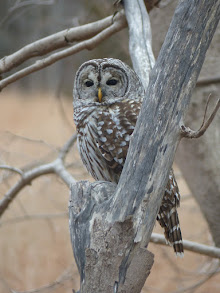
Miscellaneous photos, all taken this spring within a mile of downtown, of some of our distant cousins in the Being business.
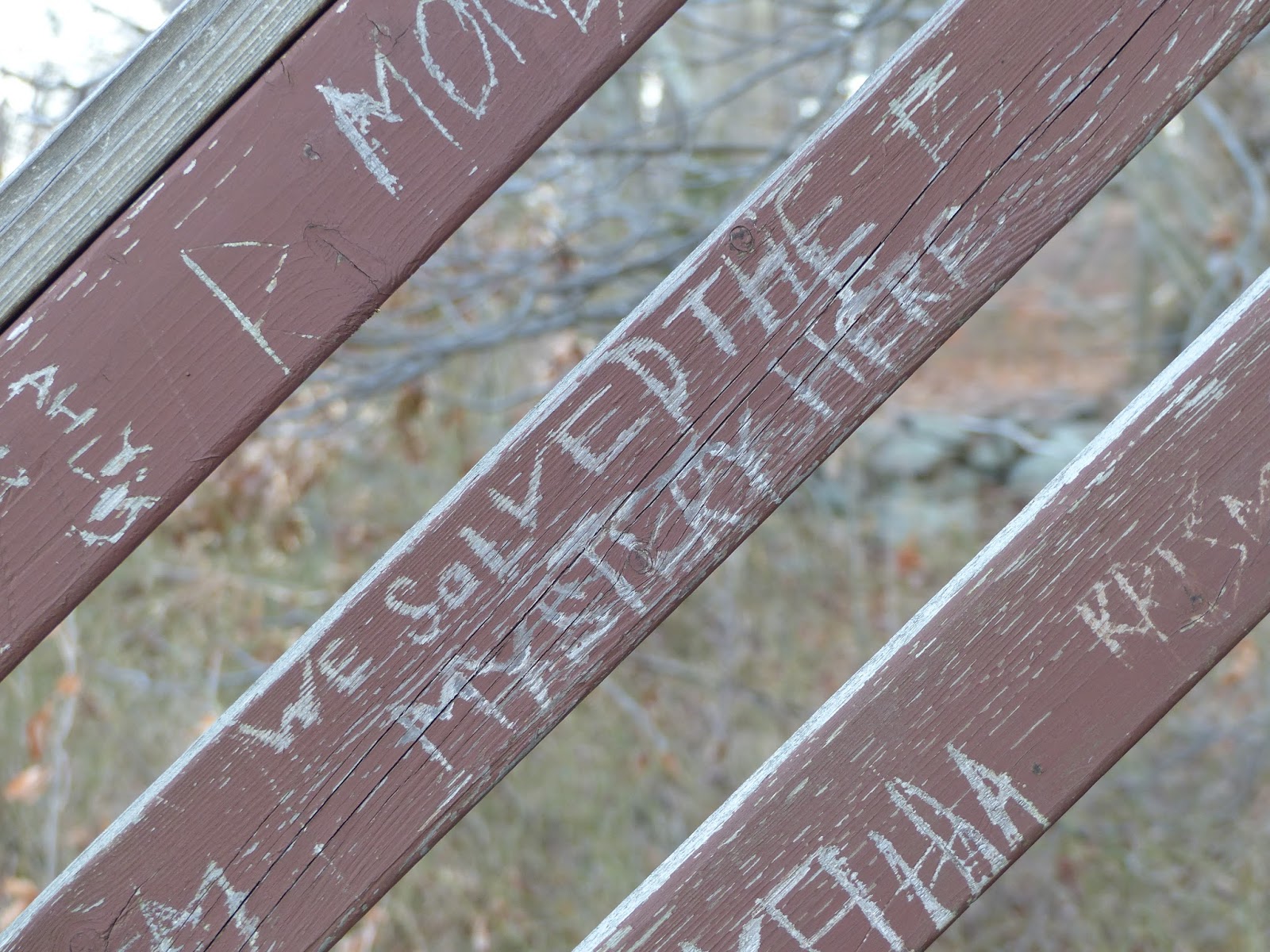
From top: unidentified snake, green frog, box turtle, melanistic gray squirrel, rose-breasted grosbeak, feral cat. Below: raven, barred owl.
Update: In posting and titling the above, I had temporarily forgotten this passage from Henry Beston (even though I had used it last year):
We need another and a wiser and perhaps a more mystical concept of animals. Remote from universal nature, and living by complicated artifice, man in civilization surveys the creature through the glass of his knowledge and sees thereby a feather magnified and the whole image in distortion. We patronize them for their incompleteness, for their tragic fate of having taken form so far below ourselves. And therein we err, and greatly err. For the animal shall not be measured by man. In a world older and more complete than ours they move finished and complete, gifted with extensions of the senses we have lost or never attained, living by voices we shall never hear. They are not brethren, they are not underlings; they are other nations, caught with ourselves in the net of life and time, fellow prisoners of the splendour and travail of the earth.
Well, they say Pat Garrett has got your number
So sleep with one eye open when you slumber
'Cause every little sound might be thunder
Thunder from the barrel of his gun.
This Bob Dylan song first surfaced on the soundtrack of Pat Garrett and Billy the Kid, a 1973 Western I've never seen (and in which Dylan has an acting role). The song has a number of verses, but this much later live cover by Gillian Welch and David Rawlings pares it down to four, in keeping with the starkness and simplicity of the performance (and the black-and-white cinematography). Rawlings's guitar work, in fact, is anything but simple, but he plays, as always, with such unassuming, seemingly effortless command of his instrument (a vintage Epiphone archtop) that it never jars or interferes.
Four verses, four plain-spoken lines each, scraps of a tattered tale about a long-dead gunslinger, it's almost enough to reconcile one with a world that is, more evidently than ever, far too much with us. Hopefully there's a quiet corner of the future where things like this still matter.
This version of "Billy" is available on a DVD entitled The Revelator Collection, which can be purchased from Gillian Welch's webstore.
Update (November 2017): The New York Times reports on a newly-discovered tintype that may show Pat Garrett and Billy together.
Though I never really gave much thought to it at the time, I grew up in a region whose contours were profoundly shaped by the requirements of New York City's water supply, and by a series of remarkable engineering projects that created a system of interlocking reservoirs in an area that had previously been criss-crossed by a network of modest streams. Vast tracts of farmland were inundated, or seized by the city in order to protect the watershed, and in a few cases whole communities were flooded (or moved). Today you can drive along certain winding roads (as I like to do) and see miles of largely unbroken woodland, almost none of which existed a century ago.
All of this was accomplished well before I was born, and large-scale modification of the landscape is, at least in the Northeast and for understandable reasons, no longer in fashion, but I can't deny that the changes have had their aesthetic, as well as utilitarian, benefits, adding an element of grandeur to an area that, whatever its virtues, might otherwise have lacked drama.
The video above shows a portion of the spillway of the New Croton Dam, inaugurated in 1906, at about 6:30 on an April afternoon.
KK (his full name is Kristján Kristjánsson, and his initials are pronounced "cow cow") is an Icelandic singer-songwriter whose music I first encountered entirely by chance during a boat trip in Reykjavík harbor a few years ago. I picked up some CDs while I was there and managed to obtain another after I got home, but his records aren't exactly easy to obtain in the US (though as it happens, he was born in Minnesota). The three songs below are from a 2008 album called Svona eru menn. I speak no Icelandic so don't ask me what any of the lyrics mean, but I really don't care; I could listen to this music all night (and I just may). One of these years I may even get my hands on a copy.
Update:Svona eru menn can be downloaded from IcelandicMusic.com. The CD seems to be essentially impossible to locate.
Walking a woodland trail the other day through an area with a number of dramatic rock outcroppings, I zeroed in on this particular boulder incised with what, to my eye at least, very much resembled the profile of a crow, a raven, or perhaps a buzzard, with a second, more ambiguous profile directly behind it. The resemblance — the protruding beak, the circular eye — became more convincing the longer I looked.
It's at least dimly possible that a human hand has been at work here, perhaps in adding detail to a stone that originally looked only vaguely avian, but I suspect it's entirely the chance work of nature. With different light, from a different angle, on a different afternoon, the "profile" might not be evident at all. But our psychological impulse to find facial figures even in inert matter must be very strong, and lies, I suspect, at the origin of many things — art, language, religion. The ability to recognize a pattern, to transform that pattern into an information-bearing symbol, is surely the first step down the road to reading. And yet the ability must long predate us; animals too know instinctively what a face is, and even if differences in vision and psychology make it unlikely that they would see anything at all in this particular boulder, they are alive to all kinds of signs — visual, aural, olfactory — whose interpretation is a key part of their mental world.
Below are two more woodland presences: a stone cat (with a bit of imagination), and a howling Ovidian wood-beast.
A man accidentally time-travels back to 1959, and is arrested on suspicion of counterfeiting when he attempts to buy lunch with a five-dollar bill dated decades in the future. His story is disbelieved until police open his wallet and find a photograph of a woman sitting under the completed Gateway Arch in St. Louis, ground for which has only recently been broken.
I'm in the early stages of a long slow re-read of Cortázar's Hopscotch, and this time I'm making a point of annotating some of the many allusions scattered through the pages of the novel, allusions which would have been time-consuming to identify in the pre-internet when I read it for the first time (c.1978?), but which can now generally be tracked down in a matter of seconds. (There's even at least one Spanish-language blog specifically devoted to the task, Mi Rayuela.)
More on that project, perhaps, another time; this morning I looked up a scrap of French that can be found in Chapter 71: Tout va très bien, madame La Marquise, tout va très bien, tout va très bien. Here's a performance of the song from which those words were taken: [Video no longer available]
For those with no French or whose French is as creaky as mine, the gist of the song is that Madame la Marquise (here played by a man in drag) has been away from home for a few weeks and calls her servants on the phone to check on things. Everything's fine, they assure her, well, except for one little incident: her gray mare has died. How did this happen?, she asks. Well, it happened when the stables burned down. In succeeding verses we learn that the stables caught fire when the
château burned to the ground, and that the château in turn was set ablaze by the candles her husband knocked over in the process of killing himself, having discovered that he was ruined financially. Other than that, tout va très bien!
The song was new to me, but not the comic routine, a staple of American folklore, renditions of which I heard various times when I was growing up. A version from Missouri, for example, begins as follows:
An old Missouri farmer hardly ever leaves home. He is one of those people who doesn't trust the world to keep on turning if he doesn't keep an eye on it. But this one time he must go to the city for a few days. His first evening in his hotel, he calls home, and his hired man answers. And our farmer says, "So, everything all right at home?"
"Jus' fine, Boss, 'cept you know your dog? Ol' Shep got holt a some dead horse meat, and it kilt 'im."
The farmer is upset, of course, that dog was a good old friend. But then it occurs to him to wonder, "Where did Shep get holt of dead horse meat?"
"Well, Boss, the horses died when the barn burned, and ol' Shep got holt a some dead horse meat, and it kilt 'im."
In the US the candles that set the fire are usually on the coffin of the mother / husband / mother-in-law of the person who has been absent.
To round out this story, a few moments after I identified the source of Tout va très bien, madame La Marquise, I visited (as I do regularly) a nice slice of tororo shiru, the blog maintained by a French copain who writes under the name Tororo, and read his most recent post. The subject was a dream he had in which someone dear to him died; the title of the post: Tout va bien.
Update (2022): There's a passing reference to the song in Georges Perec's novel La vie mode d'emploi. In Chapter 44, Perec describes how, during the liberation of Paris, a young member of the resistance, Olivier Gratiolet, receives and transcribes what are supposedly encoded messages using a clandestine radio receiver hidden in the basement of the apartment building where he lives. The messages include (in David Bellos's translation) the likes of "the presbytery has lost none of its charm nor the garden its splendour," "the archdeacon is a past master at Japanese billiards," and (in the original) "tout va très bien, Madame la Marquise."
"At the extreme, if climate change wreaks havoc on the social and economic fabric of global linchpins like Mexico City, warns the writer Christian Parenti, 'no amount of walls, guns, barbed wire, armed aerial drones or permanently deployed mercenaries will be able to save one half of the planet from the other.'" — Michael Kimmelman, "Mexico City, Parched and Sinking, Faces a Water Crisis," the New York Times, February 17, 2017
Also this week, Mike Males writes, in the Los Angeles Times:
Over the last two decades, California has seen an influx of 3.5 million immigrants, mostly Latino, and an outmigration of some 2 million residents, most of them white. An estimated 2.4 million undocumented immigrants also currently live in the state...
And yet, according to data from the FBI, the California Department of Justice, and the Centers for Disease Control, the state has seen precipitous drops in every major category of crime and violence that can be reliably measured. In Trump terms, you might say that modern California is the opposite of "American carnage."...
Before the early 1990s, California had one of the country’s highest rates of violent death. It has since fallen by 18%, and did so as the average rate of violent death across the rest of the country rose 16%. Overall, Californians are 30% less likely to die a violent death today than other Americans.
In fact, compared with averages in all other states, California now has 33% fewer gun killings, 10% fewer murders overall, and 30% fewer illicit-drug deaths. When overdoses from illicit drugs rose 160% in the rest of the country, between 1999 and 2015, they rose only 27% in California.
In nearly every respect, California’s statistics contradict the image of America painted by Trump in his inaugural address — a place of rampant violence, drugs and crime, all stoked by liberal immigration policies.
The attractions: solitude and secrecy—the orchard in the hills like a kingdom, the forbidden manufacture of liquor a prowess all my own, blessed with the contemplation of fir and beech, wild plum and cherry, and the company of the shy marten and jay as well as of cocky wrens and wagtails; the challenges of hiking, labor, and barter; the relief of exhaustion; the reassurance of a smartly contracted horizon; the refuge of my dwelling, small, neat, and warm, with its pots of flowering wallpepper and thyme, my pet dormouse staring around the thyme, and the new ikon over my writing stool whose wood shines in the clear frame of stenchless fresh oil; soft if short hours in the lamplight, pen in hand, showered with the random amber of phantasmal summers, abundances, triumphs of art; visits from the widow.
The title section of the late Harry Mathews's Armenian Papers: Poems 1954-1984 purports to be an adaptation of an Italian translation of a lost Armenian original, "a manuscript of medieval poems that had mysteriously and irrevocably disappeared during the decade preceding the First World War," whose existence was revealed to Mathews, Marie Chaix, and David Kalstone in 1979 during a visit to the Armenian monastery of San Lazzaro in Venice by a certain Father Gomidas. San Lazzaro does in fact exist, and the three writers may well have made such a visit; the rest is made up out of whole cloth, perhaps inspired by a package of papier d'Arménie.
This morning I crossed paths with a foraging possum. I'm not sure which of us was the more startled (the trail was otherwise deserted), but I took my pictures and went on my way.
Elsewhere, I found the decaying skeleton of a great horned wood-beast.
I may be in the minority here, but I really think that most if not all readers of Krazy Kat during Herriman's lifetime would have had a hard time thinking of Krazy as anything but African-American... one detail in Herriman's strip that would have absolutely cemented this identity in the minds of contemporary readers has since passed into obscurity: Krazy Kat's banjo. Through received clichés and shifts of poverty and culture in America, the banjo has come to be thought of as an instrument of poor whites, but at the turn of the century, it was as emblematic as a watermelon as part of the African-American stereotype. In fact, the banjo has a solemn origin: descended from the West African akonting, xalam, and ngoni instruments, played as an accompaniment to storytelling by Wolof griots in Senegal or the Jola in Gambia, early instruments like what became the American banjo were recreated by American slaves from whatever plantation materials were at hand — gourds, turtle shells, coconuts, animal skins — to try to hold on to a memory of life and culture torn from their grasp.
To the modern reader, the banjo in Krazy Kat might seem a lighthearted accessory, but when Krazy picks it up to sing "There is a Heppy Land Fur, Fur Away," the meaning, to thoughtful readers of the 1920s to the 1940s, would have been clear. Even more astonishingly, Krazy never plays a "proper" banjo, but plays the gourd or coconut banjo, the origins of which by the time of the strip's appearance would indeed have been obscure. Herriman knew what he was doing, and it's not insignificant that the very last strip he left unfinished on his drawing table showed Krazy playing a gourd banjo.
Caminante, son tus huellas el camino y nada más; Caminante, no hay camino, se hace camino al andar. Al andar se hace el camino, y al volver la vista atrás se ve la senda que nunca se ha de volver a pisar. Caminante, no hay camino sino estelas en la mar.