Sunday, January 22, 2017
Green
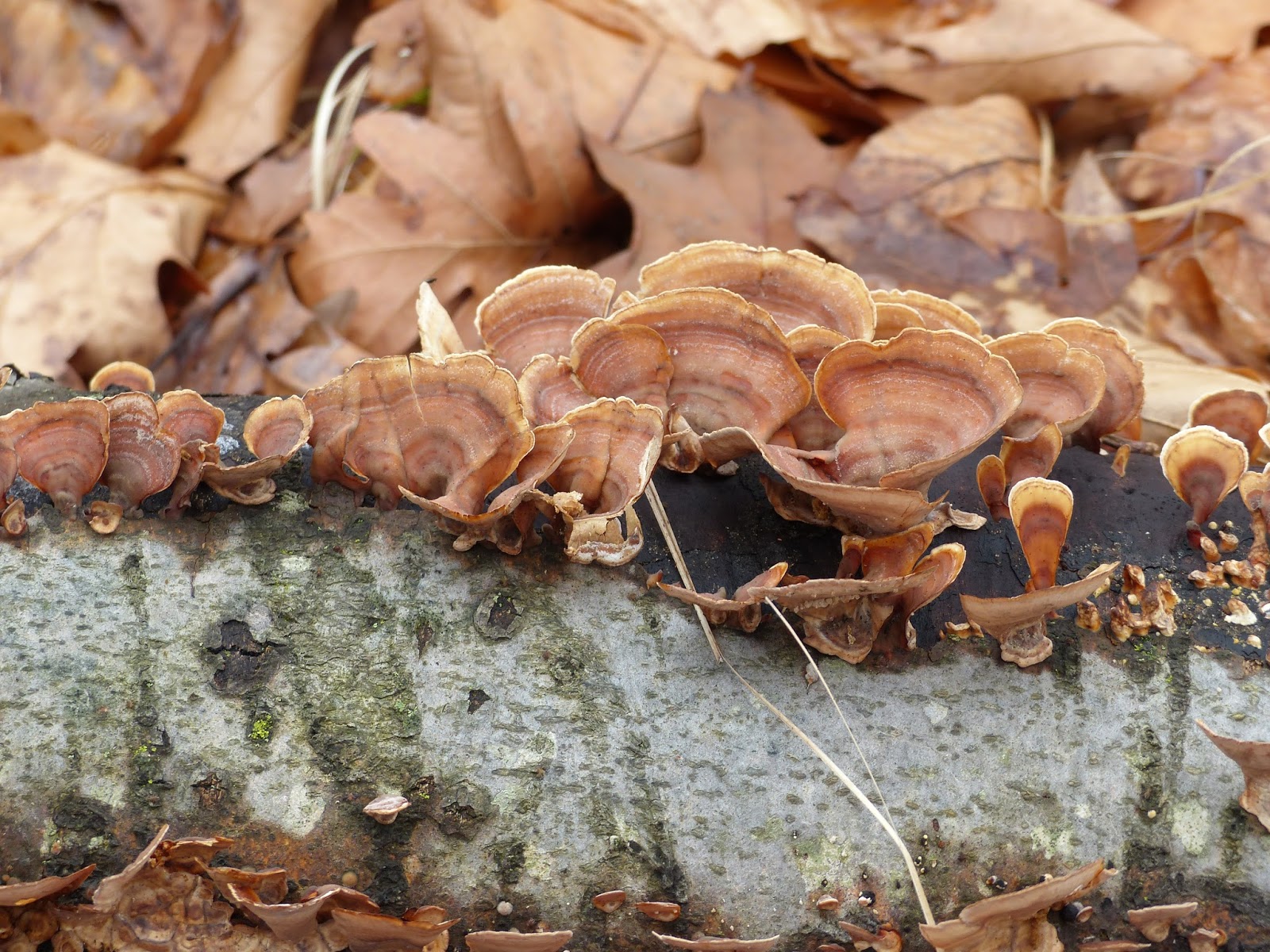
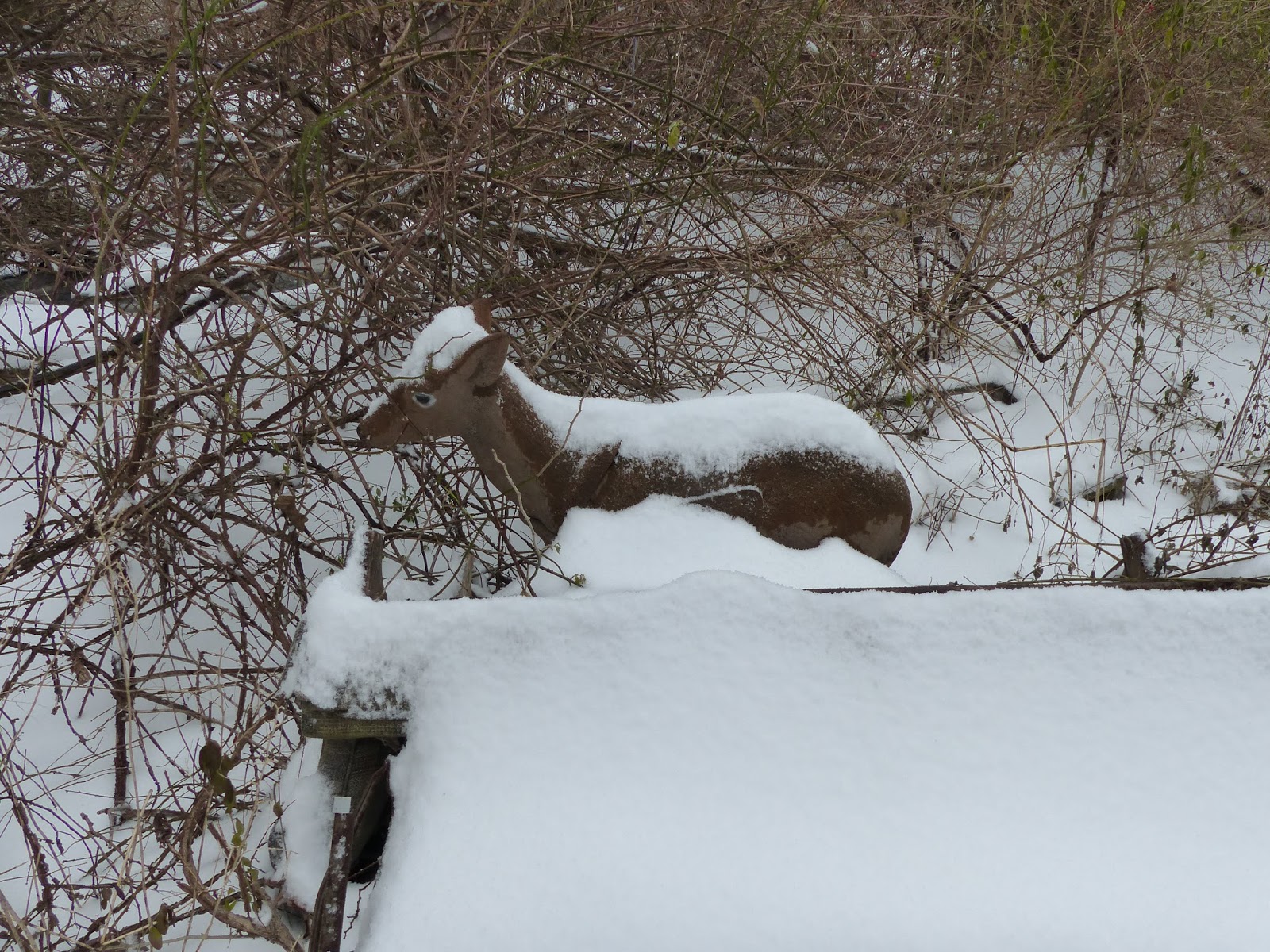
These photos were taken in and around a tiny dry stream-bed or rill a few minutes' walk from where I live. Partly obscured by fallen trees, the location is only a few yards off a well-traveled trail, and there are signs of occasional visitors (water bottles, beer cans), but all things considered it's surprisingly pristine. There's no visible water in the gully, at least at the moment, but the water table is high enough to support a rich growth of mosses, lichens, fungi, and other flora. There are some interesting rock formations and veins of minerals as well.
I spent an hour or so clambering up the slope, trying to avoid crushing the delicate vegetation, taking as many photographs as I could, until I reached a knoll surmounted by the stone sentinels shown below. I'll go back again, but in the future I'll stick to the edges. Some things need their own space.
Saturday, January 21, 2017
Rising Voices
Today, the New York Times has an astonishing series of photos from the
Friday, January 20, 2017
Notes for a commonplace book (21)
If a man gives up poetry for power,
He shall have lots of power.
— Mark Strand, "The New Poetry Handbook"
For what shall it profit a man, if he shall gain the whole world, and lose his own soul?
— Mark 8:36
A man without a moral code is just an appetite.
— Peter Blegvad, "King Strut"
When I was first in Czechoslovakia, it occurred to me that I work in a society where as a writer everything goes and nothing matters, while for the Czech writers I met in Prague, nothing goes and everything matters.
— Philip Roth (1975 interview)
À l'aurore, armés d'une ardente patience, nous entrerons aux splendides Villes. (At dawn, armed with a burning patience, we shall enter the splendid Cities.)
— Arthur Rimbaud, "Adieu"
You can hold back from the suffering of the world, you have free permission to do so and it is in accordance with your nature, but perhaps this very holding back is the one suffering you could have avoided.
— Franz Kafka, "Reflections on Sin, Pain, Hope, and the True Way" (Muir translation)
Ring the bells that still can ring
Forget your perfect offering
There is a crack in everything
That's how the light gets in.
— Leonard Cohen, "Anthem"
We are ugly but we have the music.*
— Leonard Cohen, "Chelsea Hotel No. 2"
*Also, he could have added, the art, literature, history, nature, science, scholarship, compassion, friendship, integrity, conscience, regret, resistance, subtlety, memory, imagination, humor, seriousness, curiosity...
Image: George Herriman's Krazy Kat, exact source unknown.
Update: one more, too good not to include:
The world is a dog's curly tail – no matter how many times we straighten it out, it keeps curling back. As artists we aspire to console, uplift and inspire. To unite us through sound across boundaries and borders and dissolve lines of demarcation that separate. The beautiful thing is that as human beings, even under the most adverse conditions, we are capable of kindness, compassion and love. Vision and hope. All life is one. Who knows, maybe one day we'll succeed. We go forward.
—Charles Lloyd
Labels:
Notes
Monday, January 16, 2017
Education in the Balance
A trailer from Brave New Films regarding our prospective Secretary of Education, Betsy DeVos, who sounds like she'll fit right in with the rest of the grifters who are preparing to run the country.
More information about DeVos is available here at the Nation.
Labels:
Soapbox
Wednesday, January 11, 2017
The Curiosity Cabinet of Captain Nemo
In the eleventh chapter of Jules Verne's Vingt mille lieues sous les mers, the narrator, the noted natural historian Professor Pierre Aronnax, is given a guided tour of the Nautilus, the vast submarine skippered by his host (and captor), the mysterious Captain Nemo. One room is fitted out as a kind of museum, adorned with priceless works of art as well as wonders of the undersea world, the latter all hand-collected by Nemo. Aronnax's description of these treasures, as he recalls them later, includes a catalogue of molluscs worth quoting in full. I'll translate only the beginning, because most of the paragraph consists only of glorious French names that can be appreciated even for their purely formal qualities alone — and because many of the words aren't in my dictionary in any case.
Un conchyliologue un peu nerveux se serait pâmé certainement devant d'autres vitrines plus nombreuses où étaient classés les échantillons de l'embranchement des mollusques. Je vis là une collection d'une valeur inestimable, et que le temps me manquerait à décrire tout entière. Parmi ces produits, je citerai, pour mémoire seulement...(The last-mentioned specimen is doubtless the cone shell known in English as the Glory of the Seas.) The rest of the paragraph is a headlong rush of names, some recognizable, others (to me) inscrutable.
["A somewhat nervous conchologist would surely swoon before other, more numerous showcases where samples of the line of molluscs were arranged. I saw there a collection of immeasurable value, of which time does not permit a full description. Among these productions, I mention, solely from memory..."]
- l'élégant marteau royal de l'Océan indien dont les régulières taches blanches ressortaient vivement sur un fond rouge et brun, - un spondyle impérial, aux vives couleurs, tout hérissé d'épines, rare spécimen dans les muséums européens, et dont j'estimai la valeur à vingt mille francs, un marteau commun des mers de la Nouvelle-Hollande, qu'on se procure difficilement, - des buccardes exotiques du Sénégal, fragiles coquilles blanches à doubles valves, qu'un souffle eût dissipées comme une bulle de savon, - plusieurs variétés des arrosoirs de Java, sortes de tubes calcaires bordés de replis foliacés, et très disputés par les amateurs, - toute une série de troques, les uns jaune verdâtre, pêchés dans les mers d'Amérique, les autres d'un brun roux, amis des eaux de la Nouvelle-Hollande, ceux-ci, venus du golfe du Mexique, et remarquables par leur coquille imbriquée, ceux-là, des stellaires trouvés dans les mers australes, et enfin, le plus rare de tous, le magnifique éperon de la Nouvelle-Zélande ; - puis, d'admirables tellines sulfurées, de précieuses espèces de cythérées et de Vénus, le cadran treillissé des côtes de Tranquebar, le sabot marbré à nacre resplendissante, les perroquets verts des mers de Chine, le cône presque inconnu du genre Coenodulli, toutes les variétés de porcelaines qui servent de monnaie dans l'Inde et en Afrique, la «Gloire de la Mer», la plus précieuse coquille des Indes orientales;...
- enfin des littorines, des dauphinules, des turritelles des janthines, des ovules, des volutes, des olives, des mitres, des casques, des pourpres, des buccins, des harpes, des rochers, des tritons, des cérites, des fuseaux, des strombes, des pterocères, des patelles, des hyales, des cléodores, coquillages délicats et fragiles, que la science a baptisés de ses noms les plus charmants.The image at the top of page is by Adolphe Philippe Millot (1857-1921).
.
Below, with another catalogue of marine marvels, is the Louisiana singer-songwriter Zachary Richard, singing a song he co-wrote with his young grandson Émile (the very amusing lyrics can be found here).
Que la coque de ton bateau soit imperméable à l'eau
Quand tu te lances à la mer.
Labels:
French,
Jules Verne,
Music,
Sea,
Zachary Richard
Saturday, January 07, 2017
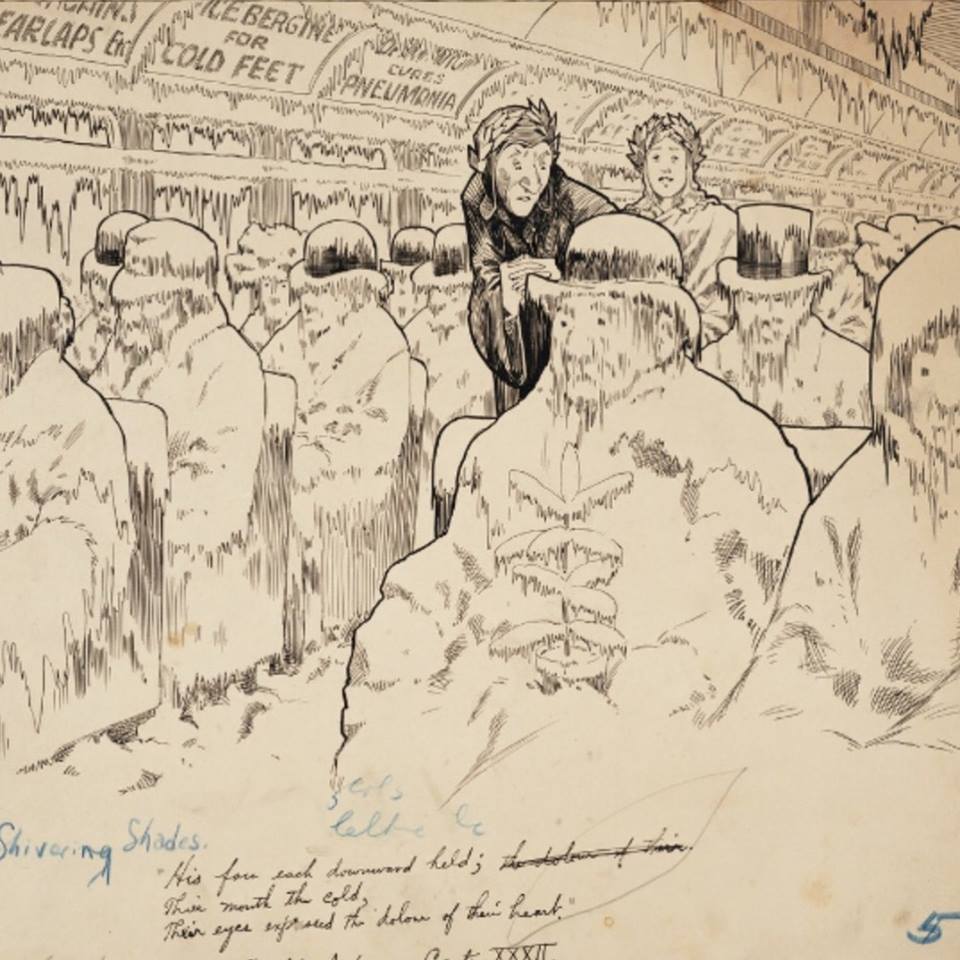
Dante on the BRT
His face each downward held; their mouth the cold,
Their eyes express'd the dolour of their heart.
"B.R.T.'s Icy Inferno" (cropped version), an undated original drawing by cartoonist Winsor McCay, inscribed with lines from H. F. Cary's translation of Inferno XXXII. The Brooklyn Rapid Transit Company went belly-up in 1919, a year after the Malbone Street Wreck killed scores of passengers, and the Billy Ireland Cartoon Library & Museum believes that the drawing is from the first decade of the twentieth century.
Monday, January 02, 2017
Sunday, January 01, 2017
For the New Year
From George Herriman's Krazy Kat, April 23, 1921. Click to enlarge the full strip below.
Source: the Comic Strip Library.
Friday, December 30, 2016
Testament
I am no poet—
and have no religion, no creed,
no faith except the little that I need
to get up in the morning
and dig in a few seeds
(not knowing even whether they will grow),
and yet
—still—
I hold
that compassion is better than cruelty,
love more virtuous than hate,
that the truth is what it is,
and that the idols of the mighty
—wealth, power, fame—
are false gods.
And that will have to do.
December 2016
Labels:
Poetry
Tuesday, December 27, 2016
Krazy, alone
I'm not sure of the origin of this panel, which I found on Tumblr with no further credit given. Herriman sprinkled a fair amount of Spanish into Krazy Kat, but the lettering doesn't appear to be his style, so I suspect it's taken from a Spanish-language translation. Spanish adjectives indicate gender, so here the gender-fluid Krazy is unambiguously male. Some rocks in the background.
Labels:
Comics,
George Herriman,
Krazy Kat
Monday, December 26, 2016
From the Archives: Krazy Kat
I dust off this piece, which I wrote more than fifteen years ago, in celebration of Michael Tisserand's splendid new biography, Krazy: George Herriman, A Life in Black and White. I've revised a few things slightly to take Tisserand's research into account (but any remaining errors are mine). An excellent two-part Comics Journal interview with Tisserand can be found here and here.
George Herriman was born in New Orleans on 22 August 1880. Like his younger contemporary Ferdinand Joseph LaMothe — better known as Jelly Roll Morton — Herriman was a New Orleans Creole, descended from the city's particular blending of French, Spanish, and African ancestries. Unlike Morton, Herriman left the city at an early age, when his parents moved to Los Angeles, possibly in search of an environment in which the family's ancestry could more easily be erased. From then on the Herrimans silently "passed as white." George Herriman tended to keep his hat on, indoors or out, apparently to conceal his “kinky” hair.
Herriman eventually moved to New York City, where the art of the newspaper cartoon was having its great flowering. In the pages of the city's furiously competing newspapers the work of Winsor McCay, F. W. Outcault, and other brilliant artists had begun to appear, and Herriman soon joined their number. Even in his early strips, with names like Professor Otto and His Auto and Acrobatic Archie, there's no mistaking the originality of his storylines or the excellence of his draftsmanship, and if Herriman's career had ended in, say, 1910, he'd be counted as one of the more interesting cartoonists of the day. But while the careers of some of his peers — such as the prodigiously gifted McCay — would show a gradual decline in originality and technique, Herriman was poised to take a great leap ahead by creating Krazy Kat, the sublime and unaccountable masterpiece of American comic art, which somehow managed to preserve its freshness, wit, and uniqueness from its origins in 1910-1913 until Herriman died, in 1944, with unfinished strips still on his drawing table.
Appropriately, Krazy Kat wasn't really born (such creations exist ab aeterno, waiting to be summoned) but gradually evolved out of the margins of Herriman's other work. According to Krazy Kat: The Comic Art of George Herriman, compiled by Patrick McDonnell, Karen O'Connell, and Georgia Riley de Havenon, the first “beaning” of Kat by Mouse appeared in the foreground of Herriman's strip The Dingbat Family on 26 July 1910, silently upstaging the domestic goings-on behind them. Within a few months the still-rudimentary sketches in the bottom of the panels had been separated into a tiny, parallel strip of their own, providing a kind of commentary on and counterpoint to the main action above. Not until 28 October 1913 did Krazy Kat become a separate feature; although Herriman would continue to draw a number of other strips for years, it was now Krazy Kat which would be forever associated with his name.
So what was it that made Krazy so special? It's premise could hardly be simpler, or — seemingly — less promising. Krazy Kat loves Ignatz Mouse, who for his part loathes the cat, whom he regularly rewards with a beaning with a well-aimed brick. The beanings don't lessen Krazy's affection a whit — in fact Krazy takes the brick as a token of love. Officer (or “Offissa”) Pupp, the third member of the triangle, faithfully dedicates himself to the protection of Krazy's noggin, dutifully hauling Ignatz off to jail to prevent or to punish Ignatz's crime. Such a relatively fixed, repeated plotline was not unusual; McCay's brilliant Little Nemo, as visually ambitious as it was, invariably ended with its namesake tumbling back to his bed, crying out for his parents. (Maurice Sendak's In The Night Kitchen, an affectionate homage to McCay, borrows the storyline.) And while Herriman varied the outcome subtly now and then, and sometimes dispensed with the bricking altogether, the same basic structure remained in place for more than thirty years.
What made Krazy Kat distinct was a combination of things. First, there was Herriman's seemingly limitless ability to riff, to invent permutations, extensions, and wrinkles on his theme, and to work into the strip endless gleanings from 20th-century American life. The characters (especially Krazy) speak in an inimitable patois drawn from slang, Brooklynese (“Dissiving” for “deserving”), Yinglish (“Dahlink”), Spanish and French, perhaps the New Orleans dialect called “Yat,” highfalutin jargon — often mispronounced or misused — (“cerulean,” “purveyor,” “somniferous,” “obstikil dillusion”), invented words (“windage,” “adenoiding”), and whatever else filtered into Herriman's ear or fancy. (Herriman's first language, interestingly, was apparently French.) Of course using dialect has been a staple of American comedy since at least Mark Twain, and has often been used to define social distance. There's no condescension or mockery in Krazy Kat's use of dialect, however; on the contrary the strip is a monument to Herriman's enduring fascination with and affection for the mingling voices and possibilities of the mongrel American vernacular. Herriman, like Joyce, was an artist who painted with voices, accents, and neologisms.
Then there's the curious indeterminateness of the strips. Herriman's characters enact their tiny dramas against the stark, surreal moonscape of “Coconino County,” based on Herriman's beloved American Southwest, which he visited often. From frame to frame mushrooms, buttes, pyramids, castles, and trees drift in and out behind the characters, with no attempt at continuity or consistency. Even the gender of the hero(ine) is curiously undefined. Krazy is generally (but not consistently) referred to in the strip as “he,” yet seems to behave as a female in relation to the male Ignatz. When asked about this, Herriman characteristically said he didn't know. In the fanciful freedom of a cartoon strip, something as apparently fundamental as the question of a character's gender could be left blithely unsettled, drifting now one way, now another.
It's tempting (and not new) to try to connect Herriman's casualness about landscape, dialect, and gender with the ambiguousness of his own ethnic background. What evidence there is suggests that Herriman was aware that he had some African-American ancestors and largely kept the fact to himself, not a surprising choice given the personal and professional restrictions endured by African-Americans in his time. It's more than likely that, under the circumstances, Herriman wouldn't have received major newspaper distribution if he had been publicly "outed" as an African-American. To some, no doubt, Herriman's “passing” is dishonest, but given the absurdity of the rigid racial categories then enforced in much of the country, under which “one drop of blood” from an African ancestor was sufficient to distinguish “black” from “white,” who is to say that Herriman's refusal to let someone else define his “race” was the wrong choice? Did Herriman, in his strips, summon the spirit of a more relaxed and fluid conception of American identity?
In the end there simply isn't any accounting for Krazy Kat. A creation so generous, so uncorrupted, so perfectly simple and so infinitely convoluted, should, by logic, never have been able to exist at all, much less survive in the newspapers for more than thirty years. That it did is in part a tribute to William Randolph Hearst, who, whatever his other sins, loved cartoons; in part a tribute to American audiences, who just possibly weren't as dumb as one might think; but most of all it's a tribute to Herriman, who deserves the last word. In 1917 he drew a strip in which Krazy comes upon a ouija board lying on the ground. Told that it divines who one's friends or enemies are, Krazy asks the board “Weeja, weeja, who is it I got for a 'enemies'?” and the board, naturally, spells out I—G—N—A—T—Z. Enraged at this slander, Krazy stomps on the board and walks off in a huff. Ignatz then happens along, finds the mangled board, which turns out to have been his, and correctly assumes that Krazy must be responsible for its destruction. Inevitably, Ignatz's brick strikes Krazy, who then exclaims: “See!! Didn't I tell you he was my friend? That 'Weeja' is a fibba!!!” Herriman ends the strip by addressing the spirits from the otherworld:
“You have written truth, you friends of the 'shadows', yet be not harsh with 'Krazy'. He is but a shadow himself, caught in the web of this mortal skein. We call him 'Cat', we call him 'Crazy' yet he is neither. At some time will he ride away to you, people of the twilight, his password will be the echoes of a vesper bell, his coach, a zephyr from the west. Forgive him, for you will understand him no better than we who linger on this side of the pale.”
Update: Thanks to the good offices and enthusiasm of A Nice Slice of Totoro Shiru, this post is now également disponible en français! Tororo notes that a new multi-volume French translation of Krazy Kat has just been issued, and I'll bet Krazy and the gang are tickled pink about that.
Labels:
Comics,
George Herriman,
Krazy Kat
Saturday, December 17, 2016
Angels & Objects
From top: a carved figurine at the site of a former encampment of the homeless; local fauna; a relic found among the roots of a fallen tree.
The Woods, December 2016.
Labels:
Migrations,
Photography
Sunday, December 11, 2016
The Way It Is (Mark Strand)
(A poem from a different time and different circumstances — but like all good prophecies, it has broken the bounds of whatever impulses first brought it into being.)
THE WAY IT ISImage: Jasper Johns. Mark Strand can be heard reading the poem here.
The world is ugly,
And the people are sad
-Wallace Stevens
I lie in bed.
I toss all night
in the cold unruffled deep
of my sheets and cannot sleep.
My neighbor marches in his room,
wearing the sleek
mask of a hawk with a large beak.
He stands by the window. A violet plume
rises from his helmet's dome.
The moon's light
spills over him like milk and the wind rinses the white
glass bowls of his eyes.
His helmet in a shopping bag,
he sits in the park, waving a small American flag.
He cannot be heard as he moves
behind trees and hedges,
always at the frayed edges
of town, pulling a gun on someone like me. I crouch
under the kitchen table, telling myself
I am a dog, who would kill a dog?
My neighbor's wife comes home.
She walks into the living room,
takes off her clothes, her hair falls down her back.
She seems to wade
through long flat rivers of shade.
The soles of her feet are black.
She kisses her husband's neck
and puts her hands inside his pants.
My neighbors dance.
They roll on the floor, his tongue
is in her ear, his lungs
reek with the swill and weather of hell.
Out on the street people are lying down
with their knees in the air, tears
fill their eyes, ashes
enter their ears.
Their clothes are torn
from their backs. Their faces are worn.
Horsemen are riding around them, telling them why
they should die.
My neighbor's wife calls to me, her mouth is pressed
against the wall behind my bed.
She says, "My husband's dead."
I turn over on my side,
hoping she has not lied.
The walls and ceiling of my room are gray —
the moon's color through the windows of a laundromat.
I close my eyes.
I see myself float
on the dead sea of my bed, falling away,
calling for help, but the vague scream
sticks in my throat.
I see myself in the park
on horseback, surrounded by dark,
leading the armies of peace.
The iron legs of the horse do not bend.
I drop the reins. Where will the turmoil end?
Fleets of taxis stall
in the fog, passengers fall
asleep. Gas pours
from a tricolored stack.
Locking their doors,
people from offices huddle together,
telling the same story over and over.
Everyone who has sold himself wants to buy himself back.
Nothing is done. The night
eats into their limbs
like a blight.
Everything dims.
The future is not what it used to be.
The graves are ready. The dead
shall inherit the dead.
Labels:
Mark Strand,
Poetry,
Prophecy
Tuesday, December 06, 2016
Notes for a commonplace book (20)
Robin Wall Kimmerer:
I am trying to understand what it means to own a thing, especially a wild and living being. To have exclusive rights to its fate? To dispose of it at will? To deny others its use? Ownership seems a uniquely human behavior, a social contract validating the desire for purposeless possession and control.Gathering Moss: A Natural and Cultural History of Mosses
To destroy a wild thing for pride seems a potent act of domination. Wildness cannot be collected and still remain wild. Its nature is lost the moment it is separated from its origins. By the very act of owning, the thing becomes an object, no longer itself.
(Kimmerer, a biologist who specializes in the ecology of mosses, describes in the chapter from which the above is taken how she was commissioned by an unnamed wealthy landowner to consult on an "ecosystem restoration project" on his estate, an undertaking that turned out to involve more vandalism of nature than restoration of it.)
Labels:
Natural history,
Notes
Friday, December 02, 2016
Birch season
Now that the leaves are off the trees it's the birches I'm noticing more, rather than the grander beeches, oaks, and tulip-trees in the same woods. The ones shown here are black birch (Betula lenta), not to be confused with the birches in Robert Frost's poem, which were — he insisted — gray birch (Betula populifolia). In common with other birches, their bark has prominent lenticels — horizontal pores — though these may become less visible on older specimens.
These are adaptable and malleable trees, susceptible to injury and rot but also possessing a great ability to heal themselves and keep on growing. Once they fall, though, they are quickly consumed by rot.
Tuesday, November 29, 2016
Rain (Pessoa and Vallejo)
It rains and keeps raining. My soul is wet from hearing it. So much rain. . .
— Fernando Pessoa, The Book of Disquiet
I will die in Paris in the rain
on a day I already remember
I will die in Paris — I won't deny it —
maybe on a Thursday, like today, in autumn
— César Vallejo, from "Black Stone on a White Stone"
This afternoon it is raining, as never before; and I
have no desire to live, my heart.
This afternoon is sweet. Why shouldn't it be?
Dressed in grace and pain; dressed like a woman.
This afternoon in Lima it is raining. And I recall
the cruel caverns of my ingratitude;
my block of ice over her poppy,
stronger than her “Don’t be like that!”
— César Vallejo, from "Dregs"
It's hailing so hard, as if to make me remember
and augment the pearls
that I've recovered from the very snout
of every storm.
Don't let this rain dry up.
Not unless it's given to me
to fall now into it, or to be buried
drenched in the water
that wells up from every fire.
How far will this rain reach in me?
I'm afraid I'll be left with one side dry;
I'm afraid it will cease, without having tasted me
in the droughts of incredible vocal cords,
through which
to make harmony,
one must always rise, never descend!
Don't we in fact rise by descending?
Sing, rain, on the still-sealess coast!
— César Vallejo, Trilce, lxxvii
The Pessoa translation is by Richard Zenith; the first Vallejo translation is a mash-up of several versions and the second is by Clayton Eshleman but with modifications. The translation from Trilce is mine, but with borrowings from the versions of David Smith (Grossman, 1973) and Clayton Eshleman. The image is a detail from a photograph of César Vallejo by Juan Domingo Córdoba.
Labels:
Poetry
Monday, November 28, 2016
Hour of lead (2)
Citing no evidence, our president-elect — and how ashamed, how defiled one feels, personally and as a citizen, having to call him that — has proclaimed himself the legitimate winner of the 2016 popular vote, alleging that millions of votes for his opponent were fraudulently cast. That no one worthy of respect takes his claim seriously makes no difference; we're in a post-truth condition and it suffices to merely make an assertion, no matter how implausible. Those who believe him can fall back on a simple syllogism: America is a country of and for white Christians, the Republican candidate positioned himself as the candidate of that country, therefore he must have won the popular vote. Being non-white, or non-Christian, and calling oneself an American, is, so the logic goes, itself fraudulent, so the technicalities of whether there was actually any significant voter fraud (there wasn't) are quite beside the point. Those with a vested interest in believing this argument — or pretending to — will be untroubled by doubt.
It's going to be a long four years.
Previous post:
Hour of lead
Image: Jasper Johns.
Monday, November 21, 2016
The One Thing We Must Keep Alive
This rousing song by Los Lobos has been one of my favorites for more than thirty years. The video for it has a corny '80s feel to it now (not to mention the poor digital transfer), but it's worth a look if only for the footage of David Hidalgo and the rest of the band. In three verses and a bridge "Will the Wolf Survive?" manages to be about a lot of different things: wolves (at least as a metaphor), migrant workers and their families, cultural survival, and the truth: "something they must keep alive." (Of all of those things, wolves would now appear to be the least endangered.)
Los Lobos are still very much active, in a line-up that is unchanged except for the addition of a young and very able drummer; I saw them last night on a double-bill with the great Mavis Staples (who was in very fine form). They didn't play this song, nor did I catch any overt allusions in their music to recent political developments, but their presence itself was a reminder that there's more than one way to be American. The band switches comfortably from English to Spanish in their songs and they're perfectly capable of playing traditional norteño styles of music, but they identify as "a band from East L.A.," and they happen to be one of the great rock and blues bands of the last forty years.
Labels:
Los Lobos,
Migrations,
Music
Saturday, November 19, 2016
Consequences
Goya's great series of prints Los desastres de la guerra (The Disasters of War) is renowned for its depiction of the horrors of the Peninsular War, but many of the later prints in the series in fact capture the postwar chill that set in with the restoration of Fernando VII, who threw out the relatively enlightened Spanish constitution that had been promulgated in 1812 and began a wholesale persecution of liberals and the press. (Like the rest of Los desastres, these images remained unpublished during Goya's lifetime.)
The print at the top of the page is captioned simply "The Results"; Robert Hughes, in his book on the artist, glosses it thus: "a flock of Goya's nightmare bats, the lay and Church parasites that accompany Fernando, is descending on prostrate Spain." The one below bears the inscription "Against the Common Good."
According to Michael Armstrong Roche, in Goya and the Spirit of Enlightenment,
With his left hand the cleric writes something contra el bien general, while with his right he points up, signifying he acts in the name of God... "Common good" is an expression rooted in the Liberal political tradition; the cleric may therefore be drafting laws restoring Old Regime privileges on Fernando VII's return to power in 1814.The third print is captioned "Truth Died," and is interpreted as representing the burial of the 1812 Constitution.
The final image asks, of the same allegorical figure, "Will She Rise Again?"
Here's Hughes:
Lovely bare-breasted Truth begins to shine again, to move, while those who would bury her recoil in confusion, clutching their shovels and books. A feverish and tentative hope is reborn in Goya's darkness.¡Ojalá!
Tuesday, November 15, 2016
Planxty in their prime
Universal Music Ireland has released a modestly-priced CD & DVD package devoted to my favorite Irish trad band, Planxty. Entitled Between the Jigs and the Reels: A Retrospective, it doesn't appear to be officially available in the US thus far, but it can be obtained from Ireland or the UK without much difficulty if you look around. As far as I can tell, all of the tracks on the CD have been released previously (though a couple were new to me), but it's nice to have them together. The DVD is a different story: it's more than two hours and forty minutes of wonderful archival footage of the band during its heyday (the footage spans the years 1972 to 1982), and although some of it has been out there in one form or another much of it I had never seen. (A disclaimer warns that some of the archival material may have imperfections because of the quality of the source material, but I didn't find that to be an issue at all.)
Planxty last reunited for a series of concerts in 2005, and word is that it's unlikely that they will do so again, although all of the original members — Christy Moore, Andy Irvine, Dónal Lunny, and Liam O'Flynn — are still around and performing, sometimes in various combinations with each other. If their work together has run its course then this retrospective is a nice summing-up.
Below: Planxty from 1973 performing "Raggle Taggle Gypsy," with the famous transition into "Tabhair dom do lámh." Leagues O'Toole describes this arrangement as "possibly the first ever attempt to play a folk song straight into a traditional tune by an ensemble of Irish musicians."
Labels:
Andy Irvine,
Christy Moore,
Ireland,
Music,
Planxty
Subscribe to:
Comments (Atom)