Friday, July 01, 2016
Rot
Scenes from the woods, spring and summer 2016.
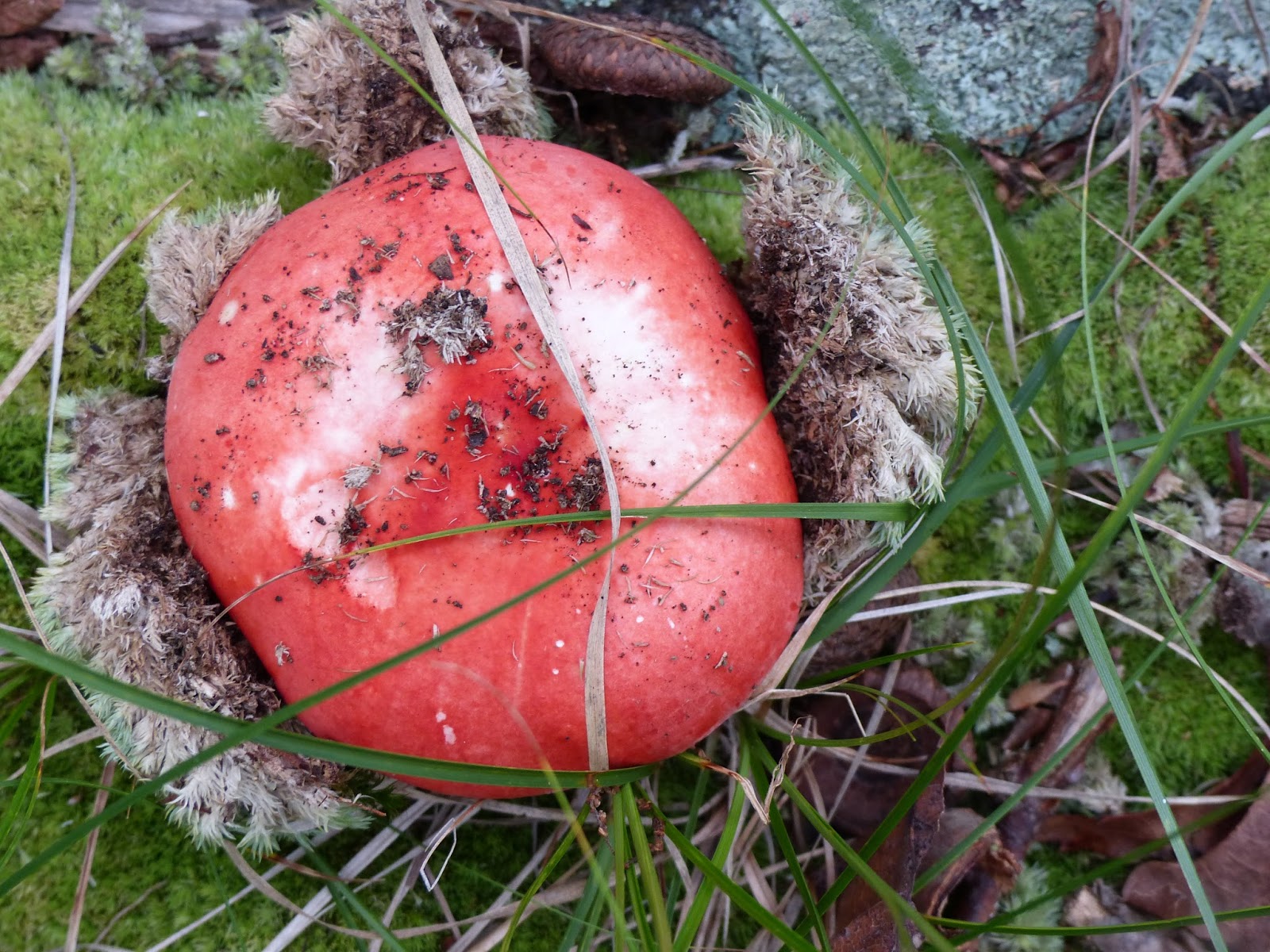
Many of these specimens seemed to appear overnight (or maybe I just didn't notice them), and many were gone or wasted away to nothing in a day or two. All are fungi except the second, which is Indian Pipe (Monotropa uniflora), and the last, which seems to be a slime mold. The brightly-colored insect in the third-to-last shot is one of the aptly-named Pleasing Fungus Beetles.
Update: Further rot below:
Above: Probably Climacodon septentrionalis.
Labels:
Fungi,
Natural history
Monday, June 27, 2016
The Door
He climbs the wooden stairway, his advancing shadow traced by sparse incandescent bulbs that emit, out of their little prisons of wire mesh, a faint whiff of singed insects. The banister is damp to his touch and he lets go. At each landing a hallway branches off; he pauses for breath but barely raises his eyes. He reaches the top storey. At the end of a long corridor there is a single door with a panel of unlettered frosted glass, diffidently backlit from within. He walks along the worn floorboards until he is within reach of the knob. As he lifts his hand to turn it he feels fingers grasp his shoulder from behind.
Labels:
Shadows
Sunday, June 19, 2016
The Clearing
One of the paths I often walk is bordered on one side by inpenetrable swamp, but today I spotted a place where I could cross easily onto an island of slightly higher ground. No one goes there. For whatever combination of reasons — light, water, chance — the understory that covers much of the edge of the swamp is absent here, nor is the spot as barren and brown as the deepest and oldest woods just a few yards away. Instead, there are nearly pure stands of ferns, a few patches of wispy grass, and here and there a fallen trunk.
At the base of a tree I found the sole remnant of some creature's successful hunt.
Labels:
Natural history,
Walking
Tuesday, June 14, 2016
Gregory Rabassa (1922-2016)
The translator Gregory Rabassa has died, according to a notice from the Associated Press.
Rabassa was a professor for many years at Queens College, but it was his work as a peerless translator of modern Latin American literature that secured his place in the literary firmament. Beginning in 1966 with an English-language version of Cortázar's Hopscotch (itself a daunting feat, given that novel's linguistic fireworks), he produced dozens of translations, including more than a few that, taken individually, would have been sufficient to secure his reputation: José Lezama Lima's Paradiso, Mario Vargas Llosa's Conversation in the Cathedral, Gabriel García Márquez's One Hundred Years of Solitude, and on and on and on. That he not only managed to translate such challenging, verbally sophisticated works at all but did so with scrupulous care and endless creativity is simply astounding. We owe him a very great debt.
Translator Susan Bernofsky has a nice appreciation.
Update: The New York Times now has a full obituary.
(Photo of Gregory Rabassa from the jacket of Rabassa's memoir If This Be Treason: Translation and Its Dyscontents, published by New Directions.)
Sunday, June 05, 2016
The Hundred-Acre Wood
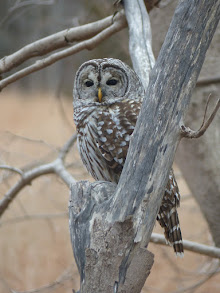
I got up early and set out on foot for the local park in search of a family of barred owls who either weren't around today or were keeping themselves out of sight. Though a light rain fell, beneath the leafed-out canopy I felt scarcely a drop. I can walk the trail that circles the wooded section of the park in ten or fifteen minutes, but this time instead I turned off into the interior of the woods, following a network of little trails that branch off here and there through sparse growth beneath tall beaches and tulip-trees and past parallel ridges of outcroppings, some topped with little cairns. Somewhere high above a single bird was calling plaintively, always the same five-note refrain — wee-HEE-heee, WEE-he — but even as its source seemed to drift from treetop to treetop I could never catch a glimpse of it. Four deer eyed me warily but held their ground; maybe they're used to me by now.
There were no other walkers today. There's a tacit fellowship of sorts among those mad enough to get up and walk the woods before work, but it's a reserved one, respectful of the cathedral-like atmosphere of the canopy as well as of the privacy of strangers whose reasons for needing to be there are their own.
On the leaf litter beneath some young beeches I found a pale white mushroom the size of a small melon — or of a brain, which in its convolutions it half-resembled. Perhaps the rest of the body lay still vertically interred, the eyes staring forward through the loam, awaiting its time. A host of tiny flies circled around it.
Labels:
Fungi,
Natural history,
Walking
Saturday, May 07, 2016
Cloud Chamber
Thomas Hardy:
Then these children of the open air, whom even excess of alcohol could scarce injure permanently, betook themselves to the field-path; and as they went there moved onward with them, around the shadow of each one's head, a circle of opalized light, formed by the moon's rays upon the glistening sheet of dew. Each pedestrian could see no halo but his or her own, which never deserted the head-shadow, whatever its vulgar unsteadiness might be; but adhered to it, and persistently beautified it; till the erratic motions seemed an inherent part of the irradiation, and the fumes of their breathing a component of the night's mist; and the spirit of the scene, and of the moonlight, and of Nature, seemed harmoniously to mingle with the spirit of wine.Tess of the D'Urbervilles
Monday, May 02, 2016
The Gloaming: 2
The ensemble known as The Gloaming (Thomas Bartlett, Dennis Cahill, Martin Hayes, Iarla Ó Lionáird, and Caoimhín Ó Raghallaigh) has released its second CD, entitled simply 2. While perhaps not as groundbreaking as the group's first release, it's still a very enjoyable record. My favorite track so far is the concluding one, "The Old Favourite."
A version of one track, "Casadh an tSúgáin," is featured in the movie Brooklyn, where it is sung on camera by Iarla Ó Lionáird. The cover image, as was the case with the first Gloaming CD, is by the artist-photographers Robert and Shana ParkeHarrison; it's called "Flying Lesson."
Labels:
Ireland,
Music,
The Gloaming
Saturday, April 30, 2016
The Water-Cure
Daniel Defoe:
I heard of one infected creature, who, running out of his bed in his shirt, in the anguish and agony of his swellings, of which he had three upon him, got his shoes on and went to put on his coat; but the nurse resisting and snatching the coat from him, he threw her down, run over her, ran down stairs, and into the street directly to the Thames, in his shirt, the nurse running after him, and calling to the watch to stop him; but the watchman, frightened at the man, and afraid to touch him, let him go on; upon which he ran down to the Stillyard stairs, threw away his shirt, and plunged into the Thames; and, being a good swimmer, swam quite over the river; and the tide being coming in, as they call it, that is, running westward, he reached the land not till he came about the Falcon stairs, where landing, and finding no people there, it being in the night, he ran about the streets there naked as he was, for a good while, when, it being by that time high water, he takes the river again, and swam back to the Stillyard, landed, ran up the streets to his own house, knocking at the door, went up the stairs, and into his bed again. And that this terrible experiment cured him of the plague, that is to say, that the violent motion of his arms and legs stretched the parts where the swellings he had upon him were (that is to say, under his arms and in his groin), and caused them to ripen and break; and that the cold of the water abated the fever in his blood.A Journal of the Plague Year
Defoe, in the person of the Journal's purported author, H. F., notes that he can not vouch for the veracity of the incident.
Labels:
Daniel Defoe,
London,
Notes
Thursday, April 28, 2016
The Woods
I've gone for a walk today, as I often do when I can spare the time. I put my things away, pulled on my jacket, and headed up the hillside behind the garden. At the far edge of the last plowed field, looking down over the village, there's an unmarked trail that leads into a ragged stand of sumac, aspen, and yellow birch. Go a little further, as the trail dips and climbs and weaves over outcroppings, little clearings, and rockfalls, and you come before long to the deeper woods, the smooth-barked beeches and great oaks, the mottled sycamores, the tulip-trees that rise like columns and disappear into the canopy above.
These woods have become my refuge when I need to be apart. I rarely meet anyone else up here, though the paths are well-worn. The others who tread here must do so in their own hour. On those rare occasions when I do meet someone we nod and smile, if we are strangers, then continue on our way; or if it is a friend we might linger for a moment's conversation, but then move off, respecting each other's need for solitude.
In a little hollow, near the foundation of an old cottage, there is something like a tiny shrine, though I have no idea what religion — if any — it might belong to. It's just a little alcove formed of stone, set above the ground a bit. Maybe once, long ago, it had some utilitarian purpose, a place to stash a pail to keep it out of the way, or something like that. As time passed and the cottage was abandoned the alcove was adopted and set to a new purpose, consecrated perhaps, to some resident spirit whose name is now no longer known — or maybe it just became the backdrop for some children playing some game invented on the spot. Occasional visitors, myself among them but I see I am not the only one, keep it swept out and adorn it, from time to time, with whatever is in our pockets or strikes our whimsy: bits of thread, wildflowers, a coin or a button. Sometimes I find snails sheltered inside, tiny ones, small enough to take shelter on the underside of a leaf, or the big brown ones that are said to be good eating though we never eat them. I'm careful not to disturb them if I can avoid it. They are there for their own reasons, as unknown to me as mine are unfathomable to them.
I go walking when I can, but that doesn't mean I come here often. Naturally there are many other things that I do; I have responsibilities. Who among us has the luxury of idleness? During the day, like everyone else, I work where I am needed, here and there, or in the fields around home. I have a wife, friends, I have children and animals to mind. And because I am not a hermit but a man who lives and works among men and women, who as we all know are spread over the surface of the earth as far as the mind can imagine, I have been known to travel, for weeks at a time even, journeying into cities and landscapes that are very different from my own familiar precincts, attending to the affairs that we share with others, in so far as it adheres to the habits and the laws we hold in common.
In time I always return, to the ones I love, to my own fields and hills. When I'm settled I make my way up to the woods again, noting the changes since my last visit, because these woods are in their own way a kind a river, of the sort of which a man once said that you could not set your foot in it twice without it being a different stream. Its current is a slow one, to be sure, but perhaps, measured in its own, infinitely longer scale of time, it flows just as swiftly as the river that lies, hidden by trees, behind me in the valley from which I have climbed.
There is much more I could say about my affairs, and I may get to all that, in time. The story of a man's life, of his works and days, can not be told in one sitting, nor from one vantage point, not even from so fine a prospect as the top of this hill, where the woods, as I walk on, have now thinned out into blueberry scrub, where the air cools and the wind scours, flicking a scattering of fine, sparse sand around the bare rocks. I eat and drink, I love, I watch my fellows age and I watch their children grow and seek their own way in the world, as I have sought my own, without, perhaps, finding it any more or less than they will in their turn. I spend my days doing what it has fallen to me to do, being whom I have become, whom I have been, perhaps, from the very start.
At night, like everyone else, I dream. Eyes closed, I step into the borderlands that lie between things as they are, as I know them to be, and things that are — what? — as I don't know them to be? If my dreams, now, seem as real as my waking life, am I then living only half my life at a time? Am I the same man in the hours between midnight and morning that I am between dawn and dusk? The longer I live the less sure I am of the answers to any of these questions.
Written in 2007, the above text has various fictional elements, although in essence it could almost serve as a journal of how I've been spending much of my time of late. It was originally conceived as part of a larger project that instead went in an entirely different direction.
Labels:
Walking
Friday, April 22, 2016
Continuity
Two poems about change, stone, farming, New England — and, obliquely, the ancient world. First up, Robert Frost:
Of the Stones of the PlaceSecond, Paul Goodman:
I farm a pasture where the boulders lie
As touching as a basket full of eggs,
And though they’re nothing anybody begs,
I wonder if it wouldn’t signify
For me to send you one out where you live
In wind-soil to a depth of thirty feet,
And every acre good enough to eat,
As fine as flour put through a baker's sieve.
I’d ship a smooth one you could slap and chafe,
And set up like a statue in your yard,
An eolith palladium to guard
The West and keep the old tradition safe.
Carve nothing on it. You can simply say
In self-defense to quizzical inquiry:
"The portrait of the soul of my Gransir Ira.
It came from where he came from anyway."
SawyerFrost's "eolith palladium" caught my eye. An eolith is a kind of flint nodule once thought to be artifactual in nature, but now considered to be the product of natural geological forces. The original Palladium or Palladion was an icon of Pallas Athena taken from the citadel of Troy and eventually transported to Rome by Aeneas; the word has since become generic for any kind of protective icon. The name of the element palladium is a later coinage, also ultimately derived from the compound epithet Pallas Athena.
These people came up here
only two hundred years ago.
A half a dozen names
of fathers in the graveyard
have brought us to the farmer
who used to be my neighbor.
But now his sons have quit
the beautiful North Country
for Boston where they will not find
a living or even safety.
The boy has joined the Navy
to bomb other farmers
where our Navy ought not to be.
“I set my mind on Ritchie.
I bought all the machinery for him
and the blue-ribbon cattle.
Now it has no point.”
So they have sold and gone
to San Diego
to see the boy on leave.
There will not be another
generation in America,
not as we have known it,
of persons and community
and continuity.
This poetry I write
is like the busy baler
that Sawyer bought for Ritchie,
what is the use of it?
But I am unwilling to be Virgil
resigned and praise what is no good.
Nor has the President invited me.
Labels:
Paul Goodman,
Poetry,
Robert Frost
Sunday, April 10, 2016
Missed connections
There were plenty of other kids in the neighborhood when I was small, and most of the time I played with them, but I had another friend who lived maybe three or four miles away, which meant that for us to get together, outside of school, one of us had to be driven. There wasn't, in the end, anything particularly special about our friendship, and I long ago lost track of him, though we never had a falling-out. What I really remember about him is that for a long time I had it my head that there was a trail through the woods that began somewhere not far from my house and came out near his. I don't remember why I believed this. It may have originated in a dream, perhaps a recurring one, or maybe it just arose somewhere along the permeable boundary between the real and the imaginary that often characterizes the mind in early childhood. Perhaps in some alternate world the door to which was only briefly open in those years there really was such a path.
The truth is, though, that I did live in a neighborhood largely surrounded by woods and abandoned fields, and though I knew those spaces fairly well when I was young, knew how to access them, knew what wonders or secrets they had to offer, that time is long past. I don't live there anymore, though I'm not so far away that I couldn't go back and take a look around if I really wanted to (and if the current homeowners weren't alarmed by the sight of a strange man wandering around just outside the perimeter of their back yards). In the end, though, that territory is no longer mine. It was a child's world, defined by coordinates of time and space that I've long since breached.
There were trails through those woods, and no doubt there still are, though they may be different from the ones I knew. The curious thing is that of all those pathways now closed off forever the one I remember the clearest is the one that never existed at all.
Labels:
Souvenirs
Sunday, April 03, 2016
Notes for a commonplace book (18)
Milan Kundera:
Man desires a world where good and evil can be clearly distinguished, for he has an innate and irrepressible desire to judge before he understands. Religions and ideologies are founded on this desire. They can cope with the novel only by translating its language of relativity and ambiguity into their own apodictic and dogmatic discourse. They require that someone be right: either Anna Karenina is the victim of a narrow-minded tyrant, or Karenin is the victim of an immoral woman; either K. is an innocent man crushed by an unjust Court, or the Court represents divine justice and K. is guilty.
This "either-or" encapsulates an inability to tolerate the essential relativity of things human, an inability to look squarely at the absence of the Supreme Judge. This inability makes the novel's wisdom (the wisdom of uncertainty) hard to accept and understand.
— From "The Depreciated Legacy of Cervantes"
Labels:
Milan Kundera,
Notes,
Novels
Saturday, March 26, 2016
Saturday, March 19, 2016
The Lost Pond
I don't know why this little body of water bears the name that it does. It's true that it's a bit isolated, though there's a well-maintained trail that runs along it. Perhaps it wasn't so much misplaced as simply forgotten. The woods around it, criss-crossed with stone walls, were once pasture-land, but that was long ago. It has outlived its original purpose, but on the day I visited, with the trees still bare and the ground covered with dry leaves, it provided a stopping-place for a pair of mallards. There were sounds of woodpeckers here and there, and the rest was mostly silence.
Labels:
Natural history,
Walking
Sunday, March 06, 2016
Late winter
Of late I've been taking weekend walks in a nearby nature preserve. The most surprising thing about these walks may be the utter stillness of the woods. When one first sets out the traffic noise from a nearby interstate highway is inescapable, but once over the first ridge there is hardly a sound: no squirrels, few birds (and only a handful of other hikers). Though the ground is covered with acorns in extraordinary profusion there is far less evident wildlife here than along the margins of town.
In addition to the oaks, the most evident trees are beeches, black birches, a few hickories, and tulip-trees.
Almost none of this land is old-growth forest. Except in the steepest or marshiest sections there are stone walls in sight almost everywhere, and in one spot, a spillway (which may be more recent; I'm not sure). Farming has moved elsewhere, to less stony ground.
Labels:
Natural history,
Walking,
Winter
Wednesday, March 02, 2016
Of Cabbages and Kings
Edward Gibbon on how the Roman emperor Diocletian, after abdicating the throne of his own free will, responded when his former co-emperor implored him to resume the purple:
He rejected the temptation with a smile of pity, calmly observing that, if he could show Maximian the cabbages which he had planted with his own hands at Salona, he should no longer be urged to relinquish the enjoyment of happiness for the pursuit of power.
Labels:
Notes
Thursday, February 25, 2016
Storm
At midnight, over the murmur of the wind, a knock at the door jolts us awake. It's a Roman centurion, in full regalia, but he's read the house number wrong, we're not who he's looking for. As he prepares to depart a ball of flame whooshes up from his chariot's gas lantern. A tarantula climbs up the window-screen.
In the morning, gulls, flown inland for shelter, dot the soccer field.
Labels:
Enigmas
Monday, February 22, 2016
Melville at the Paper Mill
Winding along at the bottom of the gorge is a dangerously narrow wheel-road, occupying the bed of a former torrent. Following this road to its highest point, you stand as within a Dantean gateway. From the steepness of the walls here, their strangely ebon hue, and the sudden contraction of the gorge, this particular point is called the Black Notch. The ravine now expandingly descends into a great, purple, hopper-shaped hollow, far sunk among many Plutonian, shaggy-wooded mountains. By the country people this hollow is the called Devil's Dungeon. Sounds of torrents fall on all sides upon the ear. These rapid waters unite at last in one turbid, brick-colored stream, boiling through a flume among enormous boulders. They call this strange-colored torrent Blood River. Gaining a dark precipice it wheels suddenly to the west, and makes one maniac spring of sixty feet into the arms of a stunted wood of gray-haired pines, between which it thence eddies on its further way down to the invisible lowlands.Herman Melville, we are told by biographer Hershel Parker, made an excursion to Carson's Old Red Mill in Dalton, Massachusetts in January 1851 in order to obtain "a sleigh-load of paper." One result was the writing of a curious narrative diptych, the second (and far more interesting) half of which — "The Tartarus of Maids" — is devoted to the narrator's fictional passage across a landscape of deep snow in order to procure supplies for his mail-order seed business from a paper factory near the aptly-named "Woedolor Mountain." It's an extraordinary (and extraordinarily odd) piece of bravura writing, marked by obsessive and blatantly allegorical use of color imagery and swirling with affinities not only to other Melville works and those of his contemporaries, but also to things as far afield as Kafka's "In the Penal Colony" and The Castle and Fritz Lang's silent-film masterpiece Metropolis.
— Herman Melville, "The Paradise of Bachelors and the Tartarus of Maids" (emphasis added)
Until around the beginning of the 19th century, paper was handcrafted in small workshops. The invention and perfection of the Fourdrinier Machine changed all that, and by Melville's time a paper mill had become, at least in his eyes, a monstrous inhuman industrial machine, "menially served" by a chilly host of pale, spectral virgins who, like their product, were spotless, blank sheets themselves:
At rows of blank-looking counters sat rows of blank-looking girls, white folders in their blank hands, all blankly folding blank paper.The Carson's mill was acquired, even before Melville's visit, by the Crane & Co. stationery company, which still exists and which operates a museum in Dalton dedicated to the history of papermaking. Lothar Müller's White Magic: The Age of Paper, among its other rewards, includes a quite interesting discussion of the Melville story.
Labels:
Herman Melville,
Paper
Saturday, February 13, 2016
Life list
We live on a small lot on a fully developed street a couple of blocks off the main drag in a busy suburban town. The train station and the nearest hospital are a ten-minute walk away, and there are more restaurants, banks, and stores nearby than I can keep track of. So even though it's not a major urban area, it's not exactly rustic either. In spite of that (partly because of that) we see a healthy variety of wildlife, far more in fact than I did when I grew up a half-century ago a few miles away in an area that had more open space then where we live know. Within a half-mile of our doorstep (often in our yard itself) we've seen:
White-tailed deerI'm sure I've forgotten some, and that's not counting miscellaneous songbirds, many of which I can't identify, frogs and toads, and invertebrates (like the leopard slug at the top of the page). Going just a few miles further afield we've seen bobcat, fox, mink, owls, and bald eagles. Bear and even moose are rumored to be occasional visitors, though I haven't seen them, and ravens are said to be moving into the region. Feral or semi-feral domestic cats are, of course, common.
Eastern coyote
Grey fox (6/9/2016)
Bobcat (possible) (4/29/2017)
Raccoon
Rabbit
Weasel (3/26/2020)
Skunk
Opossum
Muskrat
Groundhog
Gray squirrels (some of which are black)
Red squirrel (6/12/2016)
Chipmunk
Rat
Mouse
Shrew
Mole
Falcon (at least one species, possibly two)
Hawk (including an albino red-tail)
Barred owl (5/9/2016)
Great Horned Owl (April 2017)
Turkey vulture
Black vulture
Pheasant
Turkey
Pileated woodpecker
Red-bellied woodpecker
Downy woodpecker
Flicker
Crow
Pigeon
Mourning dove
Sea gull
Mute swan
Mallard duck
Wood duck (3/23/2016)
Canada goose
Heron (three species)
Killdeer
Eastern bluebird (3/22/2016)
Ruby-throated hummingbird
Bats
Garter snake
Snapping turtle
Red-eared slider
Painted turtle
Eastern box turtle (4/29/2017)
Red eft (5/7/2016)
Red-backed salamander
Sighting a deer was very uncommon when I was young; I never saw a wild turkey at all, and coyotes were unheard of. Dogs were pretty much allowed to roam the neighborhood at will, back then, which I'm sure made a difference; there's also probably less hunting locally than there used to be. Several of the common species (Canada goose, mute swan, deer) are now regarded as serious pests.
In many parts of the world the prospects for wildlife are grimmer than they are here, where there seems to be a resurgence as opportunistic and adaptable species either come to terms with human presence or even learn to benefit from being around us (crows that live in urban areas reportedly live longer than woodland crows). I can't imagine how impoverished the landscape would be without them.
I'll fill in more species to this last as I spot or recall them.
Saturday, February 06, 2016
Reading Austin Reed
More than one hundred and fifty years ago, Austin Reed, an African-American inmate of New York State's Auburn State Prison, wrote a book-length record of his life, which to that date had included several terms at Auburn as well as earlier period of confinement, as an adolescent, in the House of Refuge, a juvenile reformatory in New York City, which he first entered in 1833 at the age of ten. His manuscript was clearly intended for a potential reading public, and he apparently showed it to at least one prison official, a chaplain named Benoni I. Ives, some time around 1859; the author's handwritten note to Ives, on a tiny slip of paper, still exists.
After compiling the manuscript (some of which was written on Herman Melville's favorite writing paper), Austin Reed spent several additional years in the state prison system, receiving another conviction in 1864, but was eventually pardoned. As late as 1895 he was still alive and corresponding with the superintendent of the House of Refuge about his case records, some of which by that time would have been more than sixty years old. What became of him after that is unknown. The manuscript, still bearing the little slip of paper addressed to Ives, first surfaced a few years ago in Rochester, New York (Reed's native city), and was acquired by Yale University's Beinecke Library, which has posted it online. Caleb Smith's edition of the text, which includes a substantial introduction explaining how Reed's identity was determined and his account largely corroborated from other sources, has just been published.
The historical importance of Reed's narrative is, of course, immense; it's believed to be the earliest prison memoir by an African-American, and as a record from a "free" state, it provides useful comparison with contemporary memoirs by former slaves like Solomon Northup and Frederick Douglass. As a literary document it resists simple readings; it blends a protest against the brutal treatment he and others received at the hands of the keepers of both of the institutions he describes with a warning, couched in the language of 19th-century evangelism, to others who might follow him down the path of crime. The outlines of the story he tells, including the details of his whippings and other punishments, and the names and fates of his fellow inmates, can be verified from existing records (the institutions were nothing if not thorough in their record-keeping). At other times, particularly of his activities during the brief periods when he was free, he evidently embellishes liberally; he was clearly familiar enough with the tropes of a variety of popular literature of the day to imitate them (though he professed a vehement loathing for novels), and here and there he plagiarizes brief descriptive passages. Aside from a lively but fairly implausible picaresque section in the middle, the overall veracity of his account seems well-established, but its documentary value does not exhaust the reasons for reading it.
Because it remained unpublished until recently, the narrative was never censored or "improved"; it preserves, for instance, Reed's lengthy diatribe against masturbation, which would presumably have been suppressed by a contemporary editor. Smith has normalized punctuation and corrected the spelling of some words, but has let Reed's grammatical and other errors stand. (All of the emendations are recorded in an appendix.) The edition provides essential background and annotation, but I have no doubt that the coming years will see additional clarifications and re-interpretations of both Reed's life and the text.
There is a brief interview with Caleb Smith on the website of WXXI radio.
Subscribe to:
Comments (Atom)