Sunday, April 10, 2016
Missed connections
There were plenty of other kids in the neighborhood when I was small, and most of the time I played with them, but I had another friend who lived maybe three or four miles away, which meant that for us to get together, outside of school, one of us had to be driven. There wasn't, in the end, anything particularly special about our friendship, and I long ago lost track of him, though we never had a falling-out. What I really remember about him is that for a long time I had it my head that there was a trail through the woods that began somewhere not far from my house and came out near his. I don't remember why I believed this. It may have originated in a dream, perhaps a recurring one, or maybe it just arose somewhere along the permeable boundary between the real and the imaginary that often characterizes the mind in early childhood. Perhaps in some alternate world the door to which was only briefly open in those years there really was such a path.
The truth is, though, that I did live in a neighborhood largely surrounded by woods and abandoned fields, and though I knew those spaces fairly well when I was young, knew how to access them, knew what wonders or secrets they had to offer, that time is long past. I don't live there anymore, though I'm not so far away that I couldn't go back and take a look around if I really wanted to (and if the current homeowners weren't alarmed by the sight of a strange man wandering around just outside the perimeter of their back yards). In the end, though, that territory is no longer mine. It was a child's world, defined by coordinates of time and space that I've long since breached.
There were trails through those woods, and no doubt there still are, though they may be different from the ones I knew. The curious thing is that of all those pathways now closed off forever the one I remember the clearest is the one that never existed at all.
Labels:
Souvenirs
Sunday, April 03, 2016
Notes for a commonplace book (18)
Milan Kundera:
Man desires a world where good and evil can be clearly distinguished, for he has an innate and irrepressible desire to judge before he understands. Religions and ideologies are founded on this desire. They can cope with the novel only by translating its language of relativity and ambiguity into their own apodictic and dogmatic discourse. They require that someone be right: either Anna Karenina is the victim of a narrow-minded tyrant, or Karenin is the victim of an immoral woman; either K. is an innocent man crushed by an unjust Court, or the Court represents divine justice and K. is guilty.
This "either-or" encapsulates an inability to tolerate the essential relativity of things human, an inability to look squarely at the absence of the Supreme Judge. This inability makes the novel's wisdom (the wisdom of uncertainty) hard to accept and understand.
— From "The Depreciated Legacy of Cervantes"
Labels:
Milan Kundera,
Notes,
Novels
Saturday, March 26, 2016
Saturday, March 19, 2016
The Lost Pond
I don't know why this little body of water bears the name that it does. It's true that it's a bit isolated, though there's a well-maintained trail that runs along it. Perhaps it wasn't so much misplaced as simply forgotten. The woods around it, criss-crossed with stone walls, were once pasture-land, but that was long ago. It has outlived its original purpose, but on the day I visited, with the trees still bare and the ground covered with dry leaves, it provided a stopping-place for a pair of mallards. There were sounds of woodpeckers here and there, and the rest was mostly silence.
Labels:
Natural history,
Walking
Sunday, March 06, 2016
Late winter
Of late I've been taking weekend walks in a nearby nature preserve. The most surprising thing about these walks may be the utter stillness of the woods. When one first sets out the traffic noise from a nearby interstate highway is inescapable, but once over the first ridge there is hardly a sound: no squirrels, few birds (and only a handful of other hikers). Though the ground is covered with acorns in extraordinary profusion there is far less evident wildlife here than along the margins of town.
In addition to the oaks, the most evident trees are beeches, black birches, a few hickories, and tulip-trees.
Almost none of this land is old-growth forest. Except in the steepest or marshiest sections there are stone walls in sight almost everywhere, and in one spot, a spillway (which may be more recent; I'm not sure). Farming has moved elsewhere, to less stony ground.
Labels:
Natural history,
Walking,
Winter
Wednesday, March 02, 2016
Of Cabbages and Kings
Edward Gibbon on how the Roman emperor Diocletian, after abdicating the throne of his own free will, responded when his former co-emperor implored him to resume the purple:
He rejected the temptation with a smile of pity, calmly observing that, if he could show Maximian the cabbages which he had planted with his own hands at Salona, he should no longer be urged to relinquish the enjoyment of happiness for the pursuit of power.
Labels:
Notes
Thursday, February 25, 2016
Storm
At midnight, over the murmur of the wind, a knock at the door jolts us awake. It's a Roman centurion, in full regalia, but he's read the house number wrong, we're not who he's looking for. As he prepares to depart a ball of flame whooshes up from his chariot's gas lantern. A tarantula climbs up the window-screen.
In the morning, gulls, flown inland for shelter, dot the soccer field.
Labels:
Enigmas
Monday, February 22, 2016
Melville at the Paper Mill
Winding along at the bottom of the gorge is a dangerously narrow wheel-road, occupying the bed of a former torrent. Following this road to its highest point, you stand as within a Dantean gateway. From the steepness of the walls here, their strangely ebon hue, and the sudden contraction of the gorge, this particular point is called the Black Notch. The ravine now expandingly descends into a great, purple, hopper-shaped hollow, far sunk among many Plutonian, shaggy-wooded mountains. By the country people this hollow is the called Devil's Dungeon. Sounds of torrents fall on all sides upon the ear. These rapid waters unite at last in one turbid, brick-colored stream, boiling through a flume among enormous boulders. They call this strange-colored torrent Blood River. Gaining a dark precipice it wheels suddenly to the west, and makes one maniac spring of sixty feet into the arms of a stunted wood of gray-haired pines, between which it thence eddies on its further way down to the invisible lowlands.Herman Melville, we are told by biographer Hershel Parker, made an excursion to Carson's Old Red Mill in Dalton, Massachusetts in January 1851 in order to obtain "a sleigh-load of paper." One result was the writing of a curious narrative diptych, the second (and far more interesting) half of which — "The Tartarus of Maids" — is devoted to the narrator's fictional passage across a landscape of deep snow in order to procure supplies for his mail-order seed business from a paper factory near the aptly-named "Woedolor Mountain." It's an extraordinary (and extraordinarily odd) piece of bravura writing, marked by obsessive and blatantly allegorical use of color imagery and swirling with affinities not only to other Melville works and those of his contemporaries, but also to things as far afield as Kafka's "In the Penal Colony" and The Castle and Fritz Lang's silent-film masterpiece Metropolis.
— Herman Melville, "The Paradise of Bachelors and the Tartarus of Maids" (emphasis added)
Until around the beginning of the 19th century, paper was handcrafted in small workshops. The invention and perfection of the Fourdrinier Machine changed all that, and by Melville's time a paper mill had become, at least in his eyes, a monstrous inhuman industrial machine, "menially served" by a chilly host of pale, spectral virgins who, like their product, were spotless, blank sheets themselves:
At rows of blank-looking counters sat rows of blank-looking girls, white folders in their blank hands, all blankly folding blank paper.The Carson's mill was acquired, even before Melville's visit, by the Crane & Co. stationery company, which still exists and which operates a museum in Dalton dedicated to the history of papermaking. Lothar Müller's White Magic: The Age of Paper, among its other rewards, includes a quite interesting discussion of the Melville story.
Labels:
Herman Melville,
Paper
Saturday, February 13, 2016
Life list
We live on a small lot on a fully developed street a couple of blocks off the main drag in a busy suburban town. The train station and the nearest hospital are a ten-minute walk away, and there are more restaurants, banks, and stores nearby than I can keep track of. So even though it's not a major urban area, it's not exactly rustic either. In spite of that (partly because of that) we see a healthy variety of wildlife, far more in fact than I did when I grew up a half-century ago a few miles away in an area that had more open space then where we live know. Within a half-mile of our doorstep (often in our yard itself) we've seen:
White-tailed deerI'm sure I've forgotten some, and that's not counting miscellaneous songbirds, many of which I can't identify, frogs and toads, and invertebrates (like the leopard slug at the top of the page). Going just a few miles further afield we've seen bobcat, fox, mink, owls, and bald eagles. Bear and even moose are rumored to be occasional visitors, though I haven't seen them, and ravens are said to be moving into the region. Feral or semi-feral domestic cats are, of course, common.
Eastern coyote
Grey fox (6/9/2016)
Bobcat (possible) (4/29/2017)
Raccoon
Rabbit
Weasel (3/26/2020)
Skunk
Opossum
Muskrat
Groundhog
Gray squirrels (some of which are black)
Red squirrel (6/12/2016)
Chipmunk
Rat
Mouse
Shrew
Mole
Falcon (at least one species, possibly two)
Hawk (including an albino red-tail)
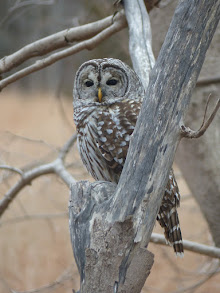
Barred owl (5/9/2016)
Great Horned Owl (April 2017)
Turkey vulture
Black vulture
Pheasant
Turkey
Pileated woodpecker
Red-bellied woodpecker
Downy woodpecker
Flicker
Crow
Pigeon
Mourning dove
Sea gull
Mute swan
Mallard duck
Wood duck (3/23/2016)
Canada goose
Heron (three species)
Killdeer
Eastern bluebird (3/22/2016)
Ruby-throated hummingbird
Bats
Garter snake
Snapping turtle
Red-eared slider
Painted turtle
Eastern box turtle (4/29/2017)
Red eft (5/7/2016)
Red-backed salamander
Sighting a deer was very uncommon when I was young; I never saw a wild turkey at all, and coyotes were unheard of. Dogs were pretty much allowed to roam the neighborhood at will, back then, which I'm sure made a difference; there's also probably less hunting locally than there used to be. Several of the common species (Canada goose, mute swan, deer) are now regarded as serious pests.
In many parts of the world the prospects for wildlife are grimmer than they are here, where there seems to be a resurgence as opportunistic and adaptable species either come to terms with human presence or even learn to benefit from being around us (crows that live in urban areas reportedly live longer than woodland crows). I can't imagine how impoverished the landscape would be without them.
I'll fill in more species to this last as I spot or recall them.
Saturday, February 06, 2016
Reading Austin Reed
More than one hundred and fifty years ago, Austin Reed, an African-American inmate of New York State's Auburn State Prison, wrote a book-length record of his life, which to that date had included several terms at Auburn as well as earlier period of confinement, as an adolescent, in the House of Refuge, a juvenile reformatory in New York City, which he first entered in 1833 at the age of ten. His manuscript was clearly intended for a potential reading public, and he apparently showed it to at least one prison official, a chaplain named Benoni I. Ives, some time around 1859; the author's handwritten note to Ives, on a tiny slip of paper, still exists.
After compiling the manuscript (some of which was written on Herman Melville's favorite writing paper), Austin Reed spent several additional years in the state prison system, receiving another conviction in 1864, but was eventually pardoned. As late as 1895 he was still alive and corresponding with the superintendent of the House of Refuge about his case records, some of which by that time would have been more than sixty years old. What became of him after that is unknown. The manuscript, still bearing the little slip of paper addressed to Ives, first surfaced a few years ago in Rochester, New York (Reed's native city), and was acquired by Yale University's Beinecke Library, which has posted it online. Caleb Smith's edition of the text, which includes a substantial introduction explaining how Reed's identity was determined and his account largely corroborated from other sources, has just been published.
The historical importance of Reed's narrative is, of course, immense; it's believed to be the earliest prison memoir by an African-American, and as a record from a "free" state, it provides useful comparison with contemporary memoirs by former slaves like Solomon Northup and Frederick Douglass. As a literary document it resists simple readings; it blends a protest against the brutal treatment he and others received at the hands of the keepers of both of the institutions he describes with a warning, couched in the language of 19th-century evangelism, to others who might follow him down the path of crime. The outlines of the story he tells, including the details of his whippings and other punishments, and the names and fates of his fellow inmates, can be verified from existing records (the institutions were nothing if not thorough in their record-keeping). At other times, particularly of his activities during the brief periods when he was free, he evidently embellishes liberally; he was clearly familiar enough with the tropes of a variety of popular literature of the day to imitate them (though he professed a vehement loathing for novels), and here and there he plagiarizes brief descriptive passages. Aside from a lively but fairly implausible picaresque section in the middle, the overall veracity of his account seems well-established, but its documentary value does not exhaust the reasons for reading it.
Because it remained unpublished until recently, the narrative was never censored or "improved"; it preserves, for instance, Reed's lengthy diatribe against masturbation, which would presumably have been suppressed by a contemporary editor. Smith has normalized punctuation and corrected the spelling of some words, but has let Reed's grammatical and other errors stand. (All of the emendations are recorded in an appendix.) The edition provides essential background and annotation, but I have no doubt that the coming years will see additional clarifications and re-interpretations of both Reed's life and the text.
There is a brief interview with Caleb Smith on the website of WXXI radio.
Tuesday, February 02, 2016
On Novels (Austin Reed)
"I despise the looks of a novel. The cursed infernal things, I can't bear the sight of one. They are a curse to every one that reads them. I never could bear the looks of them. They are pack full of lies. They are a store House of lies. I never could take any comfort in reading them. Give me the history of some great and good man who is laboring for the welfare of his country, like Wm. H. Seward, who is fighting against the world of enemies every day for the promotion and benefit of his country, and laboring with a strong arm for to crush vice and crime and morality under the feet of the world. That is such a book which I love to read. Novels are books that will bring many a young man to a gloomy cell, and many a weeping mothers to their graves."
— Austin Reed, The Life and the Adventures of a Haunted Convict, edited by Caleb Smith.
Labels:
Austin Reed,
Notes,
Novels
Sunday, January 31, 2016
Thirst
I grew up in a community of eighty or so houses built on a hill leading up from a small man-made lake. In the winter you could see the lake from our house and watch skaters in the distance, if there happened to be any; in the summer the view was mostly occluded by trees. At the summit of the hill there was a water tower, which I suppose is where our water must have come from, after having been pumped up to it from a well somewhere.
The tower, which was set in a patch of woods not far from the uppermost stretch of road, wasn't particularly imposing; I suspect it was only twenty feet high or so. Nevertheless, there was a tale connected with it, of the kind that was told to (or by) half-believing kids around the fire on summer nights when some of us got together to camp out.
The story was that the tower, the inside of which no one I knew had ever seen, was inhabited by some kind of water-dwelling creature of an unknown but uncongenial kind. In normal circumstances it remained safely inside the tower and bothered no one, but it was said that one year, when there was a drought and the water level in the tower fell precipitously and stayed low for a good part of the summer, desiccated bodies — squirrel, cats, who knew what else — were found in the surrounding woods. We avoided the area at night, just to be sure.
Friday, January 29, 2016
On Prophets
From time immemorial the function of the prophet has consisted of one thing and one thing only: to cry down the wrath of the heavens upon the wicked and proclaim the kingdom of the righteous. The prophet's domain is truth, as he or she is inspired to preach it; that many prophets preach things that are by any measure utterly demented does not perceptibly alter the job description.
Prophets are famously unpopular in their own time because, in the end, the truth isn't something we particularly want to hear, unless it happens to suit us (which it tends not to do). Nevertheless, prophets are essential, because without them we quickly lapse into our comfortable habits.
Politics, on the other hand, has little to do with virtue and even less to do with truth. Politicians often employ the language of prophecy — indeed, we generally expect them to — but no politician would last long who told us the whole truth. All kings have their flatterers, and this is no less true when sovereignty is vested in the people. Except in rare moments of crisis, when the need for sacrifice is underlined, we must always be told that we can have things both ways, that there is no difference between what is true and good on one hand and what benefits us in the fairly short run on the other.
The kingdom of the righteous never arrives, but that doesn't mean that prophets are without influence. Sometimes the truth of what they say becomes so self-evident that it is grudgingly accepted and acted upon, after a fashion at least; at other times their zeal ignites a great conflagration, empires fall, old ways are swept away, and wickedness must seek new horizons (they are rarely far).
In the end, though, corruption lurks everywhere, not least within the heart of the prophet, who, perhaps, begins to tire a bit of berating the indifferent and decides to grasp for power. Every prophet who is true to the name must, in the end, remain a voice crying out of the wilderness. The rest of us must muddle along as best we can.
Sunday, January 24, 2016
If I Had Wings
It's cold tonightThe live performance shown here is from 1992; the song would later be included on the Boatmen's third album, Opposite Sex, where it is credited to Dale Lawrence (the singer in the video), Robert Ray, and Jeff Byers.
Bell rings on a corner and just like that
Your friends, my friends, start to disappear
I can't find, I can't find her anywhere
And if I had wings
Well if I had wings
I'd come by for you, come by for you
Shake
I'd come by for you, come by for you
Shake
Walk around, walk around, walk around
Shake
Labels:
Music,
Vulgar Boatmen
Saturday, January 16, 2016
The Boy Who Was a Friend of the Devil (Ana María Matute)
Everyone, at school, at home, in the street, told him cruel and ugly things about the Devil, and in his catechism book he saw him in Hell, enveloped in flames, his horns and tail burning, with a sad, solitary face, sitting in a cauldron. "Poor Devil," he thought; "he's like the Jews, whom everyone drove from their land." And from then on every night he called the Devil "handsome one, beautiful one, my friend." His mother, who heard him, crossed herself and turned on the light. "Oh, stupid boy, don't you know who the Devil is?" "Yes," he replied; the Devil tempts the bad people, the cruel ones. But since I'm his friend I will be good forever, and he'll let me go into Heaven in peace."
My "slow reading" project for the next few weeks or months will be this enormous brick of a book, which contains all (or nearly all) of the short fiction and miscellaneous writings of the late Spanish writer Ana María Matute. The story above is from her earliest collection, Los niños tontos (1956), which contains twenty-one brief fable-like pieces, most barely longer than this one. Most of the children come to a bad end.
Earlier posts on Ana María Matute:
Last words (on Demonios familiares)
Bonfires (on Primera memoria)
Childhood (on Paraíso inhabitado)
Faithful Objects
Labels:
Ana María Matute,
Spain
Tuesday, January 12, 2016
The Journey of Shuna (anniversary re-post)
I'm re-posting this piece (with a couple of additional images) for two reasons: because I've just been leafing through my copy of The Journey of Shuna, which remains as beautiful and mysterious as ever, and because I notice that my original post is now exactly ten years old.
This delicate watercolor manga by Hayao Miyazaki has never been officially translated into English, which is a bit of a surprise, given the increasing popularity of Miyazaki's films worldwide and the ready availability here of his multi-volume manga epic Nausicaä of the Valley of the Wind. Perhaps the production cost of doing it in full color would be prohibitive — I don't really know (but see bottom of page).
The following is a brief outline of the story, as I can follow it and based on some available page-by-page fan translations.
Shuna is a young man living in a small village in what looks like some high-altitude country in Asia. (When this story takes place is deliberately unclear; the art and technology seem very old, but on the other hand there are a few primitive guns.) The country is windswept and the land barren; the villagers survive, but barely, on sparse harvests of grain.
One day a stranger, an old man, is found by the wayside and brought back to the village, barely alive. Before he expires he tells Shuna that he is a prince from a distant country. Long ago he, like Shuna, had encountered a lone traveler. The latter had given him a purse full of grain — grain so rich that it could bring plenty even to a harsh land. The old man still has the purse of grain, but after so many years it is useless. He has searched for years for the land where the grain is grown, somewhere far to the west, but he has never found it and now can go on no longer.
Shuna, of course, soon decides to leave the village and seek the land of the golden grain. He mounts his yakkul (an elk-like creature) and rides off. Like every good quest-hero, he travels through a wasteland; then he comes upon a derelict ship half-buried in the sand. There are shrouded inhabitants inside, who beckon him in, but, spooked by the sight of a pile of human bones, he steers away and camps a little ways off. During the night he is attacked by several shrouded figures (they are all apparently women), but he fights them off, severing the hand of one with a gunshot. (She later creeps back and silently retrieves the hand).
On the road he is passed by a large cart, drawn by several blue beasts and surmounted by several gunmen. They treat him rudely and continue on their way.
Soon afterwards, Shuna comes to an enormous bustling city. In the marketplace he finds a pile of the grain he seeks, but it is already threshed and dead; he is told that it comes from a distant place. He also learns of the city's flourishing trade in slaves. He sees a girl roughly his own age in chains, with a younger girl alongside. He tries to purchase their freedom but fails, and leaves the city.
He meets a hermit monk, who tells him that he can find what he seeks further west, in “the place of the god men, where the moon is born and returns to die,” a place from which no man has ever returned. The next morning Shuna wakes up and finds the hermit has gone.
He again encounters the cart with the gunmen. Inside are slaves, among them the two sisters he had met in the marketplace. He shoots the gunmen and releases the girls. Together they flee, as more armed men are seen coming from the city. They are followed to the top of a high cliff, the very precipice which overlooks the land of the god-men. Shuna sends the girls and his mount away to safety in the north, then evades his pursuers by sending them to their deaths over the precipice.
An enormous luminous face swifly crosses the sky above him and disappears over the edge of the precipice. Knowing that he has come to the place he seeks, Shuna begins to descend the cliffs. His descent seems to be, as well, a descent through time; he climbs over ancient monuments and the skeletons of antediluvian creatures and eventually reaches a sea in which enormous prehistoric beasts are swimming. He wades across to a dense and fertile land, populated by a variety of creatures, all of them, fortunately, benign.
The next few pages are strange and eventful, and I'm not sure I completely understand them — but here goes: an enormous green figure strides through the forest, then collapses, and is immediately consumed by a horde of beasts. More giants stride through the forest; Shuna passes them and comes to a clearing, where there is a vast tower which appears to be some kind of living being. He discovers that it is hollow. Just then the moonlike face crosses the sky and arrives at the top of the tower. It disgorges from its mouth a stream of human figures, slaves, apparently, acquired from the slave-traders. As they fall into the tower they are transformed into green giants; they emerge and spread out, spewing seeds from their mouths as they travel. Within hours the land becomes green — this, then, is the source of the golden grain.
Shuna grabs hold of several stalks of ripe grain. The giants howl with pain; Shuna flees, leaping into the sea.
We are now shown the two sisters. They have arrived in a village in the north, where they and the yakkul are ploughing a plot of land belonging to an old woman who has taken them in. One night they find a ragged traveler outside; it is Shuna. He is haggard and has lost his ability to speak, but around his neck he carries the precious golden grain.
The girls and Shuna plant the grain in a small plot; it sprouts. The old woman tells the older girl she is now of age and must marry one of the villagers. There is a bride-contest: the girl says that she will marry the suitor who can master the yakkul. Of course all the young men fail, until finally the mute Shuna succeeds.
The sprouted grain eventually bears fruit, after being protected by Shuna and the girls from a terrible hailstorm. Shuna recovers his speech. The three stay another year, harvesting another crop and fending off an attack from slave-traders, then depart for Shuna's native village, leaving half the grain behind for their hosts. The story ends there.
There's a lot that could be said about The Journey of Shuna, but I'm not going to try to interpret it, because, as with all great mythological stories, there seem to be so many different angles from which it can be approached. Despite the different setting, the affinities with the legend of Perceval and the grail seem very strong to me; there are also echoes of the Odyssey (the bride-contest, if nothing else), and, in the green men, similarities with Central American myths. It's also very much a Miyazaki story; other observers have commented on its connections with both the manga and film versions of Nausicaä of the Valley of the Wind, but the beginning of the tale, the departure of the hero, resembles the opening of Princess Mononoke.
There are some fascinating visual elements as well: in the background of the panels where the old traveler is dying there appear first a large upside-down female figure, then a pair of outstretched hands, as if a deity were carrying him away. This is not commented on in the text, and it has been suggested (I don't agree) that the apparent “deity” is just a painted decoration in the interior of the room where the man lies dying — in any case the effect is quite odd. The old woman who shelters the sisters reminds me, in one panel, of some of Sendak's old crones. Overall it's very rich and distinctive both visually and as story; I hope that American audiences will eventually get a full chance to appreciate it.
Update: An authorized English-language edition is now available.
Labels:
Hayao Miyazaki,
Japan
Sunday, January 03, 2016
Hero or grifter? (II)
There are two detailed primary sources, as well as a number of supporting documents, on the prosecution of Ernest de Lipowski (see previous post); all are available online, for the curious, in a folder in the Base Leonore.
The two main sources are a report bearing the letterhead of the Mairie de la Ville de Bordeaux, dated December 1873, and an article in the Journal de Bordeaux, dated 19 October of the same year, which coyly refers to the suspect as "le général X."
According to the Journal, the whole affair — "the most vulgar swindle one could dream of" — had to do with three barrels of white lead pigment and two boxes of window-glass. On September 16, 1873, two construction workers named Fargeon and Lhoste presented themselves before a Bordeaux merchant, M. Sainthérand, and asked if he could furnish a quantity of building materials for the restoration of a château in the domaine of La Tresne belonging to the général comte de X, that is, to de Lipowsky. After Sainthérand requested to see the owner, de Lipowsky appeared, a price was agreed on (to be paid on credit), and the materials were loaded onto a carriage. Once out of sight of the merchant, the goods were sold, at a steep loss but for cash, and the two workmen were given a "commission" for their efforts, de Lipowski pocketing the rest. A few hours later Sainthérand became suspicious, made inquiries, and, discovering that the château was fictional, had all three arrested.
Once in court, much of the initial discussion focused on whether de Lipowski had a right to the several titles he claimed to bear. Confronted with the alleged swindle, he stated that he and his wife had (formerly) possessed large sums of money, and that if he had done what he did, it was with the intention of repaying the merchant, on credit. He was, he explained, simply a bit hard up for ready cash. His attorney emphasized de Lipowski's service to France, denied any intention to defraud, and declared that, as to his habit of running into debt, this was due to the luxurious habits he had acquired after his marriage had brought him a considerable dowry. "He has paid such a debt to the country," he concluded, "that the country ought to pay him one in return." The court may have taken de Lipowski's war record into account, but it nevertheless sentenced him to a month in jail and a fine of 50 francs.
The handwritten report on the letterhead of the Mairie of Bordeaux is rambling and hard to decipher in spots, but it gives the impression that de Lipowski was involved in not one but multiple instances of chicanery, in which he tried to leverage his rank and his wife's supposed fortune in order to obtain goods or services from local merchants. When pressed to pay his debts, he would fly into a fury and plead his offended dignity as a general.
As a consequence of his conviction, de Lipowski was removed from the rolls of the Légion d'honneur. He does not, however, appear to have ceased to "habitually wear the insignia of a chevalier," as correspondence between the police and the Chancellor of the Légion noted in 1877. By September 1880, the point would become moot; an official decree indicates that he was awarded the title of officier (a higher title than chevalier) in the Légion, by virtue of being "commandant of the 41st regiment of the infantry of the Austrian army." (The same decree, which was issued in conjunction with the French Ministry of Foreign Affairs, awarded similar titles to a number of foreign military officers).
Had de Lipowsky, burdened by chronic debt and jealous of his social standing, become a kind of roving military consultant, trading on his family connections across several European countries and offering his expertise to whatever nation would pay his bills? His travels were not yet over; he would later enter the service of the Tsar of Russia, though he would, in the end, die in Paris in 1904.
Saturday, January 02, 2016
Hero or grifter? (I)
Here's as much as I've been able to piece together of the story of Ernest de Lipowski, the father of the young girl whose 1887 photographic portrait was the subject of an earlier post.
Joseph Antoine Ernest, Comte de Lipowski (one source includes the additional given name of Raoul) was born in Strasbourg in 1843; his parents were Pierre Nicolas Joseph Albert de Lipowski, a Spanish-born descendant of Polish nobility, and Marguerite Sophie Laroche. He was married twice, with both weddings occurring on English soil. His first wife, Marie Eggerickx (the name may be Flemish), whom he married in 1870, died within a few years, and in 1876 he married Marianne Eastwood, who reportedly brought him a substantial dowry. Although there are Jewish families surnamed Lipowski, he was presumably a Roman Catholic, as one or two members of the family, according to his death notice, evidently became nuns.
After attending the French military academy of Saint-Cyr, de Lipowski embarked on a career as an officer, but he resigned his commission in June 1870 due to a series of financial embarrassments. A note in his dossier states dryly that "M. Lipowski's colleagues no longer have the regard for him that is always indispensable to good comradeship." In 1870, however, during the Franco-Prussian War, he was named captain of a corps of franc-tireurs, and rapidly rose to the rank of général de brigade in the armée auxiliare. The highlight of his service, which earned him the title of chevalier in the Légion d'honneur, was the Battle of Châteaudun. He was sidelined during the Paris Commune of 1871, reportedly because of his friendship with Gen. Napoléon La Cécilia, a commander on the Communard side, who had also served at Châteaudun.
So far so good. Look ahead to his death and we see subsequent service in the Austrian army and under the Tsar of Russia, and (from 1880) the higher rank of officiér in the Légion d'honneur. But in 1873, his name had in fact been expunged from the rolls of the Légion as a consequence of his conviction for the crime of escroquerie — a type of fraud.
A prelude to the affair took place in Geneva in September 1871. Evidently there were again some issues of unpaid bills, and de Lipowski seems to have claimed immunity from Swiss prosecution on the grounds that he was a citizen of France and thus protected by treaty between the two countries. According to a later report, "he claimed to be married to a very rich woman — but many people doubted this marriage." There was also some suspicion (unfounded, as it happened) that he might be a certain escaped convict posing under a false name. It was noted that he displayed medals he claimed to have received from one M. Walewski (possibly Alexandre Colonna-Walewski, a noted diplomat and reputed illegitimate son of Napoleon Bonaparte); that claim, if he made it, may well have been true, but it would not be the last time that de Lipowski would lean on his titles and honors.
Not long after, de Lipowski arrived in Bordeaux, where he made frequent changes of address, but soon fell afoul of the local authorities.
(To be continued.)
Friday, January 01, 2016
New Year's Day
The fundamentals —
trees, sky, water,
the calling of crows
— do not change.
Smoke rises above the tea-house.
The geese glean the fields.
Labels:
Poetry
Wednesday, December 30, 2015
Notes for a commonplace book (17)
Luc Sante:
The game may not be over, but its rules have irrevocably changed. The small has been consumed by the big, the poor have been evicted by the rich, the drifters are behind glass in museums. Everything that was once directly lived has moved away into representation. If the game is ever to resume, it will have to take on hitherto unimagined forms. It will have much larger walls to undermine, will be able to thrive only in the cracks that form in the ordered surfaces of the future. It is to be hoped, of course, that the surface is shattered by buffoonery and overreaching rather than war or disease, but there can be no guarantee. It may be that whatever escape routes the future offers will be shadowed by imminent extinction. Life, in any case, will flourish under threat. Utopias last five minutes, to the extent that they happen at all. There will never be a time when the wish for security does not lead to unconditional surrender. The history of Paris teaches us that beauty is a by-product of danger, that liberty is at best a consequence of neglect, that wisdom is entwined with decay. Any Paris of the future that is neither a frozen artifact nor an inhabited holding company will perforce involve fear, dirt, sloth, ruin, and accident. It will entail the continual experience of uncertainty, because the only certainty is death.The Other Paris (2016)
Subscribe to:
Comments (Atom)