Thursday, December 05, 2013

Your Shoulders Hold Up the World


A time comes when you no longer can say: my God.
A time of total cleaning up.
A time when you no longer can say: my love.
Because love proved useless.
And the eyes don’t cry.
And the hands do only rough work.
And the heart is dry.

Women knock at your door in vain, you won’t open.
You remain alone, the light turned off,
and your enormous eyes shine in the dark.
It is obvious you no longer know how to suffer.
And you want nothing from your friends.

Who cares if old age comes, what is old age?
Your shoulders are holding up the world
and it’s lighter than a child’s hand.
Wars, famine, family fights inside buildings
prove only that life goes on
and nobody will ever be free.
Some (the delicate ones) judging the spectacle cruel
will prefer to die.
A time comes when death doesn’t help.
A time comes when life is an order.
Just life, without any escapes.

Poem by Carlos Drummond de Andrade; translation by Mark Strand.

The version above, which I prefer to the revised one included in Strand's Looking for Poetry, is from Souvenir of the Ancient World, published in 1976 by Antaeus Editions in an edition of 500 copies. The typography is by Samuel N. Antupit. I've cropped the page a bit.


Saturday, November 16, 2013

Life Underground


When I was a kid I lived in a neighborhood that overlooked a lake, and when we had nothing to do my friends and I would sometimes go down the hill to its far end, where there was nothing much but woods, and hunt for newts or tadpoles in the little stagnant pond that collected in the shadows just across the road. Trout-lilies and wild leeks grew around its edges, and there were trails that led off to places known and unknown.

Just up the road a group of older boys had excavated trenches twenty yards or so back in the woods, covered them with old doors and cast-off plywood, then concealed them under branches, dirt, and leaves, forming a network of winding subterranean passages we were strictly forbidden by our parents to play in, for fear that a cave-in might bury us alive. Naturally we disobeyed a little, and crawled darkly through, inhaling the smell of cool, raw earth. There wasn't much in the tunnels — a stray armored beetle that had fallen in was about all — and I don't remember ever seeing the older boys using them, but they exerted a fascination nonetheless, as if they stood ready for some unspecified but promising future use. It was the height of the Cold War, and people were going underground, digging fallout shelters, tunneling under the Berlin Wall, looking for places to hide. The trenches must have filled in long ago.

Saturday, November 09, 2013

Step It Up and Go


Lowry Hamner and Jon Sholle playing a Blind Boy Fuller tune; Mt. Kisco, NY, November 2013. Video by Frank Matheis from thecountryblues.com. Step it up and go!

Thursday, October 31, 2013

Saturday, October 19, 2013

Of Love and Bears


She had no idea what animals were about. They were creatures. They were not human. She supposed that their functions were defined by the size, shape and complications of their brains. She supposed that they led dim, flickering inarticulate psychic lives as well.
Could a great novel — or even two — arise from a premise as improbable as an interspecies relationship between a human being and a bear? Rafi Zabor's The Bear Comes Home, which is about a bear who, by some fluke of vocal anatomy, not only speaks but plays a mean alto sax, has long been a favorite of mine, and now here, not new but new to me, is this brief, exquisite 1976 novel by the Canadian writer Marion Engel, who died in 1985 at the age of 51. Engel's novel centers on Lou, an archivist who is dispatched to spend a few months cataloging the library of a 19th-century eccentric who constructed and inhabited an octagonal folly on a remote island in northern Ontario. Dropped off on the island, she learns, to her surprise, that one of her responsibilities during her sojourn will be to tend to its only other inhabitant, a quite inarticulate tame bear who formerly belonged to the family that descended from the original founder. As spring turns into summer the bear becomes Lou's constant companion, and in time one thing leads to another ...

The Bear looked out at New York City rocking past the taxi window. A stone jail with humans bunched at the major intersections. Ten million dazed and mortal beings hypnotized by love, work, hate, family and the past. What were the odds — the Bear asked himself, trying to be realistic — in all that multiplicity, on gaining sufficient purchase on real freedom? Looking out at this sampling of the millions is just the thing to convince me that I have no meaning and no chance. What could it possibly matter if one more or less creature toots on a horn?
Rafi Zabor's novel is told from the point of view of the Bear, as he is called throughout. It's a far more ambitious, sprawling book, in which romance (with human women, largely, though the Bear will occasionally dally with ordinary ursines) is a relatively minor element, secondary to the art and metaphysics of jazz and the mysteries of being. (If you're curious about the mechanics of bear-human copulation, though, Zabor's your man.) One of the amusing things about The Bear Comes Home is that the human characters, at least the musicians who are hip, by and large don't much care that the Bear is a bear, and there are some very droll set-pieces of him sitting in with other jazz musicians. It is, thus far, Zabor's only novel, discounting his unsatisfying 2005 autobiographical narrative I, Wabenzi.

Thursday, October 10, 2013

Alice Munro


Congratulations to Alice Munro, the winner of the 2013 Nobel Prize for Literature. The limited-edition chapbook shown here, which contains a single long story, was issued as a promotional item to coincide with her 1994 collection Open Secrets.

Here are the story's last four paragraphs, which, in keeping with the tale's daring oddness, describe more or less the chronological beginning of events.

The hotel moved her to one of the rooms for permanent guests, on the third floor. She could see the snow-covered hills over the rooftops. The town of Carstairs was in a river valley. It had three or four thousand people and a long main street that ran downhill, over the river, and up again. There was a piano and organ factory.

The houses were built for lifetimes and the yards were wide and the streets were lined with mature elm and maple trees. She had never been here when the leaves were on the trees. It must make a great difference. So much that lay open now would be concealed.

She was glad of a fresh start, her spirits were hushed and grateful. She had made fresh starts before and things had not turned out as she had hoped, but she believed in the swift decision, the unforeseen intervention, the uniqueness of her fate.

The town was full of the smell of horses. As evening came on, big blinkered horses with feathered hooves pulled the sleighs across the bridge, past the hotel, beyond the streetlights, down the dark side roads. Somewhere out in the country they would lose the sound of each other’s bells.

Saturday, October 05, 2013

Drinks with Paddy


In spite of the title and its subject — the British traveler, wartime SOE operative, and writer Patrick Leigh Fermor — this little volume is thus far available only in Spanish, but hopefully an English-language version will be forthcoming soon.* The author, Dolores Payás, has translated several of Leigh Fermor's books into Spanish, and Drink Time! (En compañía de Patrick Leigh Fermor) is her affectionate memoir of her visits to his home in Greece, where he made his home for decades until his death in 2011. Paddy — that was what everybody called him, except some of the Greeks, for whom he retained the nom de guerre of Mihalis — was ninety-six when he died, but even at that advanced age he retained much of the eternal youthful optimism he possessed when he set out, as a teenager in 1935, to walk across Europe from the coast of Holland to Constantinople.

Fermor completed that journey, and would make two fine books, A Time of Gifts and Between the Woods and the Water, out of his adventures along the way, but he never quite got around to narrating the last leg of the journey. (The parts he did write, found among his papers, are being published, this year in the UK and next year in the US, as The Broken Road.) Why didn't he finish the task? Old age, perhaps, or perfectionism, or too many distractions — Payás suggests that if Paddy and his wife had chosen to settle in Crete, where he spent much of World War II, rather than in the Mani Peninsula, the partying Cretans would have kept him from writing anything at all. Because Fermor was no solitary; a prodigious autodidact, polyglot, and lover of books, he also cherished companionship, conversation, good food, and plenty of wine — the local Greek stuff by preference, no need for fancy French vintages — and to the end, even as his eyesight and hearing failed him, he served as an eager host to a steady stream of old friends and new-found acquaintances in his book-crammed, disorderly, but welcoming house above the sea. Dolores Payás, when she visited, knew that every day, invariably, a knock would come at the door where she was working, and Leigh Fermor would cheerfully summon her time for drinks and conversation. It was an invitation few would have wanted to refuse.

*One has been issued by Bene Factum Publishing.

Sunday, September 29, 2013

Klíma's Century


The Czech writer Ivan Klíma, now in his early eighties, has survived the German occupation of his native land, during which he and his family — of Jewish descent, though entirely non-observant — were interned in the Theresienstadt concentration camp, as well as four decades of communist rule, and he has outlived such compatriots and friends as Josef Škvorecký, Václav Havel, Jiří Gruša, and Pavel Kohout. Though barely established as a novelist of international stature before he turned forty, he came into his own in the 1970s and '80s, at a time when it was impossible for him to publish in Czechoslovakia. A member of the Czech Communist Party from his teens (two communist uncles were executed by the Nazis), he became gradually disenchanted in the years leading up to the Prague Spring of 1968, during which he was active as a writer, journalist, and editor, and he was eventually expelled from the party. Though he evidently never signed the dissident manifesto known as Charter 77 — he is somewhat reticent about the reasons, which seem to have included both personal and philosophical factors — he was closely allied with the leaders behind the document, helped organize the publication and distribution of samizdat, and was an active participant in the breathtaking sequence of events that brought about the end of Czech communist rule in 1989. Since then he has largely kept to the political sidelines, content to concentrate on his writing.

Much of the territory in My Crazy Century, the English-language translation of a two-volume memoir published in Prague several years ago, will be familiar to readers of his fictional work, especially My First Loves, My Golden Trades, A Summer Affair, and his masterpiece, Judge on Trial. Klíma is said to have written at least twenty works of fiction, many of which are not available in English and which I have not read, but he seems to be a writer who needs to hew closely to his own personal experience; in fact in this memoir he mentions deliberately choosing menial employment, at a time when it was politically impossible for him to earn his living as a writer, in order to be able to write knowledgeably about that kind of work. He also makes it clear that his own marital infidelities have often been reflected in his fiction. He has not, to my knowledge, previously described the cultural and political movements in which he participated in as much detail as he does here.

Klíma's narrative ends in 1989 and the last hundred or so pages are made up of a group of brief essays — "expendable chapters" we might call them, following Cortázar, who may in fact have been his model — on various themes: "Ideological Murders," "The Party," "Dogmatists and Fanatics." These rather solemn and general pieces add little to the book, and suggest that although Klíma as moral novelist (and memoirist) has a keen sense of the ambiguities experienced by ordinary, essentially decent people who are unfortunate enough to live through extraordinarily dark chapters of history, he is not a particularly original moral or political philosopher. No matter, though; the stories are enough.

Update: A profile of Klíma in the New York Times (November 18, 2013) implies that the English-language version is an abridgement of the original. If so it's not clear what may have been taken out.

Saturday, September 21, 2013

Notes for a Commonplace Book (12)


The preferred reading matter of the Mexican writer and photographer Juan Rulfo, as described in Luis Harss & Barbara Dohmann's Into the Mainstream: Conversations with Latin-American Writers (1967):
He was always particularly fond of Russian literature — Andreyev, Korolenko — and, above all, a great admirer of Scandinavia literature: Selma Lagerlöf, Bjørnson, Knut Hamsun, Sillanpää. "Once upon a time I had a theory that literature had been born in Scandinavia, then gone down to Central Europe and spread from there." He is still an assiduous reader of Halldor Laxness, whom he considers a great renewer of European literature, from a position diametrically opposed, say, to that of French intellectualism. United States literature, he thinks, has also has a salutary influence in latter years. But Rulfo, with his love of the diaphanous, favors the Nordics, because of their "misty atmosphere."
Rulfo's own books are set entirely in rural Mexico, but literature is not a respecter of borders.

Saturday, September 14, 2013

War (Joe Sacco)


My impression is that, with some salutary exceptions, contemporary graphic novelists tend either to focus on personal traumas or strike out into the realm of the fantastic — or both. There's nothing in principle wrong with either approach, but the situation does leave certain territories unexplored, serious journalism being one of them. Of course, on the face of it, there might seem to be a fundamental incompatibility between the art of making "comic books" and the kind of sober and objective reporting one expects from a reporter, but the Maltese-American journalist-cartoonist Joe Sacco has made as good a case as anyone for disproving that supposed incompatibility.

Safe Area Goražde, originally published in 2000*, covers the Bosnian war of the 1990s, one of the nastier phases of the troubled breakup of what was once the multiethnic state of Yugoslavia. It focuses on a small pocket of territory, largely inhabited by Bosnian Muslims, that had been officially and ineffectually designated by the UN as a safe haven. While what happened in Goražde may not have attained the level of atrocity of the massacres at Srebrenica (another safe area, not far away), it was bad enough. Sacco doesn't appear to have been on the scene during the worst period, but he was there in 1995 when the city was still besieged and had ample opportunity to interview eyewitnesses with fresh memories. Except for a few pages of historical background, it is those eyewitness accounts, along with Sacco's self-deprecatory description of his efforts to document them, that make up the book.


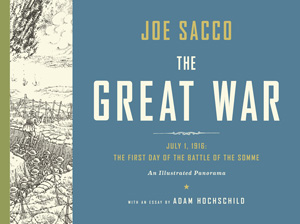
A little later this Fall W. W. Norton will be publishing The Great War, Sacco's wordless 24-panel folding panorama of the Battle of the Somme, which is being issued in a slipcase along with a pamphlet that contains Sacco's introduction and notes to the project as well as a brief essay by Adam Hochschild. (I've received an advance copy.) Hochschild's contribution (which is adapted from his book To End All Wars: A Study of Loyalty and Rebellion, 1914-1918) ends with a visit to the cemetery that holds the remains of the members of the British Devonshire Regiment who were killed in the battle:
In the cemetery's visitors' book, on a few pages the ink of the names and remarks has been smeared by raindrops — or was it tears? "Paid our respects to 3 of our townsfolk." "Sleep on, boys." "Lest we forget." "Thanks, lads." "Gt. Uncle thanks, rest in peace."

Only one visitor strikes a different note: "Never again."
* There is a more recent "Special Edition" of Safe Area Goražde, with additional material, which I have not seen.

Sunday, September 08, 2013

On the memory of stones (Benedict Kiely)


— In Devon, he assures her, lived a man who experimented in dousing and other devilment. He found by means of his dousing pendulum that some seashore stones he tested responded to the vibration tests for anger. He concluded that once upon a time those stones had been used for war and murder.
— Crap a brick, as my father used to say. What rot is that?


Though the two novels were published within a few years of each other and both deal (at least in part) with the Troubles in Northern Ireland, Bernard MacLaverty's Cal (see last post) and Benedict Kiely's Nothing Happens in Carmincross could hardly be more different in tone and manner, the former taut and efficient and the latter rambling and verbose — but not necessarily less entertaining for all that. Kiely's novel follows the travels of an Irish academic who has come home from America in order to attend a wedding just across the border in the North. For most of the novel what actually "happens" is next to nothing, mostly drinking, rambling around, talking, a bit of screwing, but the book has the pleasures of listening to a long-winded but gifted storyteller with a seemingly inexhaustible store of events, memories, legends, and lies at his disposal. Scraps of song, newspaper clippings, and references to Irish history and mythology are woven into almost every paragraph, and much of it is bound to fly over the head of the average reader (like me). Yet despite its generally flippant tone, the book never strays far from the theme of violence.

The sanguinary Irish ballad "Follow Me Up to Carlow" is quoted in the book's first pages, and Planxty's rousing version (below) is possibly the one Kiely had in mind. In keeping with the spirit of the novel it should be listened to appreciatively but with a healthy dose of irony as well. The singer is Christy Moore.


Saturday, September 07, 2013

The cottage (Bernard MacLaverty)


Cal heated a tin of beans and tasted himself slice after slice of bread at the fire. He fell asleep and when he awoke it was dark. He rubbed the window and looked out. Between the cottage and the lights of the farmhouse he could see the blizzard. It was after eight o'clock and the fire had died down. Shivering, he raked the embers to redness and put on some kindling wood, then blocks on top of that. He pulled his chair nearer to the fire and put his feet up against the tiles of the mantelpiece. After such a long sleep he knew he would spend the night tortured with guilt and insomnia. There was a knock at the door and he leapt to answer it, knowing who it was.

Bernard MacLaverty's Cal is now thirty years old, and it has probably been at least twenty-five years since the last time I read it. I picked it up again earlier this week, prompted by the death of Seamus Heaney, who like MacLaverty was a native of what depending on your point of view is either Northern Ireland or Ulster. Set during the height of the Troubles, the novel follows one not very willing participant, a teenaged boy with no particular prospects who is pretty much trapped from the outset, though his story will take some unexpected turns along the way. Dark as the background is, and as grim as the unfolding of the events, there's nevertheless a gentleness about the book, as MacLaverty is more interested in his characters than he is in indulging in yet another rehearsal of the cycles of violence and retribution that finally seem to have burned out, at least for now, in that much bled-over corner of the world.

Put another way, the book is not an example of noir. Which isn't to say that it holds out much hope, but it does at least have enough compassion for its characters to make us care about their fates, even if their prospects for happiness were never more than remote.

Bernard MacLaverty has written many short stories, some of which I've read and which are very good indeed, and several other novels, which I've never quite caught up with. This one still holds up quite well.

Saturday, August 31, 2013

Seamus Heaney 1939-2013


Across that strand of ours the cattle graze
Up to their bellies in an early mist
And now they turn their unbewildered gaze
To where we work our way through squeaking sedge
Drowning in dew. Like a dull blade with its edge
Honed bright, Lough Beg half shines under the haze.
I turn because the sweeping of your feet
Has stopped behind me, to find you on your knees
With blood and roadside muck in your hair and eyes,
Then kneel in front of you in brimming grass
And gather up cold handfuls of the dew
To wash you, cousin. I dab you clean with moss
Fine as the drizzle out of a low cloud.
I lift you under the arms and lay you flat.
With rushes that shoot green again, I plait
Green scapulars to wear over your shroud.


From "The Strand at Lough Beg"

Jacket photo by Virginia Schendler, from Selected Poems 1966-1987

Saturday, August 24, 2013

Cortázar: Of piantados and idos


Julio Cortázar's essay, "Del gesto que consiste en ponerse el dedo índice en la sien y moverlo como quien atornilla y destornilla," the title of which translates as something like "On the Gesture that Consists of Placing One's Index Finger to One's Forehead and Moving It Like Someone Screwing and Unscrewing," appears in the second volume of his collection La vuelta al día en ochenta mundos. Being a bit culture- and language-specific, the piece hasn't (as far as I can tell) been translated into English, and isn't included in the North Point Press volume (translated by Thomas Christensen) entitled Around the Day in Eighty Worlds, which gathers other pieces from La vuelta al día as well as from another Cortázar miscellany, Último Round.

The essay is dedicated to a consideration — in fact, a celebration — of a variety of eccentric characters, including such key figures in the Cortázar universe as the French postman Ferdinand Cheval, a folk architect who constructed a homemade edifice using the stones that he gathered on his daily rounds; Ceferino Piriz, the utopian whose bizarre schemes were incorporated into the pages of Hopscotch; and the pseudonymous poet El Santo, who versified Argentine history in an epic composed of hundreds or perhaps even thousands of unbearably pedestrian lines.

One section of the essay, entitled "Los piantados y los idos," discusses some of the terminology that Argentines employ to describe people who are what we would in English might call "eccentric," or "crazy," or just plain "nuts." What follows is a brief excerpt; rather than try to find English equivalents for some things, I have left them in the original. (This translation could no doubt be improved, so corrections are welcome.)
The word piantado is one of the cultural contributions of the Río de la Plata; readers north of the 32nd parallel will note that it derives from piantare, "to scram" in Italian, a usage illustrated by the sonorous tango where one can also hear the sound of broken chains: Pianté de la noria... ¡se fue mi mujer!*

Note that someone who goes [va] is ido [gone], a word that in proper Spanish means chiflado [crazy]; in giving more importance to and imposing the piantado in detriment to the ido, we Argentines reiterate one of our most cherished aspirations, which, as everyone knows, is to replace a Spanish word with an Italian one whenever possible and above all when it isn't. I, for example, was an ido when I was very small, but around the age of twelve someone referred to me as a piantado and my family adopted the neologism in accordance with the aforementioned sound principle. Naturally the interior of the country is less exposed to these terminological substitutions, and it is fair to say that if the capital can boast of a commendable percentage of piantados, our provinces on the other hand remain full of idos; the linguistic quarrel has no importance in the face of the hope that the total of idos and piantados may someday manage to overcome the influence of the cuerdos [sane people, squares], of whom we've had it up the you know where...

I always take piantados very seriously because they represent the heteroclite among the normal patterns, the earth of the salt, the humus of the future that is incorporated mysteriously into that crystalline substance composed of sodium chloride, usually of a white color and characteristic acrid taste, which is very useful for soups and stews but which has something about it of the sterile, the boring, the Valley of Death.
* "Hear the sound of broken chains" alludes to a line from the first stanza of the national anthem of Argentina: Oíd el ruido de rotas cadenas. The quotation from the tango "Victoria" ("Victory") means, roughly, "I have escaped my yoke... My woman has gone!"

Saturday, August 17, 2013

Living the disaster


Takashi Sasaki is a retired professor specializing in Spanish philosophy, with a number of translations into Japanese of the works of Unamuno and Ortega y Gasset to his credit. For a number of years, he has been blogging in Japanese under the nom de plume of Fuji Teivō (derived from the Spanish fugitivo, "fugitive"), and his posts have been collected in a series self-published books under the title Monodialogues (the word is borrowed from Unamuno). On March 11, 2011, he was at home where he lives in the city of Minamisōma in the prefecture of Fukushima, when the region was struck in quick succession by a severe earthquake, a massive tsunami, and the consequent nuclear accident at the Fukushima Daiichi Nuclear Power Plant. Fukushima: Living the Disaster, which thus far has been issued in Japanese, Spnaish, and a few other languages but not apparently in English, reprints the blog posts he wrote in the aftermath of those events. The handsomely produced edition shown above, the only one in a language I can read, was issued by the Spanish publishing company Satori Ediciones, which specializes in books about Japan.

The book begins with a post on March 10, the eve of the earthquake, and then, except for the text of a brief note hand-written on the 12th, breaks off until the 17th, when Sasaki was able to resolve some computer issues and resume blogging. By then, a great deal had transpired, but one of the curious things about this book is that Sasaki has relatively little to say about the tsunami, which devastated large parts of Minamisōma and claimed many lives there, and this may be due in part to the fact that he apparently lives a few miles inland from the coast. The book isn't really about the chain of events that made up the disaster, but about living through the aftermath, which of course was itself a kind of ongoing catastrophe (and still is) because of contamination from the damaged power plant. Rather than an eyewitness chronicle (though it is that to some extent as well), it is a moral examination centered around two questions: how the nation that had suffered the atomic bombing of Hiroshima and Nagasaki came to jeopardize the safety of its people by promoting nuclear power in one of the most seismically active regions on Earth, and how one chooses to act in the face of catastrophe.

Sasaki, though he makes no pretense of being an expert on nuclear energy, has some understandably scathing things to say about the actions of various Japanese politicians, scientists, and corporations both before and after the crisis. But as a student of philosophy, he also rigorously examines his own actions, and that examination is made more pertinent by his own particular circumstances.

At the time of the disaster, Sasaki, who is in his seventies, was living with his wife, who suffers from advanced dementia, his elderly mother, his son, and his granddaughter. Though the area where he lived was designated by the Japanese government as an exclusion zone (one of several, with varying degrees of restriction) after the nuclear accident, he elected to stay put and continue to care for his wife in their home, arguing that leaving would be both cowardly and irresponsible (he alleges, and I have no reason to doubt it, that a number of elderly citizens died from the trauma of being evacuated). Though the remainder of the family eventually relocated, he and Yoshiko stayed, and much of the book amounts to a chronicle of their efforts — and the town's efforts — to regain something approaching normal life. He is quite blunt about the frustration, and often fury, he feels in the face of what he sees as the duplicity and lack of humanity of various elected officials, bureaucrats, and corporate employees who stand in the way of that objective. When the book ends, in July 2011, he and Yoshiko are still at home, he continues blogging, and Minamisōma is slowly making a recovery, even as its future is shadowed by radioactive contamination and the still unstable state of the damaged nuclear reactors.

A final side-note: there is much wringing of hands at present about the future of the publishing business, and of the printed book. Fukushima: vivir el desastre is printed on good paper in a sturdy paperback format with French flaps and a nice cover painting by the artist Eva Vázquez. From what I've seen of the company's catalog, they seem to be producing a steady stream of high-quality, carefully focused books — and this in despite a Spanish economy that has itself been little short of disastrous. Granted, in Spain, as in a number of other European countries, books tend to be held in greater esteem than in the US, but perhaps more of our domestic publishers should take note of the example.

Thursday, August 15, 2013

Mary Jane (The Vulgar Boatmen)


This song began its life on the Vulgar Boatmen's 1989 debut album You and Your Sister, where it was performed as a full-tilt rocker and sung by Robert Ray. I like that version, but the heartbreaking, minimalist one above, from the band's compilation album Wide Awake, is the one that gets under my skin. Here it's sung by Dale Lawrence, and accompanied starkly by guitar, organ, and Kathy Kolata on viola. Ray and Lawrence are the songwriters.

Wide Awake was issued in 2003 by No Nostalgia Records, the Boatmen's own label, which sadly no longer seems to exist, and the CD also seems to be unavailable,* but downloads are available in the usual places. This band deserves better than the obscurity that largely seems to be its fate.

* As is the above video, as of 2017.

Sunday, August 11, 2013

Botany


He sought out inconspicuous things that could be only be found by those who already knew that they might be there. He learned that in early spring, if you looked carefully, where the back roads wound through woods, the little flowers of hepatica, unfolding from delicate stems, might be discovered rising a few tentative inches above the remains of last year's fallen leaves, barely visible even to those who passed that way on foot. In the weeks to come they would be joined by anemone and bloodroot, Dutchman's-breeches and trillium, Jack-in-the-pulpit and columbine and dog's-tooth violet, all of them hidden away on shadowy slopes or at the edges of swamps and streams. There was an old cart path, long disused, that ran for a mile or so through the deepest woods, past great outcroppings of rock, and if you were lucky and knew where to look you might come across lady's-slippers, sturdy yellow or pink orchids, sprouting up in tiny colonies here and there, just a few, concealed by boulders and brush until you were almost upon them. Where the brush had been cleared and the canopy opened to let in the full strength of the sun, the colonies disappeared, and it was said that the plants were impossible to cultivate, no matter how hard you tried.

If you crouched down at the base of beech trees, whose giant, smooth trunks, unless they were very well concealed, were invariably scarred with the initials of putative or intended couples, you could often find Indian-pipes, pale, waxy saprophytes that had no chlorophyll of their own and seemed relics of a radically different world. Unassertive and opaque, they did no harm and offered nothing. On the trees and the forest floor there were mushrooms in all sizes and shapes. He knew none of their names nor which would be infallibly fatal if eaten, and so he left them all alone.

On some afternoons, when he climbed to an elevated clearing surrounded by decaying paper birches, he knelt down on the moss that covered the weathered stone and found the red-capped stalks of the lichen they called British soldiers.

Saturday, August 10, 2013

Death of a Translator


Dora Knowlton Ranous's English version of Flaubert's L'Éducation sentimentale doesn't have much to recommend it (other than the magnificent daguerrotype on the cover of this New Directions reprint), but it did make me curious to learn more about its background, since it was the edition through which, years ago, I first encountered Flaubert. The New Directions edition credits it, obscurely, and, as it turns out, inaccurately, as the "Brentano translation, edited by Dora Knowles [sic] Ranous," and in fact the Brentano's bookstore in New York did issue the same text in 1922, but by then Ranous had already been dead for six years (more on that below). The version she "edited" apparently originated in the first decade of the 20th century, and the extent to which she was responsible for the actual work of translation is unclear. According to Rossiter Johnson's Dora Knowlton Ranous, Author — Editor — Translator: A Simple Record of a Noble Life,
In 1903 she was engaged to assist Robert Arnot, a learned Oxonian, in editing sets of books for the subscription business of M. Walter Dunne. They thus prepared the works of Benjamin Disraeli in twenty volumes, those of Guy de Maupassant in fifteen volumes, and those of Gustave Flaubert in ten volumes. By far the larger number of translators, while understanding the foreign language sufficiently, are defective as to any mastery of idiomatic and graceful English; and a great part of the work performed by Mrs. Ranous consisted in correcting existing translations so as to supply that quality and increase the readableness of the books. Besides this, she read all the proofs and was expert in managing the "make-up."
Johnson* (who was a collaborator with Ranous on other projects) also tells us that "in 1909-10 Mrs. Ranous was with the Pearson Publishing Company and edited sets of Flaubert and Maupassant, which carry her name on the titlepage." The Brentano's text may have been based on either the Dunne edition or the one created for Pearson (if indeed they were not identical). Whether it was Ranous or another hand who, in effect, vandalized Flaubert's text by removing dozens of brilliant descriptive passages, is unclear; publishers in that era were not as scrupulous about respecting the integrity of an author's work as we would, perhaps naively, like to think that they are now.


Be that as it may, Ranous (above), who was born in Ashfield, Massachusetts in 1859**, appears to have been an extraordinary woman in many respects, and Johnson's brief memoir, published in 1916 in a limited edition by the Publishers Printing Company, is a moving tribute. After working for many years as a writer, editor, and translator (and following an earlier career on the stage***), Ranous, by now a widow, suffered a stroke in December 1914, and another the following year. Her health and — perhaps most crucially — her sight declined, and in January 1916 she gassed herself, leaving behind a despondent note in which she referred to the "blackest misery" that was overcoming her. In addition to Johnson's memoir, details can be found in The Bookseller, Newsdealer and Stationer for February 1, 1916, and the Meriden Morning Record for January 20, 1916.

* An active opponent of women's suffrage, he wrote a pamphlet entitled Why Women Do Not Want the Ballot.

** Her grandfather Dr. Charles Knowlton, a noted freethinker, was an early advocate of birth control. Rossiter Johnson dryly notes that the doctor's daring Fruits of Philosophy "subjected him to intemperate criticism from many strictly conventional thinkers."

*** Dora Knowlton Ranous's youthful adventures in Augustin Daly's theatre company were recounted, decades later, in an anonymously published memoir, Diary of a Daly Débutante. A subsequent tour with a traveling company brought her to Cincinnati, where she mounted a live elephant in an adaptation of Verne's Around the World in Eighty Days.

Sunday, August 04, 2013

Weapons


Every autumn the fire department put on a turkey shoot as a fund raiser. No turkeys were involved — or rather there were turkeys but they were already firmly dead, frozen solid, and stowed in the back of the rescue truck. Instead, the men paid a dollar, lined up, and took turns firing shotguns at a beer coaster attached to the end of a wooden arm. As soon as a shot was fired, the arm would be swiveled away behind a protective barrier, and a man hidden from sight would set a fresh target into place. The coasters were marked with numbers, and once all of the shooters had taken a turn the results were tallied; the contestant who had pierced his target with the greatest number of pellet holes was awarded a turkey, and another round began. There was beer in abundance, cola and hot dogs for the kids. The women, who didn't shoot, stood off to one side.

The boy had never fired a gun before, and could barely wield the heavy shotgun, even though it was the lightest gauge. The kick from the exploding shell left his shoulder sore for days. He competed three times, and never nicked the target.

Many of the men in the neighborhood were hunters, and some belonged to hunting camps upstate where plumbing wasn't part of the package. One winter a man shot a bear, brought it home, and slung it over a tree branch that overhung the road in front of his house. The schoolchildren walking down the hill to the bus stop in the morning gazed up at the icicle of frozen blood that descended from the animal's snout. Someone must have said something to the man because the bear had disappeared by the time the kids came home.

Two houses up the road lived another man and his family, three or four little kids including twins. He had poor vision and an out-of-state driver's license, and he belonged to a patriotic group that sometimes left leaflets on parked cars. It was said that he owned a mortar and had once demonstrated its use to some of the neighbors by firing a can of peas into a nearby pasture full of cows. Once some boys playing in the woods behind his house found a wooden crate with stenciled markings; it seemed to contain some kind of canisters or shells. The boys left it alone, and kept their discovery to themselves. The man dug a fallout shelter deep beneath his lawn and stocked it with provisions in case the Russians attacked. One morning the state police came, seized a quantity of firearms and materiel, and led the man away in handcuffs. A year or so later the family moved away.

Friday, August 02, 2013

Memorial Day


The children were darting in all directions, in blue Cub Scout uniforms with yellow neckerchiefs if they had them or play clothes if they didn't, giggling and hollering and playing tag in the clearing beneath the high pines, ducking behind the enormous trunks, tracing circles around the hulking clapboard frame of the community house. They had marched in the parade, following the band, and had kept as still and silent as they were capable of doing while a bugler played "Taps" and the white-gloved firemen stood crisply at attention. The brocaded flags, borne on poles by the color guard in white helmets, hung laxly, barely stirring in the diffident afternoon breeze. When the riflemen shouldered their arms and aimed into the distance, the children had plugged their ears, then gasped as each salvo of blanks echoed around their heads. The cloud of smoke soon thinned but the smell of gunpowder, acrid but alluring, continued to filter through the crowd.

Later, when the coolers were hoisted out and set down on a patch of lawn, they lined up two by two for sodas, grape or root beer or orange, fishing them out of the melting ice and waiting while the grown-ups plunged can openers through the tinplate tops. Through the triangular holes they sipped the sweet cold liquid that tasted of wounded metal and gingerly waved off the yellow jackets that hovered around their hands. Finally they lined up again for paper cups of vanilla ice cream, which they scooped out, quickly before it could melt, with little wooden spoons. Then they ran off again to play until it was time to go home.