Katazome (stencil-dyed) calendar page by Keisuke Serizawa (1895-1984). (Scanned from a commercially issued reproduction.)
Nesabap alaba barababaranap mana ba STOP Palaba banabarep arefep ber erabet geret nasefaterabat gret bara basarepHe carefully wrote the words down, then examined them at length. Their significance was as inscrutable as ever, and yet the longer he looked the more there seemed to be something in them -- some delicate gesture, some faint hint of tenderness -- that desperately longed to be conveyed. He read them backwards and forwards and out of order, anagrammatized them and spent at least an hour simply staring at the forms of the letters as if the shapes alone bore some critical message that had nothing to do with any language known to man, a message that arose from some other realm where nothing was arbitrary symbol, where every communication was a direct encounter with some truth so profound and absolute that it couldn't be expressed in anything as insignificant and arbitrary as language but only as itself. Before he even knew he was doing it, he began to tap out a response:
Qa balaqa STOP Barabasabaraq qaraq ablababap STOP Balap rabelaba perap salap balarepareb na nabapThe reply was almost instantaneous:
Gasap beragera aramerabap STOP Beragabaragap blagap gasa berarqaraba basaraba berap asanta nabep rebasapar raba berabasepHe sat back, contemplating the words. At that moment they seemed to him as soothing as the freshest spring rain, as deep as a desert well, as tender as a mother's love for the infant at her breast. Weeping with gratitude at their beauty, he stood up and spoke the message aloud, chanting it over and over as he circled the room, kissing the paper on which he had written it out. Trembling with joy, he leaned over the key and tapped out a response that he knew, with complete certainty, would be received and understood as his irreversible declaration of utter and undivided submission:
Garaqasap abamaba maserab berasseraber STOP Asarabageram merasapa aba basapa mergaraga berasaperaba STOP Meragerabarap birab qaru nagraba barasabarWith one motion he swept everything off the desk -- his books, his water jug, and his lamp, which shattered onto the floor -- and awaited the answer that he knew would soon be forthcoming.

When, on the last day of August 1910, Roger Casement arrived in Iquitos after some seven weeks of exhausting travel...Iquitos, where Casement, after the conclusion of his mission to the Congo, was dispatched by the Crown to investigate similar abuses and atrocities on the part of a British-incorporated rubber company, is of course familiar territory for Vargas Llosa, who set parts of several of his earlier novels in that hub of the Peruvian Amazon. But though the chapters devoted to Casement's activities in Peru make up the longest section of the book, they don't overshadow the rest. Tying the novel together, and alternating with the narration of Casement's activities, in the Congo, South America, and Europe, are scenes from Casement's last days, as he awaits execution in a cell in a British prison and reflects on the events of his life.
My own impression -- that of a novelist, to be sure -- is that Roger Casement wrote the famous diaries but that he didn't live them, at least not entirely, that in them there is much exaggeration and invention, that he wrote certain things because he wanted to but could not live them.El sueño del celta ("The Dream of the Celt," "the Celt" being a nickname given by some of Casement's friends because of the passion he came to develop for Irish history and culture) has just been published by Alfaguara. As the novel would seem to pose no major obstacles to translation (unlike some of the author's earlier works), an English-language version can probably be expected in a year or so.
Ba bara sabara rebapara azera ba STOP Sarabara berisa seribisarabisa serata bezera razara ra STOP Berisol sorisoriso bazara sarisarasarisab STOPHe transcribed this seeming gibberish into his logbook, returned an acknowledgement, then relayed the message to the operator at Z----. There was no response.
Saraba barisaserisab azarasaraza bazirazep STOP Azirasora sarizap borisoq qrabba oraseraborisep prebanamarasarasap STOP Azapep STOPAgain he acknowledged, transcribed and forwarded the message, and received no response from Z----. To his surprise, however, an hour later an identical message arrived. Perplexed, he carefully compared it with the previous one and acknowledged it, but almost immediately a third came, and then a fourth. He duly forwarded each transmission, but when the fifth and sixth arrived he held back. Clearly the operator in the hinterlands was not receiving his acknowledgments and was repeating himself in the mistaken belief that his messages were not getting through. There was no point in annoying the authorities at Z----, if they were indeed listening, with obvious repetitions. For several hours the wires carried message after identical message, dozens, scores, eventually hundreds. He transcribed each one, for a while, then simply gave up, walking away and returning every hour or so to see if the incoming transmission was the same as the others. It always was.
Raberaparabep barabap parabarabagarap garap baregatarat top barop roparaoparop bererep qrabab STOP Garep arepabap gop STOPThese syllables, though they meant nothing to him, he transmitted without a single pause. To his surprise, the machine did not pick up where it had left off. Instead there was silence for a few moments, then a brief acknowledgment, and then it lay still.
Garabarep farabara barana marabap amar raba raba barabaramop STOP Garabananana badarap badar badar badarap bada STOPHe wrote out the message, then tore it roughly out of the logbook and paced the room, reading it over and over. He had been instructed in the making and cracking of basic ciphers during his initial training, but this fit the pattern of nothing he had ever seen. He leafed through his logbook, carefully examining old entries. There seemed to be too few unique letters, too much obvious repeated filler, for the messages to contain any but the most rudimentary communication. No doubt there was a key, known to the operator on the other end and also at Z----, or maybe not even there, maybe the transcriptions were referred to another operator at some distant headquarters, perhaps even all the way to the home country, to some intelligence officer in the national palace, who perhaps decoded them for the eyes of M. le Président himself. One way or another it was clearly beyond his ken.
Garabarep farabara barana marabap amar raba raba barabaramop STOP Garabananana badarap badar badar badarap bada STOPAnd then it seemed to wait, patiently, expecting an answer. He put his hand on the key and tapped, hesitantly at first, then fluently:
Morarerabap aramara marabeparepamar berererapap STOP Beraqraba garab megaraba babap babap babap ma garabarap STOP Serabep arbaraba barapep a pep perapebabep merera baramabap STOPA brief acknowledgment followed, and then nothing for the rest of the night.

I was completely knackered when I got home to Ireland and decided to write a song about it. Unfortunately I could remember nothing, so this may or may not be true! No one will ever know.True or not, the story is hilarious and provides Andy with a chance to spin some of his best lyrics:
In the Dubliner we played a gig, though we were all a bit hungoverThe song's best lines come later on, and concern the origin of clouds, but for that you'll have to buy the record.
A man got up and tried to dance a jig it looked more like a Bossa Nova
I had some beers and I began to flirt
And very soon I was on blonde alert
You're too late you know, thirty years or so,
she laughed and went home to her mammy


The Ainu have not intentionally forgotten their culture and their language. It is the modern Japanese state that, from the Meiji era on, usurped our land, destroyed our culture, and deprived us of our language under the euphemism of assimilation. In the space of a mere 100 years, they nearly decimated the Ainu culture and language that had taken tens of thousands of years to come into being on this earth.Though the count of the remaining Ainu population is disputed, the number of speakers of the language has dwindled to the point that its continued existence as a living tongue is unlikely. Kayano's efforts, and those of his fellow Ainu and a handful of scholars from outside, came not a moment too soon.


Anyone who doesn’t read Cortázar is doomed. Not to read him is a grave invisible disease which in time can have terrible consequences. Something similar to a man who had never tasted peaches. He would be quietly getting sadder, noticeably paler, and probably little by little, he would lose his hair. I don’t want those things to happen to me, and so I greedily devour all the fabrications, myths, contradictions, and mortal games of the great Julio Cortázar.Gregory Rabassa was once again the translator. This edition was published in September 1973, the same month that Salvador Allende was overthrown in Chile and the same month that Neruda died.

y aunque la vida murio, nos dexo harto consuelo su memoria

Paul, your translation is formidable. I've read it twice, making note in passing of the observations that I have to make to you, and they're minor details. You've managed the spirit of the thing, that way of writing that I used with the cronopios and that comes out beautifully in English (at times it makes me think a little of Damon Runyon, whom I've always admired a great deal). I congratulate you, and I give you a big hug (with one arm only, because the other one is still all messed up).A subsequent letter refers to a reading Blackburn gave in New York City that included several of the pieces, apparently with great success.
You don't know how happy this makes me. Did you make a tape recording? How I would have liked to hear your voice reading your translations, it would be fabulous. Many thanks for scattering my cronopios in the cafés of 9th Avenue. They must have eaten all the hamburgers, I imagine, and then left without paying. Deplorable conduct of the cronopios in New York.Blackburn did eventually send Cortázar a tape, whether from that reading or another. As it turned out, the cronopios, famas, and esperanzas had to wait their turn until 1969, after Pantheon's publication of two novels and one book of short stories. Dave Holzman did the artwork for this jacket. My copy is a paperback reprint. A Journey Round My Skull has the hardcover version.
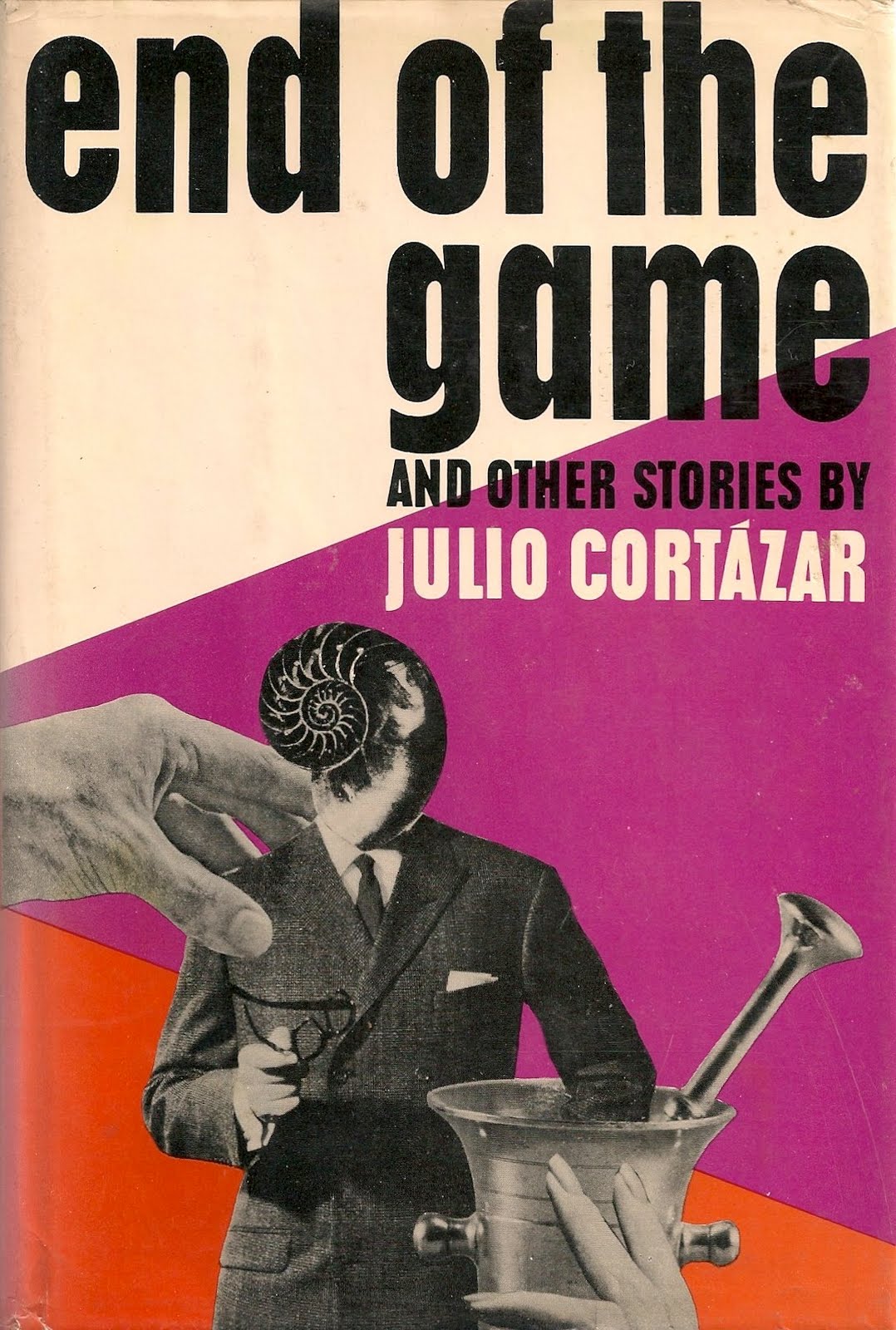 The idea of translating selections from Cortázar's work must have been in Paul Blackburn's mind at least from April 1958, when the Argentinian wrote him a friendly letter, in the course of which he outlined the books he had published to date and mentioned that he had just completed a long story, "El perseguidor" ("The Pursuer") based on Charlie Parker. Blackburn seems to have turned his hand first to Cronopios and Famas, although that book wouldn't appear in its entirety until 1969. By 1962, Cortázar was writing to Sara Blackburn (Paul's wife, and Cortázar's US editor) about a translation of "Las armas secretas" (apparently just the title story, not the entire volume) by Hardie St. Martin:
It seems formidable to me. It's very faithful, very precise, and it has all of the atmosphere of the original. I marked two or three little things that can be corrected without great effort... I would be delighted if someone would be moved to translate "The Pursuer" and the other stories in the book, but above all "The Pursuer."I'm not sure what became of St. Martin's translation, but in 1967, after Pantheon had already published The Winners and Hopscotch, End of the Game appeared, containing Blackburn's translations of most of the contents of Bestiario, Las Armas Secretas, and Final del Juego, including the Parker story, "Axolotl," "The Idol of the Cyclades," and twelve other pieces. By then Antonioni's film Blow-Up, which is loosely based on Cortázar's "Las babas del diablo," was about to appear, and so the story was retitled "Blow-Up," a felicitous change as the original title translates to something like "the devil's spittle." When the Collier Books edition appeared a year later the title of the entire volume was changed and a still from the movie became the cover art.
 In the late '70s or early '80s a Harper paperback edition restored the original title, but the subsequent Vintage edition that remains in print is once again Blow-Up.
The original surrealist-derived cover art from the hardcover edition is credited to one Hoot von Zitzewitz, whose identity appears to be a bit mysterious. In a letter to Paul Blackburn and his wife Sara (who was his editor at Pantheon), Cortázar wrote:
In the late '70s or early '80s a Harper paperback edition restored the original title, but the subsequent Vintage edition that remains in print is once again Blow-Up.
The original surrealist-derived cover art from the hardcover edition is credited to one Hoot von Zitzewitz, whose identity appears to be a bit mysterious. In a letter to Paul Blackburn and his wife Sara (who was his editor at Pantheon), Cortázar wrote: Dear Sarita, many thanks for the copy of End of the Game, which is very nice. I have the impression that we have chosen the sequence of stories well, and that some critics will say some interesting things about them.The same letter also alludes with regret to Sara's decision to leave Pantheon. By 1969 she and Paul Blackburn had divorced and Paul had married for a third time. (Translations are mine, from the three-volume Alfaguara edition of Cortázar's Cartas.)

Hopscotch was for me what the hydrographic cliché calls a watershed moment as my life took the direction it was to follow from then on. I hadn't read the book but I skimmed some pages and did two sample chapters, the first and one further along, I can't remember which. Editor Sara Blackburn and Julio both liked my version and I was off and away.When not busy translating One Hundred Years of Solitude, Paradiso, Conversation in the Cathedral, and dozens of other books, Rabassa went on translate five more of Cortázar's, the last being A Certain Lucas in 1984. His memoir, If This Be Treason: Translation and Its Dyscontents, was published by New Directions in 2005.
 The first of Cortázar's books to appear in English, The Winners (Los premios) was published by Pantheon in 1965 in a translation by Elaine Kerrigan. The jacket is by Muriel Nasser.
I really like the JACKET, Sara. Say so to Muriel Nasser, who I hope is not related to that other Nasser. Or is it the same Nasser who works for you under a feminine pseudonym? You never can tell.

I put the jacket on another book, and it looked wonderful. I like it very much, you know. I've never seen such a large photo of me. How young I was when it was taken! In this last three years I've aged a lot; now I can't read for more than two hours in one sitting, and at times I have rheumatism. But the heart is still young, as the bishop said to the actress.Excerpts from a letter to Sara and Paul Blackburn, December 17, 1964, from Cartas 2: 1964-1968, published in 2000 by Alfaguara. Sara Blackburn was Cortázar's editor at Pantheon; her husband, the poet Paul Blackburn, translated several of his works as well as being his American agent and good friend. The translation of the excerpts is my own, but the portions in italics are in English in the original.