Sunday, July 20, 2014

The Chase


Having read this short novel by Alejo Carpentier in Alfred Mac Adam's translation many years ago, I cockily told myself that I would be able to whip through it now in Spanish in a couple of nights. As it turned out, I made it about thirty pages in, then bogged down and decided to re-read the translation instead first before giving the original another stab.

Why the difficulty? I've plowed steadily through much longer books in Spanish than this one, which is barely over a hundred pages. Though the author was Cuban there's no Afro-Caribbean dialect issue to speak of; there's nothing comparable to the exuberance of Mexican regionalisms found in Elena Poniatowska's brilliant Hasta no verte Jesús mío, for example, or to the elaborate twists and turns of narrative perspective in Cortázar's novels and some of Vargas Llosa's. Maybe I just had too many distractions; in any case, the novel does present some obstacles to the reader, not insuperable ones to a native speaker, perhaps, but enough to make reading it a bit of a challenge. In Spanish or in translation (and Mac Adam's seems to be good), it repays persistence, though.

Carpentier told the critic Luis Harss that he had composed El acoso in imitation of sonata form, "with an introductory section, an exposition, three themes, seventeen variations, and a conclusion or coda." I tend to be skeptical of such claims (Milan Kundera has made similar statements) but in fact the narrative, the bulk of which consists of one long flashback, is framed within an evening's performance of Beethoven's "Eroica" symphony in a Havana concert hall, and probably should be read with that piece of music in mind.


The first character to whom we are introduced is an impecunious classical music buff who is employed as a ticket seller in the concert hall. As he sits in his booth a patron rushes in, flings down a bill many times more than sufficient for even the most expensive seat, and hurries into the hall, closely pursued by two other men. Pocketing the bill (which may or not be genuine), the ticket seller goes for a stroll, calls on a prostitute of his acquaintance, and returns, at the end of the book, in time for the final notes of the performance — and for the brief, violent aftermath of the opening incident. It is the figure he sees fleeing into the hall who will dominate the long central section of the novel. A native of the provinces, this man has incorporated himself into some kind of vaguely outlined revolutionary cell, but ideological purity has degenerated into betrayal and murder-for-hire and he is now a marked man. As we follow the series of steps that lead him to the concert hall events that were narrated in the book's first pages take on new significance.

Carpentier's vocabulary is rich ("baroque" was a word he himself used to define the character of his writing), but the greater challenge is posed by the fact that the reader often doesn't know — and isn't yet supposed to know — exactly what is happening. One section, for instance, begins, in Mac Adam's version, as follows; the ellipses and parenthesis are in the original:
(... this pounding that elbows its way right through me; this bubbling stomach; this heart above that stops beating, piercing me with a cold needle; muffled punches that seem to well up from my very core and smash on my temples, my arms, my thighs; I breathe in gasps; my mouth can't do it; my nose can't do it; the air only comes in tiny sips, fills me, stays inside me, suffocates me, only to depart in dry mouthfuls, leaving me wrenched, doubled over, empty; and then my bones straighten, grind, shudder; I stand above myself, as if hung from myself, until my heart, in a frozen surge, lets go of my ribs so that it can strike me from the front, below my chest; I have no control over this dry sobbing; then breathe, concentrating on it; first, breathe in the air that remains; then breathe out, now breathe in, more slowly; one, two, one, two, one, two ... The hammering comes back; I am shaking from side to side; now sliding down, through all my veins; I am smashing at the thing holding me in place; the floor is shaking with me; the back of the hair is shaking; the seat is shaking, giving a dull push with each shudder; the entire row must feel the tremor;
And so on and so on. It's only gradually that we realize that this passage is being told from the point-of-view of the man who has fled into the concert hall; we won't understand why he is there, or why his thoughts are frantically racing, for many more pages. Carpentier professed a disdain for "the little psychological novel" and a preference for the "big themes" of historical and social processes; perhaps the fracturing of perspective here is conducive to that more analytical, even didactic approach. El acoso was first published in 1956; since then its technical innovations have been widely borrowed and extended by other writers, but it still retains its nervy intensity.

Alejo Carpentier's description of the musical structure of The Chase, as well as his comments on the psychological novel, are quoted in Harss and Dohmann's landmark Into the Mainstream: Conversations with Latin-American Writers, which includes a respectful but sharply critical evaluation of the Cuban novelist's work.

Tuesday, July 15, 2014

HWY 62


Peter Case is kicking off a Kickstarter campaign for his next CD, HWY 62, which is scheduled to be released in 2015. Details here.

Sunday, July 06, 2014

The living


These two faded and stained studio portraits of African-American couples were taken sometime in the early decades of the twentieth century and printed on postcard stock. The one above, which is probably the earlier of the two, is the work of the Flett Studio in Atlantic City, which operated for at least fifteen years or so and must have produced countless similar images. "Mr. & Mrs...," followed by a family name, has been written on the back, but I can't make out the surname. The third figure, standing in the center, may have been the best man at the couple's wedding, or just a relative or friend.


There's even less we can say about the couple below, except that they're dressed to the nines. The studio is unidentified, but the Azo postcard stock used was manufactured from 1904-1918. Like the first postcard, this one was never mailed.


When an artifact is removed from its context without adequate documentation some of its potential for bearing information is lost; we no longer know as much about how it relates to the world that created it. The orphaned photographs above would be much more potent if we knew anything at all about the sitters' identities, life stories, occupations, and families, but people die childless or separated from their families, children have their own lives to lead and can't be bothered, any number of things can sever the thread. Things drift off and go their own ways.

*
The Dead in Frock Coats

In the corner of the living room was an an album of unbearable photos,
many meters high and infinite minutes old,
over which everyone leaned
making fun of the dead in frock coats.

Then a worm began to chew the indifferent coats,
the pages, the inscriptions, and even the dust on the pictures.
The only thing it did not chew was the everlasting sob of life that broke
and broke from those pages.

— Carlos Drummond de Andrade; translation by Mark Strand

Saturday, June 28, 2014

Survivors


Chile, the slender nation that lies along the Pacific margins of South America, has faced more than its share of disasters, natural and otherwise. This neat road novel by the Mexican-born writer Andrés Pascoe Rippey imagines an apocalyptic future in which a nuclear war between the great powers has wiped out modern communications and the electric grid worldwide, even in countries — like Chile — that are far from the center of the conflict. As the authorities lose control, rioting and looting break out, and are followed in turn by the rise of brutal paramilitary units, and, more disturbingly, by armies of crazed, cannibalistic merodeadores (marauders) in whom we — although not the characters, at least initially — recognize the characteristic traits of the zombie.

The novel's central character, Alberto, is a left-wing Mexican journalist living in Santiago. As violence breaks out, he at first withdraws to the security of his apartment, but when the situation in the capital becomes increasingly grim he flees south in a commandeered Range Rover, acquiring two companions along the way. One, Max, is a teenager from a wealthy and conservative Catholic family; the other, Valentina, is an Argentinian woman who is both a formidable hand-to-hand fighter and a sexual powerhouse. Hoping to find shelter in an isolated region, they find that little they encounter along the way — a pious farm family, a neohippie commune — is what it seems; moreover, the paramilitaries and merodeadores are also swiftly making their way south. Much of the latter part of the novel takes place among the idyllic scenery of Chile's Alerce Andino National Park, though the events that transpire there — including, of all things, a cavalry charge, are anything but tranquil.

The novel's political and social overtones are obvious and at time explicit, and memories of the violent dictatorship of Augusto Pinochet are never far from the surface, but the novel also draws on the conventions of horror cinema, as well as, I suspect, books like John Wyndham's The Day of the Triffids and the disaster novels of J. G. Ballard. It manages to be well-written and astute in its observation of society and character while supplying a ripping, well-paced narrative.

Todo es rojo is, thus far, available only in Spanish. It has been published, in a handsome edition, by a tiny Chilean press, Imbunche Ediciones, and appears to have limited distribution outside that country. (It is, however, available as a PDF download from Lulu.) Hopefully it will eventually gain wider exposure and translation into other languages.

Sunday, June 22, 2014

Destroying Angels


Kyūsaku Yumeno was the pen name of a prolific Japanese writer who died in 1936 and whose work is apparently relatively little-known in the English-speaking world. Satori Ediciones in Spain has just published El infierno de las chicas (The Hell of Girls), a Spanish-language translation by Daniel Aguilar of the three dark, intricate stories that were originally collected in Japanese as Shōjo jigoku. As far as I can tell the stories have never appeared in English.

All three tales included here are narrated largely or exclusively in epistolary fashion, though in each case we read only one side of the correspondence. One story makes use of fictional news articles, and now and then letters from third parties are nested within the letters of the primary correspondent. The first story, "No tiene importancia," (It's of no importance) takes the form of a long missive written by one physician to another, describing the case of a young woman who has worked as a nurse, first for the recipient and then for the sender. We are told from the first page that the woman, who goes by the name of Yuriko Himegusa, has killed herself; the remainder of the story, which is approximately one hundred pages long, is in effect an extended flashback explaining this act. Himegusa was, to all appearances, a model employee: pleasant, conscientious, skillful, and beloved by her patients. She was also, it seems, a pathological liar, and the eventual unraveling of the skein of lies she has wound around herself proves her undoing. Or does it? Both Aguilar, the translator of this volume, and Nathen Clerici, the author of a recent doctoral dissertation (PDF here) on Yumeno, point out that the final outcome of the story is in fact highly ambiguous; no body is found, and the "suicide" (revealed, naturally, by means of a letter) may simply be one more deception.

From the point of view of the doctor narrating her history, Himegusa represents simply an unfortunate if rather bizarre case of female psychopathology. But Himegusa sees herself as a victim of misunderstanding and suspicion, and her suicide — real or faked — amounts to a salvo in the drawn-out battle between women and a male-dominated world. This aspect is heightened in the two remaining stories in the volume, in both of which the central female characters are at once victims and avengers of the crimes of men. The briefest, "Asesinatos por relevos," (roughly, Murders by relay) takes the form of a series of letters written by a young woman who works as a conductor or ticket-taker on a bus, in which she seeks to dissuade a friend from leaving her rural home and taking up the same career. Her contention that such a career only serves to subject a woman to the whims and abuse of men is chillingly documented in the course of the correspondence, as a new male driver who appears to be a serial killer of women takes the wheel on the bus route she is assigned to.1 In the end, the man gets his comeuppance, although what amounts to a happy ending, in both this and the last story in the volume, may seem appalling to contemporary Western readers.

The final story, "La mujer de Martes" (The woman from Mars), which, like the first, is novella-length, is the most intricate of the three. It begins with a newspaper article about the discovery of a charred body after a fire in one of the outbuildings of a girls' school, and proceeds breathlessly through a series of follow-up reports, which document an increasingly bizarre and inexplicable series of events, including disappearances, a hanging, and the desecration of a cross inside a nearby Catholic church. Only after these events have been catalogued is the explanation teased out, in the form of a long letter from one of the students at the school (the gangly misfit whose nickname gives the story its title) to its headmaster, a pious bachelor who has inexplicably gone insane since the fire. As in the previous story, there is a woman wronged and vengeance to be exacted in disturbing — and in this case extraordinarily elaborate — fashion.

Daniel Aguilar notes that those stories are written from a feminine, almost feminist viewpoint, and there is something to that, bearing in mind the limitations of the time and place (1930s Japan). What is certain is that men don't come off well at all; if not all entirely depraved, they are nevertheless very bad at running things. But there's something more here too, a sense that the world is essentially amoral and devoid of meaning. The men, blinded by lust and vanity, may not acknowledge that fact, but the women know it all too well. In the words of Utae Awakawa, the "woman from Mars":
Little by little I began to feel with greater and greater intensity that the emptiness that lay in the depths of my heart and the emptiness that could be found above the blue sky were exactly the same thing. And I began to think, as well, that the act of dying was something simple and of no importance.2
This bleak sense of futility that emerges over and over throughout these stories may perhaps owe something to Buddhist thought, but in its incarnation into 20th-century urban Japan it takes on a character that is very much Yumeno's own brilliant creation.

1 The bus is staffed by two employees: the man at the wheel (conductor in Spanish), and the female cobradora or revisora who accepts tickets and provides assistance to the driver.
2 My translation from the Spanish version.

Monday, June 16, 2014

Identity


Here are four undated photographs of the same young man, all probably taken within a few minutes of each other. There's a severity to his angular features, projecting an indispensable image of male toughness to a tough world, but as we see him trying out poses — with hat or without, looking now left, now right — do we detect as well a certain lack of resolution, as if he were unsure about exactly how to best project that image?


He selects four different varieties of card mount, to be given away as keepsakes to unknown kin or girlfriends, but they're all passed down together, as if he never did quite make up his mind (or maybe he found that he had no one to give them to). A name scrawled in ink on the back of one of the cards may read "Owen Lewis," but next to it there are also traces of a different set of initials, ornately written in pencil.


The photos themselves are barely more than an inch high, and the embossed cardboard mounts that hold them are about 3.25 x 2.25. Based on the man's hat, collar, and necktie, I'm guessing that the photos date from the early 20th century. They may have been produced in an early automatic photo booth, like the one patented by Anatol Josepho, which debuted in 1925. (The technique of sealing the photos within embossed card mounts originated in the tintype era, decades earlier.)

Thursday, June 05, 2014

Cold Trail Blues


Peter Case at the Mug and Brush Barber Shop in Columbus Ohio, May 10, 2014.

"Cold Trail Blues" originally appeared on Flying Saucer Blues, and is also included in the compilation album Who's Gonna Go Your Crooked Mile?, both from Vanguard Records.

Thursday, May 29, 2014

Russell Edson (1935-2014)


I just learned from Charles Simic's notice on the website of the New York Review of Books that the poet Russell Edson died earlier this year (on April 29, 2014, according to the Poetry Foundation).

I knew Edson's work almost entirely through the one slim volume shown above, which was published as a "New Directions Paperbook Original," apparently in 1964. I doubt I had ever heard of the author when I picked it up second-hand; I was in my teens, it looked interesting, and it probably cost me all of twenty cents, which is the price marked in pencil inside the front cover.

The Very Thing That happens comprises eighty or so very short pieces — what would you call them? prose poems? anecdotes? fables? koans? — accompanied by Edson's own appropriately daft drawings. Here, in its entirety, is one example:
"Someone"

A man put a fedora on a cabbage, oh please be somebody I know.
Now who it is, as the brim is low, he cannot tell, but someone is certainly someone.
Someone, who are you?
Someone says nothing.
One and cabbage and now the moon. Round things are not unavailable in a square room.
The moon comes wearing a crown of clouds, worn too low to know who it is.
I ate it up: the whimsy, the perverse logic, that last line so deliciously cadenced it demanded to be sung (and sing it I did). And likewise with "The Cruel Rabbit," "Notice for the Meatball Fund," "The Tub and the Woman," "Mouse-music," and the title piece, which begins with a father riding into his kitchen on an imaginary white horse and after going downhill from there ends with this incontrovertible bit of wisdom:
But why why why is it happening? cries mother.
Because of all the things that might have happened this is the very thing that happens.
I've hung on to my copy of the book for a least forty years. I can't say that I've dipped into it more than occasionally for a long time, but its spell, in its own small way, has never really been broken.

Tuesday, May 20, 2014

The Orphan


Paweł Pawlikowski's Ida is my kind of film: spare, understated, sensitively directed, small in scope but firmly anchored in its time and place, which in this case means Poland in the early 1960s. Sumptuously shot in black-and-white in a narrow-screen format, it's very much a movie to be looked at, the way one looks at still photographs, supplying one's own active eye and interpretation, and not just something to be watched, the way one witnesses a spectacle that's been programmed to hit all the right emotional buttons at the predetermined moments.

The lead character — she's called Anna, a Catholic novice, but she learns that she's really Ida, the daughter of murdered Jews — actually has relatively little to say, usually no more than a few words per scene, and her face betrays little of what's going on inside her head, but she is, in the end, not only the ostensible protagonist of the movie but its audience as well, the one whose fate it is to experience the unfolding of a story that, even as it is about her, is fundamentally not of her own devising. Which is not to suggest that Ida is without a visceral punch. There's something in fact very Greek about it, not so much in the events as in the suddenness and starkness of its emotions, the way the characters — the young novice aside — respond in almost stylized fashion to the revelation of long-hidden secrets, as if purging the collective sins of an entire community.

The trailer below gives an idea of the storyline and the film's beautiful visual style, though inevitably it can't capture its graceful pacing. Stuart Klawans, at the Nation, has a comprehensive and thoughtful review that nicely encapsulates its virtues and ambiguities. I think this is a movie you should see.

Saturday, May 17, 2014

Ties


Around the beginning of the 20th century a marriage took place between two nascent media: the postcard, which was becoming the source of an enormous international craze, and amateur photography, a hobby democratized by Eastman Kodak's affordable and portable cameras. The result was the "real photo postcard," continuous-tone photographic prints made directly onto postcard stock, huge numbers of which were created by both amateurs and professionals. While the professional studios made both individual portraits commissioned by customers and mass-produced souvenir postcards in runs of thousands, the amateurs generally made unique prints. Large numbers of the latter survive; although designed to be mailed, many never were, or were enclosed in envelopes and thus never postmarked. Some of the images are fascinating (there are several excellent books devoted to them) but most are fairly dull. They were made for a specific purpose, as keepsakes, to exhibit the likeness of a loved one or the old homestead or the graduating class, imbued with meaning for the photographer and the recipient, but not conveying much to strangers. Separated from their context, they are largely mute.

The obvious amateur image at the top of the page is a little different; while it presents no drama, it does give us a sense of the subject's location and integration within an active, occupied urban space. The card stock was produced by Velox, a company acquired by Kodak in 1902, and this particular variety, which is marked "Made in Canada," was probably manufactured between 1907 and 1914. It bears no address and no identification of the woman in the foreground, although based on provenance I suspect that it was taken in the province of Quebec, perhaps in Quebec City itself. The pyramidal roofs of the skyline at right might potentially make an exact identification of the location possible.

Half of the woman's face is in shadow, as is the street behind her, and a stray fiber appears to have been captured in the printing process at top right, but the image is not without interest in spite of these flaws. If you look carefully (a magnifying glass helps), you can make out on the left side several figures stoop-sitting down the length of the block, the second set of stairs has some kind of ornate stencilled pattern on its vertical surfaces, and there may be an awning projecting from a storefront in the far distance. And then there are the overhead wires, which, like almost everything in this picture, provide a glimmer of connection. The poles, the wires, the street, the sidewalk, the stoop-sitters, the buildings clustered together, all speak of a world in which the texture of an individual's existence is inextricably entwined in sophisticated networks of interaction, communication, transportation, and marketing.


There's no snow on the sidewalk, but there appears to be some piled against the curb on the far side of the street. The child sitting closest to us, who is paying no attention to the woman or the photographer, is wearing a snug wool cap. It's perhaps the end of winter, and the woman has likely removed her own head covering to pose for the camera. A moment later she will move away, but the city that surrounds her will keep on humming even when she's gone.

Sunday, May 04, 2014

The Gloaming


The Gloaming
— Iarla Ó Lionáird (vocals), Thomas Bartlett (piano), Caoimhín Ó Raghallaigh (hardanger fiddle), Martin Hayes (violin/fiddle) & Dennis Cahill (guitar) — are a quintet of experienced musicians, three from Ireland, and two from the US, whose self-titled first record (above) was released in January 2014. They play a kind of stripped-down Irish trad, by turns haunting and breathtaking, that manages at once to innovate and to draw forth the music's deepest and most ancient core. It's really quite special. Below is one live performance, featuring nine and one-half dazzling minutes of Martin Hayes.


The Gloaming can be purchased from Real World Records or Brassland Records.

Sunday, April 20, 2014

Helens


I few months ago I signed up for a year's worth of New Directions' Poetry Pamphlets and (prose) Pearls, two series of chapbooks from a publishing company I've long admired but haven't always kept up with. As the books have arrived each month I've found some that I had already seen on the NDP list and knew I would like, like Paul Auster's The Red Notebook which I had read years ago in another format, and a few (definitely a minority) that I set aside after a quick skim. Bernadette Mayer's The Helens of Troy, NY arrived last week (coincidentally as I was re-reading the Odyssey in Robert Fitzgerald's splendid translation) and it's one of the better ones.


This is a modest collection of poetry, perfectly befitting its chapbook format; it's not particularly "literary" in a traditional sense (in the sense in which the poets I usually like tend to be "literary"), by which I mean that although the book includes, among other things, a couple of sestinas, a villanelle, and a sonnet, the language isn't particularly elevated or elaborated in relation to the kind of ordinary conversations that seem to have given rise to the poems. There's no explanatory Foreword or Afterword to the volume (nor is one really called for), but from what one gathers Mayer interviewed a number of women who happened to share a first name and a place of residence, and then worked scraps of their stories and conversations into something like a hybrid of oral history and found poetry, accompanied by black-and-white photographs of the Helens, most of whom are middle-aged or older. (There is one nude — named but mysterious — whom Mayer seems not to have met in person.)

At times fragmentary or cryptic, always unassuming, the poems nevertheless adeptly evoke the particularities of time and place, of what it has been like to grow up and grow old in a city that may have known better days but that hasn't quite given up on itself. (There's an awareness of decline throughout, but no self-pity; one subject proudly holds a bumper-sticker that proclaims "TROY: BACK ON TRACK!") The Helens reminisce about childhood haunts, favorite restaurants, long-dead husbands — or just about what it's like to be named after the most famous woman of antiquity. Names are important here; one of the women, Australian-born, bears the extravagant married name of Helen Hypatia Bailey Bayley [sic], while another, born Helen Mayer (but evidently no relation to the author), quips that she "once met rollo may's son & I thought i was more may [emphasis mine] than he."

Photo at top: Helen Worthington Bonesteel. Bernadette Mayer is now working on a similar project centered on Troy, Missouri.

Saturday, April 12, 2014

Cassie Burns


The first snows of December haven't yet fallen on the dirty streets of lower Manhattan, but already there's a chill in the air. The photographer, shifting the legs of his tripod and adjusting the camera for just the right view, shudders under his dark frock. It's an overcast morning without much shadow. The little cluster of urchins have observed his preparations, asking him questions and begging him to take their picture. He has waved them off at first but finally agrees, if they will only stand without moving where he tells them to stand, drawing the eye down from that dead expanse of exposed wall. He has other sites to shoot today and can't waste too much time.

A few men, loitering outside the mission or doing business in the shop that pays cash for "old books, newspapers, pamphlets," have been attracted by the commotion and stand in the background, curious but by old habit loath to draw too much attention to themselves. Along the fence there are posters advertising the plebeian entertainments of the week of December 19th — the Windsor, Huber's Museum, the annual ball in honor of John P. Kenney, and Bartholomew's Equine Paradox — but already one of the posters has had patches of paper torn away by the wind or vandals.

The girl lives a few blocks behind where the photographer makes his preparations, at New Chambers and Cherry Streets, an intersection that today no longer exists. Her name is Cassie Burns. She has dark blue eyes and has just turned thirteen, but she's small for her age; there's TB in the family. Wearing an oatmeal skirt, she stands a bit apart from the boys, the usual playmates she watches over almost like a mother. Womanhood is already inexorably separating her fate from theirs. They will be factory workers or soldiers or will join the drunks that haunt the mission; she will have the harder path of motherhood, struggle, lonely old age.

The children, hunched up against the cold in their worn coats, finally settle themselves enough for the photographer to begin. Only after the fact does he notice that two solitary standing figures, one on either side a few yards away, have left ghostly impressions on the glass. The image is issued as a lantern slide bearing the title "N.Y. City — Homes and Ways 62. McAuley Mission, Water St."


The above isn't a "true story," in that I don't know it to be true, but who knows how far it is from the mark? There really was a Cassie Burns in the neighborhood of Water Street and Cherry Hill when this picture was made, in the first decade of the 20th century. It's highly unlikely but not impossible that the girl — if it really even is a girl — is her, but she undoubtedly knew this block well and may well have played with the children shown here. The real Cassie Burns, it is said, would go on to have nine children of her own.

Monday, March 31, 2014

Silver Garden


I know next to nothing about the group called the everybodyfields except that they popped up about a decade ago, made three records that caused some excitement in alt-country/folk circles, then went their separate ways. The lead singer here is Jill Andrews; the bass player and singer to her left is Sam Quinn. When you sing this well you don't need a lot of theatrics. This is pretty close to perfect in my book.

Friday, March 28, 2014

Notebook (March 2014)


How many times has this happened? I'm out in a restaurant somewhere, hanging out with friends, and suddenly a song I've never heard before comes on in the background and even though I'm only hearing scraps of the lyrics there's such heartbreak and dignity there that all at once I know that those five or six minutes of music are offering me an answer, a key, the vindication of meaning over the absurd, the proof that against all evidence matter and spirit aren't condemned to incompatible, mutually exclusive destinies. The way the voice is laying down the words across the melody is so perfect, so inevitable, because if there was a revelation, a reconciliation, it would have to be inevitable and complete and final, it couldn't have conditions or qualifications, it couldn't be perfect when seen from one angle but not when seen from another.

And of course later I'm never able to track the song down, even if I know the singer's name, I can't remember the lyrics at all, or if I do track it down it turns out to be just one more hackneyed, hollowed-out artifice, agreeable enough in its way like any number of other things one savors for a moment and then allows to dissipate, gnawing away at the meaning in them until nothing is left, but as its to being an answer to anything, nothing could be more ridiculous.

But what if it was an answer — but only in that moment?

Saturday, March 22, 2014

Dance Respite, Dance Catalan, and if You Can, Dance Hopeful


Translated, with permission, from Tororo's French original at A Nice Slice of Tororo Shiru.

The year 2014 has been decreed the año Cortázar by the relevant authorities.

For the duration of the año Cortázar, the cronopios have deposited receptacles intended to receive contributions towards the financing of the festivities on windowsills, on loose planks at construction sites, on shelves in telephone booths (where these still exist), and in various other locations reasonably well-sheltered from rain (preferably, but not always, because after all one can't think of everything).

These receptacles consist of china tea cups, faux-bronze key trays inherited from grandparents, colored advertising mugs given away by various catering companies, plastic toothbrush-cups, ashtrays recently discarded by the bistros that once utilized them, and aluminum pie-tins; you will easily recognize them, in spite of their variety, because the cronopios, with admirable foresight, have deemed that it would be a shame if these objects served absolutely no purpose until they had been completely filled with money — something which, they are aware, will require the passage of a certain amount of time — and have thus garnished the bottoms of the receptacles with bird seed.

Locate the ones in your neighborhood, and wait before depositing your offering until the birds have eaten all the seed, because it would be a shame if your bills, softened by long circulation, were to be diverted from their fiduciary purpose in order to line the nest of swallows, or that your shiny coins should end up decorating the abodes of magpies.

During the same period, the famas have announced through official channels that in honor of Julio Cortázar they will dance respite on even-numbered days from 4:30 to 5:00 in the afternoon, and that they will dance catalan on odd-numbered days from 5:00 to 5:30.

Green and humid, a cronopio poses on a slab...

... on which someone has carved "Julio Cortázar," somewhere in the cemetery of Montparnasse.

Once there, not really knowing what to do, he smiles with a slightly embarrassed air.


Translator's note: I have borrowed the names of the dances (which are tregua, catala, and espera in the original Spanish) from Paul Blackburn's translation of Cronopios and Famas. Blackburn had apparently worked up a hypothesis, based on the similarity between catala and catalán, to explain the three-fold division of cronopios, famas, and esperanzas along ethnic lines. Below is Cortázar's response, from a letter dated March 27, 1959 that was written in a mix of Spanish (which I've translated) and English. The passages in brackets are missing words restored by the editors of Cortázar's letters:
Let me explain: to dance tregua and dance catala can't be [translated as] "to dance truce and dance catalan," because I never thought that tregua and [catala] had that meaning. For me it's simply a phrase with a certain magic of [rhyme], a sort of "runic rhyme" in Poe's sense. To begin with, catala doesn't [mean] Catalan. Of course now that I've read your division between [Spanish], Catalan, and Madrid businessmen, I wonder if you're not right. Who is right, [the Agent] or the Author? No use to scan the contract. No explanatory clause provided. But, Paul, if Cortázar's Famas dance catalan, is that fundamentally wrong? The Author SAYS, no. Famas may dance catalan and dance truce. Let them dance. I think your philological enquiry is delightful and quite true in the poetic sense of Truth, which is the ONLY sense of Truth. (I am speaking like Shelley, I'm afraid.)
In the end, Blackburn's published translation replaced "truce" with the much funnier "respite," but arguably the terms should be left untranslated so that the cronopios, famas, and esperanzas may freely dance tregua, catala, and espera as the spirit moves them. — CK

Saturday, March 15, 2014

Julio Cortázar: A Model Kit


This year marks the 100th anniversary of the birth of Julio Cortázar (in the suburbs of Brussels, August 26th, 1914, just days into the German occupation of the city), as well as the 30th anniversary of his death, and last year was the 50th anniversary of the publication of Rayuela, so there has been a predictable amount of hoopla — though apparently relatively little in the US, so far. Cortázar, who was congenitally allergic to hagiography, at least as far as his own public image was concerned, would no doubt have been exasperated by most of this activity, but I think he would have made an exception for this book, which has been lovingly and creatively edited by his first wife and literary executor, Aurora Bernárdez, together with Carles Álvarez Garriga and the book designer Sergio Krin.

Taking their cue from the the experiments with the form of the book that Cortázar himself engaged in, they have assembled an alphabetical "biographical album," which, as the editors state in their introductory "Justification," is "in its way many books but which can be read above all in two ways: in the normal manner (from A to Z) or in a leaping manner, following the spiral of curiosity and chance (AZar). The book thus begins with "Abuela," a two-page spread of pictures of the author's grandmother and a memorial poem he wrote in 1963, and ends with "Zzz...," a brief, sarcastic passage from Rayuela. In between there are reproductions of first editions of his books, postcards, scraps of manuscripts, photographs of friends (my favorite is a priceless shot of Cortázar seated at a table discoursing to a cigar-toting José Lezama Lima), poems and excerpts from his novels, letters, and other writings (some previously unpublished), even his passports and metro tickets. Taking itself lightly, the book includes an entry on "Sacralization," reproducing bookmarks, postage stamps, an abominable coffee mug, and other posthumous Cortázar tchotchkes along with a characteristically tart Cortázar text that makes his own attitude towards such fetishization abundantly clear. Very few aspects of Cortázar's personal life, public activity, and work are left undocumented (Edith Aron, the purported original of la Maga, is one of the few), but the approach through out is respectful but never reverential or ponderous. Above all, like the man himself, it is fundamentally ludic.

Cortázar de la A a la Z: Un álbum biográfico has been published by Alfaguara in Spain; the ISBN is 978-84-204-1593-2. It's only available in Spanish (and wouldn't work in translation, at least in the same format, because of the reproduction of considerable manuscript and typescript material), but anyone seriously interested in Cortázar should seek it out nevertheless, if only for the illustrations.

Sunday, March 09, 2014

Favorite son


Burnside Park in Providence, Rhode Island currently sports an installation of rotatable signpost sculptures, including the one shown here, which is dedicated to the horror writer Howard Phillips Lovecraft, a local native.


I have mixed feelings about H. P. Lovecraft in general (q.v. my earlier post), but the handwriting and appropriately ghoulish illustration here seem to hit just the right note. Lovecraft is, in any case, now at least as much a mythical creature as he is anything else, and who knows if perhaps that fate wouldn't have displeased him. So far, I haven't been able to find out who created these sculptures.

Additional (and better) photos can be found in a blog post at Are there Any More Cookies?.

Saturday, March 01, 2014

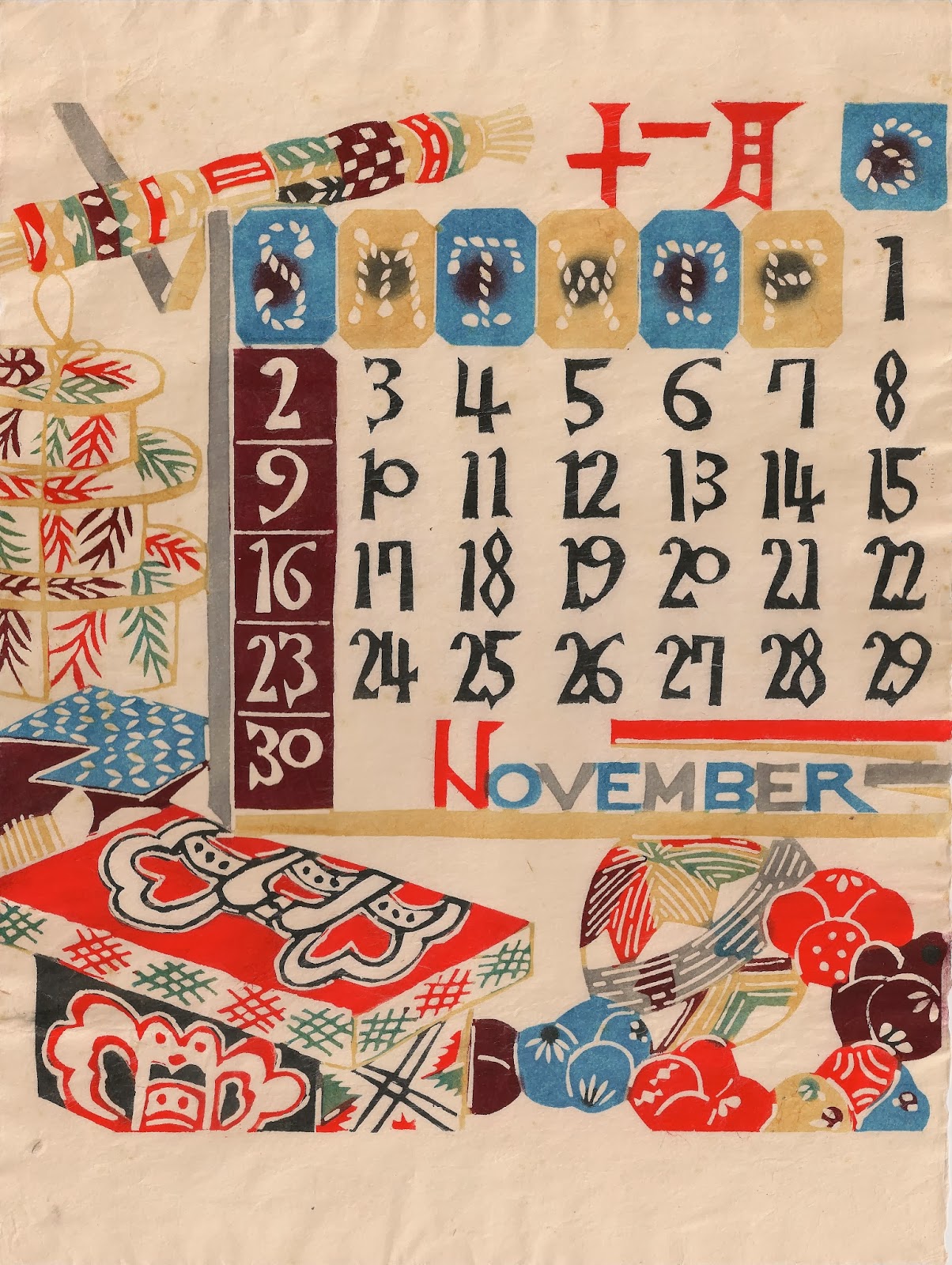
Keisuke Serizawa: 1969 Calendar


This hand-printed calendar was produced by the Japanese katazome (stencil-dyeing) master Keisuke Serizawa, whose mark can be seen just below and to the left of the bird on the cover print (see following image). He produced calendars, with different designs each year, from 1946 until the mid-1980s; at least one associate and friend, Takeshi Nishijima, produced his own similar calendars during part of that period.


This particular production is relatively restrained. On most of the individual panels it is the numbered squares or circles, rather than the accompanying illustrations, that are the dominant design element; many of the spaces not needed for dates are filled with little vignettes.


For the August print below, Serizawa worked the letters of the name of the month into the first row of the calendar, but since he was one square short he combined the last two letters into one space.


November, I think, is my favorite. Notice that the "S" for Saturday is displaced to a line above the other days, again because there was no empty square available for it.


All of these pages were printed on handmade paper, so the originals are not as neat and square as the images shown here imply.

A variant of this calendar has the name of the Western Automobile Co., Ltd. (the Japanese affiliate of Mercedes-Benz) printed on each page; the image below is from an auction listing.


I am relying on George Baxley for identification on this calendar as the work of Keisuke Serizawa. There are relatively few English-language sources on the artist, with the fine exhibition catalog Serizawa: Master of Japanese Textile Design (Yale University Press, 2009) being the notable exception.

The passenger


Call it an urban legend or what you will: here's a twice-told tale that only acquired its full impact years after the events it purports to describe.

The story emerged from a conversation in Paris between Julio Cortázar and an Argentine expatriate couple, Aldo Franceschini and Rosario Moreno. During the conversation, someone (apparently Cortázar) alluded to Mendoza in western Argentina; at the mention of the name Aldo Franceschini suddenly became excited and began to narrate an incident that had happened to him and his wife years before:
It was at the end of the 1950s, on the highway from Córdoba to Buenos Aires. Just at dusk the couple's car ran out of gas. Night fell with no sign of another vehicle passing by. They remained in the dark, smoking, waiting, hoping for someone to appear who could lend them some gas or give them a lift into the nearest town. Finally, around one in the morning, a car appeared. They signaled with a flashlight for it to stop and stood in the middle of the highway until it came skidding to a halt. Aldo approached the car in order to ask the driver for help, but even as he neared the window he detected something strange, an enigmatic fear that made him hesitate, an unease that seemed to emanate from the passenger seat, where the slumped form of a human being was outlined in the glow of the instrument panel. As Aldo explained that they had run out of gas the driver abruptly said that he had none to spare and quickly pulled away, leaving the couple stranded in the middle of the Pampean night. Oddly, as Aldo watched the car disappear he felt an inexplicable relief. A few hours later the couple were rescued by a passing trucker.
When Cortázar heard this tale it brought something else to mind and he quickly put two and two together. The motionless figure in the passenger seat, he suggested, was in fact a corpse.
The reason was economic. In the 1940s and '50s patients from Buenos Aires suffering from lung ailments like tuberculosis were frequently sent to the mountains around Córdoba, a climate considered drier and healthier than the capital. While they were there, naturally, some of them died, but returning their bodies to Buenos Aires entailed considerable expense in the payment of duties and taxes imposed by the city government. In order to skirt having to pay this tribute, the corpse would be propped up in the passenger seat and given a bit of hasty make-up, and the driver would then speed to the capital at seventy miles an hour. Upon arrival, the authorities having been notified of the death as if it had taken place locally, the required fees were avoided.
Cortázar added, perhaps facetiously, that at least two of the drivers in this clandestine business went on to become famous race car drivers.

The story above is translated loosely from the version told by Miguel Herráez in his biography of Cortázar. I have embellished it with a few details from Cortázar's own, longer treatment, "El copiloto silencioso" which can be read in Spanish online or in Un tal Lucas (Sudamericana, 1979) and in English, in Gregory Rabassa's translation, as "The Silent Copilot" in A Certain Lucas (Pantheon Books, 1984).

Saturday, February 22, 2014

The New Man


As far as I can tell there is no "biography" of Julio Cortázar in English, though there are any number of book-length critical studies. There are at least three (probably more) in Spanish, of which Miguel Herráez's "revised biography," published in 2011, is among the more recent and the first that I've read. Not having compared it to the biographies by Mario Goloboff (1998) and Eduardo Montes-Bradley (2005), I can only say that this one seems thorough and judicious and worth putting before an English-speaking audience, although even in this año Cortázar — the centenary of his birth — I don't know how likely it is that a publisher in the US or UK will make the effort.

Herráez's book doesn't pretend to be "definitive"; if such a qualifier will ever be applicable to a life of Cortázar it will be some time in the future and the resulting product will no doubt be vastly longer than the 351 pages — nicely illustrated, I might add — we have before us. Herráez has been able to draw on the three-volume edition of the writer's letters published in 2000, but presumably didn't have access to the greatly expanded edition published two years ago; he has, however, interviewed many of Cortázar's friends and associates, including his first wife, Aurora Bernárdez, who has overseen his legacy since his death.

One of the puzzles of Cortázar's life is how its segments fit together, in particular how the provincial schoolteacher and professor in his late twenties and early thirties, a man who published little of note before 1951, became, as an expatriate in France, the daring and confident writer who would knock down the walls of the modern novel with the publication of Rayuela (Hopscotch) in 1963, and who would devote much of his later life to a political activism that at first glance at least seems at odds with the stubborn aestheticism of his younger years. Herráez doesn't entirely resolve these mysteries, and in fact underlines some of them, revealing how Cortázar cut his ties with many old acquaintances once he moved abroad. There are gaps in the story — Herráez says little, for instance, about Cortázar's years as the director of the Cámara Argentino del Libro in Buenos Aires — and no doubt some of these will be filled in in years to come, but we ought to remind ourselves that the whole notion of being "provincial" is here, as elsewhere, highly suspect; Cortázar at thirty-five, though he had as yet never left the continent of South America, had absorbed more French and English literature (much of it in the original) than many educated Europeans or North Americans ever would. Though the years in France would be decisive for his development, in many ways the mature writer must have always been there in embryo. Even so, one can't help being impressed by the force of the deliberate reinvention of himself that was to come.

Saturday, February 08, 2014

The Prehistory of Cronopios, Famas & Esperanzas (Epistolary Phase)


Julio Cortázar's Historias de cronopios y de famas, a volume of short, unclassifiable whimsical fables and texts, was published by Francisco Porrua's Ediciones Minotauro in Buenos Aires in 1962, and appeared (as Cronopios and Famas) in Paul Blackburn's English translation for Pantheon Books in 1969, that is, well after the US editions of The Winners, Hopscotch, and End of the Game and Other Stories (also known as Blow-up and Other Stories). Curiously, though, it appears that the cronopios reached an English-speaking audience before they were widely available in Spanish. Here's the story in brief as I've been able to piece it together thus far.

Blackburn, a poet and translator from several languages, first exchanged correspondence with Cortázar in the spring of 1958 through the auspices of Edith Aron (who, incidentally, is said to have been the inspiration for the character of la Maga in Hopscotch). Aron, a native German speaker, had translated some of the pieces that would eventually become Historias de cronopios y de famas into German for a magazine, and Blackburn may have seen them there. (It's also possible that he had come across the selection of seven pieces that were published in Havana by the review Ciclón in 1956.) In March 1958, at Aron's instigation, Cortázar sent Blackburn some of the cronopio material, possibly in the form of a homemade mimeographed "edition" similar or identical to one he had sent to the Cuban poet José Lezama Lima in January 1957. In April 1958, responding to a letter he had received in return, he wrote again, complimenting Blackburn on his Spanish, expressing an interest in reading the latter's own poetry, and providing a brief curriculum vitae that listed the books he had written to that point, including the story collections Bestiario and Final del juego as well as the (as yet unpublished) novels El examen and Los premios.

Blackburn seems to have set to work quickly on translating the material Cortázar had provided, and two excerpts appeared, in his translation, in the 1958 edition of New World Writing. By June 1959, he had translated large portions of the book and sent it to the author. A letter from Cortázar on June 29th describes the translation as "formidable" and mentions that he had read it twice and noted with pleasure that it reminded him in spots of Damon Runyon ("whom I always admired a great deal"). Several pages of suggested corrections follow, not all of which would be reflected in the final version.

By now, Blackburn was acting as Cortázar's literary agent in the US, and was seeking an American publisher for the cronopio material, without notable success. In December 1959, Cortázar refers to a public reading by Blackburn of the stories in New York City:
Paul, it's stupendous that you've read the cronopios in N.Y. and that people have enjoyed them so much. You don't know how happy this makes me. Did you make a tape recording? How I would have liked to hear your voice reading your translations, it would be fabulous. Many thanks for scattering my cronopios in the cafés of 9th Avenue. They must have eaten all the hamburgers, I imagine, and then left without paying. Deplorable conduct of the cronopios in New York.
A tape recording of this performance (or a later one) must have existed, because in a letter sent in March 1960 Cortázar reports having received it and having greatly enjoyed listening to it. He also delightedly acknowledges receipt of a tube of garish Stripes toothpaste — a bit of an inside joke, as one of the cronopio texts involved misbehavior with toothpaste. Later in that same letter he indicates that an Argentine publisher had agreed to accept a volume including those pieces as well as several other groups of texts that would eventually be included in the published book. In April 1961, Cortázar told Francisco Porrua, the publisher, that the texts had met with great success in their New York reading:
Last year a radio station in New York broadcast all of the cronopios in a magnificent version by Paul Blackburn. There was a torrent of mail, which the translator showed me...
By 1961, Editorial Minotauro was beginning work on the Argentine edition and Cortázar reports that Maurice Girodias' Olympia Press, located in Paris, had agreed to publish some of the cronopio texts in English in an issue of a new review, Olympia. They would, in fact, appear in issue No. 2 of that short-lived publication, but as of a June 1962 letter to Sara Blackburn — both Paul's wife and Cortázar's editor at Pantheon — Cortázar complained of not having been paid.

Cronopios and Famas would, as it happened, have to wait its turn in the US; the novels and longer stories were no doubt considered more easily marketable. The version that Pantheon eventually released includes a translation of at least one text ("Instructions on How to Dissect a Ground Owl") that Porrua persuaded Cortázar not to include in the Spanish-language version. It also incorporates most, but not all, of the changes Cortázar had suggested to Blackburn. The most puzzling of the corrections not made is found in "Improprieties in the Public Service," where Cortázar's objection to the incomprehensible "the confusion daddy" as a translation of "una confusión padre" (roughly, "one hell of a confusion") was never addressed. Nevertheless, Blackburn's translation of this elusive material holds up well, and Cortázar was right to be happy with it.

But what was the tape Blackburn sent Cortázar in 1960? The Pacifica Radio Archives holds a tape recording (not yet digitalized, sadly) of a 44-minute performance of Cortázar's "Stories of Cronopios and Famas" read by Blackburn and fellow poet Robert Kelly on WBAI in New York on July 19, 1962, which may or may not represent a re-broadcast of an earlier reading. The UC San Diego library, which holds Blackburn's papers, has a tape of what may be the same performance. It's possible that the original 1959 or 1960 tape still exists somewhere among Cortázar's papers.

(Translations from Cortázar's letters, taken from Cartas I (2000), are mine.)

Saturday, February 01, 2014

Travelers


Evolutionary biology and biogeography are basically outside of my bailiwick here, not because I'm not interested in those fields (I am) but because, as is generally the case with all the sciences, a smattering of layperson's knowledge really doesn't qualify one to give an informed evaluation of advances in the discipline undertaken by people who have both years of scientific training and a thorough knowledge of the relevant literature. (Which doesn't stop any number of crackpots and pseudoscientists from jumping in with both feet, of course.) So I will only say of Alan de Queiroz's The Monkey's Voyage: How Improbable Journeys Shaped the History of Life that it is enjoyably written in a way that is comprehensible to a lay reader without being unnecessarily dumbed down, and that it puts forward what appears to be a plausible, if certain to be disputed, argument that may shed new light on how the world's flora and fauna came to be distributed where they are.

To sum up the book's argument very briefly, one of the early problems that Darwin and his contemporaries faced was how species that were clearly related to each other came to be distributed in places oceans apart; the example alluded to in de Queiroz's title is the monkey lineage, which is found in both Old and New worlds. The discovery of plate tectonics seemingly provided an answer: the ancestral homeland of these species had drifted apart, and the descendants went their separate evolutionary ways thereafter, in a process known as vicariance. The problem is that recent DNA studies suggest that the timing is all wrong.
If the opening of the South Atlantic caused the separation between platyrrhines [New World monkeys] and catarrhines [Old World monkeys], then that split in the evolutionary tree should have occurred on the order of 100 million years ago. To put this in some perspective, such an old date would imply that the New World and Old World monkey lineages, which we know are not early branches in the primate tree, are actually about 50 million years older than the earliest known primate fossils of any kind. In fact, these monkey lineages would have to be some 35 million years older than the first known fossils of any placental mammal.
The DNA evidence, which gets a bit complicated, suggests that the split in fact took place within the last 51 million years, and possibly as late as 33 million years ago. But if those numbers are right, then why are there monkeys in the Americas at all?

De Queiroz, a biologist at the University of Nevada, suggests that they got there the same way that a surprising number of seemingly out-of-place species came to be where they are: by accidental ocean crossings long after the continents had drifted apart. This may seem far-fetched, and in fact de Queiroz recognizes that the monkey example, of all the cases of potential oceanic dispersal that he examines, requires the greatest suspension of one's initial disbelief. But by building up careful evidence for other, less extreme dispersals, he makes a plausible case for even the ancestor of the platyrrhines as an accidental transoceanic migrant. The scenario — monkeys clinging to driftwood or to "islands" of vegetation swept out to sea by drainage from Africa's rivers (or, he might have added, by tsunamis) — would have extremely long odds against it, but one should bear in mind the vast quantity of time available; a one-in-10 million-years freak event might actually stand a fair chance of happening, given the tens of millions of years during which it could potentially have taken place. (The Atlantic would have been substantially narrower than it is now, and de Queiroz suggests that the monkeys — or maybe one pregnant monkey — might only have had to cling on for a week or so.)

There are many other well-documented case studies in the book — New Zealand, Hawaii, the Falkland Islands — and de Queiroz, whether or not he is ultimately proved to be right, appears to have done his homework. It seems likely that we'll be hearing more about his book in the coming years.

Saturday, January 25, 2014

Man of letters


Alfagura began issuing this five-volume expanded edition of Julio Cortázar's letters in February 2012, but it's taken me a bit to get around to it, starting now with the third and fourth volumes, which cover the period between 1965, when Cortázar's name was still largely unknown outside of the Spanish-speaking world, to 1976, by which time his international reputation had been solidly established and he had already completed his last novel, Libro de Manuel.

We're no doubt nearing the point where collections of this nature, sadly, will no longer be produced, or needed. Cortázar, who died in 1984 and thus antedated the age of email, didn't seem to use the telephone much, but he did conduct a prodigious multicontinental (and trilingual) correspondence. I suspect that even this greatly enlarged edition of Cartas, which includes more than 1,000 previously unpublished letters, doesn't come close to collecting his entire output. Several important recipients seem to be absent or underrepresented, perhaps because their papers have not yet been made available to the public*; in a few years, if the state of the book industry permits it, we may well be looking at a seven-volume or even ten-volume third edition.

Where does one even begin to open these volumes, given the richness of the material? Is it best to strike out chronologically, or to follow the threads of literary history in the letters to individual recipients like José Lezama Lima, Paul Blackburn, Mario Vargas Llosa, or Ariel Dorfman? Pick an event in the history of modern Latin America — the death of Che Guevara, the overthrow of Allende, the assassination of the Salvadorean poet Roque Dalton — and you'll find Cortázar's reaction to it, in real time, as they say. The importance of these letters to Latin American literary history, on the other hand, is simply immense, given that Cortázar exchanged regular correspondence with not only the major writers of the continent, but the important publishers, critics, agents, and translators as well. His correspondence with translators and academics is particularly fascinating; unlike many writers, Cortázar, an experienced translator himself, was quite willing to discuss in detail and with great patience his intentions in writing particular works, even if at times he had to admit being stumped himself by stories like "Las babas del diablo" (which Antonioni transformed into Blow-Up).

Cortázar's writing, as well as his life, became increasingly political during the 1960s and the awful decade of the 1970s, which saw countries like Chile and his native Argentina fall under barbaric military regimes. His political activism may have taken its toll on some friendships, as his continuing (but not entirely uncritical) support for Cuba separated him from old friends who were becoming increasingly alienated from the Castro regime. After the publication of the very political Libro de Manuel in 1973, his commitments, as well as occasional bouts of ill health and the deaths of old friends, may have taken a toll on his literary production, but inside he remained the eternal cronopio, able to take delight in reading, of all things, The Lord of the Rings from cover to cover in August 1975.


NB: The new edition omits the useful list of biographical references from the first edition that provided brief identifications for the recipients of the letters, and has changed the index so that references to individuals are only indexed at the end of the volume in which they are mentioned. On the positive side, an index of cited works has been added, which makes it easier to find the letters in which Cortázar discusses particular stories or novels. The thoroughness and care of the editors in these volumes is admirable throughout.

*Letters to Carlos Fuentes held at Princeton University have apparently been restricted until 2014. It's possible that some of Cortázar's letters to Octavio Paz may have been destroyed in a fire in 1996.

Tuesday, January 21, 2014

Mexico City


I approach the heart of the city down a narrow, winding road that weaves among thick settlements of low buildings and clusters of trees. (I have been to Mexico City, many years ago. The geography doesn't correspond, but it does correspond to the topography of the city as I may once have dreamed it, perhaps, before I went there.)

It's morning and I set out by foot to change a bit of money. I find myself in a small gift shop attached to a restaurant. There are some stacks of books about contemporary Mexican artists; I pick one up and leaf through it, admiring the work, then set it down and look around to see what else they have. But the shop is small, there's just the one corner of books. I get on line at the cash register to change some money. When I get to the front of the line the cashier and the cash register have disappeared somewhere behind me, and I wander off outside. I go into a bank. "Se puede cambiar dólares por pesos?," I ask the teller, but she says no and gives me directions, which I can't follow, to another bank. After a while I enter a small building that looks more like a car repair shop. While I'm waiting in line someone knocks me down and begins rifling through my pockets; I come to and give the man a beating. A third man, waiting in front of me, helps me up and thanks me profusely, but I think it best to beat it; I stuff my money awkwardly into my pockets and exit through a long arcade. Here I have a commanding view of much of the city. I look at my watch — it's ten A.M. — and at the sun to orient myself, then set off in the direction where I think the center of the city lies. Off to one side there's a little wrought-iron pedestrian gate that opens into an old neighborhood; there's a name and date on a sign next to the gate. But I don't go that way; instead, I climb a long series of steps past a vacant lot overgrown with tall trees. A man in a pale polo shirt, who doesn't appear to be Mexican, is descending the steps; he says "buenas" as we pass. I start to mumble "buenas tardes" but remember that it's still only morning. The man steps into a small office, where another man listens sympathetically as he pleads, "necesito un poquito más sustancia que me den, para poder vivir." The other man nods and agrees; he will take steps.

I've emerged at the edge of a small college campus. I pass through it; on the other side there is an abandoned fairground. A sign reads "NY World's Fair" and there's a date: 1961. I wonder, is this where fairs come to die? Is this a cemetery for fairs? Everything is white and there are life-size calaveras strewn over the ground.

Sunday, January 12, 2014

"He was my brother"


The letter below was sent to the American writer Toby Olson on October 1, 1971. A few weeks earlier the poet Paul Blackburn, Julio Cortázar's translator, agent, and friend, had died in Cortland, New York. The letter was written in English, with a few minor errors; it was addressed from Paris.
Dear Toby,

I found your letter last night when coming back from Vienna. You see, I knew that Paul was dead, I had the feeling all the time since I got Joan and Sara's letters. The only thing I learned from you was the date, September 13. He was my brother, Toby, he was a wonderful friend, he was the first and most wonderful of cronopios, who he loved, who he made live in English. Toby, he sent me a letter, his last, in July 3, in full summer, he sent it to my small rancho in Vaucluse where he and Joan spent two or three weeks in 69, and where he finished his translation of the cronopios book. I was unhappy then and he came and he made me laugh and forget a lot of unpleasant things. He gave me hell with a tape of the Beatles which he played for hours and hours until I cried for mercy. We were so happy, we drank so much pastis, we read poetry, his and Latin American poetry, and he promised to come back in two years. Ah, Toby, is so tough and my English is so bad, forgive me, I just wanted to tell how I loved my brother, how I feel now. I'd like to be there with you and Jerry and Schwerner, in a way I'll be there, please count me there, Toby. I send you a photograph of Paul's last letter. He wrote a poem about the way he had to drive to get to my rancho. If you want to read that poem I'll be there to listen to it, with all his friends. I can't write no more, forgive me.

Julio

Wednesday, January 01, 2014

Back to the Garden


I bought a copy of the LP of this recording by the Stanley Buetens Lute Ensemble back in the 1970s and listened to it many times, but after CDs came along it was consigned to a box and I probably hadn't heard it for thirty years until recently, when I pulled it out and found that I still enjoyed it as much as I did back then. Many of the old Nonesuch LPs from that era have been out of print for years, but I was delighted to learn that just a year or so ago Raymond Buetens, Stanley's son, obtained a license for it and released it on CD and as a download.

This was the ensemble's only record, although Stanley Buetens, who died in 2009, appears on other recordings (including some by P.D.Q. Bach) and wrote several well-regarded instructional books on playing the lute. Most of the other musicians heard here were apparently not particularly well-known, and some may have been amateurs; the viol player, Lawrence Selman, was a chemistry professor who founded a business devoted to paperweights, on which he was an expert. Professional or not, they were accomplished players (and singers — Buetens himself sings tenor on several pieces) and this remains a very enjoyable set of music, one that spans the sacred and the secular and encompasses a wide range of styles.

Of one cut, the 15th-century Spanish "Dale si le das," the original liner notes state, "the lyrics are rather indecent and practically unusable on records today." The ensemble performed it as an instrumental, at a fairly slow tempo, and it comes across as a fairly dignified march with one odd feature — a curiously long line played just by the recorder. A more recent performance (below) by the Capella Virelai, however, gives it a brisker reading, and includes the full lyrics, which are, in fact, strikingly bawdy, though thankfully no longer "unusable." In each verse, a rhyme with the end of the previous line makes one anticipate a fairly crude obscenity, which is then safely transformed, as one singer is interrupted by another, into a perfectly innocent ending. It's a 15th-century precursor of "Mary Had a Steamboat" — but much bluer.


In A Medieval Garden can be obtained through Bandcamp.