Saturday, March 01, 2014

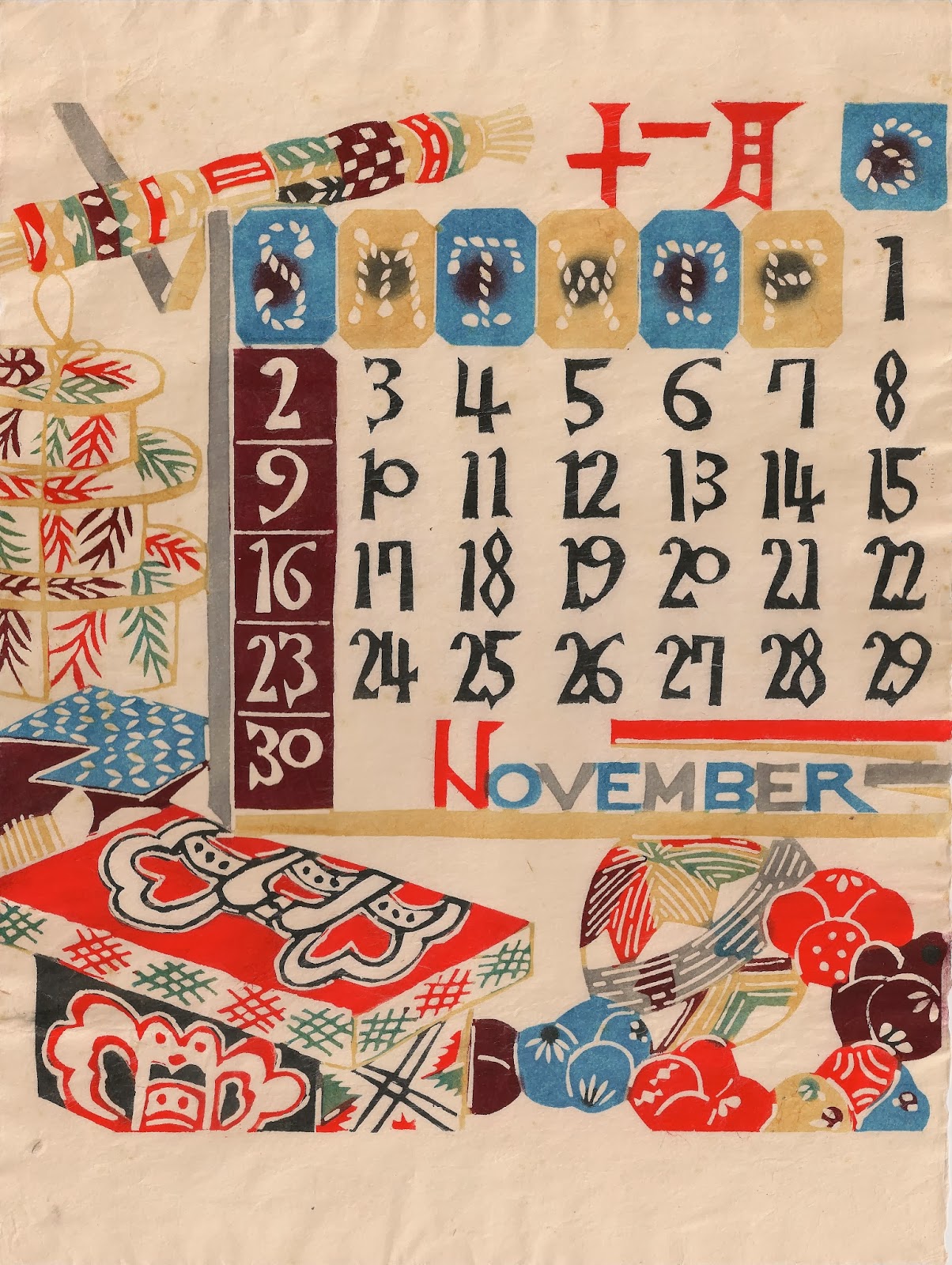
Keisuke Serizawa: 1969 Calendar


This hand-printed calendar was produced by the Japanese katazome (stencil-dyeing) master Keisuke Serizawa, whose mark can be seen just below and to the left of the bird on the cover print (see following image). He produced calendars, with different designs each year, from 1946 until the mid-1980s; at least one associate and friend, Takeshi Nishijima, produced his own similar calendars during part of that period.


This particular production is relatively restrained. On most of the individual panels it is the numbered squares or circles, rather than the accompanying illustrations, that are the dominant design element; many of the spaces not needed for dates are filled with little vignettes.


For the August print below, Serizawa worked the letters of the name of the month into the first row of the calendar, but since he was one square short he combined the last two letters into one space.


November, I think, is my favorite. Notice that the "S" for Saturday is displaced to a line above the other days, again because there was no empty square available for it.


All of these pages were printed on handmade paper, so the originals are not as neat and square as the images shown here imply.

A variant of this calendar has the name of the Western Automobile Co., Ltd. (the Japanese affiliate of Mercedes-Benz) printed on each page; the image below is from an auction listing.


I am relying on George Baxley for identification on this calendar as the work of Keisuke Serizawa. There are relatively few English-language sources on the artist, with the fine exhibition catalog Serizawa: Master of Japanese Textile Design (Yale University Press, 2009) being the notable exception.

The passenger


Call it an urban legend or what you will: here's a twice-told tale that only acquired its full impact years after the events it purports to describe.

The story emerged from a conversation in Paris between Julio Cortázar and an Argentine expatriate couple, Aldo Franceschini and Rosario Moreno. During the conversation, someone (apparently Cortázar) alluded to Mendoza in western Argentina; at the mention of the name Aldo Franceschini suddenly became excited and began to narrate an incident that had happened to him and his wife years before:
It was at the end of the 1950s, on the highway from Córdoba to Buenos Aires. Just at dusk the couple's car ran out of gas. Night fell with no sign of another vehicle passing by. They remained in the dark, smoking, waiting, hoping for someone to appear who could lend them some gas or give them a lift into the nearest town. Finally, around one in the morning, a car appeared. They signaled with a flashlight for it to stop and stood in the middle of the highway until it came skidding to a halt. Aldo approached the car in order to ask the driver for help, but even as he neared the window he detected something strange, an enigmatic fear that made him hesitate, an unease that seemed to emanate from the passenger seat, where the slumped form of a human being was outlined in the glow of the instrument panel. As Aldo explained that they had run out of gas the driver abruptly said that he had none to spare and quickly pulled away, leaving the couple stranded in the middle of the Pampean night. Oddly, as Aldo watched the car disappear he felt an inexplicable relief. A few hours later the couple were rescued by a passing trucker.
When Cortázar heard this tale it brought something else to mind and he quickly put two and two together. The motionless figure in the passenger seat, he suggested, was in fact a corpse.
The reason was economic. In the 1940s and '50s patients from Buenos Aires suffering from lung ailments like tuberculosis were frequently sent to the mountains around Córdoba, a climate considered drier and healthier than the capital. While they were there, naturally, some of them died, but returning their bodies to Buenos Aires entailed considerable expense in the payment of duties and taxes imposed by the city government. In order to skirt having to pay this tribute, the corpse would be propped up in the passenger seat and given a bit of hasty make-up, and the driver would then speed to the capital at seventy miles an hour. Upon arrival, the authorities having been notified of the death as if it had taken place locally, the required fees were avoided.
Cortázar added, perhaps facetiously, that at least two of the drivers in this clandestine business went on to become famous race car drivers.

The story above is translated loosely from the version told by Miguel Herráez in his biography of Cortázar. I have embellished it with a few details from Cortázar's own, longer treatment, "El copiloto silencioso" which can be read in Spanish online or in Un tal Lucas (Sudamericana, 1979) and in English, in Gregory Rabassa's translation, as "The Silent Copilot" in A Certain Lucas (Pantheon Books, 1984).

Saturday, February 22, 2014

The New Man


As far as I can tell there is no "biography" of Julio Cortázar in English, though there are any number of book-length critical studies. There are at least three (probably more) in Spanish, of which Miguel Herráez's "revised biography," published in 2011, is among the more recent and the first that I've read. Not having compared it to the biographies by Mario Goloboff (1998) and Eduardo Montes-Bradley (2005), I can only say that this one seems thorough and judicious and worth putting before an English-speaking audience, although even in this año Cortázar — the centenary of his birth — I don't know how likely it is that a publisher in the US or UK will make the effort.

Herráez's book doesn't pretend to be "definitive"; if such a qualifier will ever be applicable to a life of Cortázar it will be some time in the future and the resulting product will no doubt be vastly longer than the 351 pages — nicely illustrated, I might add — we have before us. Herráez has been able to draw on the three-volume edition of the writer's letters published in 2000, but presumably didn't have access to the greatly expanded edition published two years ago; he has, however, interviewed many of Cortázar's friends and associates, including his first wife, Aurora Bernárdez, who has overseen his legacy since his death.

One of the puzzles of Cortázar's life is how its segments fit together, in particular how the provincial schoolteacher and professor in his late twenties and early thirties, a man who published little of note before 1951, became, as an expatriate in France, the daring and confident writer who would knock down the walls of the modern novel with the publication of Rayuela (Hopscotch) in 1963, and who would devote much of his later life to a political activism that at first glance at least seems at odds with the stubborn aestheticism of his younger years. Herráez doesn't entirely resolve these mysteries, and in fact underlines some of them, revealing how Cortázar cut his ties with many old acquaintances once he moved abroad. There are gaps in the story — Herráez says little, for instance, about Cortázar's years as the director of the Cámara Argentino del Libro in Buenos Aires — and no doubt some of these will be filled in in years to come, but we ought to remind ourselves that the whole notion of being "provincial" is here, as elsewhere, highly suspect; Cortázar at thirty-five, though he had as yet never left the continent of South America, had absorbed more French and English literature (much of it in the original) than many educated Europeans or North Americans ever would. Though the years in France would be decisive for his development, in many ways the mature writer must have always been there in embryo. Even so, one can't help being impressed by the force of the deliberate reinvention of himself that was to come.

Saturday, February 08, 2014

The Prehistory of Cronopios, Famas & Esperanzas (Epistolary Phase)


Julio Cortázar's Historias de cronopios y de famas, a volume of short, unclassifiable whimsical fables and texts, was published by Francisco Porrua's Ediciones Minotauro in Buenos Aires in 1962, and appeared (as Cronopios and Famas) in Paul Blackburn's English translation for Pantheon Books in 1969, that is, well after the US editions of The Winners, Hopscotch, and End of the Game and Other Stories (also known as Blow-up and Other Stories). Curiously, though, it appears that the cronopios reached an English-speaking audience before they were widely available in Spanish. Here's the story in brief as I've been able to piece it together thus far.

Blackburn, a poet and translator from several languages, first exchanged correspondence with Cortázar in the spring of 1958 through the auspices of Edith Aron (who, incidentally, is said to have been the inspiration for the character of la Maga in Hopscotch). Aron, a native German speaker, had translated some of the pieces that would eventually become Historias de cronopios y de famas into German for a magazine, and Blackburn may have seen them there. (It's also possible that he had come across the selection of seven pieces that were published in Havana by the review Ciclón in 1956.) In March 1958, at Aron's instigation, Cortázar sent Blackburn some of the cronopio material, possibly in the form of a homemade mimeographed "edition" similar or identical to one he had sent to the Cuban poet José Lezama Lima in January 1957. In April 1958, responding to a letter he had received in return, he wrote again, complimenting Blackburn on his Spanish, expressing an interest in reading the latter's own poetry, and providing a brief curriculum vitae that listed the books he had written to that point, including the story collections Bestiario and Final del juego as well as the (as yet unpublished) novels El examen and Los premios.

Blackburn seems to have set to work quickly on translating the material Cortázar had provided, and two excerpts appeared, in his translation, in the 1958 edition of New World Writing. By June 1959, he had translated large portions of the book and sent it to the author. A letter from Cortázar on June 29th describes the translation as "formidable" and mentions that he had read it twice and noted with pleasure that it reminded him in spots of Damon Runyon ("whom I always admired a great deal"). Several pages of suggested corrections follow, not all of which would be reflected in the final version.

By now, Blackburn was acting as Cortázar's literary agent in the US, and was seeking an American publisher for the cronopio material, without notable success. In December 1959, Cortázar refers to a public reading by Blackburn of the stories in New York City:
Paul, it's stupendous that you've read the cronopios in N.Y. and that people have enjoyed them so much. You don't know how happy this makes me. Did you make a tape recording? How I would have liked to hear your voice reading your translations, it would be fabulous. Many thanks for scattering my cronopios in the cafés of 9th Avenue. They must have eaten all the hamburgers, I imagine, and then left without paying. Deplorable conduct of the cronopios in New York.
A tape recording of this performance (or a later one) must have existed, because in a letter sent in March 1960 Cortázar reports having received it and having greatly enjoyed listening to it. He also delightedly acknowledges receipt of a tube of garish Stripes toothpaste — a bit of an inside joke, as one of the cronopio texts involved misbehavior with toothpaste. Later in that same letter he indicates that an Argentine publisher had agreed to accept a volume including those pieces as well as several other groups of texts that would eventually be included in the published book. In April 1961, Cortázar told Francisco Porrua, the publisher, that the texts had met with great success in their New York reading:
Last year a radio station in New York broadcast all of the cronopios in a magnificent version by Paul Blackburn. There was a torrent of mail, which the translator showed me...
By 1961, Editorial Minotauro was beginning work on the Argentine edition and Cortázar reports that Maurice Girodias' Olympia Press, located in Paris, had agreed to publish some of the cronopio texts in English in an issue of a new review, Olympia. They would, in fact, appear in issue No. 2 of that short-lived publication, but as of a June 1962 letter to Sara Blackburn — both Paul's wife and Cortázar's editor at Pantheon — Cortázar complained of not having been paid.

Cronopios and Famas would, as it happened, have to wait its turn in the US; the novels and longer stories were no doubt considered more easily marketable. The version that Pantheon eventually released includes a translation of at least one text ("Instructions on How to Dissect a Ground Owl") that Porrua persuaded Cortázar not to include in the Spanish-language version. It also incorporates most, but not all, of the changes Cortázar had suggested to Blackburn. The most puzzling of the corrections not made is found in "Improprieties in the Public Service," where Cortázar's objection to the incomprehensible "the confusion daddy" as a translation of "una confusión padre" (roughly, "one hell of a confusion") was never addressed. Nevertheless, Blackburn's translation of this elusive material holds up well, and Cortázar was right to be happy with it.

But what was the tape Blackburn sent Cortázar in 1960? The Pacifica Radio Archives holds a tape recording (not yet digitalized, sadly) of a 44-minute performance of Cortázar's "Stories of Cronopios and Famas" read by Blackburn and fellow poet Robert Kelly on WBAI in New York on July 19, 1962, which may or may not represent a re-broadcast of an earlier reading. The UC San Diego library, which holds Blackburn's papers, has a tape of what may be the same performance. It's possible that the original 1959 or 1960 tape still exists somewhere among Cortázar's papers.

(Translations from Cortázar's letters, taken from Cartas I (2000), are mine.)

Saturday, February 01, 2014

Travelers


Evolutionary biology and biogeography are basically outside of my bailiwick here, not because I'm not interested in those fields (I am) but because, as is generally the case with all the sciences, a smattering of layperson's knowledge really doesn't qualify one to give an informed evaluation of advances in the discipline undertaken by people who have both years of scientific training and a thorough knowledge of the relevant literature. (Which doesn't stop any number of crackpots and pseudoscientists from jumping in with both feet, of course.) So I will only say of Alan de Queiroz's The Monkey's Voyage: How Improbable Journeys Shaped the History of Life that it is enjoyably written in a way that is comprehensible to a lay reader without being unnecessarily dumbed down, and that it puts forward what appears to be a plausible, if certain to be disputed, argument that may shed new light on how the world's flora and fauna came to be distributed where they are.

To sum up the book's argument very briefly, one of the early problems that Darwin and his contemporaries faced was how species that were clearly related to each other came to be distributed in places oceans apart; the example alluded to in de Queiroz's title is the monkey lineage, which is found in both Old and New worlds. The discovery of plate tectonics seemingly provided an answer: the ancestral homeland of these species had drifted apart, and the descendants went their separate evolutionary ways thereafter, in a process known as vicariance. The problem is that recent DNA studies suggest that the timing is all wrong.
If the opening of the South Atlantic caused the separation between platyrrhines [New World monkeys] and catarrhines [Old World monkeys], then that split in the evolutionary tree should have occurred on the order of 100 million years ago. To put this in some perspective, such an old date would imply that the New World and Old World monkey lineages, which we know are not early branches in the primate tree, are actually about 50 million years older than the earliest known primate fossils of any kind. In fact, these monkey lineages would have to be some 35 million years older than the first known fossils of any placental mammal.
The DNA evidence, which gets a bit complicated, suggests that the split in fact took place within the last 51 million years, and possibly as late as 33 million years ago. But if those numbers are right, then why are there monkeys in the Americas at all?

De Queiroz, a biologist at the University of Nevada, suggests that they got there the same way that a surprising number of seemingly out-of-place species came to be where they are: by accidental ocean crossings long after the continents had drifted apart. This may seem far-fetched, and in fact de Queiroz recognizes that the monkey example, of all the cases of potential oceanic dispersal that he examines, requires the greatest suspension of one's initial disbelief. But by building up careful evidence for other, less extreme dispersals, he makes a plausible case for even the ancestor of the platyrrhines as an accidental transoceanic migrant. The scenario — monkeys clinging to driftwood or to "islands" of vegetation swept out to sea by drainage from Africa's rivers (or, he might have added, by tsunamis) — would have extremely long odds against it, but one should bear in mind the vast quantity of time available; a one-in-10 million-years freak event might actually stand a fair chance of happening, given the tens of millions of years during which it could potentially have taken place. (The Atlantic would have been substantially narrower than it is now, and de Queiroz suggests that the monkeys — or maybe one pregnant monkey — might only have had to cling on for a week or so.)

There are many other well-documented case studies in the book — New Zealand, Hawaii, the Falkland Islands — and de Queiroz, whether or not he is ultimately proved to be right, appears to have done his homework. It seems likely that we'll be hearing more about his book in the coming years.

Saturday, January 25, 2014

Man of letters


Alfagura began issuing this five-volume expanded edition of Julio Cortázar's letters in February 2012, but it's taken me a bit to get around to it, starting now with the third and fourth volumes, which cover the period between 1965, when Cortázar's name was still largely unknown outside of the Spanish-speaking world, to 1976, by which time his international reputation had been solidly established and he had already completed his last novel, Libro de Manuel.

We're no doubt nearing the point where collections of this nature, sadly, will no longer be produced, or needed. Cortázar, who died in 1984 and thus antedated the age of email, didn't seem to use the telephone much, but he did conduct a prodigious multicontinental (and trilingual) correspondence. I suspect that even this greatly enlarged edition of Cartas, which includes more than 1,000 previously unpublished letters, doesn't come close to collecting his entire output. Several important recipients seem to be absent or underrepresented, perhaps because their papers have not yet been made available to the public*; in a few years, if the state of the book industry permits it, we may well be looking at a seven-volume or even ten-volume third edition.

Where does one even begin to open these volumes, given the richness of the material? Is it best to strike out chronologically, or to follow the threads of literary history in the letters to individual recipients like José Lezama Lima, Paul Blackburn, Mario Vargas Llosa, or Ariel Dorfman? Pick an event in the history of modern Latin America — the death of Che Guevara, the overthrow of Allende, the assassination of the Salvadorean poet Roque Dalton — and you'll find Cortázar's reaction to it, in real time, as they say. The importance of these letters to Latin American literary history, on the other hand, is simply immense, given that Cortázar exchanged regular correspondence with not only the major writers of the continent, but the important publishers, critics, agents, and translators as well. His correspondence with translators and academics is particularly fascinating; unlike many writers, Cortázar, an experienced translator himself, was quite willing to discuss in detail and with great patience his intentions in writing particular works, even if at times he had to admit being stumped himself by stories like "Las babas del diablo" (which Antonioni transformed into Blow-Up).

Cortázar's writing, as well as his life, became increasingly political during the 1960s and the awful decade of the 1970s, which saw countries like Chile and his native Argentina fall under barbaric military regimes. His political activism may have taken its toll on some friendships, as his continuing (but not entirely uncritical) support for Cuba separated him from old friends who were becoming increasingly alienated from the Castro regime. After the publication of the very political Libro de Manuel in 1973, his commitments, as well as occasional bouts of ill health and the deaths of old friends, may have taken a toll on his literary production, but inside he remained the eternal cronopio, able to take delight in reading, of all things, The Lord of the Rings from cover to cover in August 1975.


NB: The new edition omits the useful list of biographical references from the first edition that provided brief identifications for the recipients of the letters, and has changed the index so that references to individuals are only indexed at the end of the volume in which they are mentioned. On the positive side, an index of cited works has been added, which makes it easier to find the letters in which Cortázar discusses particular stories or novels. The thoroughness and care of the editors in these volumes is admirable throughout.

*Letters to Carlos Fuentes held at Princeton University have apparently been restricted until 2014. It's possible that some of Cortázar's letters to Octavio Paz may have been destroyed in a fire in 1996.

Tuesday, January 21, 2014

Mexico City


I approach the heart of the city down a narrow, winding road that weaves among thick settlements of low buildings and clusters of trees. (I have been to Mexico City, many years ago. The geography doesn't correspond, but it does correspond to the topography of the city as I may once have dreamed it, perhaps, before I went there.)

It's morning and I set out by foot to change a bit of money. I find myself in a small gift shop attached to a restaurant. There are some stacks of books about contemporary Mexican artists; I pick one up and leaf through it, admiring the work, then set it down and look around to see what else they have. But the shop is small, there's just the one corner of books. I get on line at the cash register to change some money. When I get to the front of the line the cashier and the cash register have disappeared somewhere behind me, and I wander off outside. I go into a bank. "Se puede cambiar dólares por pesos?," I ask the teller, but she says no and gives me directions, which I can't follow, to another bank. After a while I enter a small building that looks more like a car repair shop. While I'm waiting in line someone knocks me down and begins rifling through my pockets; I come to and give the man a beating. A third man, waiting in front of me, helps me up and thanks me profusely, but I think it best to beat it; I stuff my money awkwardly into my pockets and exit through a long arcade. Here I have a commanding view of much of the city. I look at my watch — it's ten A.M. — and at the sun to orient myself, then set off in the direction where I think the center of the city lies. Off to one side there's a little wrought-iron pedestrian gate that opens into an old neighborhood; there's a name and date on a sign next to the gate. But I don't go that way; instead, I climb a long series of steps past a vacant lot overgrown with tall trees. A man in a pale polo shirt, who doesn't appear to be Mexican, is descending the steps; he says "buenas" as we pass. I start to mumble "buenas tardes" but remember that it's still only morning. The man steps into a small office, where another man listens sympathetically as he pleads, "necesito un poquito más sustancia que me den, para poder vivir." The other man nods and agrees; he will take steps.

I've emerged at the edge of a small college campus. I pass through it; on the other side there is an abandoned fairground. A sign reads "NY World's Fair" and there's a date: 1961. I wonder, is this where fairs come to die? Is this a cemetery for fairs? Everything is white and there are life-size calaveras strewn over the ground.

Sunday, January 12, 2014

"He was my brother"


The letter below was sent to the American writer Toby Olson on October 1, 1971. A few weeks earlier the poet Paul Blackburn, Julio Cortázar's translator, agent, and friend, had died in Cortland, New York. The letter was written in English, with a few minor errors; it was addressed from Paris.
Dear Toby,

I found your letter last night when coming back from Vienna. You see, I knew that Paul was dead, I had the feeling all the time since I got Joan and Sara's letters. The only thing I learned from you was the date, September 13. He was my brother, Toby, he was a wonderful friend, he was the first and most wonderful of cronopios, who he loved, who he made live in English. Toby, he sent me a letter, his last, in July 3, in full summer, he sent it to my small rancho in Vaucluse where he and Joan spent two or three weeks in 69, and where he finished his translation of the cronopios book. I was unhappy then and he came and he made me laugh and forget a lot of unpleasant things. He gave me hell with a tape of the Beatles which he played for hours and hours until I cried for mercy. We were so happy, we drank so much pastis, we read poetry, his and Latin American poetry, and he promised to come back in two years. Ah, Toby, is so tough and my English is so bad, forgive me, I just wanted to tell how I loved my brother, how I feel now. I'd like to be there with you and Jerry and Schwerner, in a way I'll be there, please count me there, Toby. I send you a photograph of Paul's last letter. He wrote a poem about the way he had to drive to get to my rancho. If you want to read that poem I'll be there to listen to it, with all his friends. I can't write no more, forgive me.

Julio

Wednesday, January 01, 2014

Back to the Garden


I bought a copy of the LP of this recording by the Stanley Buetens Lute Ensemble back in the 1970s and listened to it many times, but after CDs came along it was consigned to a box and I probably hadn't heard it for thirty years until recently, when I pulled it out and found that I still enjoyed it as much as I did back then. Many of the old Nonesuch LPs from that era have been out of print for years, but I was delighted to learn that just a year or so ago Raymond Buetens, Stanley's son, obtained a license for it and released it on CD and as a download.

This was the ensemble's only record, although Stanley Buetens, who died in 2009, appears on other recordings (including some by P.D.Q. Bach) and wrote several well-regarded instructional books on playing the lute. Most of the other musicians heard here were apparently not particularly well-known, and some may have been amateurs; the viol player, Lawrence Selman, was a chemistry professor who founded a business devoted to paperweights, on which he was an expert. Professional or not, they were accomplished players (and singers — Buetens himself sings tenor on several pieces) and this remains a very enjoyable set of music, one that spans the sacred and the secular and encompasses a wide range of styles.

Of one cut, the 15th-century Spanish "Dale si le das," the original liner notes state, "the lyrics are rather indecent and practically unusable on records today." The ensemble performed it as an instrumental, at a fairly slow tempo, and it comes across as a fairly dignified march with one odd feature — a curiously long line played just by the recorder. A more recent performance (below) by the Capella Virelai, however, gives it a brisker reading, and includes the full lyrics, which are, in fact, strikingly bawdy, though thankfully no longer "unusable." In each verse, a rhyme with the end of the previous line makes one anticipate a fairly crude obscenity, which is then safely transformed, as one singer is interrupted by another, into a perfectly innocent ending. It's a 15th-century precursor of "Mary Had a Steamboat" — but much bluer.


In A Medieval Garden can be obtained through Bandcamp.

Sunday, December 29, 2013

Goriot


Without really intending to, I seem to be following the course of the French novel in reverse chronological order, which, if you ignore the niceties of causation and the direction in which time is actually understood to flow, yields such discoveries as the recognition of Flaubert's Frédéric as the model for Balzac's Rastignac and the profound influence of the extended deathbed sequence in Roger Martin du Gard's la Mort du père (Book VI of The Thibaults) on the identically titled final section of le Père Goriot.

This is a curious book, one that could just as well have been entitled Rastignac, since it devotes at least as much attention to the ambitious young social climber from the provinces as it does to the pathologically doting father who divests himself of a considerable fortune, and thus dies penniless and unmourned, in order to satisfy the whims of his two shallow and disastrously married daughters. Among the other characters are Vautrin, Rastignac's voluble fellow boarder in the pension of Mme. Vauquer, who is improbably unmasked as a criminal mastermind, arrested, and then largely forgotten, the pathetic Victorine, who is smitten with Rastignac but simply disappears from the novel's pages as soon as she is poised to inherit a fortune, and Bianchon, the young medical student obviously modeled (again, disregarding chronology) on Martin du Gard's Antoine Thibault. Some of these eccentricities can no doubt be set down to the manner in which Balzac constructed the overall scheme of la Comédie humaine, in which many characters reappear in various of the component novels; but all of these difficulties are dispelled when one recognizes that the true protagonist of the novel is money, the pursuit of which and (especially) squandering of which is revealed as the true source of agency in human affairs.

Saturday, December 21, 2013

From the House of Bondage


Yale University's Beinecke Library has announced the acquisition and authentication of a 304-page manuscript said to be the earliest known prison memoir by an African-American. Entitled The Life and Adventures of a Haunted Convict, or the Inmate of a Gloomy Prison, the manuscript has been traced to one Austin Reed, who was born to a free black family in Rochester, New York around 1827, was assigned to the New York House of Refuge, a reformatory, at an early age, and served multiple terms in Auburn State Prison. He was apparently imprisoned at Auburn when the manuscript was written, sometime in the late 1850s, and he was still alive as late as 1895, when he wrote a letter to the warden of the House of Refuge seeking records of his confinement. Reed clearly had a keen, and longstanding, interest in documenting his own life; an unbound scrap of paper that accompanies the manuscript appears to instruct an unidentified person (Ms. Ives?) "this is the beg[inn]ing of the first chapter of my book — please [do] not lose it."


There are a number of well-known African-American slave narratives from the nineteenth century, including those of Frederick Douglass, Harriet Jacobs, and Solomon Northup, but Reed was evidently never enslaved, though the conditions of his own civil captivity are said to have been appallingly brutal. His detailed account was preserved and passed down, in a manner not publicly described, until it was sold to Yale by the rare book dealer Between the Covers in 2009. Random House has acquired the rights to the manuscript, which, however, won't be available until 2016, presumably in order to give the editors time to a prepare a definitive text and supply additional material on Reed's life and confinement. Update: details on the edition are here.

For those disinclined to wait, the Beinecke Library has made images of the entire manuscript available online. I've dipped into it just enough to be able to predict that the final result should be eye-opening and fascinating, but I suspect I'll wait for the published version before I read it as a whole. This kind of discovery inevitably raises the question of how many other accounts of comparable interest may have been lost, or are still preserved tucked away in someone's attic or bookshelf; from a first look at this manuscript, however, the answer would seem to be "not many."

Thursday, December 12, 2013

Les chansons d'Émile et Zachary dans l'univers


Hard on the heels of his 2012 CD Le fou, (which is currently up for a Grammy), the Louisiana singer and songwriter Zachary Richard has released this genial album, which has an unusual backstory. A few years ago, Richard's grandson Émile Cullin announced that he wanted to make a record. Carrying on a family's musical tradition isn't that uncommon, of course, but Cullin was all of ten years old at the time; moreover, he was born with some neurological deficits (in Cullin's words, he is "handicapé... un peu mais pas beaucoup"). Richard could easily have gently put Émile off about the matter, but instead he presented his petit-fils with a challenge: if he wanted to make a record, he had to come up with some songs. What did he love? Émile's answer, j'aime la vie, became the genesis of the album's first track:


Eight of the ten compositions here are Cullin-Richard collaborations; Émile provided the ideas and most of the words; Richard (along with his musical collaborators) polished them into songs. The lyrics (and the liner notes) are in French, but they aren't hard to follow for anyone who has even a soupçon of that tongue. (Richard is bilingual and has also made records in English, but he has been a passionate advocate of the preservation of French in Louisiana.)

It should be made clear that J'aime la vie is not what typically gets called "a children's record," though it certainly will be enjoyed by children; it's musically very much a Zachary Richard record, and is of a piece with his other work, in particular with Le fou. The lyrics are light but thoughtful and inventive, and sometimes wise and profound:
Et pourtant, ce n'est pas très clair
Mais je me sens beaucoup moins solitaire
Sachant que te es dans l'univers.
As of this writing, autographed copies of J'aime la vie are available through Richard's official website.

Thursday, December 05, 2013

Your Shoulders Hold Up the World


A time comes when you no longer can say: my God.
A time of total cleaning up.
A time when you no longer can say: my love.
Because love proved useless.
And the eyes don’t cry.
And the hands do only rough work.
And the heart is dry.

Women knock at your door in vain, you won’t open.
You remain alone, the light turned off,
and your enormous eyes shine in the dark.
It is obvious you no longer know how to suffer.
And you want nothing from your friends.

Who cares if old age comes, what is old age?
Your shoulders are holding up the world
and it’s lighter than a child’s hand.
Wars, famine, family fights inside buildings
prove only that life goes on
and nobody will ever be free.
Some (the delicate ones) judging the spectacle cruel
will prefer to die.
A time comes when death doesn’t help.
A time comes when life is an order.
Just life, without any escapes.

Poem by Carlos Drummond de Andrade; translation by Mark Strand.

The version above, which I prefer to the revised one included in Strand's Looking for Poetry, is from Souvenir of the Ancient World, published in 1976 by Antaeus Editions in an edition of 500 copies. The typography is by Samuel N. Antupit. I've cropped the page a bit.


Saturday, November 16, 2013

Life Underground


When I was a kid I lived in a neighborhood that overlooked a lake, and when we had nothing to do my friends and I would sometimes go down the hill to its far end, where there was nothing much but woods, and hunt for newts or tadpoles in the little stagnant pond that collected in the shadows just across the road. Trout-lilies and wild leeks grew around its edges, and there were trails that led off to places known and unknown.

Just up the road a group of older boys had excavated trenches twenty yards or so back in the woods, covered them with old doors and cast-off plywood, then concealed them under branches, dirt, and leaves, forming a network of winding subterranean passages we were strictly forbidden by our parents to play in, for fear that a cave-in might bury us alive. Naturally we disobeyed a little, and crawled darkly through, inhaling the smell of cool, raw earth. There wasn't much in the tunnels — a stray armored beetle that had fallen in was about all — and I don't remember ever seeing the older boys using them, but they exerted a fascination nonetheless, as if they stood ready for some unspecified but promising future use. It was the height of the Cold War, and people were going underground, digging fallout shelters, tunneling under the Berlin Wall, looking for places to hide. The trenches must have filled in long ago.

Saturday, November 09, 2013

Step It Up and Go


Lowry Hamner and Jon Sholle playing a Blind Boy Fuller tune; Mt. Kisco, NY, November 2013. Video by Frank Matheis from thecountryblues.com. Step it up and go!

Thursday, October 31, 2013

Saturday, October 19, 2013

Of Love and Bears


She had no idea what animals were about. They were creatures. They were not human. She supposed that their functions were defined by the size, shape and complications of their brains. She supposed that they led dim, flickering inarticulate psychic lives as well.
Could a great novel — or even two — arise from a premise as improbable as an interspecies relationship between a human being and a bear? Rafi Zabor's The Bear Comes Home, which is about a bear who, by some fluke of vocal anatomy, not only speaks but plays a mean alto sax, has long been a favorite of mine, and now here, not new but new to me, is this brief, exquisite 1976 novel by the Canadian writer Marion Engel, who died in 1985 at the age of 51. Engel's novel centers on Lou, an archivist who is dispatched to spend a few months cataloging the library of a 19th-century eccentric who constructed and inhabited an octagonal folly on a remote island in northern Ontario. Dropped off on the island, she learns, to her surprise, that one of her responsibilities during her sojourn will be to tend to its only other inhabitant, a quite inarticulate tame bear who formerly belonged to the family that descended from the original founder. As spring turns into summer the bear becomes Lou's constant companion, and in time one thing leads to another ...

The Bear looked out at New York City rocking past the taxi window. A stone jail with humans bunched at the major intersections. Ten million dazed and mortal beings hypnotized by love, work, hate, family and the past. What were the odds — the Bear asked himself, trying to be realistic — in all that multiplicity, on gaining sufficient purchase on real freedom? Looking out at this sampling of the millions is just the thing to convince me that I have no meaning and no chance. What could it possibly matter if one more or less creature toots on a horn?
Rafi Zabor's novel is told from the point of view of the Bear, as he is called throughout. It's a far more ambitious, sprawling book, in which romance (with human women, largely, though the Bear will occasionally dally with ordinary ursines) is a relatively minor element, secondary to the art and metaphysics of jazz and the mysteries of being. (If you're curious about the mechanics of bear-human copulation, though, Zabor's your man.) One of the amusing things about The Bear Comes Home is that the human characters, at least the musicians who are hip, by and large don't much care that the Bear is a bear, and there are some very droll set-pieces of him sitting in with other jazz musicians. It is, thus far, Zabor's only novel, discounting his unsatisfying 2005 autobiographical narrative I, Wabenzi.

Thursday, October 10, 2013

Alice Munro


Congratulations to Alice Munro, the winner of the 2013 Nobel Prize for Literature. The limited-edition chapbook shown here, which contains a single long story, was issued as a promotional item to coincide with her 1994 collection Open Secrets.

Here are the story's last four paragraphs, which, in keeping with the tale's daring oddness, describe more or less the chronological beginning of events.

The hotel moved her to one of the rooms for permanent guests, on the third floor. She could see the snow-covered hills over the rooftops. The town of Carstairs was in a river valley. It had three or four thousand people and a long main street that ran downhill, over the river, and up again. There was a piano and organ factory.

The houses were built for lifetimes and the yards were wide and the streets were lined with mature elm and maple trees. She had never been here when the leaves were on the trees. It must make a great difference. So much that lay open now would be concealed.

She was glad of a fresh start, her spirits were hushed and grateful. She had made fresh starts before and things had not turned out as she had hoped, but she believed in the swift decision, the unforeseen intervention, the uniqueness of her fate.

The town was full of the smell of horses. As evening came on, big blinkered horses with feathered hooves pulled the sleighs across the bridge, past the hotel, beyond the streetlights, down the dark side roads. Somewhere out in the country they would lose the sound of each other’s bells.

Saturday, October 05, 2013

Drinks with Paddy


In spite of the title and its subject — the British traveler, wartime SOE operative, and writer Patrick Leigh Fermor — this little volume is thus far available only in Spanish, but hopefully an English-language version will be forthcoming soon.* The author, Dolores Payás, has translated several of Leigh Fermor's books into Spanish, and Drink Time! (En compañía de Patrick Leigh Fermor) is her affectionate memoir of her visits to his home in Greece, where he made his home for decades until his death in 2011. Paddy — that was what everybody called him, except some of the Greeks, for whom he retained the nom de guerre of Mihalis — was ninety-six when he died, but even at that advanced age he retained much of the eternal youthful optimism he possessed when he set out, as a teenager in 1935, to walk across Europe from the coast of Holland to Constantinople.

Fermor completed that journey, and would make two fine books, A Time of Gifts and Between the Woods and the Water, out of his adventures along the way, but he never quite got around to narrating the last leg of the journey. (The parts he did write, found among his papers, are being published, this year in the UK and next year in the US, as The Broken Road.) Why didn't he finish the task? Old age, perhaps, or perfectionism, or too many distractions — Payás suggests that if Paddy and his wife had chosen to settle in Crete, where he spent much of World War II, rather than in the Mani Peninsula, the partying Cretans would have kept him from writing anything at all. Because Fermor was no solitary; a prodigious autodidact, polyglot, and lover of books, he also cherished companionship, conversation, good food, and plenty of wine — the local Greek stuff by preference, no need for fancy French vintages — and to the end, even as his eyesight and hearing failed him, he served as an eager host to a steady stream of old friends and new-found acquaintances in his book-crammed, disorderly, but welcoming house above the sea. Dolores Payás, when she visited, knew that every day, invariably, a knock would come at the door where she was working, and Leigh Fermor would cheerfully summon her time for drinks and conversation. It was an invitation few would have wanted to refuse.

*One has been issued by Bene Factum Publishing.

Sunday, September 29, 2013

Klíma's Century


The Czech writer Ivan Klíma, now in his early eighties, has survived the German occupation of his native land, during which he and his family — of Jewish descent, though entirely non-observant — were interned in the Theresienstadt concentration camp, as well as four decades of communist rule, and he has outlived such compatriots and friends as Josef Škvorecký, Václav Havel, Jiří Gruša, and Pavel Kohout. Though barely established as a novelist of international stature before he turned forty, he came into his own in the 1970s and '80s, at a time when it was impossible for him to publish in Czechoslovakia. A member of the Czech Communist Party from his teens (two communist uncles were executed by the Nazis), he became gradually disenchanted in the years leading up to the Prague Spring of 1968, during which he was active as a writer, journalist, and editor, and he was eventually expelled from the party. Though he evidently never signed the dissident manifesto known as Charter 77 — he is somewhat reticent about the reasons, which seem to have included both personal and philosophical factors — he was closely allied with the leaders behind the document, helped organize the publication and distribution of samizdat, and was an active participant in the breathtaking sequence of events that brought about the end of Czech communist rule in 1989. Since then he has largely kept to the political sidelines, content to concentrate on his writing.

Much of the territory in My Crazy Century, the English-language translation of a two-volume memoir published in Prague several years ago, will be familiar to readers of his fictional work, especially My First Loves, My Golden Trades, A Summer Affair, and his masterpiece, Judge on Trial. Klíma is said to have written at least twenty works of fiction, many of which are not available in English and which I have not read, but he seems to be a writer who needs to hew closely to his own personal experience; in fact in this memoir he mentions deliberately choosing menial employment, at a time when it was politically impossible for him to earn his living as a writer, in order to be able to write knowledgeably about that kind of work. He also makes it clear that his own marital infidelities have often been reflected in his fiction. He has not, to my knowledge, previously described the cultural and political movements in which he participated in as much detail as he does here.

Klíma's narrative ends in 1989 and the last hundred or so pages are made up of a group of brief essays — "expendable chapters" we might call them, following Cortázar, who may in fact have been his model — on various themes: "Ideological Murders," "The Party," "Dogmatists and Fanatics." These rather solemn and general pieces add little to the book, and suggest that although Klíma as moral novelist (and memoirist) has a keen sense of the ambiguities experienced by ordinary, essentially decent people who are unfortunate enough to live through extraordinarily dark chapters of history, he is not a particularly original moral or political philosopher. No matter, though; the stories are enough.

Update: A profile of Klíma in the New York Times (November 18, 2013) implies that the English-language version is an abridgement of the original. If so it's not clear what may have been taken out.

Saturday, September 21, 2013

Notes for a Commonplace Book (12)


The preferred reading matter of the Mexican writer and photographer Juan Rulfo, as described in Luis Harss & Barbara Dohmann's Into the Mainstream: Conversations with Latin-American Writers (1967):
He was always particularly fond of Russian literature — Andreyev, Korolenko — and, above all, a great admirer of Scandinavia literature: Selma Lagerlöf, Bjørnson, Knut Hamsun, Sillanpää. "Once upon a time I had a theory that literature had been born in Scandinavia, then gone down to Central Europe and spread from there." He is still an assiduous reader of Halldor Laxness, whom he considers a great renewer of European literature, from a position diametrically opposed, say, to that of French intellectualism. United States literature, he thinks, has also has a salutary influence in latter years. But Rulfo, with his love of the diaphanous, favors the Nordics, because of their "misty atmosphere."
Rulfo's own books are set entirely in rural Mexico, but literature is not a respecter of borders.

Saturday, September 14, 2013

War (Joe Sacco)


My impression is that, with some salutary exceptions, contemporary graphic novelists tend either to focus on personal traumas or strike out into the realm of the fantastic — or both. There's nothing in principle wrong with either approach, but the situation does leave certain territories unexplored, serious journalism being one of them. Of course, on the face of it, there might seem to be a fundamental incompatibility between the art of making "comic books" and the kind of sober and objective reporting one expects from a reporter, but the Maltese-American journalist-cartoonist Joe Sacco has made as good a case as anyone for disproving that supposed incompatibility.

Safe Area Goražde, originally published in 2000*, covers the Bosnian war of the 1990s, one of the nastier phases of the troubled breakup of what was once the multiethnic state of Yugoslavia. It focuses on a small pocket of territory, largely inhabited by Bosnian Muslims, that had been officially and ineffectually designated by the UN as a safe haven. While what happened in Goražde may not have attained the level of atrocity of the massacres at Srebrenica (another safe area, not far away), it was bad enough. Sacco doesn't appear to have been on the scene during the worst period, but he was there in 1995 when the city was still besieged and had ample opportunity to interview eyewitnesses with fresh memories. Except for a few pages of historical background, it is those eyewitness accounts, along with Sacco's self-deprecatory description of his efforts to document them, that make up the book.


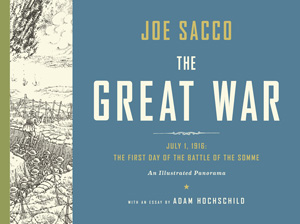
A little later this Fall W. W. Norton will be publishing The Great War, Sacco's wordless 24-panel folding panorama of the Battle of the Somme, which is being issued in a slipcase along with a pamphlet that contains Sacco's introduction and notes to the project as well as a brief essay by Adam Hochschild. (I've received an advance copy.) Hochschild's contribution (which is adapted from his book To End All Wars: A Study of Loyalty and Rebellion, 1914-1918) ends with a visit to the cemetery that holds the remains of the members of the British Devonshire Regiment who were killed in the battle:
In the cemetery's visitors' book, on a few pages the ink of the names and remarks has been smeared by raindrops — or was it tears? "Paid our respects to 3 of our townsfolk." "Sleep on, boys." "Lest we forget." "Thanks, lads." "Gt. Uncle thanks, rest in peace."

Only one visitor strikes a different note: "Never again."
* There is a more recent "Special Edition" of Safe Area Goražde, with additional material, which I have not seen.

Sunday, September 08, 2013

On the memory of stones (Benedict Kiely)


— In Devon, he assures her, lived a man who experimented in dousing and other devilment. He found by means of his dousing pendulum that some seashore stones he tested responded to the vibration tests for anger. He concluded that once upon a time those stones had been used for war and murder.
— Crap a brick, as my father used to say. What rot is that?


Though the two novels were published within a few years of each other and both deal (at least in part) with the Troubles in Northern Ireland, Bernard MacLaverty's Cal (see last post) and Benedict Kiely's Nothing Happens in Carmincross could hardly be more different in tone and manner, the former taut and efficient and the latter rambling and verbose — but not necessarily less entertaining for all that. Kiely's novel follows the travels of an Irish academic who has come home from America in order to attend a wedding just across the border in the North. For most of the novel what actually "happens" is next to nothing, mostly drinking, rambling around, talking, a bit of screwing, but the book has the pleasures of listening to a long-winded but gifted storyteller with a seemingly inexhaustible store of events, memories, legends, and lies at his disposal. Scraps of song, newspaper clippings, and references to Irish history and mythology are woven into almost every paragraph, and much of it is bound to fly over the head of the average reader (like me). Yet despite its generally flippant tone, the book never strays far from the theme of violence.

The sanguinary Irish ballad "Follow Me Up to Carlow" is quoted in the book's first pages, and Planxty's rousing version (below) is possibly the one Kiely had in mind. In keeping with the spirit of the novel it should be listened to appreciatively but with a healthy dose of irony as well. The singer is Christy Moore.


Saturday, September 07, 2013

The cottage (Bernard MacLaverty)


Cal heated a tin of beans and tasted himself slice after slice of bread at the fire. He fell asleep and when he awoke it was dark. He rubbed the window and looked out. Between the cottage and the lights of the farmhouse he could see the blizzard. It was after eight o'clock and the fire had died down. Shivering, he raked the embers to redness and put on some kindling wood, then blocks on top of that. He pulled his chair nearer to the fire and put his feet up against the tiles of the mantelpiece. After such a long sleep he knew he would spend the night tortured with guilt and insomnia. There was a knock at the door and he leapt to answer it, knowing who it was.

Bernard MacLaverty's Cal is now thirty years old, and it has probably been at least twenty-five years since the last time I read it. I picked it up again earlier this week, prompted by the death of Seamus Heaney, who like MacLaverty was a native of what depending on your point of view is either Northern Ireland or Ulster. Set during the height of the Troubles, the novel follows one not very willing participant, a teenaged boy with no particular prospects who is pretty much trapped from the outset, though his story will take some unexpected turns along the way. Dark as the background is, and as grim as the unfolding of the events, there's nevertheless a gentleness about the book, as MacLaverty is more interested in his characters than he is in indulging in yet another rehearsal of the cycles of violence and retribution that finally seem to have burned out, at least for now, in that much bled-over corner of the world.

Put another way, the book is not an example of noir. Which isn't to say that it holds out much hope, but it does at least have enough compassion for its characters to make us care about their fates, even if their prospects for happiness were never more than remote.

Bernard MacLaverty has written many short stories, some of which I've read and which are very good indeed, and several other novels, which I've never quite caught up with. This one still holds up quite well.

Saturday, August 31, 2013

Seamus Heaney 1939-2013


Across that strand of ours the cattle graze
Up to their bellies in an early mist
And now they turn their unbewildered gaze
To where we work our way through squeaking sedge
Drowning in dew. Like a dull blade with its edge
Honed bright, Lough Beg half shines under the haze.
I turn because the sweeping of your feet
Has stopped behind me, to find you on your knees
With blood and roadside muck in your hair and eyes,
Then kneel in front of you in brimming grass
And gather up cold handfuls of the dew
To wash you, cousin. I dab you clean with moss
Fine as the drizzle out of a low cloud.
I lift you under the arms and lay you flat.
With rushes that shoot green again, I plait
Green scapulars to wear over your shroud.


From "The Strand at Lough Beg"

Jacket photo by Virginia Schendler, from Selected Poems 1966-1987

Saturday, August 24, 2013

Cortázar: Of piantados and idos


Julio Cortázar's essay, "Del gesto que consiste en ponerse el dedo índice en la sien y moverlo como quien atornilla y destornilla," the title of which translates as something like "On the Gesture that Consists of Placing One's Index Finger to One's Forehead and Moving It Like Someone Screwing and Unscrewing," appears in the second volume of his collection La vuelta al día en ochenta mundos. Being a bit culture- and language-specific, the piece hasn't (as far as I can tell) been translated into English, and isn't included in the North Point Press volume (translated by Thomas Christensen) entitled Around the Day in Eighty Worlds, which gathers other pieces from La vuelta al día as well as from another Cortázar miscellany, Último Round.

The essay is dedicated to a consideration — in fact, a celebration — of a variety of eccentric characters, including such key figures in the Cortázar universe as the French postman Ferdinand Cheval, a folk architect who constructed a homemade edifice using the stones that he gathered on his daily rounds; Ceferino Piriz, the utopian whose bizarre schemes were incorporated into the pages of Hopscotch; and the pseudonymous poet El Santo, who versified Argentine history in an epic composed of hundreds or perhaps even thousands of unbearably pedestrian lines.

One section of the essay, entitled "Los piantados y los idos," discusses some of the terminology that Argentines employ to describe people who are what we would in English might call "eccentric," or "crazy," or just plain "nuts." What follows is a brief excerpt; rather than try to find English equivalents for some things, I have left them in the original. (This translation could no doubt be improved, so corrections are welcome.)
The word piantado is one of the cultural contributions of the Río de la Plata; readers north of the 32nd parallel will note that it derives from piantare, "to scram" in Italian, a usage illustrated by the sonorous tango where one can also hear the sound of broken chains: Pianté de la noria... ¡se fue mi mujer!*

Note that someone who goes [va] is ido [gone], a word that in proper Spanish means chiflado [crazy]; in giving more importance to and imposing the piantado in detriment to the ido, we Argentines reiterate one of our most cherished aspirations, which, as everyone knows, is to replace a Spanish word with an Italian one whenever possible and above all when it isn't. I, for example, was an ido when I was very small, but around the age of twelve someone referred to me as a piantado and my family adopted the neologism in accordance with the aforementioned sound principle. Naturally the interior of the country is less exposed to these terminological substitutions, and it is fair to say that if the capital can boast of a commendable percentage of piantados, our provinces on the other hand remain full of idos; the linguistic quarrel has no importance in the face of the hope that the total of idos and piantados may someday manage to overcome the influence of the cuerdos [sane people, squares], of whom we've had it up the you know where...

I always take piantados very seriously because they represent the heteroclite among the normal patterns, the earth of the salt, the humus of the future that is incorporated mysteriously into that crystalline substance composed of sodium chloride, usually of a white color and characteristic acrid taste, which is very useful for soups and stews but which has something about it of the sterile, the boring, the Valley of Death.
* "Hear the sound of broken chains" alludes to a line from the first stanza of the national anthem of Argentina: Oíd el ruido de rotas cadenas. The quotation from the tango "Victoria" ("Victory") means, roughly, "I have escaped my yoke... My woman has gone!"

Saturday, August 17, 2013

Living the disaster


Takashi Sasaki is a retired professor specializing in Spanish philosophy, with a number of translations into Japanese of the works of Unamuno and Ortega y Gasset to his credit. For a number of years, he has been blogging in Japanese under the nom de plume of Fuji Teivō (derived from the Spanish fugitivo, "fugitive"), and his posts have been collected in a series self-published books under the title Monodialogues (the word is borrowed from Unamuno). On March 11, 2011, he was at home where he lives in the city of Minamisōma in the prefecture of Fukushima, when the region was struck in quick succession by a severe earthquake, a massive tsunami, and the consequent nuclear accident at the Fukushima Daiichi Nuclear Power Plant. Fukushima: Living the Disaster, which thus far has been issued in Japanese, Spnaish, and a few other languages but not apparently in English, reprints the blog posts he wrote in the aftermath of those events. The handsomely produced edition shown above, the only one in a language I can read, was issued by the Spanish publishing company Satori Ediciones, which specializes in books about Japan.

The book begins with a post on March 10, the eve of the earthquake, and then, except for the text of a brief note hand-written on the 12th, breaks off until the 17th, when Sasaki was able to resolve some computer issues and resume blogging. By then, a great deal had transpired, but one of the curious things about this book is that Sasaki has relatively little to say about the tsunami, which devastated large parts of Minamisōma and claimed many lives there, and this may be due in part to the fact that he apparently lives a few miles inland from the coast. The book isn't really about the chain of events that made up the disaster, but about living through the aftermath, which of course was itself a kind of ongoing catastrophe (and still is) because of contamination from the damaged power plant. Rather than an eyewitness chronicle (though it is that to some extent as well), it is a moral examination centered around two questions: how the nation that had suffered the atomic bombing of Hiroshima and Nagasaki came to jeopardize the safety of its people by promoting nuclear power in one of the most seismically active regions on Earth, and how one chooses to act in the face of catastrophe.

Sasaki, though he makes no pretense of being an expert on nuclear energy, has some understandably scathing things to say about the actions of various Japanese politicians, scientists, and corporations both before and after the crisis. But as a student of philosophy, he also rigorously examines his own actions, and that examination is made more pertinent by his own particular circumstances.

At the time of the disaster, Sasaki, who is in his seventies, was living with his wife, who suffers from advanced dementia, his elderly mother, his son, and his granddaughter. Though the area where he lived was designated by the Japanese government as an exclusion zone (one of several, with varying degrees of restriction) after the nuclear accident, he elected to stay put and continue to care for his wife in their home, arguing that leaving would be both cowardly and irresponsible (he alleges, and I have no reason to doubt it, that a number of elderly citizens died from the trauma of being evacuated). Though the remainder of the family eventually relocated, he and Yoshiko stayed, and much of the book amounts to a chronicle of their efforts — and the town's efforts — to regain something approaching normal life. He is quite blunt about the frustration, and often fury, he feels in the face of what he sees as the duplicity and lack of humanity of various elected officials, bureaucrats, and corporate employees who stand in the way of that objective. When the book ends, in July 2011, he and Yoshiko are still at home, he continues blogging, and Minamisōma is slowly making a recovery, even as its future is shadowed by radioactive contamination and the still unstable state of the damaged nuclear reactors.

A final side-note: there is much wringing of hands at present about the future of the publishing business, and of the printed book. Fukushima: vivir el desastre is printed on good paper in a sturdy paperback format with French flaps and a nice cover painting by the artist Eva Vázquez. From what I've seen of the company's catalog, they seem to be producing a steady stream of high-quality, carefully focused books — and this in despite a Spanish economy that has itself been little short of disastrous. Granted, in Spain, as in a number of other European countries, books tend to be held in greater esteem than in the US, but perhaps more of our domestic publishers should take note of the example.

Thursday, August 15, 2013

Mary Jane (The Vulgar Boatmen)


This song began its life on the Vulgar Boatmen's 1989 debut album You and Your Sister, where it was performed as a full-tilt rocker and sung by Robert Ray. I like that version, but the heartbreaking, minimalist one above, from the band's compilation album Wide Awake, is the one that gets under my skin. Here it's sung by Dale Lawrence, and accompanied starkly by guitar, organ, and Kathy Kolata on viola. Ray and Lawrence are the songwriters.

Wide Awake was issued in 2003 by No Nostalgia Records, the Boatmen's own label, which sadly no longer seems to exist, and the CD also seems to be unavailable,* but downloads are available in the usual places. This band deserves better than the obscurity that largely seems to be its fate.

* As is the above video, as of 2017.

Sunday, August 11, 2013

Botany


He sought out inconspicuous things that could be only be found by those who already knew that they might be there. He learned that in early spring, if you looked carefully, where the back roads wound through woods, the little flowers of hepatica, unfolding from delicate stems, might be discovered rising a few tentative inches above the remains of last year's fallen leaves, barely visible even to those who passed that way on foot. In the weeks to come they would be joined by anemone and bloodroot, Dutchman's-breeches and trillium, Jack-in-the-pulpit and columbine and dog's-tooth violet, all of them hidden away on shadowy slopes or at the edges of swamps and streams. There was an old cart path, long disused, that ran for a mile or so through the deepest woods, past great outcroppings of rock, and if you were lucky and knew where to look you might come across lady's-slippers, sturdy yellow or pink orchids, sprouting up in tiny colonies here and there, just a few, concealed by boulders and brush until you were almost upon them. Where the brush had been cleared and the canopy opened to let in the full strength of the sun, the colonies disappeared, and it was said that the plants were impossible to cultivate, no matter how hard you tried.

If you crouched down at the base of beech trees, whose giant, smooth trunks, unless they were very well concealed, were invariably scarred with the initials of putative or intended couples, you could often find Indian-pipes, pale, waxy saprophytes that had no chlorophyll of their own and seemed relics of a radically different world. Unassertive and opaque, they did no harm and offered nothing. On the trees and the forest floor there were mushrooms in all sizes and shapes. He knew none of their names nor which would be infallibly fatal if eaten, and so he left them all alone.

On some afternoons, when he climbed to an elevated clearing surrounded by decaying paper birches, he knelt down on the moss that covered the weathered stone and found the red-capped stalks of the lichen they called British soldiers.