Friday, February 03, 2012

Orpheus — The Lowdown (Blegvad & Partridge)


Peter Blegvad and Andy Partridge reportedly worked on this recording project off and on for twelve years, which works out to about two minutes and change a year of finished material, but if that's what it takes to create something this perfect then I'm all for it. Partridge was one of the founders of the rock band XTC and Blegvad has been, among other things, a member of the 1970s trio Slapp Happy, a cartoonist (Leviathan), and a solo singer / songwriter, but Orpheus — The Lowdown, which was released in 2003, isn't made up of "songs," though it does have words and music. What it is made up of is harder to explain; except for one wordless cut it's a suite of short texts recited or occasionally chanted by Blegvad over an aural environment composed of music, sound effects, squawks, and warbles, all organized around the mythological figure of Orpheus, legendary musician (a "lyricist" in the etymological sense of the word), charmer of beasts, and voyager to the underworld in search of his wife Eurydice, whom he won back from Hell by the beauty of his playing only to lose her on the return trip when he disobeyed an injunction not to look behind him as he ascended. Issued by Partridge's Ape House Records, the single CD comes accompanied by an illustrated booklet in which the lyrics (including some that are meant to be part of the project even though they aren't spoken aloud in the recording) are paired with effectively eerie artworks created by Blegvad and Partridge, of which the radiograph-like cover illustration is a representative example.

Blegvad's delicious deadpan narration — he manages to sound droll and legitimately profound at the same time — belongs to a category of declaimed performance that's relatively rarely encountered. Some of the texts he reads could pass for "poetry" (one of them is in fact an adaptation from Rilke), another is a quotation from an essay by the critic George Steiner, but most inhabit a hazy border zone between storytelling and incantation. The closest examples I can think of are John Cage's Indeterminancy pieces (also paired with music), and the work of the late Spencer Holst, though Holst's stories were, and were meant to be, light as a feather, while Orpheus — The Lowdown dives into deep mysteries of creation, death, and language.

Orpheus is a musician, but he is also a poet, a creator of words. In the first piece here he is revealed as a creator of worlds as well, able to build a city on the savannah out of nothing in order to win a bet against the gods. He is a distant cousin to Blegvad's King Strut (from the CD King Strut and Other Stories):
Imagination, like a muscle, will increase with exercise
King Strut developed his by having dreams and telling lies
He'd describe a situation or a piece of merchandise
He could summon it from nothing to appear before your eyes
Orpheus draws so much divine energy that he causes a "Brown-Out on Olympus." Later, in "Noun Verbs," the longest and one of the best of these pieces, Blegvad whispers that "what the dead lack / is substance..."
Time means nothing to them now, but words...
speech,
hot air shaped by thought
into blobs and ribbons
of intelligible discourse,
words have not only substance
but value.
In "Beetle," Orpheus deciphers the marks on paper made by an insect that he has first made to crawl through a pool of ink, and mutters excitedly "as image / after image / astonishes him / with its unexpected force and purity." In "Galveston," (a city "which he's heard is hell"), Orpheus tells a group of prostitutes:
When you come into this world you find pockets in your pants, handlebars on your bike, put there by those who preceded you. You walk in their footsteps. But, as regards the entry into and possession of yourself, you're a solitary pioneer.
There are brilliant illuminations like this throughout.

The aural backdrop to these texts can't be quoted and isn't easily described, but fortunately the CD can be heard, in full, by visiting the Ape House site. To fully appreciate Orpheus — The Lowdown, though (not to mention to support the artists), you'll want to get a hold of the physical package.

Blegvad and Partridge are reportedly in the final stages of assembling another CD, to be entitled Gonwards.

Thursday, January 26, 2012

Cortázar: Cartas (new edition)


A post by Gustavo Ribeiro at Blog Morellianas brings news of a forthcoming, vastly expanded edition of Julio Cortázar's letters, replacing the already substantial three-volume edition published twelve years ago.

The new edition, which promises more than 1,000 new letters, will appear in five volumes, three of which (shown above) are being published in February 2012, with the balance to follow in March. The publisher is Alfaguara in Argentina; the ISBNs of the initial volumes are 9789870421238 (Vol. 1), 9789870421405 (Vol. 2), and 9789870422709 (Vol 3.).

Sunday, January 22, 2012

The Rotograph Project


I have spun off a separate blog, The Rotograph Project, to serve as a virtual gallery for the display and interpretation of the American view postcards created c.1904-1911 by the Rotograph Co. of New York. This new arrangement should give those images more room of their own without unduly monopolizing the webspace here.

Friday, January 13, 2012

The truth


This photographic postcard, most likely created between 1907-1914, depicts a family group against the backdrop of a snowy field. The identities of the subjects and the photographer are unknown, and there's no inscription or address on the reverse. The only external information is the mark of photographic paper (Velox) and the existence of another image, not in my possession but evidently taken on the same day, that shows only the man, the boy, and the woman on the far right, and thus perhaps can be taken as an indication of which of these figures are the boy's parents.

So in this picture we see four women, one man, a boy -- and a cat. But of course one more person is present, the photographer, who may have been a professional but more likely was another member of the family, an amateur shutterbug. His or her possible role in the family, even though it can't be determined, shouldn't be overlooked.

I'm not an expert on period clothing nor am I particularly good at reading family relationships from facial features, and in the end there's only so much information to be gleaned from a photograph like this. Still, there are a number of curious things here that leap out, things that, without telling us anything more for certain about these people and what they were like, at least open up some suggestive possibilities.

Let's start with the background. It's a barren, snow-covered field, at least part of which is hilly, and there's a line of trees, perhaps other hills, in the far distance. There is a pole on the left that at first sight looks like a utility pole, but it's too short and the apparent crosspiece at the top seems to be an illusion caused by a horizontal line of brush behind it. There's at least one other vertical structure some distance back, but I suspect it's just a small tree. If the field is barren in winter it may be pastureland; there's no sign of stubble left over from a summer harvest.

The woman on the right is clutching a small potted evergreen with one hand, almost as if it had been set there temporarily and might fall over if she didn't support it. At least one and more likely two similar trees are partially hidden by the human figures. It seems a curious way to pose, but maybe the bucolic effect of the greenery was deliberately sought. It's also possible that the evergreen on the right is a Christmas tree. Perhaps the image was taken to be used as a Christmas greeting, though since it's a photographic print and not a lithographic reproduction there's no certainty that this is not the only copy ever made. The dark diagonal shadow at the bottom of the picture may be a developing flaw -- or it may just be a shadow.

The formidable-looking old woman at center, the only seated figure, may be a widow; in any case she seems to be the unquestioned center of authority in the family. She wears an elaborate lace collar, perhaps of her own making. The woman in the dark dress immediately behind her -- her daughter or granddaughter? -- peers at the photographer with a look that could be called anxious or just curious; in either case she seems to be accustomed to a subordinate role. The woman on the far left might be a family member (she bears some resemblance to the seated woman), but she could also be a domestic. She wears an apron, one of her eyes behind her spectacles doesn't look quite right, and the awkwardly downturned corners of her mouth might be an indication of Bell's palsy.

The man, who is quite far back in the group, appears to be a bit of a dandy, at least for out in the country. He's wearing a lively cap and a bow-tie and clearly hasn't been laboring with his hands today. He may work in an office in town or perhaps has simply dressed up for the occasion. His son, obscured except for his face, appears to be about five years old. Off to the right, with the barest hint of a smile and a distinctly independent bearing, is the boy's mother.

Finally, there is the cat. From his body language he is evidently feeling the cold. No one else appears to have noticed his presence (though the photographer no doubt sees him) and he seems to have crept into the margins of the group with the deliberate intention of being included in the shot.

I'm not sure that there's anything terribly profound to be learned from this particular photograph. If you looked at thousands, or tens of thousands of similar images from the same period (many millions exist) then you could, if you wanted, make interesting deductions about how people lived and thought about themselves, and perhaps reach conclusions that would tell you things you didn't already know about the broader social and economic currents of the period, but that's not my intent, at least here. My interest instead is epistemological, perhaps even metaphysical. This photo is an indication that the people in this image once existed, it's potentially evidence for who they were and how they existed, but in the end it's also a reminder that, whatever conclusions we may reach about them, the truth will always be something quite different, something forever out of reach, something that in one fleeting instant on a snowy hillside left an indelible, inscrutable trace.

Saturday, January 07, 2012

Money home


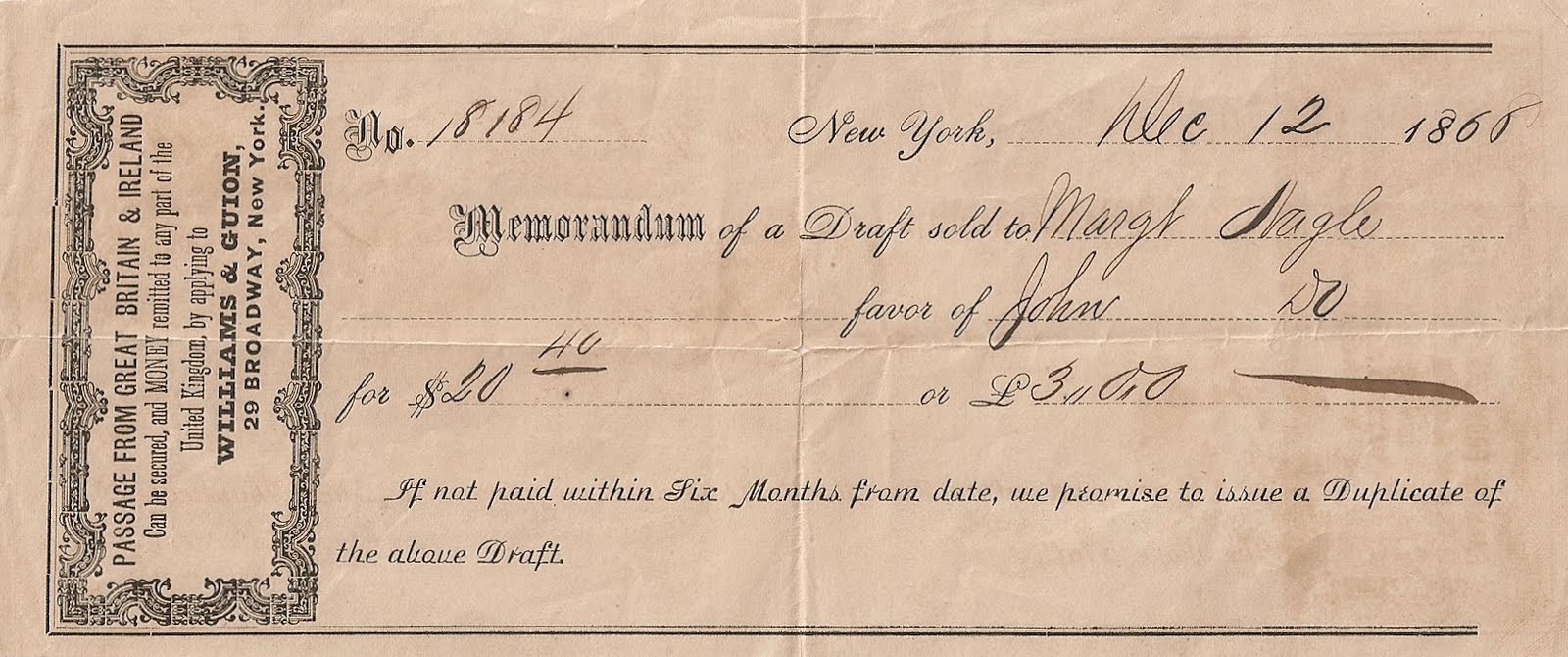
These receipts from The Williams & Guion steamship company were made out to a young Irish immigrant named Margaret Nagle for sums she sent to her father from New York City in 1866 (or possibly 1868) and 1870. A portion of the correspondence between Margaret and her family also survives, and is the subject of an earlier post.

A contemporary account, John Francis Maguire's The Irish in America (1868), conveys in vivid if occasionally rather florid terms the importance of the widespread practice of sending money home, which served both to maintain emotional ties with distant family and to provide a crucial lifeline for those left behind.
The great ambition of the Irish girl is to send "something" to her people as soon as possible after she has landed in America; and in innumerable instances the first tidings of her arrival in the New World are accompanied with a remittance, the fruits of her first earnings in her first place. Loving a bit of finery dearly, she will resolutely shut her eyes to the attractions of some enticing article of dress, to prove to the loved ones at home that she has not forgotten them; and she will risk the danger of insufficient clothing, or boots not proof against rain or snow, rather than diminish the amount of the little hoard to which she is weekly adding, and which she intends as a delightful surprise to parents who possibly did not altogether approve of her hazardous enterprise. To send money to her people, she will deny herself innocent enjoyments, womanly indulgences, and the gratifications of legitimate vanity; and such is the generous and affectionate nature of these young girls, that they regard the sacrifices they make as the most ordinary matter in the world, for which they merit neither praise nor approval. To assist their relatives, whether parents, or brothers and sisters, is with them a matter of imperative duty, which they do not and cannot think of disobeying, and which, on the contrary, they delight in performing. And the money destined to that purpose is regarded as sacred, and must not be diverted to any object less worthy.
One of the receipts pictured above is dated December 12th (the other date is harder to make out), which corresponds to what Maguire has to say about the seasonal pattern of homeward remittances:
With all banks and offices through which money is sent to Ireland the months of December and March are the busiest portions of the year. The largest amount is then sent; then the offices are full of bustling, eager, indeed clamorous applicants, and then are the clerks hard set in their attempts to satisfy the demands of the impatient senders, who are mostly females, and chiefly "girls in place."
The "girls in place" were domestic servants, the army of Irish "Bridgets" like Margaret Nagle who freed upper- and middle-class women from household duties that conflicted with Victorian ideals of womanhood. At least in urban areas, the daughters were regarded as more reliable remitters:
In populous cities the women send home more money than the men; in small towns and rural districts the men are as constant in their remittances, and perhaps send larger sums. Great cities offer too many temptations to improvidence or to vice, while in small places and rural districts temptations are fewer, and the occasion for spending money recklessly less frequent; hence it is, that the man who, amidst the whirl and excitement of life in a great city, but occasionally sends $10 or $20 to the old people at home, sends frequent and liberal remittances when once he breathes the purer air of the country, and frees himself from the dangerous fascination of the drinking-saloon.
The Williams & Guion steamship company was operated by John S. Williams & Stephen B. Guion. Below are excerpts from the latter's obituary in the New York Times (December 20, 1885), which provides an overview of the company's history.
Stephen Barker Guion was born in New-York June 17, 1820. [...] In 1843, at the age of 23, he entered into partnership with John S. Williams, and founded the firm of Williams & Guion to engage in the ocean-carrying trade. In those days the great bulk of the business of transportation between this country and Europe was done in sailing vessels, and Williams & Guion established a line of fast sailing packets between New-York and Liverpool, known as the "Black Star Line." They carried cabin and steerage passengers as well as freight, and the line soon became popular on account of its speed and the superior accommodations provided for its passengers. The ships were American clippers, and the fleet soon grew to 18 vessels, which did a large and profitable business. The Adelaide, John Bright, Cultivator, Universe, and their sister ships made some remarkably quick passages which old sailors are fond of recalling even in the present day of ocean steamships. In 1858 Mr. Guion went to Liverpool, and while still retaining his connection as junior partner of the New-York house established a new English house under the title of Guion & Co., which acted as agents of the Black Star Line. He had resided there ever since.

In 1868 Williams & Guion determined to abandon sailing-vessels, and the Manhattan was built, the first steamship or the Williams & Guion Line. The old packets were kept running until a sufficient fleet of steamers to accommodate the patrons of the firm was constructed, and then the Black Star Line disappeared from the commercial world. The old flag, with its inky star, was retained, however, and it still floats above the Guion steamers.
Since Margaret Nagle is known to have arrived in New York by August 1866, she may well have taken a Black Star ship on her voyage across the Atlantic and then continued to use the company for her remittances home.

Further reading:

Lynch-Brennan, Margaret The Irish Bridget: Irish Immigrant Women in Domestic Service in America, 1840-1930 (Syracuse University Press, 2009)

Miller, Kerby Emigrants and Exiles: Ireland and the Irish Exodus to North America (Oxford University Press, 1985)

Stansell, Christine City of Women: Sex and Class in New York, 1789-1860 (University of Illinois Press, 1987)

Saturday, December 31, 2011

The Lost Tower


This postcard of the Brooklyn Bridge and the adjacent waterfront, published by the Rotograph Co., was postmarked in 1905. Offering a view of the bridge at a time before automobile traffic had begun to transform the city, and of the rough-and-tumble district that, considerably scrubbed-up, is now anchored by the South Street Seaport, it's interesting for a number of reasons, but there's one particular detail that leaps out, and that's the curious structure on the far right that appears to be some sort of obelisk or monument, and which hardly seems to belong in the picture at all.

A bit of research soon revealed that the tower was not a ceremonial structure or an observatory for turn-of-the-century sightseers but, in fact, an industrial building constructed to serve a very specific purpose. It was one of two cast-iron "shot towers" designed by the 19th-century architect James Bogardus for use in the manufacture of lead shot. From a vat near the summit of the building, molten metal would be poured through a sieve; as the droplets fell from the heights they would be shaped by surface tension into tiny spheres, which would then harden when they fell into a tank of water at the bottom. This particular tower, which stood at 82 Beekman Street and rose some 215 feet high, was built for Tatham & Brothers around 1856; its construction followed by a year or so that of a similar but shorter structure which Bogardus had built further uptown for the McCullough Shot and Lead Co.

A pioneer of cast-iron construction, which relied on prefabricated elements that could be strikingly ornate, James Bogardus designed a number of important commercial buildings in Manhattan and elsewhere, but only a handful are still standing, including buildings at 75 Murray Street, 63 Nassau Street, and 254 Canal Street. A plaque at City Hall memorializes the McCullough Tower, and in TriBeCa a street sign officially designates James Bogardus Triangle.

The New York Times reported, in 1892, that the formerly dull red Tatham Tower had recently been repainted a yellow so vivid that "you can hardly see anything else as you look off toward the river." The color shown in the Rotograph postcard is not reliable, as it has been layered onto an image taken from a black-and-white original. Over the years the building suffered at least two serious fires, which were reported in the Times on February 8, 1895 and June 28, 1899. The image below depicts the earlier incident, which resulted in one death. Both shot towers were demolished in 1907.


The definitive volume on James Bogardus is Cast-Iron America: The Significance of James Bogardus, by Margot and Carol Gayle.

Monday, December 26, 2011

The Bleaching Stream (Peter Blegvad)


The modest-looking covers of this 80-page paperback conceal a number of curiosities and mysteries within and without, starting with the identity of the book itself, which is actually The Bleaching Stream by Peter Blegvad "in conversation with Kevin Jackson." The title page, which features an elaborate illuminated red letter "B," informs us that the words "the bleaching stream" are a literal translation of what the name "Blegvad" means in Danish. It also designates Peter Blegvad as the "President of the LIP" (London Institute of 'Pataphysics), an organization which apparently does exist, this being Number 3 of its journal, and identifies his interviewer or interlocutor Kevin Jackson as "Regent of the Collège de 'Pataphysique." The cover date ("Absolu 139 EP") corresponds to Alfred Jarry's 'pataphysical calendar, though in a concession to Gregorian reckoning it also includes "September 2011 vulg." in parentheses. There are actually two monograms on the cover, for in addition to the obvious one of the LIP at the bottom the drawing of a glass of milk (yes, it is milk) in the center slyly incorporates Blegvad's initials.

An introduction is probably in order. Peter Blegvad is, depending on your perspective, either a rock musician and songwriter who also draws, or a cartoonist and graphic artist who also engages in music-making. As a musician he has been a member of such ensembles as Slapp Happy, Henry Cow, and the Golden Palominos, has collaborated on the progressive rock landmark Kew. Rhone (the lyrics of which contain one of the world's longest palindromes, "Peel's foe, not a set animal, laminates a tone of sleep"), and has written a number of unusually verbally adept songs, including the ineffable "King Strut." As an artist he is best known for the cartoon strip Leviathan which ran for several years in the Independent, though he has always been doodling this and that, both professionally and for his own amusement. The full range of his activity is in fact greater than that, as he has written fiction and essays, delivered lectures ("performances" might be a better word), and compiled various aural collages and "eartoons" which have appeared on the BBC and elsewhere. Born in the US in 1951 (his Danish-born father is a prolific illustrator of children's books, his mother an author), he has lived mostly in Europe since his teens. He is 6' 7", which means that in several photographs included in this volume he is seen looming over everyone else in the frame.

The Bleaching Stream consists of a series of interviews covering Blegvad's childhood, creative activities, influences, and obsessions. The last, which have been remarkably consistent through his life, notably include milk (hence the monogram). Printed on glossy stock, the book is generously illustrated with drawings, photographs, album covers, and ephemera, mostly in black-and-white although there are a couple of color plates. (I haven't attempted to scan any of the interior art, which I couldn't really do without dismembering the book.)

The influence that Alfred Jarry and his disciples have had on Blegvad was not something I was aware of nor would necessarily have suspected, though when you read these pages it all makes good sense. Blegvad mentions, and wears with pride, the fact that he has several times been disparaged by critics or collaborators for his "flippant" attitude; the ludic element has been a constant in his work, whether in the elaborate image-and-text punning of Leviathan or the droll recitation over Andy Partridge's musical backdrop of the whimsical text of "The Cryonic Trombone," to be included on the forthcoming Ape House (UK) CD Gonwards.

Over the years Blegvad has worked with or for a surprising variety of people and enterprises. For a while he drew backgrounds for some books spun off from Charles Schulz's Peanuts; later he served as a personal assistant to the director Arthur Penn. At one point in the freewheeling mid-1970s he was working with a German record producer who, though Blegvad wasn't aware of it at the time, had ties to the Baader-Meinhof group. His own position, characteristically, is traced out in humor and paradox:
KJ: And you weren't very interested in revolutionary politics?
PB: Everybody was, they were desperate times. But my "politics" came down to basically siding with the underdog. I wouldn't have been able to kidnap an industrialist because that would mean I'd immediately be on his side against me.
Blegvad has long had a following, which, though perhaps never very large, has been enthusiastic and appreciative. (A footnote here mentions that a first pressing of Slapp Happy's debut record recently sold for £1,131.00.) The Leviathan strips have been collected in a wonderful volume which remains in print, although according to Blegvad it only includes about a third of the total run. Some of his earlier print projects were run off in small numbers and left in restaurant napkin holders and subway cars for people to find by chance. His musical output, both solo and collaborative, has been issued, discarded, re-recorded, and re-issued by a variety of record labels, most of them small and European; my favorite disc (though not everyone's) is the mostly acoustic Choices Under Pressure. John Relph maintains a useful and admirably comprehensive discography. Blegvad can be heard as a regular participant in the Radio Free Song Club, a podcast of (mostly) original songs contributed by a variety of songwriters.

The present volume, which has been issued in an edition of 501 copies, is unlikely to bring Blegvad much additional recognition, though it should please, if not the audience he deserves, the audience that is devoted to him. A future LIP volume, collecting Blegvad's "scientific papers," is promised.

Sunday, December 11, 2011

The stain


"The little tintypes, and their more elegant cousins the ambrotypes and daguerrotypes, provide the oldest direct connection to the visual past that we can depend upon. All photography is fictional, by which I mean that any photograph is a picture, not the world from which it was generated. But these little bits of early photography pull that fiction closer to the world than any pictures known. Many other photographic techniques make pictures that "look" more like the world, but the early direct-positive photographs on glass and metal bear the actual stain of light from the past." — Richard Benson, The Printed Picture


Three of these tiny images were produced by photographic studios in Philadelphia, possibly as early as the 1860s, though they could be somewhat later. The other is unlabeled but may be from the same city, as they were purchased together. The first three photographs above, of which the visible part is less than an inch high, are tintypes (or "ferrotypes" as they were then called); the last, which is slightly larger than an inch, is probably an albumen print. The embossed mounting cards, which were manufactured by several companies and sold in bulk to photographers, are about four inches high.

None of the sitters can be identified. The images that were intended to capture their likenesses for posterity now display only disinherited chemical traces, while preserving, ironically, the names of three of the photographic studios on the backs of the cards. Below, for instance, is the reverse of the card shown at the top of this page.


An Albion K. P. Trask (c. 1830-1900), born in Maine, was active in Philadelphia from the 1860s until his retirement in 1891. He was the author of Trask's Practical Ferrotyper, a popular manual, and his passing was duly noted in the pages of Wilson's Photographic Magazine, where it is observed that "many of the prominent photographers of to-day served an apprenticeship under him." If this photograph is in fact from his studio (there is some indication of an "E. K. Trask" being active in Philadelphia at the same time) it was probably produced before 1870, as he operated from a different address on 8th Street (and later still from Chestnut Street) after that date.

Trask's book mentions C. L. Lovejoy, whose studio produced the second image from the top; below is the reverse.


According to The American Tintype, an outstanding reference volume compiled by Floyd Rinhart, Marion Rinhart, and Robert W. Wagner, Charles Lovejoy (they list his middle initial as "K") operated his tintype studio c.1864-67, and was also Secretary of the Ferrotype Association of Philadelphia during that period.

There's no studio name on the third tintype, but the albumen print is the work of the United Photographic Company of No. 808 Arch Street in Philadelphia. In this case since there is no hole in the card (the image appears to be pasted onto the front) the address is printed directly on the back of the card, rather than on the labels that were pasted on to reverse of the others. The delicate design surrounding the photo gives the only clue to the sitter's possible identity, as there is a letter "C" on both sides of his name. Did the studio have borders for each letter in the alphabet?

On the first two tintypes there are faint traces of added tint to give the women rosy cheeks.

Friday, November 25, 2011

The Akin Hall Library (c.1907)


This Rotograph postcard of what is now known as the Akin Free Library, located in Pawling, New York, was probably taken during the final stages of its construction, which was completed in 1908. The "undivided back" format of the reverse became obsolete after March 1, 1907, when new postal regulations permitted a message to be included on the same side as the address.

The Library was founded by a local Quaker businessman, Albert J. Akin. At the time, the Quaker Hill neighborhood in which it was located was dominated by a large resort, the Mizzentop Hotel, which Akin had also founded. During the Depression the hotel was shuttered, and apart from the library, a nearby church, and an old Quaker meeting house the hill is now strictly residential. The business district of Pawling is several miles away at the base of the hill, strung along the rail line.

The library, which is run by a private association, remains in operation during limited hours. In addition to its modest book holdings, which circulate to members, it houses a small natural history museum in the basement as well as historical exhibits in the upper storey. The relatively open terrain seen around the building in this view is now more heavily wooded.

Saturday, November 19, 2011

Till Minne


I came across this little group of European cartes de visite in a box in an antique shop for a nominal price and bought the lot of them. Some of them clearly belong together; others, particularly the last, may have gotten mixed in by chance.

The first two images are by a photographer named Agnes Lundbom in Bäckefors, Sweden, which is now part of the municipality of Bengtsfors. The two sitters were likely related, and wear the same pin, which reads "Tille Minne" (In Memory or In Remembrance), but both the jewelry and the clothes may have been studio props.


The next three are apparently also Swedish, from a studio named Visit Fotografi, and once again the first two sitters are wearing what appears to be an identical crescent moon and star pin, although it's hard to see the similarity without a magnifying glass because of the difference in angle and exposure. All three cards have traces of glue and paper in the same spot on the reverse, indicating that they were probably kept in an album together. There is a very faint pencil inscription on the back of the first; it is all but unreadable but the woman's name may have been Augusta.


The next two photographs were taken by Norwegian studios, the first by Aug. Haraldsson in Christiania (now Oslo) or Arendal, the other by Olaf M. Madsen in Fredrikshald (now Halden) near the border with Sweden. Both have ornate printed designs on the reverse side which include the words pladen opbevares, meaning, I'm told, that the photographer held onto the negative in case the customer wanted copies at some future date. On the back of the first one there is a space for a year, with the first digits "18" preprinted, so it was probably taken before 1900.


The last photograph comes from the studio of Beck Ödön in Budapest at the other extreme of Europe, and is the only one for which it's possible to assign the sitter a reasonably firm identity. According to an inscription on the back, written first in pencil and then partially traced over in ink, this young man is one Andrew Schwalier. Underneath his name, written in English and in ink, are the words "Born - 10/20/88." Since he appears to be between twelve and fifteen, the image was probably taken just after the beginning of the 20th century. According to a Social Security death record, an Andrew Schwalier with that birthdate died in New York in 1970. Unless he was an American native travelling in Budapest at the time he sat for this portrait it's likely that he had Americanized his original given name at some point.


Vast quantities of studio portraits like these were produced in the latter part of the 19th century and the beginning of the 20th, in Europe, the US, and probably other parts of the world as well. A good number still survive, some carefully labelled in family photo albums or historical collections, others lurking in boxes and drawers or wandering the world, separated forever from their identities, their stories, their tragedies and dreams.

Friday, November 04, 2011

The woman by the stream


A number of years ago I was invited to deliver a lecture at a summer conference on ethnobotany at the University of Tokyo. It was not my first visit to the country; I had been stationed there for two years shortly after the war, and had developed cordial relationships with a number of Japanese colleagues. Although I never learned to recognize more than a handful of kanji, I became fairly conversant in the spoken language, thanks largely to the instruction of my informal mentor, the highly regarded scholar Professor S. Matuzaki, one of the most cultured men I have ever known and most certainly the kindest. It was at the behest of Professor Matuzaki, who had kept careful track of my scholarly achievements in the intervening years, that I had been invited, and in fact it was his extremely generous offer to serve as my host for the duration of the conference that had prompted my immediate acceptance.

I was met at the airport by the professor, now a widower in his seventies, and by his daughter, herself already both an accomplished agronomist and the mother of two small boys, and taken by taxi to the modest apartment of the daughter and her husband, which is where the professor, by then semi-retired, stayed during his frequent visits to Tokyo. Though the presence of an extra guest must have inconvenienced my hosts, they never gave the slightest sign that this was the case, and my week in their company remains one of my fondest memories.

The conference was, as these affairs nearly always are, a mixture of tedium, moments of intense intellectual exhilaration, and more or less constant social activity, and it is the last of these, more than anything else, which eventually wears one down. Fortunately, Professor Matuzaki's impeccable considerateness had extended to an offer to spend the week following the conclusion of the conference "recuperating" at his country house in Hyōgo Prefecture, not far from the Hatsuka River, an area of great historical and biological interest, which, though somewhat remote from Tokyo, was where the professor had spent most of his childhood. As a true scientist is never really off duty, this kind offer was made even sweeter by the prospect of being able to make some short excursions to investigate the cultivars and traditional agricultural practices of the region.

My host had become somewhat frail over the years since I had last seen him, and if he had ever learned to drive he had given it up with age, so after devoting an initial day to rest we were chauffered about for most of the week by a wiry local man, himself in his sixties, who did odd jobs and served as caretaker when the professor was away. In his light Toyota pickup truck we explored fertile river valleys and rugged foothills, taking in only those few temples and historic sites that Professor Matuzaki deemed absolutely indispensable for the visitor from abroad, but making ample use of the opportunity to meet with local farmers, examine wild relatives of local crop plants in their natural settings, and get an overview of the range of geology and soil types to be found in those parts.

On the fifth day, however, our driver had business of his own to attend to, and the professor suggested that I might enjoy taking a day hike on my own through the hills in the immediate vicinity of his home, which, because of their discontinuous terrain, had as yet been largely unscathed by development. He provided me with a hand-drawn map and a simple lunch prepared by his housekeeper, a woman who lived a few houses down the road, and pointed me off in the right direction. It was an overcast and fairly damp morning, and I brought along a light coat, but as I climbed away from the main road the exertion soon made this more of an encumbrance than anything else. I am a strong hiker, accustomed to vigorous outings, but I was glad that the professor had not sought to accompany me out of an excess of courtesy, as the trail was steep and in some places largely overgrown.

I reached the summit of the ridge marked on the map a little after noon, and from there walked along the heights for several miles. Though the sun never really broke through as the day wore on, the morning mist had cleared off and above the intervening canopy of forest I was able to see many hectares of neatly tended farmland in the distance. There were a few old cottages dotting the sides of the ridge, and at one point I caught sight of a section of sinuous highway not far off, but I met with no one. After a while I descended the far slope, and as I did so I must have misread the professor's map, for I soon found that, having thought it unnecessary for me to bring a compass and not having the sun to guide me, I was no longer sure in which direction I was heading. On an undulating piece of ground I came upon the remains of an old orchard. It's not in the character of the Japanese to neglect things that require attention nor to let good land go unused, but these trees had obviously gone untended for several years at least; the fruit, much of which lay rotting in thick clusters on the ground, was stunted and mealy, and the trunks were surrounded with a dense overgrowth of suckers and weeds. At the lower end of the slope the land turned sodden, and little runnels arose that made my footing tricky as I picked my way down to the orchard's lower edge.

I heard a trickle of water running ahead of me, and soon emerged on the rocky bank of a shallow stream a few yards wide. Though I probably could have waded through, the farther side appeared impenetrably marshy and choked with reeds, so I decided to turn and walk upstream along the near bank, where a path had been trodden out which, though muddy in spots, was easy enough to follow. Here and there patches of iris were in flower along the stream.

After hiking for an hour or more over increasingly difficult ground, I emerged into a little clearing on a ledge above the water, where smoke was drifting from the chimney of a single small stone hut or cottage roofed with thatch, of a style so primitive I was surprised to see it still in use outside of a museum village or the like. The door was open and when I stuck my head inside and uttered a tentative greeting in Japanese I'm afraid I startled the lone occupant, who quickly put down what she had been doing and rushed in some embarrassment to usher me in. She was one of the most peculiar looking women I had ever seen, though I can not honestly say that her appearance was unpleasant -- in fact, quite the opposite. Well under five feet tall, she wore a long, trailing kimono printed with a curious mottled red pattern the like of which I had never seen before. Her hair was tied up but largely hidden by an elaborately folded hat, of the same pattern as her kimono, which she wore low on her brow. Her eyes were small and dark and I quickly got the impression that she was either blind or at best could not see well. Her nose was delicate, but her mouth, which she seemed to barely open even when speaking, was unusually broad, though her lips were thin. I could not hazard a guess at her age, which might have been anywhere between twenty-five and fifty.

Once she had recovered from the surprise of my unexpected arrival, for which I of course apologized as best I could, she seemed positively delighted to see me. Her fingers were unusually slender but proved quite agile as she set about making her guest some tea and a hastily prepared meal, which I dared not refuse for fear of giving offense, though I still had the lunch the professor's housekeeper had provided me tucked away in my knapsack.

The cottage had a dirt floor and there was little furniture, only a pair of low three-legged stools, an ancient iron stove, and some small rustic wooden cabinets she used for storing food and sundries. It was evident that she customarily slept on mats on the floor, and I saw no sign that she had any substantial wardrobe other than what she was wearing. When she was done cooking she handed me a bowl with some sticky rice and a few bits of what I took to be smoked eel, which proved to be unexpectedly delicious, along with a cup of a rather bitter but flavorful and invigorating tea. She had accepted without evident curiosity my awkward attempt to explain who I was and why I had intruded on her privacy, and gave no sign of recognizing the name of the professor or the village near which he lived. She seemed, on the other hand, quite interested in the condition of the stream outside, and whether it had overrun its banks in the meadows across from the old orchard. I got the impression that, in spite of the language barrier, she was quite glad to have someone to chat with, and I suspected that it had been some weeks or months since she had been provided with a similar opportunity.

After we had finished our meal and she had poured us each another cup of tea, she seemed to grow more serious, lowering her voice to just above a whisper, and began to intone a long story of which I'm afraid I could not follow even half, though it appeared that she was relating some kind of onomastic folk legend about a young girl many centuries ago and about a stream which I gathered was the very one outside her door. Some parts of the story were evidently quite humorous, as she several times broke into laughter, but here and there the telling brought her nearly to tears with the heartbreak of it. Spellbound by her manner more than the matter of the tale, I did my best to react appropriately at the proper times. When the story was done she seemed pleased, fell silent, then looked down meditatively into her empty cup for a long while. I noticed that it had begun to rain.

The downpour lasted until well after nightfall, and by then there was no question of my setting out again that day. The woman seemed untroubled by this. She had a small oil lamp that provided a few moments of flickering light, but as this dwindled she arranged a mat for me on the floor not far away from her own. Like many country folk who have not yet been told that their ways are "backward," she seemed unconcerned that this arrangement might be regarded as indelicate. As the product of a less innocent world, I confess that for a few moments some ungentlemanly thoughts did cross my mind, but the combination of my upbringing and fatigue swiftly put them to rest.

I was awakened in the night, in total darkness, by the feverish impression of a pair of lips on my own. I reached up with my hands and felt the woman's kimono slip from her shoulders. Tiny fingers were deftly undoing the buttons of my shirt...

In the morning chill, as the first pale light began to filter under the door, I heard the woman rise and stoke the fire. For a while I heard her bustling with dishes and pots, then in my weariness I fell back to sleep. When at last I did get up there was no sign of her. She had left some rice and tea, still warm, beside the fire, but though I waited nearly until midday I never saw her again. Absurdly, I left my card propped up on one of the stools, though I knew she would be unable to read it.

I began to follow the trail downstream, confident that, even though I didn't know exactly where I was, I would be able to find my way back to the professor's house by retracing my steps of the previous day. I had only gone twenty yards or so, however, when I was brought up short. In front of me, on a low shelf of stone just above the water, lay a Japanese giant salamander. I had seen one of these extraordinary creatures, among the largest amphibians in the world, once before, in a Tokyo aquarium, but the specimen I beheld now, with its beautifully mottled, pinkish skin still wet from swimming, was much larger and at nearly five feet from nose to tail must have been fully grown. I cursed myself for not having thought to pack my camera.

The creature eyed me neutrally for a moment -- indeed its expressionless, almost featureless face was probably incapable of displaying emotion in any case -- and then slipped smoothly but unhurriedly into the water. It swam downstream past me a few yards while I watched, then, reversing its course and drawing close to the bank, lifted its head just above the water and seemed to incline it in my direction. I scarcely breathed until, after circling back and forth three or four times, it dove down into the muddy current and disappeared from sight forever.

Though they suffer, like many species, from the loss of their native habitat to the activities of man, these salamanders are carefully protected in Japan and their population appears for the time being to be fairly stable throughout much of their range, which is confined to the islands of Honshu, Shikoku, and Kyushu. (A closely related species in China, sadly, is critically endangered.) Possessing few natural enemies once they reach adulthood, individual specimens can live for decades -- perhaps nearly a century. They breed in August and September.

I made it back to Professor Matuzaki's house at around two o'clock in the afternoon; he had been concerned, but not greatly alarmed, by my failure to return the previous night. I am afraid that my inability to provide a full explanation of my activities during my absence caused one of the rare moments of awkwardness in my otherwise highly productive and enjoyable sojourn in his company.

Friday, October 21, 2011

Still Playin'


In the first quarter of the 20th century it gradually dawned on a generation of entrepreneurs and budding media moguls that that there was money to be made out of marketing the artistry of the kind of musicians and singers who, in one form and style or another, had been providing popular entertainment in small towns, county fairs, and rent parties for as long as anybody could remember. As the American Century wore on, and as first jazz and then rock and what for want of a better term would be described as "folk music" was disseminated and gained a national (and indeed international) audience, it was discovered that there was in fact a great deal of money to be made there. For a while, at least for the lucky few, writing and performing popular music offered a viable way up and out of the dance halls and suburban garages and college-town coffee houses where it was created, offering enticements of fame and fortune for those who had the craft or the luck to survive the journey to the top.

For some time, though, it's been apparent that we've been witnessing the long downslope of that process, as commercialization has diluted and cheapened the "product" into bloodless hybrids of country, rock, R&B, and Broadway, and whatever else it could absorb, and as the rise of mp3s and file-sharing has cut into the ability of record labels to convert music into a marketable commodity in the form of LPs, CDs, or whatever the format of the day might be. As major labels cut back on recruiting new acts and terminated the contracts of long-respected performers, boutique labels and the artists themselves were left to try to pick up the slack. Tom Weber's feature-length documentary Troubadour Blues follows a number of talented traveling songwriters and musical performers who are living in the wake of that transformation, but one of the striking things about is that the film doesn't wind up being a lament at all; in fact it's consistently upbeat. The surprise? -- the music keeps on welling up underneath, in good times and bad, reshaping and reinventing itself, and whether or not there are riches to be had there are still people who have the gifts and determination to make it their life's work, and even make a living out of it.

Several of the musicians featured here, like Peter Case and Mary Gauthier, were already familiar to me; a few others I was vaguely aware of, but some not at all. At least a couple have had brushes with fame and, having been tossed aside by the majors, are now out on their own. Others have never had their fifteen minutes and probably never will, but even so, they express few regrets. As one of their number, an Irish-born painter and musician named Karl Mullen, quietly insists, "I have succeeded, because I still continue to do this, and do it for the same reason that I started doing it, in that it makes me feel something that's real." They range in age from veterans in the sixties down to relative newcomers who appear to be in their twenties or early thirties. Though their lives can be exhausting, consisting mostly of long car trips broken by an hour or two of live performing, they keep at it, and continue to connect with people face to face, one on one, heart to heart, in ways that make it worthwhile for both them and their audiences.

The guitar is pretty much ubiquitous here (what other instrument is so well-adapted to a nomadic life?) but the styles range from delicate acoustic finger-picking to Garrison Starr's sweaty hard rock. Some of the musicians readily cross back and forth between styles; in his long career Case has gone from busking on San Francisco street corners to the power pop of the Plimsouls to a life as a solo "folk singer." One of the highlights is watching another veteran, Dave Alvin, (and how is he not a household name?) start off a song with a few soft phrases chanted into a mic and then rip into a blistering electric guitar solo. (It's refreshing, by the way, in an age of endless inaudible YouTube clips, to see live performances captured with some kind of professional attention to sound and camera angle.)

In addition to the music there's plenty of storytelling and a good bit of theater in what these performers do every night. Chris Smither (pictured at top) introduces a song by eerily channelling a long-departed New Orleans fruit vendor, and Mary Gauthier prefaces one about a roadside way station by sagely observing that "when the folk singer has the nicest car in the parking lot you do not want to bring your family to this motel." (Gauthier's insistence in an interview here that she doesn't know how to please an audience is, by the way, belied by the assured deadpan timing of her between-songs patter.)

Peter Case, who's featured on camera the most here, serves a bit as the genial philosopher-in-residence for the project, revisiting the town he grew up near Buffalo and taking at greatest length about his background and what motivates him (he claims, half in earnest, to have tried to run away from home for the first time at the age of three), but the truth is that all of these artists have accumulated stories and wisdom from the road. In the end, you don't do this kind of work if you don't have some idea of what it is you want to say and how to go about saying it.

So there's no elegy here; even the sections which reflect on the loss of the songwriter Dave Carter, who died of a sudden heart attack while touring, are colored more with the fondness and respect his fellows feel for his memory than with raw grief (the passage of time no doubt helped). A few minutes from the end we learn that Peter Case has had to undergo open-heart surgery, but the film ends with him back on the road and in fine fettle, shifting gears once again to record an album with a harder-edged electric sound than he's done in years. It seems you can't keep a good troubadour down.

Troubadour Blues was self-produced by Tom Weber and supported in part by donations through Kickstarter (full disclosure: I kicked in a few bucks). It's being screened in some theaters now but can also be purchased on DVD from the film's website, which also has some clips. Don't miss it.

Sunday, October 16, 2011

Wormwood, and Others


Marvin Malone, who was the editor of the Wormwood Review for almost its entire long run, sounds like he must have been an interesting person. A pharmacologist and educator with a long resumé of scholarly papers and professional accomplishments, he somehow found time to more or less single-handedly put out this little saddle-stitched avant-garde quarterly, which regularly featured such (now) well-known contributors as Charles Bukowski and Billy Collins as well as a host of other writers whose names would have been familiar mostly only to each other, if that.

The Wormwood Review got its start in 1959 in Mt. Hope, Connecticut and almost disappeared after its second number. Malone got involved with #3, eventually took it with him when he relocated to California, and kept at it until the final regular issue, number 144, which appeared posthumously in 1997. A bit of a writer and artist himself, he often used pseudonyms — A. Sypher, Ernest Stranger — to mask his own contributions. The cover art shown here, including the anamorphic design of issue #72, is probably all his work.


Some of the numbers were special issues devoted to the work of one poet, which is why #63 is Ronald Koertge's Cheap Thrills! on the cover and #59 is Lyn Lifshin's Paper Apples. For #70 he created a quasi-anagram from the title.


Each of the above issues was limited to 700 numbered copies, a few of which were signed. There's an excellent website devoted to the Wormwood Review, by the way, featuring a history, complete index, and tributes from some of Malone's regular contributors.

Perhaps due to geographic accident, there's no mention of Malone or of Wormwood Review in Steven Clay and Rodney Phillips's A Secret Location on the Lower East Side: Adventures in Writing, 1960-1980, which documents many of the little magazines which were published around the same time, particularly in New York and San Francisco. Their book does, however, mention Dennis Cooper's Little Caesar, shown below, which featured some of the same contributors and ran from 1976-1980. Little Caesar included a few photographs and had a bit of a fanzine style but overall it had the same home-made, one-man shop feel as Wormwood Review.


Nausea, edited and published by one Leo Mailman out of Long Beach, California, was another small magazine of the time, in the same trim size and saddle-stitched format as the ones above. This number, from the Fall of 1975, includes Collins and Wormwood Review regular Gerald Locklin among its contributors. Nausea imitated Wormwood Review in devoting a page or so at the back to the addresses of similar publications.


Finally, not a journal but very much from the same publishing scene is this chapbook from 1975, Tarzan and Shane Meet the Toad which collects the work of three poets, all of whom would have been familiar to the readers of Wormwood Review. It was published by the Russ Haas Press, also in Long Beach.


How lastingly significant was any of this? (Keep in mind that there were dozens, probably scores of comparable magazines at the time, each reflecting the interests and talents of their editors and contributors.) I can't honestly say that most of the material here appeals to my particular literary taste, and some of it is frankly no better (and no less narcissistic) than what appears in the average college or even high school literary magazine, but at least it was lively, it was energetic, and now and then these little chapbooks may have rescued a few gems from oblivion. Everything shown above came from one library book sale I went to a number of years ago. If I hadn't happened to be there that day, if these copies had wound up unsold and pitched in a dumpster, would anyone have been better or worse off? I can't answer that question. The small magazine scene lives on, of course, and today it's often integrated with web-only publications, but I hope in its anarchic way it will continue to leave a paper trail here and there.

Saturday, October 01, 2011

The survivor


(Found on the body of a partisan)*

My Dearest M—,

As you are no doubt aware, on the 12th day of this month the invading army, after an extended siege, was able to breach the inner ring of our defenses at several points on the eastern side of the city, leaving our forces in an untenable position. Amid the general evacuation that ensued, our unit was among several assigned to hinder the enemy's advance and thus gain time to permit our army to retreat in an orderly manner and to remove or destroy any remaining matériel. After several days of ferocious fighting, during which we were repeatedly forced to abandon our positions while sustaining severe losses (I am happy to say that we inflicted much of the same in kind on the invaders), several of us, now detached from the other members of our unit, fell back to a textile mill along the L— River, from the upper story of which we had a commanding view of one of the two main bridges leading to the western outskirts of the city through which our army was evacuating. Here we stationed our machine gun at a window and for the time being were able to prevent the advance guard of the enemy from securing the bridge and crossing the river. In the meantime other units, still fighting block to block in the center of the city, were able to prevent the enemy's main column from reaching the waterfront and putting our position within ready range of their artillery.

Of our friends that you would remember, only Trofim was still with us at this time. Some of the others may have escaped after we became dispersed, but I am sad to say that many of those whose memory you cherish no longer walk upon this earth. For two days and two nights we heard the incessant retort of shelling and gunfire coming from across the bridge, and we knew that our brothers were valiantly resisting the oncoming army and perishing in the streets of our beloved city. At last, when all had fallen silent except the roar of the enemy's advancing columns of tanks, a messenger arrived bearing orders to fight on only until our position became impossible, along with instructions on where to rendezvous with other units after our retreat. A few hours later, having used up the remainder of our ammunition and disabled the machine gun, we slipped out of the back of the building just after nightfall, hearing as we did so the percussion of the first rounds of artillery being lobbed across the river at our now empty outpost.

As the enemy chose not to attempt the crossing of the bridge until morning, we made our way unimpeded through the deserted outskirts of the city, where many buildings had been set afire by our retreating army and still smouldered in the dark, but where not a child or a dog remained, all having withdrawn in the army's wake. By dawn we had left the city at our backs and were walking through fields of ripening barley. No longer hearing the sounds of battle, the scene radiated a sense of great peace, though we knew that within days or even hours the enemy's motorized columns would be hastening along these roads in vain pursuit of our retreating army.

It was near midday when we reached our appointed destination, a large farmhouse set in a little grove of chestnut trees. Here we were reunited with several of our comrades, including H— whom you no doubt remember well, but here we also shared sad tales of those who had lately fallen, whose number is too painful for me to relate. A few of the survivors had been wounded, though none gravely, and the kitchen of the farmhouse had been pressed into service as a dispensary and surgery, as well as to provide us with tea and a welcome hot meal after so many days of short rations.

Three small military trucks had been assigned to evacuate ourselves and our remaining supplies, which if truth be told were no longer substantial. A fourth, larger truck, which had been commandeered from civilian use, stood by as well, but the back of this truck, which was open to the sky, was still occupied by a large and thoroughly placid elephant. This beast, which had evidently been removed from a circus or the zoological park during the retreat, seemed reluctant to descend and surrender its place, and four or five soldiers were gently trying to coax it down the ramp at the back of the truck. Though the animal could easily have turned on the men and crushed them against the side of the truck or trampled them underfoot, it seemed to be of a quite genial disposition, only unwilling to be persuaded. At last, lured by a handful of fruit, it trod with heavy step onto the dirt driveway and was left to amble off on its own as the final truck was loaded with guns and ammunition and the remaining soldiers climbed aboard. As we drove off it watched us with what seemed a rather bemused but patient expression, as if it were indulging us in the little game we were playing and expected our return in good time.

As I hope to return to you, in good time, if not in this world then in another.

Your own,

S—

*Unlike the various items of found correspondence that I have posted here from time to time, this one is entirely fictional.