Sunday, August 09, 2009

The Madonna of Cherry Hill


I don't do it that much anymore, but for many years I made a point of going to as many used book sales as I could get to, and over time I suppose I bought hundreds of books -- maybe more than a thousand -- that way, some of which I still own, most of which I read once or twice and then culled out of my shelves years ago.

The thing about buying second-hand books is that as a rule you generally don't know anything about their previous owner or owners. Once in a while there might be a name scrawled on the endpapers, but outside of a handful of occasions when I bought a copy that had coincidentally belonged to someone I knew or had heard of, the books came to me with their past histories and prior associations stripped away, just as the volumes in my own library, should they escape the dumpsters and landfills that are fated to be the last resting places of countless millions of other forgotten books and go on to live a further life, will likely tell no stories of me.


This book is an exception. When I bought it, some two decades ago, I didn't just purchase a fairly ordinary volume about a turn of the century mission in lower Manhattan, I became the guardian of a memory as well. For one of its previous owners -- perhaps the original owner from the time it was published in 1903 -- had filled the endpapers and available blank pages of the book with his own recollections of the neighborhood in which the mission was located. Though it appears that he was never as badly off as the indigents and alcoholics who made up the majority of those who were fed and ministered to there, he often attended services at the mission, almost certainly in this room:


According to an 1897 notice in The New York Times, "the mission was established by Jerry McAuley, ex-convict, river pirate, and desperado, for religious work especially among the lowest class of outcast men and women of the city." It stood at 316 Water Street, in the shadow of the Brooklyn Bridge. Down in Water Street, written by one of McAuley's successors, contains more than two dozen illustrations, but sadly most are rather uninteresting portraits of the worthies who were active in the running of the mission. The photo below is a notable exception. The mission is the building at the extreme left, with the large white sign on its side; the building in the center of the frame, ironically, may be a saloon, as it is festooned with signs advertising lager beer.


The creator of the handwritten account in the book's endpapers was named William Siemes or perhaps Siemis, which suggests that his parents may have been among the millions of German immigrants who arrived in New York City in the 19th century, an influx even exceeding that of the Irish. At least one set of grandparents were already resident in the city by 1845, as he mentions their having formerly owned a grocery store in lower Manhattan. Siemes worked as a fireman, assigned to a firehouse just blocks from the McAuley Water Street Mission, but lived in High Bridge, miles away in the Bronx; his father was apparently also a fireman at the same house. New York City firefighting had once been a rough-and-tumble occupation dominated by competing private companies that were little more than gangs, but that had all been done away with by the time of the events he describes.

In the following transcription of Siemes's account I have tidied some of the punctuation and spelling, but have made no effort to form complete sentences where there were none. At a few points, which I have indicated, the handwriting is not legible.
While attached to Engine Co. 12, William St. near Pearl St. 1902-1904 I often attended meeting at the mission, too tired to travel home to the Bronx for a meal I ate in different restaurants in vicinity of Brooklyn Bridge, sometimes in very clean Chinese restaurants also, along the water front for a fish dinner, and in Nassau restaurant famous for its ham, corned beef, and beans, custard cocoanut pie, and delicious coffee — coffee I've supped and sipped and poured it while in firehouse, and at fires in heavy winter weather, an old battered 4 quart tin can, blacked by gas light smoke, was the container, coffee from the bakery looked like spilled gasoline on a wet pavement — all colors of the rainbow, a medical officer of the Department, Dr Ransdale [?] in 1903 said “you firemen should be the healthiest men in the city, the coffee you drink looks like a disinfectant, and just as potent.”

The Water St. mission in the early 1900 [illegible] was crowded with worshippers and often disturbed by hostile groups.

Living in High Bridge [in the Bronx] in the early days, among bright sunshine, green fields, birds, and flowers, it was a revelation to see the contrast — narrow streets, shabby buildings, squalor, poverty, and crime.

To tell of experiences I witnessed would be hard to believe. Of course, girls of all types I came in contact with, some vicious, others victims of ignorance and misfortune. I vividly recall the little 13 year old Cassie Burns first noticed her one bitter winter night rationing strong tea to the grateful firemen, who soaked and chilled, drank with grateful hearts, Cassie was apple cheeked [?], rosy as the dawn, her lovely Irish dark blue eyes looked straight into yours. We called her the madonna of Cherry Hill.

I learned her brother Lawrence was ill, “T.B.,“ so several of us visited him, corner of New Chambers [?] near Cherry St.

I later learned with interest the building was once occupied by my Grandfather's grocery store in 1845.

A 3 story triangle with fire escape hanging from iron straps [in?] the rotted brick mortar of lime. Well we built a large flower box, placed it on the escape, sad to say in violation of law, but who cared. The box filled with colored asters, petunias, and geraniums bloomed all seasons, and concealed in the soil were tulip and hyacinth bulbs taken from my garden. Lawrence died before the tulips bloomed, a year later his mother also T.B. Years later I learned Cassie had married a “foreigner” and was the mother of 9 children. Every time a fire [illegible] in the vicinity Cassie [illegible — “mother”?] brewed a large water pail of tea and Cassie did the rest at all hours, in the snow and cold she could be seen comforting the men with her drinks that “cheers but not inebriates.”

One night in her home building a fire occurred in the bakery in store floor and cellar, wrecking the place. Cassie's old grandmother was bellowing like an East River fog horn as she stood on the fire escape near the flower box, her language was expressive of the neighborhood. A ladder was quickly raised and grandma reached the ground in safety a fireman laughing as he told how he lifted the frail old lady of 80, over the fire escape rail, when she said “I'll slap you if you drop me.”

After the fire apparatus left for quarters, I was in charge of a watch line hose “just in case,“ the weather was cold, and the store [illegible] basement were not pleasably [?] placed [?] to occupy — about 4 AM a salvage patrolman on duty said “Do you hear a noise“ all I heard was the drip of water from charred wood.

Then it happened, little Cassie and a 10 yrs old brother carrying a 4x4 ft apple dumpling pan filled with soggy smoky dumpling; struggling [?] to carry its [?] tray up to their room.

The patrolman laughed and said “come back here wid them [?] dumpling[s?].” They came back all right, one at a time as Cassie and her brother threw them at him, sad to say, the dumplings were apple sauce centres and hits in his neck and face smeared him.


Later, down they came again and carted to the regions above whole ferkins of butter, smoky and charred, then several cases of eggs some cracked, roasted, etc. [?] I was relieved at 6 AM learned later the bakery goods were moved to Cassie's flat for safe keeping or for what ever purpose only the children knew.

We humans have much to account for, I remember an incident at 9 Bowery. A small fire summoned us to the cheap, wooden partitioned floor above the street, found our services were not needed, except for a woman lying on a cot worn and thin she begged our captain Michael E. Graham to take her out, said she had been a prisoner for several years and she had no hope of escape.

Capt. Graham summoned an ambulance to carry her to Bellevue Hospital. Our Captain Graham of Engine Co 12 lived in [illegible], we respected him and admired him greatly. I recall the time he was promoted to Batt. chief, how [?] his last night with us was more like a wake than a time of congratulations. My Dad fried three large top sirloin chunks into steaks first in butter and served on toasted bread. Several months later I attended his funeral, a fireman [?] had fallen and our beloved chief and friend was no more. His aged mother said “he was my first born,“ and she soon found rest beside him.
Pasted inside the volume is a newspaper clipping reporting the demolition of the original mission building (the Water Street Mission relocated and in fact still operates.) The clipping is dated, by hand, July 28, 1948, and the ink and penmanship match the fireman's account, so he must still have been alive at that time. On the title page there is a note in another hand stating that the book was "given to Grandpa M[...] by neighbor Mr. Siemis in Ardsley, NY." There is also another owner's name, which I can't make out, in pencil at the top of the page.

(I have since discovered a Social Security Death Record for a William L. Siemes, b. 27 March 1878, d. October 1971 in Ardsley, NY. I've also found a New York Times entry, dated July 9, 1913, recording the transfer of a William L. Siemes from Engine 82 of the New York City Fire Department to Engine 48. Both departments are located in the Bronx. Federal census records for 1920 show a firefighter named William Siemes, age 42, living with his parents and sister on West 166th Street in the Bronx.)

Also see postscript.

Saturday, August 08, 2009

Notes for a Commonplace Book (3)


Luc Sante:

The dead ... are a notoriously perverse and unmanageable lot. They tend not to remain safely buried, and in fact resist all efforts at obliterating their traces. Cultures that glorify and memorialize their dead have simply found a clever way to satisfy and therefore quiet them. When the dead are endlessly represented in monuments, images, memorials, and ceremonies, their vigor passes into these objects and events; it is safely defused, made anodyne. New York, which is founded on forward motion, and is thus loath to acknowledge its dead, merely causes them to walk, endlessly unsatisfied and unburied, to invade the precincts of supposed progress, to lay chill hands on the heedless present, which does not know how to identify the forces that tug at its rationality.

From Low Life: Lures & Snares of Old New York (1989)

Saturday, August 01, 2009

The Woman on the Wharf


A number of years ago, before the harbor was dredged and deepened and the entire surrounding district modernized to accommodate container ships, an old man lived in a kind of cramped cabin or shack on one of the long wharves that used to jut out into the bay. He was employed as watchman and fire warden by an import-export firm that held a long-term lease on many of the harborside properties; in lieu of a salary he received free tenancy of the shack and daily meals and as much acrid coffee as he could drink in the firm's commissary. The work was undemanding -- walking the docks several times a night, keeping a lookout for suspicious activity -- and he found it preferable to life in a mission or the poor house. As he made his nightly circuit he carried a kind of staff or cudgel that he would, if necessary, wave in the air to persuade straying drunks to move on, as well as a switchblade in his pocket should real trouble arise, but the waterside was generally deserted once night fell, and it was no longer certain that much of value was passing through the wharves in any case.

Even in the fairest weather it was cold and misty by the water in the evenings, and the old man never left his lodgings without an ancient leather coat, a snug felt cap, and a pair of heavy work gloves. Though a series of pale electric lights had been strung overhead along the length of his route he carried a kerosene lantern with him at all times; his vision was beginning to fail and he held a particular loathing for the formidable rats that sometimes scuttled in front of him as he walked. He did not drink -- had never done so, even in all his travels in his younger days -- never mentioned family and had not been known to be ill or to request a day off. When he had occasion to engage in conversation, which was infrequently, it was noted that he spoke with a faint trace of an accent, though one that was hard to place. It was rumored that he might have been born in Norway or perhaps Orkney or the Hebrides, but no one knew for sure and no one ever took the trouble to inquire.

One particular October evening, after eating his supper in the half-deserted mess and catching a brief twilight nap in his cabin, the watchman dressed, collected his staff and lantern, and stepped out into the night air to begin his rounds. The moon was two nights past full, and its light was diffused by a thin, lingering mist. There were few ships moored at the docks that night, only a listing German freighter -- the Marut -- whose crew had made themselves scarce a few days before, as well as a pair of dark barges piled with scrap iron. Out on the water a long low coaler was steaming further up the harbor, guided by a pair of tugs, and its wake was rocking up against the moorings along shore. It sounded its horn, once, and the muffled echo repeated several times across the bay before dying out.

He passed beneath the dark belly of the freighter, listening to the slapping of the waves against its side, and began walking slowly out towards the end of the wharf. The slanted-roof warehouses that had been constructed along most of its length were now largely empty and stood in need of a coat of paint and more than a few fresh boards. Here and there a window had been broken and boarded up; the rest were dull with salt spray. Between the buildings lay collections of abandoned things: empty barrels and rusting coils of cable, a broken block-and-tackle and an old propeller.

As he approached the opening of the alley between the two outermost buildings he heard an unfamiliar sound that he thought for a second might have been a footfall. He was not alarmed; there was nothing out this far on the wharf to interest a prowler and he suspected it was really just the breaking of the surf, but almost immediately he heard it a second time -- it was unmistakable now -- and then once more again. It didn't sound like the solid tread of a booted workman -- more the light slap of a bare foot on wet wood -- and he wondered if a dog had gotten lost or had wandered out in search of a refuse pail to knock over for scraps. He turned and passed through the narrow alley, and just as he emerged and started for the end of the wharf he caught a fleeting glimpse of a slight figure, dressed in light-colored clothing, who was moving steadily ahead of him.

He called out, but the figure had already disappeared around the corner. He hastily adjusted his lantern, widening its pale glow, and followed, quickening his step. As he came to the end of the warehouse he saw that the fugitive had once again crossed to the opposite side of the wharf and was now heading outwards along the twenty yards of empty deck that remained at its tip. When he called again the figure turned, just for a moment, and to his considerable surprise he saw that it was a woman, whose long, light brown hair flowed down the back of a plain white dress that was not nearly warm enough for the season. In the instant before she turned her back to him again and resumed her course she gave him a frank stare unmarked by either fear or evident curiosity, and as she did so he observed that she was quite strikingly pretty but also not nearly as young as her stride would suggest -- a woman, to all appearances, well into her middle years.

He knew at once that there could be only one explanation for her presence at such an hour, and with more annoyance at her for trespassing on his domain than concern for her welfare he immediately resolved to frustrate her intent. He hurried forward -- not at a run, as the surface of the wharf was slick and treacherous, but as quickly as he could walk -- but she was moving swiftly herself and the distance was too great. When she reached the end of the wharf, just a few yards ahead of him, he nearly caught up with her and lunged for her arm, but it was too late. She did not jump into the bay but instead simply continued walking until the last metal girder was no longer beneath her feet and she plunged downwards and out of sight, making a hollow sound as she broke the surface. The watchman held his lantern up and looked out. A few yards out, the woman had begun to swim calmly and purposefully into the bay; he ordered her to return but she either didn't hear or chose not to heed. He hesitated; there was a dinghy hauled up at the shore end of the wharf but he knew that the oars were locked in a shed and he would have had to find the key. Deciding there was no time, he set the lantern down on the end of the wharf, hurriedly shed his coat and cap, then unbuckled and drew off his boots. Before he leapt he yelled as loud as he could for help, knowing there was little chance that anyone would be within earshot.

As he hit the water the shock of the cold convulsed him and it was a moment before he could regain control of his limbs. Treading water until he had caught his breath, he drew a bead on the woman, illuminated by the moonlight now some thirty yards offshore, and began his pursuit.

He was an experienced swimmer, though no longer as strong as he had once been, and though he quickly drew up to within a few yards of the woman he could not overtake her. Even as he was appalled by her recklessness he could not help but marvel at her practiced stroke. He had never known a woman to swim so well, certainly not in the cold and powerful currents of the bay. She looked over her shoulder briefly and caught sight of him, but gave no indication that his presence affected her or would alter her plan. There were lights on the far shore and on the boats pulled up alongside, casting shining trails across the water, but they were too far away for anyone there to be able make out the two swimmers, even had someone chanced to look, and at that distance the chopping of the waves would muffle even the loudest cry for help. There was nothing for it but to follow the woman until she began to tire, and then hope to persuade her to return with him to shore, assuming his own strength did not give out first.

As she reached the midpoint between the near and far shore, where the channel was cut the deepest, she began to change her course, swinging around until she was parallel to the current, bearing outwards towards the mouth of the bay. For a moment he persuaded himself, with relief, that she was about to make a full circle and return to the wharf and that her madness had, after all, some limit, but all too soon it was clear that that was not at all her purpose. She kept to the center of the bay and even seemed to redouble her pace. He felt fury rising in him at her perverseness and obstinacy, but fascination as well, as he wondered about the mettle of a woman whose strength and determination were more than a match for his own.

They continued swimming and soon had left the busiest part of the harbor behind. The surface of the water was darker here, lit only by the haze-shrouded moon, and the waves began to pick up and slap around him and into his face, but still he maintained a fixed eye on the woman ahead. He could not fathom what purpose she might have in acting as she did; if it were to drown herself she could have done so simply and far closer to shore, unless perhaps his unexpected interference had spoiled her design.

By now, he was no longer swimming to save her -- at this point he no longer thought he could -- nor even to save himself, but still he followed her without knowing why, as if, having already pursued her so far, he had surrendered his will and forfeited the right to turn back. Curiously, he felt no fear. As the cold penetrated his muscles his limbs began to tire and the water felt heavier and darker around him. The steady pull of the falling tide was taking hold, drawing him out into the widest part of the bay. He had begun to swim more slowly now; she seemed to sense this and relaxed her pace as well, turning her head every few strokes as if to gauge where he was. He called to her and for once he thought he saw her listen and consider his words, but still she swam outward, outward...

At last he was exhausted and could do nothing but float. As the current bore him along the woman swam in time with it, still showing no sign of feeling either cold or fatigue. The waves began to break over his head and he gasped for breath, unable to move. The figure ahead of him stopped swimming and turned towards him one last time, treading water, observing him silently, intently, without emotion. As he felt himself being drawn down into the dense, deep water her face was the last thing he saw.

Two days later the crew of a fishing boat spied the watchman's body drifting a few yards offshore at the outermost point of the bay. They notified the harbor patrol, who gaffed him out of the water and brought him to the city morgue. He was buried in an unmarked grave.

Monday, July 27, 2009

A Girl's Diary (1898)


This hardbound German-language "Golden Jubilee Calendar" was issued in New York in 1898. An item in Publisher's Weekly (December 4, 1897) announced its publication:
Lemcke & Buechner in honor of the fiftieth anniversary of the establishment of the firm of B. Westermann & Co., to which they have succeeded, have issued in book form "Meyer's Historisch-Geographischer Kalender" for 1898. This calendar, which contains useful historical and geographical information, was formerly issued in the shape of a pad, and so had only ephemeral value. In book form it will no doubt be acceptable to a wider circle than heretofore.
Each day of the year is decorated with an engraving or other illustration, mostly of points of interest although there are vignettes of such worthies as Martin Luther and Walter Scott as well. The calendar's pages are extremely brittle and the binding is in a ruinous state, though enough of it remains intact to make it difficult to get undistorted scans of a few sample pages:


The versos and endpapers of this copy were used as a diary and scrapbook by an American girl in her teens who lived in New York City. She was not from a German-speaking family but was apparently learning German from a governess, as the entries occasionally mention someone referred to only as "Fräulein." I've been able to identify the diarist, who belonged to a fairly well-to-do Manhattan family with military and political connections. Though her diary has no great literary merit, it preserves interesting glimpses of her daily round of social and educational activities, including visits to West Point, Warwick (New York), and other locations.

Monday Dec 27 I packed my trunk and Tuesday I went to West Point & Mama and Papa went to Washington. I took an early train, arrived at twelve and found Bus (?) waiting for me. After lunch she & I went to see the yearlings drill. Capt. Parker had hurt himself the day before and another man drilled them. Later we met the Jackson kids Maud & Evelyn and we had a short talk with their brother. Wed. afternoon we had a tea at the Parkers & I met about 35 - 40 cadets....
On several pages she sketches and describes the designs of dresses she was making by hand:


Though the handwriting in the above pages is sometimes difficult to make out, it is often far worse elsewhere in the diary. Confined as she was to a single page per day, when she had a particularly busy day she simply wrote smaller. On a couple of occasions she filled the page, rotated the book 90 degrees, and wrote over what she had already written. It was as if she despaired of leaving anything out, as if she realized all too well that in time her words would be all that remained.

The young diarist later married, had children, and eventually died at an advanced age. I have no way of knowing whether she ever kept a diary again.

Tuesday, July 21, 2009

Water Street


Evening has come. I have lit my lamp and shut out the night. My Bible lies close at hand on the table by the bed, and in a few moments -- as soon as I finish these lines -- I will set down my pen and close my desk, turn down the covers and retire to bed. I will read a few chapters, beginning at the place I marked when I finished last evening, then I will extinguish the lamp and let my head fall back in the absolute darkness and stillness of my room. Sleep will come swiftly, as it always does, like a silent phantom.

Elsewhere in the city, well away from the harbor, the crowds move through restless streets. Along the broad promenades of the wealthy and in the tubercular quarters of the destitute they spill from houses and workplaces and fan out into cafés and dives, into theatres, brothels, gin mills and social halls. They laugh and they shout, they gorge themselves and drink themselves to stupefaction, they defile their bodies without shame or cosh each other for coin or sport. But not here. On the narrow street that winds below my window every last door is drawn tight and locked, every shutter secured. The shop windows are dark, the displays of haberdashery gloomy and crestfallen. And nothing moves, no hansom rattling through these alleys, no horse's hoof striking against the cobblestones -- not at this hour. A few blocks away, around the mission at the edge of the water district, a handful of stragglers -- inebriates and syphilitic sailors -- still skulk in the shadows, drawn outwards by the magnetic pull of madness or impossible cravings, but that is the limit, the border that nothing marks and that no one will cross once night falls.

As a young man I went to sea but I will never leave this city again. I was married once -- it was far from here -- but the woman died and the child with her. During the day I work quietly at my desk until I am summoned. There is much business to be done here, though you would not suspect it at this hour of the night. On Sundays I sit in a pew in the rear of the church and slip quietly out the door before the rest of the congregation has begun to rise.

My material needs are few and my means commensurate. As for the rest, I know that I am damned. I read my Bible faithfully, but I know that the mark is on me and on this district. One day I will no longer fear it and that is when I will be taken, as in time the city will be taken in its turn, all the gaudy palaces of sin, and there will be nothing left but smoke and darkness.

Monday, July 20, 2009

Not Fade Away


These images -- I believe they're chromolithographs, but don't quote me on it -- are souvenir or advertising cards commemorating the 1876 Centennial Exhibition in Philadelphia. They've been enclosed in a scrapbook, probably for well over a century, and thus their paleness is not the result of exposure to the sun but is either due to the natural deterioration of the ink or to the fact that they simply were made to look as they now appear. (None of the other material in the album shows significant fading.) Scanning them hasn't really helped matters; the horizontal stripes, for example, in some of the scans are real but far less noticeable in the originals.


Main Exhibition Building


Machinery Hall


Art Gallery


German Government Building


Arkansa State Building (sic)


New York Tate Building (sic)


Agricultural Hall

I'm afraid the uncanniness of these cards -- especially the first three above -- doesn't quite come across in the scans (the delicate blue skies definitely don't). The aqua color in the windows of the Art Gallery produces an eerie, almost three-dimensional depth, which may have been the intent but also may just be due to the limitations of the process employed. The tiny figures in the foreground, and the vastness and isolation of the buildings, seem all out of scale for a crowded 19th-century metropolis -- in fact they don't seem to belong to our world at all. They're faint echoes of a time no one living now remembers, dwindling ghosts growing every more distant from their corporeal origins.

These pictures must have been endlessly reproduced and copied and either given away or sold cheaply. I've seen barely distinguishable versions online, and in The Illustrated History of the Centennial Exhibition published in the year of the fair there are numerous black-and-white engravings depicting similar or identical scenes. Because the cards are pasted onto the pages of the album I can't tell what if anything may be on the other side.

Sunday, July 19, 2009

Truth in Advertising


The remarkable properties of everyday products, from 19th-century advertising cards.


Wednesday, July 15, 2009

Kit Eastman / Annie Bissett


Two American artists who, working separately, have each adapted traditional Japanese techniques for use in their work.

First, Kit Eastman of Silver Minnow, who uses the stencil-printing method known as katazome, as in this splendid egret, who seems to be taking an avid interest in the minnows swimming in the margins:


Below is the original stencil:


As I understand it, the katazome technique (see my earlier post) makes use of a paste that resists pigment. As Eastman explains the process, "the open areas of the stencil allow the rice paste to flow through. The brown paper masks the fabric, so these areas will eventually be dyed with a variety of pigments."

The method can be applied to a variety of surfaces, usually cloth or paper. Of her adoption of katazome she writes:
I feel I have at last come home — this technique suits my sensibilities in so many ways. With textile art and craft, there are often periods of waiting due to the requirements of the materials. This rhythm draws me deeper into the work. I find myself contemplating the idea of time, as measured in natural cycles, including my own experience.
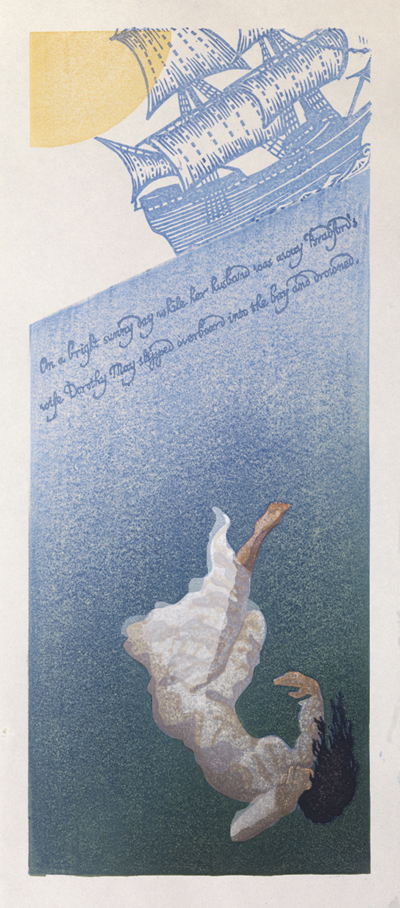
The woodblock print below, by Annie Bissett, depicts Dorothy Bradford, a Mayflower pilgrim who fell -- or leaped -- to her death in Provincetown Harbor in 1620, and is part of a group of works entitled We Are Pilgrims.

Click through to read the inscription, which seems to be based on the original account of the incident as recorded by Cotton Mather.


(I'm afraid the colors of this image are not coming through very faithfully here; try this link to the original.)

Bissett describes the technique she employs:
I use the traditional Japanese method, called moku hanga or ukiyo-e, where a block is carved for each color and then the blocks are printed successively with water-based pigments using a hand-held burnishing tool. This time-consuming and somewhat arduous process (a single print edition can take two to three months to complete) has become a welcome counterbalance to the fast-paced, deadline-driven digital work I've done for 20+ years as a commercial artist.
There is a fuller explanation of moku hanga on Bissett's blog, Woodblock Dreams.

Tuesday, July 14, 2009

Notes for a Commonplace Book (2)


Werner Herzog:

Our civilization doesn't have adequate images. And I think a civilization is doomed or is going to die out like dinosaurs if it does not develop an adequate language or adequate images. I see there's a very very dramatic situation. For example we have found out there are serious problems facing our civilization, like energy problems or environment problems or nuclear power or all this overpopulation of the world, but generally it is not understood yet that a problem of the same magnitude is that we do not have adequate images; and that's what I'm working on. A new grammar of images.

Quoted in Les Blank's Werner Herzog Eats His Shoe

Sunday, July 12, 2009

The stream


The little brook collected somewhere in the hills just out of town. When it reached the state road it trickled in and out of culverts and catch basins, then meandered through woodland for a quarter of a mile. Channeled and bordered with plantings of yellow iris, it ran in orderly fashion through the center of town, but once past the heart of the business district, unable to flow uphill once more, it sank beneath the pavement and emerged on the other side, winding serpentine and forgotten into a patch of green and inaccessible wetlands. The railway lay just beyond, its smooth stone-bedded rails running straight and level in either direction as far as the eye could see. The stream would continue on its course, parallel to the tracks, sometimes on the right side, sometimes on the left, until it reached the great city and discharged into the bay.

Back in town, two men were descending the hill the stream could not climb, going downtown for a meal at the end of a day's work. They were short of stature, compact, their skin light brown. Just in front of the little streetside restaurant, where a middle-aged couple sat on the porch drinking ice tea and watching the traffic go by, they met a third man on the sidewalk, heading away from town. They smiled and exchanged greetings in the language of the place where they were born, then continued walking until they were out of sight.

They had come a long way.

Elsewhere (Otherness)


New work by Carla Rippey, at El uso de la memoria.


Rippey writes:
I have to make clear that I use cultural elements from “elsewhere” as an amateur or tourist and not as a student of cultures. The iconography doesn’t imply for me all that it would imply for the natives of these borrowed cultures; my constructions are inventions, perhaps metaphors, a sort of pastiche of elements that come to have, which must assume, a significance distinct from that which they carry in context of their own culture. But the existence of that original, implicit meaning can give the created image another layer of resonance.
The image below is from a separate project, The Figure in the Carpet.


See my earlier post, or, better yet, the artist's blog.

Friday, July 10, 2009

Linda Butler: Rural Japan


This splendid 1992 volume of photographs, sadly no longer in print, is the work of the American photographer Linda Butler, who has an uncanny eye for and command of visual texture, whether it is on the grand scale of a river landscape or just the meticulous detailing on the surface of a cast-iron kettle. In her introduction she relates a vivid -- if somewhat alarming -- anecdote of how she began the project and how the cover image, in particular, came to be taken.
At noon the Fujita's grandmother asked me to take a break from my photography to join her family for lunch. She was planning to serve a rural delicacy that is now rarely eaten by the Japanese. In the kitchen, she placed a two-inch cube of tofu (bean curd) and several small, live eels at the center of lacquer bowls. Just before the soup was served, she added five small eels and poured soup stock in the bowls. In order to escape the heat, the eels dove into the cool tofu and smothered.

In the formal dining room we knelt around a lacquer table. The fifty year-old Mr. Fujita sat at the head of the table. Outside the sliding screens was a carefully composed rock garden, but it was the fifteen-inch long white radishes drying in the cool fall air under the eaves that captured my attention. Just as the soup arrived, there was a break in the clouds and the sun came out. The radishes were transformed--looking almost translucent. I knew I had to act quickly to capture this image so I excused myself in the polite language customarily used by Japanese in formal situations. It took me ten minutes to set-up the camera and expose a negative. When I returned to lunch, my soup was lukewarm and the eels seemed particularly dead, but the image of the radishes would become the beginning of my photographic work in rural Japan.
Below are a representative sample of images chosen from the photographer's website.


Pagoda, Yamagata-ken


Seacoast Village, Yamagata-ken


Earthen Floor, Iwate-ken


Grape Vineyard, Yamagata-ken

The next image is here simply because I can never let anything having to do with cuttlefish or squid go by.


Drying Squid

But I think this last one is still my favorite:


Tea Ceremony Kettles, Iwate-ken

Butler explains the above image:
Cast iron kettles are used to hold hot water in the tea ceremony. Made in the Suzuki studio in Morioka, the pots were cast in a clay and plaster mold that is used once and then discarded. The tiny indentations in the mold (bottom left), made dot by dot with a pointed hand-tool, become textural protrusions in the metal container.
Second-hand copies of Rural Japan are not impossible to find if you poke around for them, and individual prints may be available as well through the galleries who represent Butler's work. She has three other books that remain in print, all of them well worth getting a hold of; they are Inner Light: The Shaker Legacy, Italy: In the Shadow of Time, and Yangtze Remembered: The River Beneath the Lake.

Tuesday, July 07, 2009

House


The weekend after the burial the relatives came with a van and carted off what they wanted, the things that still had some use in them. They took the china and the silverware, the chairs that didn't wobble or need caning, the dining room table they had to disassemble to get through the door, but left the sagging bed, the ironing board, and the leaking refrigerator, the plastic gas-station tumblers and the scant dust-rimmed books. They shut off the water, took the phones out of the jacks, and flung the electric fuses into the woods for sport.

Later that summer vandals jimmied the door-latch and broke or stole what little of value they found, stripped the pipes and shattered the windows with stones, leaving nothing but a few mildewed magazines, broken bottles, and shotgun casings. They lit a fire but it wouldn't catch and they gave up. Rain blew in and soaked the floors, and before long the faded wallpaper began to peel down in ruined curls. Mice nested in the insulation and swallows built under the porch eaves, and the house soon stank of their urine and droppings.

Within a few years a thicket of young maples grew up around the foundation, and a dark green stain of algae spread up the white clapboard walls. Shingles slid from the roof to the ground and were buried in the next fall's leaves. Finally not even the ghosts remained.

Monday, July 06, 2009

Tatsuro Kiuchi


Following up on my last post about Rafe Martin's Mysterious Tales of Japan, with pictures by Tatsuro Kiuchi, here are some samples of two of Kiuchi's other projects, both of which use a very different palette and approach from the more conventionally "painterly" (but very appealing) illustrations he created for that book.

The first group are from a series of 294 color illustrations Kiuchi created to accompany Hikaru Okuizumi's novel The New Journey to the Center of the Earth, which was serialized in the Asahi Shimbun in 2002-2003.


The whole set can be viewed as a Flicker slideshow online.

At least one of Hikaru Okuizumi's other novels, The Stones Cry Out, has appeared in translation in the US, but this one apparently hasn't; in fact I'm not even sure it's been released in bound format in Japan. [Update: according to Tatsuro Kiuchi, the book has been published, but sadly without his illustrations.] The little information I've been able to turn up, from the Japanese Literature Publishing Project, seems promising, though:
Okuizumi is known for his parodies of the Meiji-period literary giant Natsume Soseki, but the model he chose for his full-length novel Shin chitei ryoko (New Journey to the Center of the Earth) is the Jules Verne classic. Always full of literary schemes, Okuizumi here recasts the original story as the historical record of an actual journey which he retells in a pseudoclassical style reminiscent of Soseki, transposing the action to early twentieth-century Japan. In late Meiji, a scientist who believes the Earth is hollow disappears, along with his beautiful daughter. He has apparently traveled to the center of Mt. Fuji to prove his theory, but there is another possibility: some say he is really after a secret cache of gold hidden by a feudal warlord. Hooked by his friend's promise to let him use a highly advanced camera, the main character, a painter named Roshu Nonomura, accompanies his friend and two other amateur explorers on an adventurous expedition deep within Mt. Fuji. Along the way, they encounter a cat that glows in the dark, a monster that seems to be a living relic of the dinosaur age, and a race of underground humans. This amply realized work of fantasy, laced with delicious humor, is written on a scale surpassing the original in grandeur.
This could make a hell of a nice volume if it were published here with the original illustrations, but I have a feeling it's not going to happen anytime soon. I'd settle for a Japanese edition -- if one exists -- just to be able to thumb through the pictures at leisure.

The remaining images are from a set of illustrations Kiuchi executed for a Folio Society edition of Iris Murdoch's The Sea, The Sea.


Kiuchi's website, which has both Japanese and English versions, has a biography and a generous selection of his other work, including some animated spots he created for Starbucks.

Late note: a post on the blog of the Heflinreps Illustration Agency has several Kiuchi illustrations for a Japanese children's book called Let's Go Out for a Ride!

Sunday, July 05, 2009

Mysterious Tales of Japan


There are countless illustrated versions of Lafcadio Hearn's Japanese ghost stories, but I have a fondness for this one, which was published in 1996 by Putnam and is apparently already out-of-print, though secondhand copies are readily available. A couple of the tales are from sources other than Hearn, but the volume includes three of the four stories on which Masaki Kobayashi's magnificent film Kwaidan was based, lacking only "In a Cup of Tea."


The retelling is by storyteller and author Rafe Martin, the illustrations by Tatsuro Kiuchi, a prolific artist who has worked in a variety of styles both here and in his native Japan. Among his other projects is a series of nearly 300 images to accompany a serialized novel by Hikaru Okuizumi, The New Journey to the Center of the Earth.

Friday, July 03, 2009

Notes for a Commonplace Book (1)


Lafcadio Hearn:

By the use of a few chosen words the composer of a short poem endeavors to do exactly what the painter endeavors to do with a few strokes of the brush, --- to evoke an image or a mood, --- to revive a sensation or an emotion. And the accomplishment of this purpose, --- by poet or by picture-maker, --- depends altogether upon capacity to suggest, and only to suggest. A Japanese artist would be condemned for attempting elaboration of detail in a sketch intended to recreate the memory of some landscape seen through the blue haze of a spring morning, or under the great blond light of an autumn afternoon. Not only would he be false to the traditions of his art : he would necessarily defeat his own end thereby. In the same way a poet would be condemned for attempting any completeness of utterance in a very short poem : his object should be only to stir imagination without satisfying it. So the term ittakkiri --- meaning "all gone," or "entirely vanished," in the sense of "all told," --- is contemptuously applied to verses in which the verse-maker has uttered his whole thought; --- praise being reserved for compositions that leave in the mind the thrilling of a something unsaid. Like the single stroke of a temple-bell, the perfect short poem should set murmuring and undulating, in the mind of the hearer, many a ghostly aftertone of long duration.

"Bits of Poetry," from In Ghostly Japan


Michael Jarrett:

Why didn't the Boatmen's music attract a theory? Why didn't it draw analysis into its orbit? The music was "easy to say." In short, it seemed ordinary. And when music seems ordinary -- self-evident, natural, and familiar -- explanations come off as either forced (arcane) or obvious (banal). Analytical discourse fails not in the face of complexity but when it perceives simplicity.

What remains are associations, impressions, the very sort of observations that analysis derides. [...] The Boatmen find their subject matter in ordinary life and, very often, create a distinctive kind of rhythm and blues, however disguised. They're more Stax/Volt than pop-art avant-garde. [...]

We can talk all day about rock. Making sense of rock 'n' roll is vastly more challenging. For example, why are there so many books on Bob Dylan and so few on the musical significance and contributions of Little Richard and James Brown? Why is Elvis Presley a sociologist's dream and a musicologist's nightmare? What lends itself more readily to detailed description, "I Want to Hold Your Hand" or "Tomorrow Never Knows"? Why is Pink Floyd easy to write about but impossible to enjoy? Why is Led Zeppelin more academically defensible than the Shirelles? Why does Jimi Hendrix matter more than Bo Diddley? Why is self-indulgence easier to theorize than self-effacement?

Liner notes to Wide Awake by The Vulgar Boatmen