Showing posts with label Islands. Show all posts

Thursday, September 04, 2025

Islander

Amy Liptrot:
I never saw myself as, and resist becoming, the wholesome ‘outdoors’ type. But the things I experience keep dragging me in. There are moments that thrill and glow: the few seconds a silver male hen harrier flies beside my car one afternoon; the porpoise surfacing around our small boat; the wonderful sight of a herd of cattle let out on grass after a winter indoors, skipping and jumping, tails straight up to the sky with joy.

I am free-falling but grabbing these things as I plunge. Maybe this is what happens. I've given up drugs, don't believe in God and love has gone wrong, so now I find my happiness and flight in the world around me.
I came upon Amy Liptrot's memoir "by accident," by way of the film adaptation starring Saoirse Ronan. But what constitutes an accident? Most of The Outrun takes place in Orkney, a place that has long interested me because of its geography and long history of human occupation, and if it had been set elsewhere I might never have been aware of it.

Liptrot was raised in Orkney (of English parents) but as a teenager couldn't wait to get away from it. She spent a decade in London going to clubs, finding and losing jobs, and — most of all — drinking. She tried and failed to get off the bottle various times, but finally succeeded, with the help of a treatment program, when it became clear that she was facing a choice of either life or booze. She retreated to Orkney, got a summer job with the Royal Society for the Protection of Birds counting elusive corncrakes, then rented a cottage on the tiny, treeless island of Papay (population less than one hundred).

The memoir and the film adaptation both have merits, but they're different merits. The movie is darker and more intense (and occasionally frustratingly non-linear); it focuses more on Liptrot's hellish and frenetic London years; the book is retrospective and meditative, following Liptrot as she retunes herself to the rhythms of the islands. Overall the film is faithful, and Ronan's high-energy performance is wonderful.

There is, of course, a movie tie-in edition with Saoirse Ronan on the cover, but I opted for this earlier Canongate paperback edition with cover art by an artist who works under the name Kai and Sunny.

Friday, June 27, 2025

Anathematizing All Islands

Celia Thaxter:
Boone Island is the forlornest place that can be imagined. The Isles of Shoals, barren as they are, seem like Gardens of Eden in comparison. I chanced to hear last summer of a person who had been born and brought up there; he described the loneliness as something absolutely fearful, and declared it had pursued him all through his life. He lived there till fourteen or fifteen years old, when his family moved to York. While living on the island he discovered some human remains which had lain there thirty years. A carpenter and his assistants, having finished some building, were capsized in getting off, and all were drowned, except the master. One body floated to Plum Island at the mouth of the Merrimack; the others the master secured, made a box for them, all alone the while, - and buried them in a cleft and covered them with stones. These stones the sea washed away, and, thirty years after they were buried, the boy found the bones, which were removed to York and there buried again. It was on board a steamer bound to Bangor, that the man told his story. Boone Island Light was shining in the distance. He spoke with bitterness of his life in that terrible solitude, and of "the loneliness which had pursued him ever since." All his relatives were dead, he said, and he had no human tie in the wide world except his wife. He ended by anathematizing all islands, and, vanishing into the darkness, was not to be found again; nor did his name or any trace of him transpire, though he was sought for in the morning all about the vessel.

Among the Isles of Shoals

Saturday, February 19, 2022

The Lost Altar

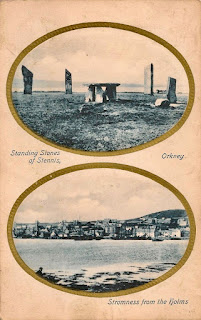
This double-view postcard of scenes from Orkney was issued by J. M. Stevenson, a longtime stationer in Kirkwall and Stromness. It also bears the initials of V. & S. Ltd., that is, Valentine & Sons of Dundee, the actual printer. There's no writing on the back of the card, but I'm guessing that it dates from around 1910. "The Holms" are two small islets just across the water from Stromness.

The central "altar" or "dolmen" shown in the view of the neolithic Standing Stones of Stennis (or Stenness) was a "reconstruction" from 1907, possibly inspired by Sir Walter Scott's interpretation of the site. It was dismantled under murky circumstances in 1972 and only the uprights were put back in place. A century earlier a landowner had vandalized the site extensively, resulting in the loss of much of the surrounding circle of stones.

Despite its barren northern location, Orkney has some of the most extraordinary neolithic monuments in Britain. I haven't been there (my wife and daughter have), but perhaps someday I will make a visit.

Wednesday, April 21, 2021

Strange Islands


The story of the adventures of the Irish abbot St. Brendan or Brenainn was a popular one in the middle ages, with a substantial number of manuscripts surviving. The most familiar version, the Navigatio Sancti Brendani Abbatis, was written in Latin and may date to the eighth century, that is, roughly two centuries after Brendan is thought to have died. A translation is found in the Penguin Classics volume entitled The Age of Bede (where it's arguably an odd fit); another, by John J. O'Meara, is available from Colin Smythe Ltd under the title of The Voyage of Saint Brendan, Journey to the Promised Land.

Brendan's travels, like those of Odysseus, involve visits to several wondrous islands, including in his case one that is inhabited entirely by psalm-singing birds and another that turns out to be an enormous sea-creature named Jasconius (from Old Irish íasc, fish). He and his fellow monks come upon what seems to be an iceberg as well as something that sounds very much like a volcano, and these and other passages have led some observers to surmise that Brendan or other early Irish travelers may have visited the North Atlantic and even North America. The notion isn't entirely far-fetched, as Irish monks — the papar — traveled as far as Iceland at a very early date. On the other hand, Brendan's adventures seem to have mythological parallels in pre-Christian Ireland and elsewhere.

But there's another Brendan tradition, one that is preserved in the Irish language in a manuscript known as the Book of Lismore. This version, the Betha Brenainn, seems to be harder to find outside of scholarly works like Whitley Stokes's Lives of Saints from the Book of Lismore and Denis O'Donoghue's Brendaniana: St. Brendan the Voyager in Story and Legend, both of which date to the 1890s. The Irish-language version may be less satisfying to the modern reader than the Latin one, but it has its own charm (at least in translation). Here, for example, is Stokes's rendering of a dazzling passage — not unworthy of Homer — that describes the outset of Brendan's voyage:
So Brenainn, son of Finnlug, sailed then over the wave-voice of the strong-maned sea, and over the storm of the green-sided waves, and over the mouths of the marvellous, awful, bitter ocean, where they saw the multitude of the furious red-mouthed monsters, with abundance of great sea-whales. And they found beautiful, marvellous islands, and yet they tarried not therein.
The writer's sheer delight in language receives its richest expression in a lengthy enumeration of the sights of Hell, which are shown to Brendan in consideration of his special sanctity. Stokes again:
It goes on from there, itemizing "cats scratching; hounds rending; dogs hunting; demons yelling; stinking lakes..." and, finally, "tortures vast, various." No torment is left uncatalogued, no linguistic resource left unused. If no one has thought of doing so, it would be fun to see an edition bringing together translations of the Latin Navigatio and the Irish version in one accessible volume.

Sunday, May 17, 2009

The abandoned


Let's get one thing straight: there was no Ariel. That was only the first of his countless lies. Here's another one: he had no magic, no book. It was all me. When I found them on the rocks -- him and his daughter -- they were half-drowned, at death's door. I revived them, conjured food and drink from thin air, built him a palace from sea foam. I was his architect, his slave, his whore. At his bidding I assumed the form of a woman, a boy, whatever he wanted. I took on other likenesses as well, ones he might find uncomfortable to talk about. I passed no judgment -- that was of his world.


In the end, of course, he was "rescued," restored. When he promised me that he would come back to me, in time, I knew better than to believe him. I could have killed him -- all of them -- right then, but the truth is, my one weakness, I loved him. I let him go.

Though I can't cross the water I know all things. I know how he mocked and slandered me, calling me hideous, a monster, the whelp of a witch -- I who have existed from the beginning of time. But my anger burned itself out long ago. He's dead now, as are they all. And no one will ever find this island again. I will see to that.

Wednesday, February 16, 2005

The awaited


(A synopsis of a story, perhaps a screenplay)

The setting: Northern Europe; a small island community on the edge of the sea; sometime before 1700.

The two-dozen or so men and older boys of the community have set off in two boats on a fishing or sealing trip expected to last three or four days. They don't return.

Many of the women have never been out of the village; a few are from other islands or the mainland, but have never gone back. There are a few small currachs, but nothing sturdy enough for a sea voyage.

At first the women and young children hope for the return of the men. After a while — later for some than for others — they realize that this will never happen. They do not alter their routines much, but carry on, as they had been accustomed to doing when the men were away, living off stored food and gathered shellfish, plus milk from their livestock. They eat a little less.

After a hard winter that reduces their numbers by two or three the women begin to address the matter of food. They fish a little from the currachs in the surrounding waters, they work in their stony fields as they have always done but a little harder. There is not enough but they survive anyway. Very occasionally, during the good weather, a fishing boat puts into shore for a visit, but the women have little to trade and no one is willing to get on board with the fishermen and leave. Eventually, though, one of the younger wives does go off with a young fisherman. She is never spoken of again.

After a year or two has gone by, and the women have become thin and drawn, one of them refers in passing to a chore she must see to before her husband comes home. There is cold silence. A few weeks later someone else makes a similar remark, and this time heads are nodded. Before long the imminent arrival of the men becomes the sole topic of conversation. Hands are kept busy sweeping out and tidying the dwellings. There are increasing indications of madness.

The story ends with the prow of a boat breaking around the rocks and into view from shore. We don't see who is on board.